Upsilon
In-game article clicks load inline without leaving the challenge.
Upsilon (US:/ˈʌpsɪlɒn,ˈ(j)uːp-,-lən/, UK:/(j)uːpˈsaɪlən,ˈʊpsɪlɒn/ ⓘ; uppercase Υ, lowercase υ; Greek: ύψιλον ýpsilon [ˈipsilon]) or ypsilon /ɪp-/ is the twentieth letter of the Greek alphabet. In the system of Greek numerals, Υʹ has a value of 400. It is derived from the Phoenician waw (𐤅).
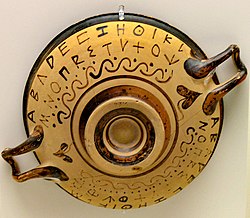
Etymology
The name of the letter was originally just υ (y, also called ὑ hy, hence hyoid, meaning 'shaped like the letter υ'), but the name changed to υ ψιλόν (=υ psilon, 'u-plain' or 'u-simple') to distinguish it from οι, which had come to have the same [y] pronunciation.
Pronunciation
In early Attic Greek (6th century BCE), it was pronounced [u] (a close back rounded vowel like the English "long o͞o"). In Classical Greek, it was pronounced [y] (a close front rounded vowel), at least until 1030. In Modern Greek, it is pronounced [i]; in the digraphs ⟨αυ⟩ and ⟨ευ⟩, as /f/ or /v/; and in the digraph ⟨ου⟩ as /u/. In ancient Greek, it occurred in both long and short versions, but Modern Greek does not have a length distinction.
As an initial letter in Classical Greek, it always carried the rough breathing (equivalent to h) as reflected in the many Greek-derived English words, such as those that begin with hyper- and hypo-. This rough breathing was derived from an older pronunciation that used a sibilant instead; this sibilant was not lost in Latin, giving rise to such cognates as super- (for hyper-) and sub- (for hypo-).
Upsilon participated as the second element in falling diphthongs, which have subsequently developed in various ways.
Correspondence with Latin Y

The use of Y in Latin dates back to the first century BC. It was used to transcribe loanwords from Greek, so it was not a native sound of Latin and was usually pronounced /u/ or /i/. The latter pronunciation was the most common in the Classical period and was used mostly by uneducated people. The Roman Emperor Claudius proposed introducing a new letter into the Latin alphabet to transcribe the so-called sonus medius (a short vowel before labial consonants), but in inscriptions, the new letter was sometimes used for Greek upsilon instead.
Four letters of the Latin alphabet arose from it: V, Y and, much later, U and W. In the Cyrillic script, the letters U (У, у) and izhitsa (Ѵ, ѵ) arose from it.
In some languages, including German and Portuguese, the name upsilon (Ypsilon in German, ípsilon in Portuguese) is used to refer to the Latin letter Y as well as the Greek letter. In some other languages, the (Latin) Y is referred to as a "Greek I" (i griega in Spanish, i grec in French), also noting its Greek origin.
Usage
- In particle physics the capital Greek letter ϒ denotes an Upsilon particle. Note that the symbol should always look like Υ {\displaystyle \,\Upsilon } in order to avoid confusion with a Latin Y denoting the hypercharge. This may be done either with a font such as FreeSerif or with the dedicated Unicode character U+03D2 ϒ.
- Automobile manufacturer Lancia has a model called the Ypsilon.
- In the International Phonetic Alphabet, the symbol ⟨ʋ⟩ is used to represent a labiodental approximant.
- In astrophysics and physical cosmology, ϒ refers to the mass-to-light ratio.
- In statistics, it is sometimes used instead of v or nu to indicate degrees of freedom.
- In the Persian language, “one upsilon” is used to describe a positive amount close to 0 (zero).[citation needed]
Similar appearance
- A similar symbol U+2648♈ ARIES is used for the astrological sign of Aries.
Symbolism

Upsilon is known as Pythagoras' letter, or the Samian letter, because Pythagoras used it as an emblem of the path of virtue or vice. As the Roman writer Persius wrote in Satire III:
and the letter which spreads out into Pythagorean branches has pointed out to you the steep path which rises on the right.
Lactantius, an early Christian author (c.240 – c.320), refers to this:
For they say that the course of human life resembles the letter Y, because every one of men, when he has reached the threshold of early youth, and has arrived at the place "where the way divides itself into two parts," is in doubt, and hesitates, and does not know to which side he should rather turn himself.
Character encodings
Upsilon and Coptic Ua characters.
- U+01B1Ʊ LATIN CAPITAL LETTER UPSILON
- U+028Aʊ LATIN SMALL LETTER UPSILON
- U+038EΎ GREEK CAPITAL LETTER UPSILON WITH TONOS
- U+03A5Υ GREEK CAPITAL LETTER UPSILON (Υ)
- U+03ABΫ GREEK CAPITAL LETTER UPSILON WITH DIALYTIKA
- U+03B0ΰ GREEK SMALL LETTER UPSILON WITH DIALYTIKA AND TONOS
- U+03C5υ GREEK SMALL LETTER UPSILON (υ, υ)
- U+03CBϋ GREEK SMALL LETTER UPSILON WITH DIALYTIKA
- U+03CDύ GREEK SMALL LETTER UPSILON WITH TONOS
- U+03D2ϒ GREEK UPSILON WITH HOOK SYMBOL (ϒ, ϒ)
- U+03D3ϓ GREEK UPSILON WITH ACUTE AND HOOK SYMBOL
- U+03D4ϔ GREEK UPSILON WITH DIAERESIS AND HOOK SYMBOL
- U+1D7Fᵿ LATIN SMALL LETTER UPSILON WITH STROKE
- U+1DB7ᶷ MODIFIER LETTER SMALL UPSILON
- U+1F50ὐ GREEK SMALL LETTER UPSILON WITH PSILI
- U+1F51ὑ GREEK SMALL LETTER UPSILON WITH DASIA
- U+1F52ὒ GREEK SMALL LETTER UPSILON WITH PSILI AND VARIA
- U+1F53ὓ GREEK SMALL LETTER UPSILON WITH DASIA AND VARIA
- U+1F54ὔ GREEK SMALL LETTER UPSILON WITH PSILI AND OXIA
- U+1F55ὕ GREEK SMALL LETTER UPSILON WITH DASIA AND OXIA
- U+1F56ὖ GREEK SMALL LETTER UPSILON WITH PSILI AND PERISPOMENI
- U+1F57ὗ GREEK SMALL LETTER UPSILON WITH DASIA AND PERISPOMENI
- U+1F59Ὑ GREEK CAPITAL LETTER UPSILON WITH DASIA
- U+1F5BὛ GREEK CAPITAL LETTER UPSILON WITH DASIA AND VARIA
- U+1F5DὝ GREEK CAPITAL LETTER UPSILON WITH DASIA AND OXIA
- U+1F5FὟ GREEK CAPITAL LETTER UPSILON WITH DASIA AND PERISPOMENI
- U+1F7Aὺ GREEK SMALL LETTER UPSILON WITH VARIA
- U+1F7Bύ GREEK SMALL LETTER UPSILON WITH OXIA
- U+1FE0ῠ GREEK SMALL LETTER UPSILON WITH VRACHY
- U+1FE1ῡ GREEK SMALL LETTER UPSILON WITH MACRON
- U+1FE2ῢ GREEK SMALL LETTER UPSILON WITH DIALYTIKA AND VARIA
- U+1FE3ΰ GREEK SMALL LETTER UPSILON WITH DIALYTIKA AND OXIA
- U+1FE6ῦ GREEK SMALL LETTER UPSILON WITH PERISPOMENI
- U+1FE7ῧ GREEK SMALL LETTER UPSILON WITH DIALYTIKA AND PERISPOMENI
- U+1FE8Ῠ GREEK CAPITAL LETTER UPSILON WITH VRACHY
- U+1FE9Ῡ GREEK CAPITAL LETTER UPSILON WITH MACRON
- U+1FEAῪ GREEK CAPITAL LETTER UPSILON WITH VARIA
- U+1FEBΎ GREEK CAPITAL LETTER UPSILON WITH OXIA
- U+2CA8Ⲩ COPTIC CAPITAL LETTER UA
- U+2CA9ⲩ COPTIC SMALL LETTER UA
- U+1D6BC𝚼 MATHEMATICAL BOLD CAPITAL UPSILON
- U+1D6D6𝛖 MATHEMATICAL BOLD SMALL UPSILON
- U+1D6F6𝛶 MATHEMATICAL ITALIC CAPITAL UPSILON
- U+1D710𝜐 MATHEMATICAL ITALIC SMALL UPSILON
- U+1D730𝜰 MATHEMATICAL BOLD ITALIC CAPITAL UPSILON
- U+1D74A𝝊 MATHEMATICAL BOLD ITALIC SMALL UPSILON
- U+1D76A𝝪 MATHEMATICAL SANS-SERIF BOLD CAPITAL UPSILON
- U+1D784𝞄 MATHEMATICAL SANS-SERIF BOLD SMALL UPSILON
- U+1D7A4𝞤 MATHEMATICAL SANS-SERIF BOLD ITALIC CAPITAL UPSILON
- U+1D7BE𝞾 MATHEMATICAL SANS-SERIF BOLD ITALIC SMALL UPSILON
Notes
External links
- Merrifield, Michael (2009). . Sixty Symbols. Brady Haran for the University of Nottingham.