1st millennium
In-game article clicks load inline without leaving the challenge.
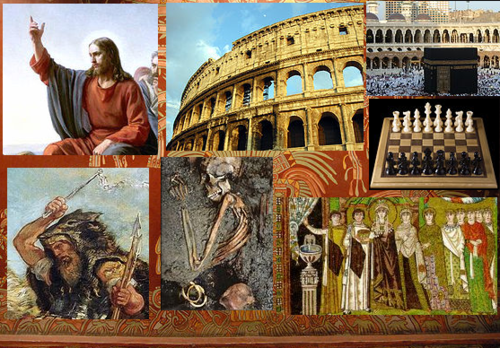

The 1st millennium of the anno Domini or Common Era was a millennium spanning the years 1 to 1000 (1st to 10th centuries; in astronomy: JD 1721425.5 – 2086667.5). The world population rose more slowly than during the preceding millennium, from about 200 million in the year 1 to about 300 million in the year 1000.
In Western Eurasia (Europe and Near East), the first millennium was a time of great transition from Classical Antiquity to the Middle Ages. The 1st century saw the peak of the Roman Empire, followed by its gradual decline during the period of Late Antiquity, the rise of Christianity and the Great Migrations. The second half of the millennium is characterized as the Early Middle Ages in Europe, and marked by the Viking expansion in the west, and the continuation of the Byzantine Empire (Eastern Roman Empire) in the east.
In East Asia, the first millennium was also a time of great cultural advances, notably the spread of Buddhism to East Asia. In China, the Han dynasty is replaced by the Jin dynasty and later the Tang dynasty until the 10th century sees renewed fragmentation in the Five Dynasties and Ten Kingdoms period. In Japan, a sharp increase in population followed when farmers' use of iron tools increased their productivity and crop yields. The Yamato court was established. The North Indian subcontinent was divided among numerous kingdoms throughout the first millennium, until the formation of the Gupta Empire. Islam expanded rapidly from Arabia to western Asia, India, North Africa and the Iberian Peninsula, culminating in the Islamic Golden Age (700–1200).
In Mesoamerica, the first millennium was a period of enormous growth known as the Classic Era (200–900). Teotihuacan grew into a metropolis and its empire dominated Mesoamerica. In South America, pre-Incan, coastal cultures flourished, producing impressive metalwork and some of the finest pottery seen in the ancient world. In North America, the Mississippian culture rose at the end of the millennium in the Mississippi and Ohio river valleys. Numerous cities were built; Cahokia, the largest, was based in present-day Illinois. The construction of Monks Mound at Cahokia was begun in 900–950.
In Sub-Saharan Africa, the Bantu expansion reaches Southern Africa by about the 5th century. The trans-Saharan slave trade spans the Sahara and the Swahili coast by the 9th century.
Civilizations, kingdoms and dynasties
Events
The events in this section are organized according to the United Nations geoscheme
| Africa | Americas | Asia | Europe | Oceania | |
|---|---|---|---|---|---|
| 1st century | AD 70 Amanikhatashan sends Kushite cavalry to aid Roman Emperor in Jerusalem revolt AD 100 Rise of the Kingdom of Aksum AD 100 Khoekhoe reach southern coast of Africa | AD 1 Cahuachi established AD 50 Pyramid of the Sun began | AD 25 Han dynasty reestablished under Guangwu AD 33 Christianity begins AD 70 Jewish diaspora | AD 9 Rhine established as boundary between Rome and Germany AD 47 Londinium founded AD 58 Alpes Cottiae becomes a Roman province AD 79 Pompeii destroyed | AD 1 Caroline Islands colonized |
| 2nd century | 150 Rhapta, hint of pre-Swahili, Periplus of the Erythraean Sea 200 Bantu reach east Africa 200 Nok culture ends | 150 Cahuachi becomes dominant ceremonial site in southern Peru | 184 Yellow Turban Rebellion | 106 Dacia becomes a Roman province 166 Siege of Aquileia 180 End of the Macromannic Wars | |
| 3rd century | 212 Egyptians granted Roman citizenship 230 Aksum wars with Himyar and Saba alliance 300 Aksum prints own coins | 250 Rise of Laguna de los Cerros 292 Stela 29 inscribed 300 Tikàl conquers El Mirador | 208 Battle of Red Cliffs during the decline of the Han dynasty 280 Jin reunifies China | 212 Roman citizenship extended to all free people in the empire 214 Hispania divided into Gallaecia, Tarraconensis, Baetica and Lusitania 286 Diocletian divides the empire East and West | 300 Eastern Polynesian culture develops |
| 4th century | 333 Aksum converts to Christianity 350 Meroe comes to an end 350 King of Anwar, Kaja Maja | 378 Teotihuacan conquers Waka, Tikal, and Uaxactun, the beginning of its conquest of the Maya | 319 Rise of Gupta Empire in South Asia 383 Battle of Fei River 393 Last Olympic Games | 313 Edict of Milan 370 Huns invade Eastern Europe 396 Alaric and the Visigoths invade Greece | |
| 5th century | 401 c. camel main transport for trans-Sahara 429 Vandal invasion 500 Nubia split into Nobadia, Makuria, Alodia | 420 Northern and Southern dynasties period begins | 407 Vandals enter Iberia 421 Romans defeat Persians 476 Fall of the Western Roman Empire | 500 Settlement of Hawaii, Easter Island, Society Islands, Tuamotus and Mangareva | |
| 6th century | 520 Kaleb attacks Yemen 533 Belisarius invades Africa 540 Nubia converts to monophysite Christianity | 600 Wari' conquer Peru 600 Construction of Palenque | 538 Buddhism introduced in Japan. 570 Birth of the Islamic prophet Muhammad | 507 Battle of Vouillé 535 Byzantine army invades Italy 585 Visigoths conquer Suevi kingdom | |
| 7th century | 641 Muslims invade Africa 690 Za dynasty founded 697 Carthage destroyed | 650 Settlement of Xochitecatl and Cacaxtla 700 Teotihuacan destroyed | 618 Tang dynasty established 632 Rise of Islam 651 Islamic conquest of Persia | c.680 First Bulgarian Empire is founded | 700 Settlement of the Cook Islands |
| 8th century | 702 Aksum attacks Arabia 706 Arabic in Egypt 789 Independent Morocco | 738 Quiriguá becomes independent of Copan 750 Sacred Cenote built at Chichén Itzá 780 Murals at Bonampak abandoned | 738 Caliphate campaigns in India and invasion of India by Umayyad Caliphate is averted 755 An Shi Rebellion | 717 Siege of Constantinople 718 Muslim conquest of the Iberian Peninsula c.722 Reconquista begins | |
| 9th century | 801 c. Kanem Empire founded 801c. Aksum declines, capital moved to interior 900c. Igbo-Ukwu founded | c.830 Classic Maya collapse | 835 Ganlu Incident | 872 Battle of Hafrsfjord helped unified Norway c.874 Settlement of Iceland 896 Hungarian conquest of the Carpathian Basin | |
| 10th century | 905 Tulunids ejected 909 Fatimid established 969 Fustat captured | 950 Great Serpent Mound constructed 990 Toltecs conquer Chichen Itza | 907 Political upheaval of the Five Dynasties begins 960 Song dynasty established | 958 Denmark unites 985 Erik the Red founds colony in Greenland | AD 1000 Polynesians build stone temples |
Inventions, discoveries, introductions
| Communication | Math and Science | Agriculture | Transportation | Warfare |
|---|---|---|---|---|
| Woodblock printing Paper Quipu | Algebra Ptolemaic system Wootz steel | Coffee Hops | Horseshoe Stirrup Magnetic compass | Greek fire Gunpowder |