AC power plugs and sockets
In-game article clicks load inline without leaving the challenge.
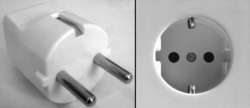
AC power plugs and sockets connect devices to mains electricity to supply them with electrical power. A plug is the connector attached to an electrically operated device, often via a cable. A socket (also known as a receptacle or outlet) is fixed in place, often on the internal walls of buildings, and is connected to an AC electrical circuit. Inserting ("plugging in") the plug into the socket allows the device to draw power from this circuit.
Plugs and wall-mounted sockets for portable appliances became available in the 1880s, to replace connections to light sockets. A proliferation of types were subsequently developed for both convenience and protection from electrical injury. Electrical plugs and sockets differ from one another in voltage and current rating, shape, size, and connector type. Different standard systems of plugs and sockets are used around the world, and many obsolete socket types are still found in older buildings.
Coordination of technical standards has allowed some types of plug to be used across large regions to facilitate the production and import of electrical appliances and for the convenience of travellers. Some multi-standard sockets allow use of several types of plug. Incompatible sockets and plugs may be used with the help of adaptors, though these may not always provide full safety and performance.
Overview of connections
Single-phase sockets have receptacles for two power pins, one to carry the electrical current from the power source to the connected device (called live, line, or phase pin) and another one to carry it back to the power source (called neutral pin). Many sockets have a third receptacle or pin for a safety connection to earth ground. The plug is a male connector, usually with protruding pins that match the receptacles (female contacts) in a socket. Some plugs also have a female contact, used only for the earth ground connection. Typically no energy is supplied to any exposed pins or terminals on the socket, hence the power pins are always part of the plug rather than the socket. In addition to the recessed contacts of the energised socket, plug and socket systems often have other safety features to reduce the risk of electric shock or damage to appliances.
History
When commercial electric power was first introduced in the 1880s, it was used primarily for lighting. Other portable appliances (such as vacuum cleaners, electric fans, smoothing irons, and curling-tong heaters) were connected to light-bulb sockets. As early as 1885 a two-pin plug and wall socket format was available on the British market. By about 1910 the first three-pin earthed (grounded) plugs appeared. Over time other safety improvements were gradually introduced to the market. One of the first national standards for plugs and wall sockets was enacted in 1915 in the UK.
Safety features
Protection from accidental contact
Designs of plugs and sockets have gradually developed to reduce the risk of electric shock and fire. Plugs are shaped to prevent bodily contact with live parts. Sockets may be recessed and plugs designed to fit closely within the recess to reduce risk of a user contacting the live pins. Contact pins may be sheathed with insulation over part of their length, so as to reduce exposure of energized metal during insertion or removal of the plug. Sockets may have automatic shutters to stop foreign objects from being inserted into energized contacts. Sockets are often set into a surround which prevents accidental contact with the live wires in the wall behind it. Some also have an integrated cover (e.g. a hinged flap) covering the socket itself when not in use, or a switch to turn off the socket.
Overcurrent protection
Some plugs, particularly the British TypeG, have a built-in fuse which breaks the circuit if too much current flows.
Earthing (grounding)
A third contact for a connection to earth is intended to protect against insulation failure of the connected device. Some early unearthed plug and socket types were revised to include an earthing pin or phased out in favour of earthed types. The plug is often designed so that the earth ground contact connects before the energized circuit contacts. The assigned IEC appliance class is governed by the requirement for earthing or equivalent protection. ClassI equipment requires an earth contact in the plug and socket, while ClassII equipment is unearthed and protects the user with double insulation.
Polarization
Where a "neutral" conductor exists in supply wiring, polarization of the plug can improve safety by preserving the distinction in the equipment. For example, appliances may ensure that switches interrupt the live side of the circuit, or can connect the shell of a screw-base lampholder to neutral to reduce electric shock hazard. In some designs, polarized plugs cannot be mated with non-polarized sockets. In most NEMA1 plugs, for example, the neutral blade is slightly wider than the hot blade, so it can only be inserted one way. Wiring systems where both circuit conductors have a significant potential with respect to earth do not benefit from polarized plugs.
Voltage rating of plugs and power cords

Plugs and power cords have a rated voltage and current assigned to them by the manufacturer. Using a plug or power cord that is inappropriate for the load may be a safety hazard. For example, high-current equipment can cause a fire when plugged into an extension cord with a current rating lower than necessary. Sometimes the cords used to plug in dual voltage 120V / 240V equipment are rated only for 125V, so care must be taken by travellers to use only cords with an appropriate voltage rating.
Extension

Various methods can be used to increase the number or reach of sockets.
Extension cords
Extension cords (extension leads) are used for temporary connections when a socket is not within convenient reach of an appliance's power lead. This may be in the form of a single socket on a flexible cable or a power strip with multiple sockets. A power strip may also have switches, surge voltage protection, or overcurrent protection.
Multisocket adaptors

Multisocket adaptors (or "splitters") allow the connection of two or more plugs to a single socket. They are manufactured in various configurations, depending on the country and the region in which they are used, with various ratings. This allows connecting more than one electrical consumer item to one single socket and is mainly used for low power devices (TVsets, table lamps, computers, etc.).
They are usually rated for 6A, 10A, or 16A at 250V or for 15A or less at 125V. This is the general rating of the adaptor, and indicates the maximum total load in amperes, regardless of the number of sockets used (for example, if a 16A 250V adaptor has four sockets, it would be fine to plug four different devices into it that each consume 2A as this represents a total load of only 8A, whereas if only two devices were plugged into it that each consumed 10A, the combined 20A load would overload the circuit).
In some countries such adaptors are banned and are not available in shops, as they may lead to fires due to overloading them or can cause excessive mechanical stress to wall-mounted sockets. Adaptors can be made with ceramic, Bakelite, or other plastic bodies.
Cross-compatibility
Hybrid and universal sockets

"Hybrid", "multi-standard", or "universal" sockets are intended to accommodate plugs of two or more types. In some jurisdictions, they violate safety standards for sockets. Safety advocates, the United States Army, and a manufacturer of sockets point out a number of safety issues with universal socket and adaptors, including voltage mismatch, exposure of live pins, lack of proper earth ground connection, or lack of protection from overload or short circuit. Universal sockets may not meet technical standards for durability, plug retention force, temperature rise of components, or other performance requirements, as they are outside the scope of national and international technical standards.
A technical standard may include compatibility of a socket with more than one form of plug. The Thai dual socket is specified in figure4 of TIS166-2549 and is designed to accept Thai plugs, and also TypeA, B, and Cplugs. Chinese dual sockets have both an unearthed socket that accepts A and C plugs and an earthed socket that accepts TypeI plugs. Since the 2021 revision of the Chinese standard, the installation of such dual sockets is no longer allowed in China, but they can still be found in many existing installations.
Such Thai or Chinese dual sockets also accept plugs normally fitted to 120V appliances (e.g. 120V rated NEMA1-15 ungrounded plugs). This can cause an electrical incompatibility, since both countries supply residential power at 220–230V. These dual sockets also accept French and Schuko plugs (TypesE and F), but unsafely: no earth contact is established and live pins may be exposed when a plug is partially inserted.
Swappable cables and plugs

Commonly, manufacturers provide an IEC 60320 inlet on an appliance, with a detachable power cord (mains flex lead) and appropriate plug in order to avoid manufacturing whole appliances, with the only difference being the type of plug. Alternatively, the plug itself can often be swappable using standard or proprietary connectors.
Travel adaptors

Adaptors between standards are not included in most standards, and as a result they have no formal quality criteria defined. Physical compatibility does not ensure that the appliance and socket match in frequency or voltage. Adaptors allow travellers to connect devices to foreign sockets, but do not change voltage or frequency. A voltage converter is required for electrical compatibility in places with a different voltage than the device is designed for. Mismatch in frequency between supply and appliances may still cause problems even at the correct voltage. Some appliances have a switch for the selection of voltage. Many modern devices use AC adapters that accept 100–240 V voltage at 50 or 60Hz, meaning they can be used anywhere in the world as long as a suitable plug adapter is used.
Standard types in present use

The plugs and sockets used in a given area are regulated by local governments.
The International Electrotechnical Commission (IEC) maintains a guide with letter designations for generally compatible types of plugs, which expands on earlier guides published by the United States Department of Commerce. This is a de facto naming standard and guide to travellers. Some letter types correspond to several current ratings or different technical standards, so the letter does not uniquely identify a plug and socket within the type family, nor guarantee compatibility. Physical compatibility of the plug and socket does not ensure correct voltage, frequency, or current capacity. Not all plug and socket families have letters in the IEC guide, but those that have are noted in this article, as are some additional letters commonly used by retail vendors.
In Europe, CENELEC publishes a list of approved plug and socket technical standards used in the member countries.
Australasian AS/NZS 3112 and compatible plugs (Type I)
A number of countries in Oceania as well as China and Argentina use a plug that has two flat pins at an angle, forming a V-shape, as well as a flat vertical grounding pin. While the exact pin dimensions and the polarity vary between different countries, these plugs and sockets are all compatible with each other and are known as TypeI.
Argentina IRAM 2073 and 2071

The plug and socket system used in Argentina is defined by several standards of the Argentine Normalization and Certification Institute (IRAM). IRAM2071 defines two sockets that have the same form factor, but differ in size and rating. The smaller, more common socket is rated for 10A. The larger variant, rated for 20A, is mostly used for higher-power appliances such as air conditioners. IRAM2073 defines the corresponding plugs used for ClassI appliances (that require earthing). The plug and socket system has an earthing pin and two flat current-carrying pins forming an inverted V-shape (120°).
The pins for the 10A version measure 6.25 by 1.55mm (0.246 by 0.061in). The power pins are set at 30° to the vertical with a distance of 7.92mm (0.312in) from their centres to the centre of the plug; they are 18.2mm (0.717in) long. The earthing pin is 21.4mm (0.843in) long and placed below the plug centre at a distance of 10.31mm (0.406in). The pins of the 20A version are larger – 8.0 by 1.9mm (0.315 by 0.075in) – and placed further away from the centre of the plug – 9.53mm (0.375in) for the power pins, 11.1mm (0.437in) for the earthing pin. At 21.8mm (0.858in), the earthing pin is a bit longer, while the power pins are a bit shorter at 17.8mm (0.701in).
There is also an unearthed version of the 10A plug, defined by IRAM2063, that lacks an earthing pin and can be used with ClassII appliances. 20A plugs, on the other hand, must always provide earthing.
Insulating sleeves around the upper parts of the power pins are allowed, but not required. When used, they significantly reduce the risk of electric shock from accidentally touching the pins of a partially inserted plug. Because the pins of the 20A plug are placed farther apart than those of the 10A plug, the two Argentine plug types are mutually incompatible. It is not possible to insert a 20A plug into a 10A socket or vice versa.
The most important difference from the Australasian and Chinese plugs is that the Argentine plug is wired with the live and neutral contacts reversed. In Argentina, when the earth contact is positioned downward, the live (line) contact is on the right side of the socket, while in Australasia and China it is on the left (assuming the same orientation).
In Brazil, TypeI–style plugs and sockets are still commonly used in old installations for high-power appliances like air conditioners, dishwashers, and household ovens. These are often called "Argentine plugs" and are indeed physically identical to the IRAM plugs rated for 20A, though they might have been developed independently on the basis of the American NEMA10-20 standard (which uses the same form factor). While these plugs are sometimes used for normal single-phase power and wired in the same way as in Argentina, some are wired for split-phase power with two "hot" (or phase) wires and a neutral wire, but no earth connection. Care must therefore be taken that the same wiring scheme is used in the socket and in the plug, since otherwise the equipment would surely be damaged. In newer installations, the 20A version of the TypeN plug, adopted by Brazil as national standard NBR14136, is generally preferred.
Australian/New Zealand standard AS/NZS 3112


This Australian/New Zealand standard is used in Australia, New Zealand, Fiji, Tonga, Solomon Islands, and Papua New Guinea. The plug shape and basic dimensions are identical to the 10A plug used in Argentina. The Australasian standard defines a series of plugs and sockets for devices drawing up to 10, 15, 20, 25 and 32A that are one-way compatible. All sockets accept plugs of equal or lower current ratings, but not higher. For example, a 10A plug will fit all sockets but a 20A plug will fit only 20, 25 and 32A sockets.
In all plugs, the power pins are set at 30° to the vertical with a distance of 7.92mm (0.312in) from their centres to the centre of the plug, while the earthing pin is placed below the plug centre at a distance of 10.31mm (0.406in) – exactly the same dimensions as used by the Argentine 10A plug. The three flat pins all measure 6.35 by 1.63mm (0.250 by 0.064in) – very slightly larger than in Argentina. The length of the power pins is 17.06mm (0.672in), while the earthing pin has a length of 19.94mm (0.785in) – somewhat shorter than in Argentina.
In the 15A plug, the height of the earth pin is increased from 6.35 to 9.08mm (0.357in), while the dimensions of the power pins remain the same. In the 20A plug, however, their height is increased in the same way, so that the surface dimensions of the three pins are again identical. In the 25A version, the earthing pin takes the shape of an inverted L (an extra bar is added at the top end), and in the 32A version it takes the shape of a sideways U (extra bars are added at both ends).
In general, only 10A and 15A socket outlets are likely to be encountered in domestic or commercial installations. 20A sockets are rare and higher rated ones are very rare. An unearthed version of the 10A plug with two angled power pins but no earthing pin is used with double-insulated appliances, but sockets and higher-rated plugs always include an earth contact. In New Zealand, PDL940 "tap-on" or "piggy-back" plugs are available which allow a second 10A plug to be fitted to the rear of the plug. In Australia these piggy-back plugs are now available only on pre-made extension leads.
A novel feature of modern Australian socket outlets is a snap-fitting surround for the socket, covering the screws that affix the socket to the wall, and extending all the way around the socket periphery. Australia is unique in having electrical rules that stipulate that only licensed electricians may remove the socket from the wall, so the easily removed outer cover facilitates repainting the wall without exposing power and incurring the expense of engaging an electrician to remove and replace the sockets.
Australia's standard plug/socket system was originally codified as standard C112 (floated provisionally in 1937, and adopted as a formal standard in 1938), which was based on a design patented by Harvey Hubbell and was superseded by AS3112 in 1990.
The requirement for insulated pins was introduced in the 2000 revision, and became effective 5 years after its publication. The current version is AS/NZS3112:2025.
China GB 2099.1 and GB 1002 (Type A & I)

The standard for Mainland Chinese plugs and sockets (excluding Hong Kong and Macau) is set out in GB2099.1 and GB1002. As part of China's commitment for entry into the WTO, the new CPCS (Compulsory Product Certification System) has been introduced, and compliant Chinese plugs have been awarded the CCC Mark by this system. The plugs are three-wire, earthed, rated for 10 or 16A, 250V, and are chiefly used for ClassI applications. The pins of the 10A version are 1.55mm (0.061in) thick by 6.4mm (0.252in) wide; the centres of the power pins are placed 7.9mm (0.311in) from the plug centre, while the centre of the earth pin is 10.3mm (0.406in) away. In both plug types, the live and neutral pins are 18mm (0.709in) long, while the earth pin is 21mm (0.827in) long. This makes the 10A version compatible with Argentine and Australasian 10A sockets, as their dimensions are nearly identical.
Except for the pin length, all dimensions of the 16A version are slightly larger. Its pins are 1.8 by 8.1mm (0.071 by 0.319in); the centres of the power pins are placed 9.5mm (0.374in) from the plug centre, while the centre of the earth pin is 11.1mm (0.437in) away. This makes this plug compatible with the 20A sockets used in Argentina. It is, however, incompatible with Chinese 10A sockets as well as all Australasian sockets because of the different pin spacing.
Some sockets in China include a physical lockout preventing access to the active and neutral terminals unless an earth pin (which is slightly longer than the other two pins) is entered first; others require pins to be inserted into both live terminals to open the shutter. Since its 2024 revision, GB1002 also defines unearthed two-pin ClassII plugs, though such plugs cannot be inserted into sockets that require an earth pin to open the shutters. Already since 2008 for 16A, and since 2021 also for 10A, there is an unearthed ClassII plug variant that uses an unwired dummy earth pin to open the shutters; unearthed plugs of this kind fit into all Chinese sockets of the same rating.
China also uses American/Japanese NEMA1-15 sockets and plugs for Class II appliances (however, polarized plugs with one prong wider than the other are not accepted). Older versions of GB1002 also defined a socket type that accepts Europlugs (TypeC), but this hybrid socket was removed from the 2021 revision of the standard. The voltage at a Chinese socket of any type is 220V.
In China, sockets typically have the earth contact above the power pins, while in Argentina and Australasia it is usually positioned below them. While Australasian plugs have insulating sleeves around the upper part of their power pins, that is not the case for most existing Chinese plugs, hence their pins may become live while there is still a large enough gap between the faces of the plug and socket to allow a finger to touch the pin. Since 2022, insulating sleeves are also allowed on plugs sold in China; they will be mandatory from 2027.
British and compatible standards
The polarity of all grounded British sockets is standardized: earth is at the top and live is at the right of the socket. This convention is also followed in other countries using these plugs and sockets.
BS 546 and related types (Type D and M)

BS 546, "Two-pole and earthing-pin plugs, socket-outlets and socket-outlet adaptors for AC (50-60Hz) circuits up to 250V" describes four sizes of plug rated at 2A, 5A (TypeD), 15A (TypeM) and 30A. The plugs have three round pins arranged in a triangle, with the larger top pin being the earthing pin. The plugs are polarized and unfused. Plugs are non-interchangeable between current ratings. Introduced in 1934, the BS546 type has mostly been displaced in the UK by the BS1363 standard. According to the IEC, some 40countries use TypeD (among them India) and about 15countries use TypeM.
BS 1363 (Type G)

BS 1363 "13 A plugs, socket-outlets, adaptors and connection units" is the main plug and socket type used in the United Kingdom. According to the IEC it is also used in over 50 countries worldwide. Some of these countries have national standards based on BS1363, including Bahrain, Hong Kong, Ireland, Cyprus, Macau, Malaysia, Malta, Saudi Arabia, Singapore, Brunei, Sri Lanka, and the UAE.
This plug has three rectangular pins forming an isosceles triangle. The BS1363 plug has a fuse rated to protect its flexible cord from overload and consequent fire risk. Modern appliances may only be sold with a fuse of the appropriate size pre-installed.
BS 4573 (British shaver)

The United Kingdom, Ireland, and Malta use the BS4573 two-pin plug and socket for electric shavers and toothbrushes. The plug has insulating sleeves on the pins. Although similar to the Europlug TypeC, the diameter and spacing of the pins are slightly different and hence it will not fit into a Schuko socket. There are, however, two-pin sockets and adaptors which will accept both BS4573 and Europlugs.
CEE 7 standard

The CEE7 standard is a set of general specifications and standard sheets for AC plugs and sockets, first created by the IECEE standards body in 1951. They are now the main system in use in most of Europe. CEE7 incorporates the two round pinned (with centres spaced at 19mm) Schuko or TypeF plug that was patented by Siemens-Schuckertwerke in 1929, and also the TypeE plug, likely developed in Belgium around 1930 but never patented, therefore adopted by Czechoslovakia, Poland and France. CEE7 have also developed and incorporated "universal" plugs that will work on both TypeE and TypeF sockets such as the Europlug.
European countries (whether EU or non-EU) each have their own regulations and national standards; for example, some require child-resistant shutters, while others do not. CE marking is neither applicable nor permitted on plugs and sockets. The CEE7 system has been adapted in many countries outside of Europe as well.
CEE 7/1 unearthed socket and CEE 7/2 unearthed plug

CEE7/1 sockets and CEE7/2 plugs are 2-pole connectors rated 10/16A up to 250V, with 4.8 by 19mm (0.189 by 0.748in) pins. It has no protective earth and therefore poses a risk of electric shock due to missing circular recess. Their sale or use has been banned in a number of countries.
CEE 7/3 socket and CEE 7/4 plug (German "Schuko"; Type F)
The CEE7/3 socket and CEE 7/4 plug are commonly called Schuko, an abbreviation for Schutzkontakt, Protective contact to earth ("Schuko" itself is a registered trademark of a German association established to own the term). It is rated at 16A. The socket has a circular recess with two round holes and two earthing clips that engage before live pin contact is made. The pins are 4.8 by 19mm (0.189 by 0.748in). The Schuko system is unpolarized, allowing live and neutral to be reversed.
The plug is used in most European countries and on other continents, including in South Korea and Uruguay. The European countries not using it at all are Belgium, Czech Republic, Cyprus, Ireland, Liechtenstein, Malta, Switzerland, and the United Kingdom; those not using it predominantly are Denmark, Faroe Islands, France, Italy, Monaco, San Marino, and Slovakia.
CEE 7/5 socket and CEE 7/6 plug (Belgian or French; Type E)

This electrical connector most likely originated in Belgium, where it was introduced in the 1930s by Vynckier Frères as well as Niko. The CEE7/5 socket and CEE7/6 plug are defined in several national standards, among them the Belgian NBN C 61‑112, the French NF C 61-314, and the Czech ČSN 35 4516. The CEE7/5 socket is in Europe the primary standard of Belgium, Czechia, France, Poland, and Slovakia. In Denmark including the Faroe Islands and Greenland, both CEE7/3 and CEE7/5 are nowadays explicitly allowed alongside Type K.
The socket has a circular recess with two round holes. The round earth pin projecting from the socket connects before the energized contacts touch. The earth pin is centred between the apertures, offset by 10mm (0.394in). The plug has two round pins measuring 4.8 by 19mm (0.189 by 0.748in), spaced 19mm (0.748in) apart and with an aperture for the socket's projecting earth pin.
Hybrid connectors
CEE 7/7 plug (compatible with E and F)
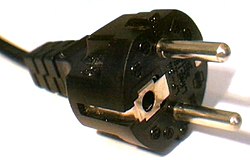
CEE7/4 (Schuko) plugs are not compatible with the CEE7/5 (Belgian/French) socket because of the round earthing pin permanently mounted in the socket; CEE7/6 (Belgian/French) plugs are not compatible with Schuko sockets due to the presence of indentations on the side of the recess, as well as the earth clips. CEE7/7 plugs have been designed to solve this incompatibility by being able to fit in either type of socket.
The plug is rated at 16A and looks similar to CEE7/4 plugs, but with earth contacts to fit both CEE7/5 and CEE7/3 sockets. Due to its compatibility with the inherently unpolarized Schuko (CEE7/4) plugs, appliances using it cannot expect the current to flow in any particular direction.
CEE 7/16 Alternative I
The CEE7/16 Alternative I unearthed plug is used for unearthed appliances. It has two round 4 by 19mm (0.157 by 0.748in) pins, rated at 2.5A. Alternative I is a round plug with cutouts to make it compatible with CEE7/3 and CEE7/5 sockets. (The similar-appearing CEE7/17 has larger pins and a higher current rating.) This alternative is seldom used.
CEE 7/16 Alternative II "Europlug" (Type C)
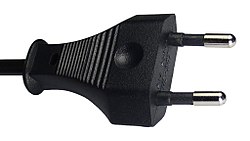
Alternative II, popularly known as the Europlug, is a flat 2.5A-rated plug with two round 4 by 19mm (0.157 by 0.748in) pins, defined by Cenelec standard EN50075 and national equivalents. The Europlug is not rewirable and must be supplied with a flexible cord. It can be inserted in either direction, so live and neutral are connected arbitrarily. To improve contact with socket parts the Europlug has slightly flexible pins which converge toward their free ends.
The Europlug is widely used in most of Europe and parts of the Middle East, Africa, South America, and Asia. There is no socket defined to accept only the Europlug. Instead, it fits a range of sockets including all three CEE7 sockets (unearthed, German/"Schuko", and Belgian/French) and also many non-CEE7 standard sockets such as Swiss, Danish and Italian (10A) ones as well as Israeli sockets. British shaver sockets also accept Europlugs, although in this configuration the connection supply is only rated at 200mA.
CEE 7/17 unearthed "contour" plug

This is a round plug compatible with all three types of CEE7 sockets. Also called the "contour plug", it has two round pins measuring 4.8 by 19mm (0.189 by 0.748in). The pins are not sheathed, in contrast to e.g. CEE7/16 Europlugs. It may be rated at either 10A or 16A.
Danish plug (Type K)

This Danish standard plug is described in the Danish Plug Equipment Section 107-2-D1 Standard sheet (SRAF1962/DB16/87DN10A-R). Like in most European plugs, the power pins of Danish plugs are 19mm (0.75in) long and spaced 19mm (0.75in) apart, with a diameter of 4.8mm (0.19in). The earthing pin is part of the plug (in contrast to French and Schuko plugs); it is D-shaped, 14mm (0.55in) long, and offset from the power pins by 13mm (0.51in). It is 4mm (0.16in) thick with a diameter of 6.5mm (0.26in). Sockets and plugs are rated for 16A. The Danish standard provides for sockets to have child-resistant shutters. Sockets are polarized in the same way as British ones: if earth is at the bottom, live is at the left of the socket.
Europlugs (CEE7/16) and contour plugs (CEE 7/17) can safely be used with Danish sockets. Physically the sockets also accept earthed CEE7/4 (Schuko), CEE7/6 (French), and CEE7/7 (Schuko-French hybrid) plugs, but no earth connection will be established. Therefore news sites and industry magazines warn that plugging these directly into a Type K socket can give noticeable electric shocks, be dangerous and even be life-threatening.

Traditionally all Danish sockets were equipped with a switch to prevent touching live pins when connecting/disconnecting the plug. Today, sockets without switch are allowed, but they must be recessed to prevent touching the live pins. Since the early 1990s earthed sockets have been required in all new electric installations in Denmark. Older sockets need not be earthed, but all sockets, including old installations, must be protected by earth-fault interrupters by 1 July 2008.
A variation (standard DK2-5a) of the Danish plug is for use only on surge protected computer sockets. It fits into the corresponding computer socket and the normal socket, but normal plugs deliberately do not fit into the special computer socket. The plug is often used in companies, but rarely in private homes. There is another variation for hospital equipment with a rectangular left pin, which is used for life support equipment.
IEC 60906-1 (Type N)


In 1986, the International Electrotechnical Commission published IEC 60906-1, a specification for a plug and socket that look similar, but are not identical, to the Swiss plug and socket. This standard was intended to one day become common for all of Europe and other regions with 230V mains, but the effort to adopt it as a European Union standard was put on hold in the mid-1990s.
The plug and socket are rated 16A 250VAC and are intended for use only on systems having nominal voltages between 200V and 250VAC. The plug pins are 4.5mm in diameter, live and neutral are on centres 19mm apart. The earth pin is offset by 3.0mm. The live pin is on the right when looking at a socket with the earth pin offset up. Shutters over the live and neutral pins are mandatory.
The first country to have officially adopted the standard is South Africa (as SANS164-2). Paraguay has also adopted it as national standard (PNA-IEC 60906-1), but so far its application is voluntary, and as of March2025[update], there is no indication that sockets of this type are commonly installed in the country.
Brazil developed a plug resembling IEC 60906-1 as the national standard under specification NBR14136. The NBR14136 standard has two versions, neither of which has pin dimensions or ratings complying with IEC 60906-1. Use at 127V is permitted by NBR14136, which is against the intention of IEC 60906-1.
South African standard SANS 164-2
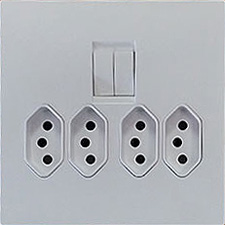
South Africa adopted IEC 60906-1 as its national standard, SANS164-2, in 1992. The standard specifies both a 2-pin unearthed and 3-pin earthed plug system, equivalent to IEC TypeN. SANS164-2 was designated the "preferred standard" in 2013, and South Africa is in the process of transitioning to it as the dominant system, expected to be completed by 2025 to 2035.
The SANS164-2 system is compatible with the SANS164-5 Europlug, commonly used in the country. This transition aims to improve electrical safety and standardization, aligning South Africa with international plug and socket systems.
Brazilian standard NBR 14136


Brazil, which had been using mostly Europlugs as well as NEMA1-15 and NEMA5-15 plugs, adopted a (non-compliant) variant of IEC 60906-1 as the national standard in 1998 under specification NBR14136 (revised in 2002). These are used for both 220-volt and 127-volt regions of the country, despite the IEC 60906-2 recommendation that NEMA5-15 be used for 120V connections. There are two types of sockets and plugs in NBR14136: one for 10A, with a 4.0mm pin diameter, and another for 20A, with a 4.8mm pin diameter. This differs from IEC60906-1 which specifies a pin diameter of 4.5mm and a rating of 16A. NBR14136 does not require shutters on the apertures, a further aspect of non-compliance with IEC 60906-1. NBR14136 was not enforced in that country until 2007, when its adoption was made optional for manufacturers. It became compulsory on 1 January 2010.
Few private houses in Brazil have an earthed supply, so even if a three-pin socket is present it is not safe to assume that all three terminals are actually connected. Most large domestic appliances were sold with the option to fit a flying earth tail to be locally earthed, but many consumers were unsure how to use this and so did not connect it. The new standard has an earth pin, which in theory eliminates the need for the flying earth tail.
Due to their smaller pin diameter, Brazilian plugs rated for 10A also fit into Brazilian sockets rated for 20A and South African sockets rated for 16A. 20A plugs do not fit into 10A sockets, which is as intended. However, if the Brazilian and South African variants are mixed, due to receptacle tolerances it might be possible to insert a 16A plug into a 10A socket or a 20A plug into a 16A socket, which could overload the socket.
Israel SI32 (Type H)
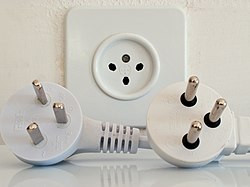
The plug defined in SI32 (IS16A-R) is used only in Israel, the Gaza Strip and the West Bank. There are two versions: an older one with flat pins, and a newer one with round pins.
The pre-1989 system has three flat pins in a Y-shape, with live and neutral 19mm (0.75in) apart. The plug is rated at 16A. In 1989 the standard was revised, with three round 4.5mm (0.177in) pins in the same locations designed to allow the socket to accept both older and newer Israeli plugs, and also non-grounded Europlugs (often used in Israel for equipment which does not need to be grounded and does not use more current than the Europlug is rated for). Pre-1989 sockets which accept only old-style plugs have become very rare in Israel.
Sockets have a defined polarity; looking at the front, neutral is to the left, ground at the bottom, and live to the right.
Italy (Type L)

Italian plugs and sockets are defined by the standard CEI23-50 and referred to as "Type L". This includes models rated at 10A and 16A that differ in contact diameter and spacing. Both are symmetrical, allowing the live and neutral contacts to be inserted in either direction. The 10A plug has 4mm diameter pins and the centres spaced 19mm apart, while the 16A plug has 5mm diameter pins and the centres spaced 26mm apart. This plug type is also used in Chile and Uruguay.
The two form factors were initially adopted because up to the second half of the 20th century in many regions of Italy electricity was supplied by means of two separate consumer connections – one for powering illumination and one for other purposes – and these generally operated at different voltages, typically 127V (a single phase from 220V three-phase) and 220V (a single phase from three-phase 380V or two-phase from 220V three-phase).

Modern installations in Italy (and in other countries where TypeL plugs are used) typically use sockets that accept several plug types. The simplest type, designated CEI23-50 P17/11, has a central round hole flanked by two figure-8 shaped holes, allowing the insertion of Italian 10A and 16A plugs as well as Europlugs. These compact hybrid sockets are known as presa bipasso (twin-gauge socket). A larger, but more flexible hybrid socket is called CEI23-50 P40. It merges the bipasso form factor with a "Schuko" socket, thus also accepting earthed CEE7/4 (Schuko) and CEE7/7 (CEE hybrid) as well as unearthed CEE7/17 ("contour") plugs.
Many appliances sold in Italy today are equipped with hybrid CEE7/7 or CEE7/17 plugs, but only these larger CEI23-50 P40 sockets will accept them without an adapter. However, adaptors that allow plugging them into smaller sockets are also commonly sold and regulated by a specific standard.
North America, Central America and IEC 60906-2

Most of North America and Central America, and some of South America, use connectors standardized by the National Electrical Manufacturers Association (NEMA). The devices are named using the format NEMA n-mmX, where n is an identifier for the configuration of pins and blades, mm is the maximum current rating, and X is either P for plug or R for receptacle. For example, NEMA5-15R is a configuration type5 receptacle supporting 15A. Corresponding P and R versions are designed to be mated. Within the series, the arrangement and size of pins will differ, to prevent accidental mating of devices with a higher current draw than the receptacle can support.
NEMA 1-15 ungrounded (Type A)


NEMA-1 plugs have two parallel blades and are rated 15A at 125volts. They provide no ground connection but will fit into a grounding NEMA5-15 receptacle. Early versions were not polarized, but today most plugs are polarized via a wider neutral blade. (Unpolarized ACadaptors are a common exception.) Harvey Hubbell patented a parallel blade plug in 1913, where the blades were equal width (). In 1916 Hubbell received a patent for a polarized version where one blade was both longer and wider than the other (). In the polarized version of NEMA1-15, introduced in the 1950s, both blades are the same length, with only the width varying.
Ungrounded NEMA-1 outlets are not permitted in new construction in the United States and Canada, but can still be found in older buildings.
NEMA 5-15 grounded (Type B)
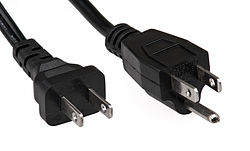
The NEMA5-15 plug has two flat parallel blades like NEMA1-15, and a ground (earth) pin. It is rated 15A at 125volts. The ground pin is longer than the live and neutral blades, such that an inserted plug connects to ground before power. The ground hole is officially D-shaped, although some round holes exist and many plugs have round ground pins. Both current-carrying blades on grounding plugs may be narrow, since the ground pin enforces polarity, but outlets have a wider opening for the neutral blade to prevent ungrounded polarized plugs from being put in backwards. This socket is recommended in IEC standard 60906-2 for 120-volt 60Hz installations.
The National Electrical Contractors Association's installation standard (NEIS130-2016) requires a consistent orientation for sockets installed together or nearby, but does not prescribe any specific orientation. In practice, most sockets are mounted with the ground contact below the other contacts. This ground-down orientation has been called the "sad socket", "dismayed face", or "shocked face" – names which reflect pareidolia.
Tamper-resistant sockets may be required in new residential construction, with shutters on the power blade sockets to prevent contact by objects inserted into the socket.
In stage lighting, this connector is sometimes known as PBG for Parallel Blade with Ground, Edison or Hubbell, the name of a common manufacturer.
NEMA 5-20

The NEMA 5-20AP variant has blades perpendicular to each other. The receptacle has a T-slot for the neutral blade which accepts either 15A parallel-blade plugs or 20A plugs.
NEMA 14-50

NEMA 14-50 devices are frequently found in RV parks, since they are used for "shore power" connections of larger recreational vehicles. Also, it was formerly common to connect mobile homes to utility power via a 14-50 device. Newer applications include Tesla's Mobile Connector for vehicle charging, which formally recommended the installation of a 14-50 receptacle for home use.
Other NEMA types
240V 20-, 30- and 50-amp rated sockets are often used for high-current appliances such as air conditioners, clothes dryers and electric stoves, respectively.
JIS C 8303, Class II unearthed

The Japanese Class II plug and socket appear physically identical to NEMA1-15 and also carries 15A. The relevant Japanese Industrial Standards, JISC8303, imposes stricter dimensional requirements for the plug housing, different marking requirements, and mandatory testing and type approval.
Older Japanese sockets and multi-plug adaptors are unpolarized—the slots in the sockets are the same size—and will accept only unpolarized plugs. Japanese plugs generally fit into most North American sockets without modification, but polarized North American plugs may require adaptors or replacement non-polarized plugs to connect to older Japanese sockets. In Japan the voltage is 100V, and the frequency is either 50Hz (Eastern Japan: Tokyo, Yokohama, Tohoku, Kawasaki, Sapporo, Sendai and Hokkaido) or 60Hz (Western Japan: Osaka, Kyoto, Nagoya, Shikoku, Kyushu and Hiroshima) depending on whether the customer is located on the Osaka or Tokyo grid. Therefore, some North American devices which can be physically plugged into Japanese sockets may not function properly.
JIS C 8303, Class I earthed
Japan also uses a grounded plug similar to the North American NEMA5-15. However, it is less common than its NEMA1-15 equivalent. Since 2005, new Japanese homes are required to have classI grounded sockets for connecting domestic appliances. This rule does not apply for sockets not intended to be used for domestic appliances, but it is strongly advised to have class I sockets throughout the home.
Swiss SN 441011 (Type J)

The Swiss standard, also used in Liechtenstein, is SN441011 (SNSEV1011 until 2019) Plugs and socket-outlets for household and similar purposes. The standard defines a hierarchical system of plugs and sockets with two, three and five pins, and 10A or 16A ratings. Sockets will accept plugs with the same or fewer pins and the same or lower ratings. The standard does not require the use of child protective shutters.
10 A plugs and sockets (Type J)

SN 441011 defines a "Type 1x" series of 10A plugs and sockets. The type11 plug is unearthed, with two 4mm diameter round pins spaced 19mm apart. The type12 plug adds a central 4mm diameter round earth pin, offset by 5mm. The obsolete type12 socket had no recess, while the newer type13 socket is recessed. Both sockets will accept type11 and type12 plugs, and also the 2.5A Europlug. Earlier type11 and 12 plugs had live and neutral pins without sleeved pins, which present a shock hazard when partially inserted into non-recessed sockets. The IEC TypeJ designation refers to SEV1011's type12 plugs and type13 sockets.
Unique to Switzerland is a three-phase power socket compatible with single-phase plugs: The type15 plug has three round pins, of the same dimensions as type12, plus two smaller flat rectangular pins for two additional power phases. The type15 socket is recessed, and has five openings (three round and two flat rectangular). It will accept plugs of types11, 12, 15 and the Europlug.
16 A plugs and sockets

SN441011 also defines a "Type 2x" series of 16A plugs and sockets. These are the same as their 10A "Type 1x" counterparts, but replace the round pins with 4mm × 5mm rectangular pins. The sockets will also accept "Type 1x" plugs. The unearthed type 21 plug has two rectangular pins, with centres 19mm apart. The type23 plug adds a central rectangular earth pin, offset by 5mm. The recessed type23 socket will accept plugs of types11, 12, 21, 23 and the Europlug.
Again, the three-phase power socket is compatible with single-phase plugs, either of 10A or 16A ratings. The type25 plug has three rectangular pins of the same dimensions as type23, plus two rectangular pins of the same dimensions as type15. The corresponding type25 socket is recessed and will accept all Swiss plug types as well as the Europlug.
Thai plug TIS 166-2549 (Type O)

Thai Industrial Standard (TIS)166-2547 and its subsequent update TIS166-2549 replaced prior standards which were based on NEMA1-15 and 5-15, as Thailand uses 230V electricity. The plug has two round power pins 4.8mm in diameter and 19mm in length, insulated for 10mm and spaced 19mm apart, with an earthing pin of the same diameter and 21.4mm in length, located 11.89mm from the line connecting the two power pins. The earth pin spacing corresponds to that of NEMA5 and provides compatibility with prior hybrid three-pin sockets, which accept NEMA1-15, NEMA5-15, and Europlugs, all of which have been variably used in Thailand.
The standard also defines an ungrounded plug with a smaller form factor that is very similar to the Europlug (but a bit higher); its power pins are identical to the grounded variant and both are rated for up to 16A (while the Europlug is only rated for 2.5A). The generally used hybrid socket is also defined in TIS166-2547, in addition to a plain three-round-pin socket, with plans to eventually replace the former and phase out support for NEMA-compatible plugs. Sockets are polarized (as in NEMA5-15).
The grounded plug is similar to, but not interchangeable with, the Israeli SI32 plug. The Thai plug is designated as "TypeO" at IEC World Plugs.
Special purpose plugs and sockets

Special purpose sockets may be found in residential, industrial, commercial or institutional buildings. Examples of systems using special purpose sockets include:
- "Clean" (low electrical noise) earth for use with computer systems,
- Device for Connection of Luminaires (DCL) is a European standard for ceiling- and hanging light fixtures.
- Emergency power supply,
- Uninterruptible power supply for critical or life-support equipment,
- Isolated power for medical instruments, tools used in wet conditions, or electric razors,
- "Balanced" or "technical" power used in audio and video production studios,
- Theatrical lighting,
- CEE 17 are a series of industrial grade (IP44) three-phase "pin & sleeve" connectors for industrial purposes, carpentry- and gardening appliances and also used as a weather-resistant connector for outdoor usage, like Caravans, Motorhomes, campervans and tents for mains hook-up at camp-sites.
- Sockets for electric clothes dryers, electric ovens, and air conditioners with higher current rating.
Special-purpose sockets may be labelled or coloured to identify a reserved use of a system, or may have keys or specially shaped pins to prevent use of unintended equipment.
Single-phase electric stove plugs and sockets

The plugs and sockets used to power electric stoves from a single-phase line have to be rated for greater current values than those used with three-phase supply because all the power has to be transferred through two contacts, not three. If not hardwired to the supply, electric stoves may be connected to the mains with an appropriate high power connector. Some countries do not have wiring regulations for single-phase electric stoves. In Russia, an electric stove can often be seen connected with a 25, 32, or even 40A connector.

In Norway, a 25A grounded connector, rectangular shaped with rounded corners, is used for single-phase stoves. The connector has three rectangular pins in a row, with the grounding pin longer than other two. The corresponding socket is recessed to prevent shocks. The Norwegian standard is NEK502:2005 – standard sheet X (socket) and sheet XI (plug).
Shaver supply units

National wiring regulations sometimes prohibit the use of sockets adjacent to water taps, etc. A special socket, with an isolation transformer, may allow electric razors to be used near a sink. Because the isolation transformer is of low rating, such outlets are not suitable to operate higher-powered appliances such as hair dryers.
An IEC standard 61558-2-5, adopted by CENELEC and as a national standard in some countries, describes one type of shaver supply unit. Shaver sockets may accept multiple two-pin plug types including Australian (TypeI) and BS4573. The isolation transformer often includes a 115V output accepting two-pin US plugs (TypeA). Shaver supply units must also be current limited, IEC 61558-2-5 specifies a minimum rating of 20VA and maximum of 50VA. Sockets are marked with a shaver symbol, and may also say "shavers only".
Isolation transformers and dedicated NEMA1-15 shaver receptacles were once standard installation practice in North America, but now a GFCI receptacle is used instead. This provides the full capacity of a standard receptacle but protects the user of a razor or other appliance from leakage current.
Though BS4573 plugs look similar to Europlugs (TypeC), there are subtle differences between them. While the BS4573 plug has round 5mm contacts, spaced at 16mm, the Europlug has 4mm contacts, spaced at (roughly) 19mm. In order to insert a Europlug into a BS4573 socket, an adaptor should be used.
Comparison of standard types
| IEC TR 60083 World Plugs Type | Standard | Origin | Rating | Earthed (grounded) | Polarized | Fused | Insulated pins | Recessed socket | Socket accepts Europlug | |
|---|---|---|---|---|---|---|---|---|---|---|
| A | NEMA1-15 | American and Canadian | 15A | 125V | No | Optional | No | No | No | No |
| JISC8303, ClassII | Japanese | |||||||||
| CNS690, CNS15767-1 & CNS15872 | Taiwanese | |||||||||
| GB1002 | Chinese | 10A | 250V | No | No | No | Optional | No | No | |
| B | NEMA5-15 | American and Canadian | 15A | 125V | Yes | Yes | No | No | No | No |
| JISC8303, ClassI | Japanese | |||||||||
| CNS690, CNS15767-1 & CNS15872 | Taiwanese | |||||||||
| C | CEE7/16 | Europlug | 2.5A | 250V | No | No | No | Yes | —N/a | —N/a |
| —N/a | CEE7/17 plug | French / German hybrid | 16A | 250V | No | No | No | No | —N/a | —N/a |
| —N/a | CEE7/1 socket & CEE7/2 plug | European | 16A 10A | 250V | No | No | No | No | Yes | Yes |
| —N/a | BS4573 | British | 0.2A | 250V | No | No | No | Yes | No | No |
| Socket only; plug is unspecified | ||||||||||
| D | BS546 | British | 5A | 250V | Yes | Yes | Optional | Optional | No | No |
| IS1293 | Indian | 6A | 250V | Yes | Yes | Optional | Optional | No | No | |
| SANS164-3 | South African | Yes | Yes | Optional | Optional | No | No | |||
| E | CEE7/5 socket & CEE7/6 plug | French | 16A | 250V | Yes | Partially | No | No | Yes | Yes |
| F | CEE7/3 socket & CEE7/4 plug | German "Schuko" | 16A | 250V | Yes | No | No | No | Yes | Yes |
| —N/a | CEE7/7 plug | French / German hybrid | 16A | 250V | Yes | No | No | No | —N/a | —N/a |
| G | BS1363, IS401 & IS411, MS589, SS145 | British | 13A | 250V | Yes | Yes | Yes | Yes | No | No |
| H | SI32 | Israeli | 16A | 250V | Yes | Yes | No | No | No | Yes |
| I | AS/NZS3112 | Australian and New Zealand | 10A 15A 20A | 250V | Yes | Yes | No | Yes | Optional | No |
| GB1002 & GB2099.1 | Chinese | 10A 16A | 250V | Yes | Yes | No | Optional | No | No | |
| IRAM2071 (socket), IRAM2073 & IRAM2063 (plugs) | Argentine | 10A 20A | 250V | Yes | Yes | No | Optional | No | No | |
| J | SN441011 (formerly SNSEV1011) Type 12 plug and Type 13 receptacle | Swiss | 10A | 250V | Yes | Yes | No | Yes | Yes | Yes |
| K | 107-2-D1 | Danish | 16A | 250V | Yes | Yes | No | No | Optional | Yes |
| L | CEI23-50 (formerly CEI23-16) | Italian | 10A | 250V | Yes | No | No | Yes | No | Yes |
| 16A | 250V | Yes | No | No | Yes | No | No | |||
| M | BS546 | British | 15A | 250V | Yes | Yes | Optional | Optional | No | No |
| IS1293:2005 | Indian | 16A | 250V | Yes | Yes | Optional | Optional | No | No | |
| SANS164-1 | South African | Yes | Yes | Optional | Optional | No | No | |||
| N | NBR14136 two-pin | Brazilian | 20A 10A | 250V | No | No | No | Yes | —N/a | —N/a |
| NBR14136 three-pin | 20A 10A | Yes | Yes | No | Yes | Yes | Yes | |||
| SANS164-2 two-pin | South African | 16A | 250V | No | No | No | Yes | —N/a | —N/a | |
| SANS164-2 three-pin | Yes | Yes | No | Yes | Yes | Yes | ||||
| O | TIS166-2549 two-pin | Thai | 16A | 250V | No | No | No | Yes | —N/a | —N/a |
| TIS166-2549 three-pin | Yes | Yes | No | Yes | No | Yes | ||||
| IEC World Plugs Type | Standard | Origin | Rating | Earthed | Polarized | Fused | Insulated pins | Recessed socket | Socket accepts Europlug |
Unusual types
Lampholder plug

A lampholder plug fits into a light socket in place of a light bulb to connect appliances to lighting circuits. Where a lower rate was applied to electric power used for lighting circuits, lampholder plugs enabled the consumers to reduce their electricity costs. Lampholder plugs are rarely fused. Edison screw lampholder adaptors (for NEMA1-15 plugs) are still commonly used in the Americas.
Soviet standard GOST 7396 C 1 unearthed
- Soviet grip plug, 6A 250V AC, thermoset plastic
- Soviet round plug, 6A 250V AC, thermoset plastic, half height
- Moulded rubber Soviet plugs cut with knife so that they can fit into CEE7/3 socket. Originally the plugs had a round base.
- Soviet shaver power cord. The plug is similar to CEE7/16, but has different configuration. Thermoplastic plug is rated 6A and 250V.
This Soviet plug, now rarely used, has pin dimensions and spacing equal to the Europlug, but lacks the insulation sleeves. Unlike the Europlug, it is rated 6A. It has a round body like the European CEE7/2 or flat body with a round base like CEE7/17. The round base has no notches. The pins are parallel and do not converge. The body is made of fire-resistant thermoset plastic. The corresponding 6A socket accepts the Europlug, but not others as the 4.5mm holes are too small to accept the 4.8mm pins of CEE7/4, CEE7/6 or CEE7/7 plugs.
There were also moulded rubber plugs available for devices up to 16A similar to CEE7/17, but with a round base without any notches. They could be altered to fit a CEE7/5 or CEE7/3 socket by cutting notches with a sharp knife.
Soviet adaptor plugs

Some appliances sold in the Soviet Union had a flat unearthed plug with an additional pass-through socket on the top, allowing a stacked arrangement of plugs. The usual Soviet apartment of the 1960s had very few sockets, so this design was very useful, but somewhat unsafe; the brass cylinders of the secondary socket were uncovered at the ends (to allow them to be unscrewed easily), recessed by only 3mm, and provided bad contact because they relied on the secondary plug's bisected expanding pins. The pins of the secondary plug (which lacked insulation sleeves) could not be inserted into the cylindrical sockets completely, leaving a 5mm gap between the primary and secondary plugs. The adaptors were mostly used for low power appliances (for example, connecting both a table lamp and a radio to a socket).
UK Walsall Gauge plug

Compared to the standard BS1363 plugs found in the UK, each pin is rotated 90 degrees. This style of plug/socket was used by university laboratories (from batteries) and the BBC, and is still in use in parts of the London Underground for 110VAC voltage supply. In the 1960s they were used for 240VDC in the Power laboratory of the Electrical Engineering department of what was then University College, Cardiff. Power was supplied by the public 240VDC mains which remained available in addition to the 240VAC mains until circa 1969, and thereafter from in-house rectifiers. They were also used in the Ministry of Defence Main Building inside circuits powered from the standby generators to stop staff from plugging in unauthorized devices. They were also known to be used in some British Rail offices for the same reason.
Italian BTicino brand Magic Security connector
- Magic Security socket, detail.
- Assortment of Magic Security sockets (in orange, the industrial three-phase type)
- Assortment of Magic Security plugs
- Magic Security plug (10A) (left) with a TypeL to Magic Security plug adaptor
In the 1960s, Italian firm BTicino introduced an alternative to the Europlug or CEI23-16 connectors then in use, called Magic Security. The socket is rectangular with lateral key pins and indentations to maintain polarization and prevent insertion of a plug with different current ratings. Three single-phase general purpose connectors were rated 10A, 16A and 20A; and a three-phase industrial connector rated 10A; all of them have different key-pin positioning so plugs and sockets cannot be mismatched. The socket is closed by a safety lid (bearing the word Magic on it) which can be opened only with an even pressure on its surface, thus preventing the insertion of objects (except the plug itself) inside the socket. The contacts are positioned on both sides of the plug; the plug is energised only when it is inserted fully into the socket.
The system is not compatible with Italian CEI plugs, nor with Europlugs. Appliances were never sold fitted with these security plugs, and the use of adaptors would defeat the safety features, so the supplied plugs had to be cut off and replaced with the security connector. Even so, the Magic security system had some success at first because its enhanced safety features appealed to customers; standard connectors of the day were not considered safe enough. The decline of the system occurred when safety lids similar to the Magic type were developed for standard sockets.
In Italy, the system was never definitively abandoned. Though very rarely seen today, it is still marked as available in BTicino's catalogue, (except for the three-phase version, which stopped being produced in July 2011).
In Chile, 10A Magic connectors are commonly used for computer/laboratory power networks, as well as for communications or data equipment. This allows delicate electronics equipment to be connected to an independent circuit breaker, usually including a surge protector or an uninterruptible power supply backup. The different style of plug makes it more difficult for office workers to connect computer equipment to a standard unprotected power line, or to overload the UPS by connecting other office appliances.
In Iceland, Magic plugs were widely used in homes and businesses alongside Europlug and Schuko installations. Their installation in new homes was still quite common even in the late 1980s.
See also
- Anderson Powerpole
- DC connector
- History of AC power plugs and sockets
- IEC 60309 high-power industrial and polyphase connectors
- IEC 60320 Appliance couplers for household and similar general purposes
- Industrial and multiphase power plugs and sockets
- Mains electricity
- Mains electricity by country lists voltage, frequency, and connector types for over 200 countries
- Perilex
- Pattress
- Plug load
- Polyphase system
- Smart plug
- Stage pin connector
- Light switch
External links
- (comprehensive collection of plugs and sockets)