American Institute of Architects
In-game article clicks load inline without leaving the challenge.
The American Institute of Architects (AIA) is a professional organization for architects in the United States. It is headquartered in Washington, D.C. AIA offers education, government advocacy, community redevelopment, and public outreach programs, and collaborates with other stakeholders in the design and construction industries.. While many US-based architects are members of the AIA, it is not a professional requirement.
History
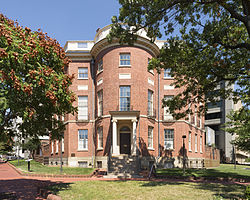

The American Institute of Architects (AIA) was founded in 1857 in New York City by a group of thirteen architects. The founding members include Charles Babcock, Henry W. Cleaveland, Henry Dudley, Leopold Eidlitz, Edward Gardiner, Richard Morris Hunt, Detlef Lienau, Fred A. Petersen, Jacob Wrey Mould, John Welch, Richard M. Upjohn, and Joseph C. Wells, with Richard Upjohn serving as the first president. They held their inaugural meeting on February 23, 1857, and invited 16 additional architects to join, including Alexander Jackson Davis, Thomas U. Walter, Frederick Clarke Withers, and Calvert Vaux. There were no architectural schools or licensing laws in the United States at the time, allowing anyone to claim to be an architect.
By March 10, 1857, they had drafted a constitution and bylaws under the name New York Society of Architects. The name was later changed to The American Institute of Architects at the suggestion of Thomas U. Walter. On April 15, 1857, the members signed the new constitution, having previously filed a certificate of incorporation two days earlier. The following year, the constitution was amended to include the mission of promoting the artistic, scientific, and practical aspects of architecture, facilitating professional interaction and camaraderie, raising the profession's standing, and uniting architects for the advancement of the field.
In the 1860s, architects from other cities began joining AIA. By the 1880s, chapters had been established in Albany, Baltimore, Boston, Chicago, Cincinnati, Indianapolis, Philadelphia, Rhode Island, San Francisco, St. Louis, and Washington, D.C. As of 2008, AIA boasts over 200 chapters.
In the mid-1960s, a design competition was held to select an architect for a new AIA headquarters located at 1735 New York Avenue, NW, in Washington, D.C. Mitchell Giurgola Architects won the competition but failed to gain approval from the United States Commission of Fine Arts for the design concept. Subsequently, the firm resigned from the commission, and The Architects Collaborative (TAC) was chosen to redesign the building. Led by TAC principals Norman Fletcher and Howard Elkus, the design was ultimately approved in 1970 and completed in 1973.
AIA's headquarters also serves as the home of the American Institute of Architecture Students, the Association of Collegiate Schools of Architecture, and the National Architectural Accrediting Board.
Organization
Membership
The American Institute of Architects (AIA) has a membership of over 100,000 licensed architects and associated professionals. AIA members adhere to a code of ethics and professional conduct designed to demonstrate commitment to upholding the highest standards in professional practice and dedication.
AIA offers membership at five different levels:
- Architect members (AIA): These individuals are licensed to practice architecture by a recognized licensing authority in the United States.
- Associate members (Assoc. AIA): While they do not hold a license to practice architecture, associate members work under the supervision of an architect in a professional or technical capacity. They may have earned professional degrees in architecture, work as faculty members in architecture programs, or be interns earning credit toward licensure.
- International associate members: This category is for individuals who hold an architecture license or its equivalent from a licensing authority outside the United States.
- Emeritus members: These members have maintained AIA membership for 15 consecutive years and are either at least 70 years old or incapacitated and unable to work in the architecture profession.
- Allied members: Allied members are professionals whose work is related to the building and design communities. This includes engineers, landscape architects, planners, and senior executive staff from building and design-related companies, such as publishers, product manufacturers, and research firms. Allied membership represents a partnership between the AIA and the American Architectural Foundation.
AIA's most esteemed recognition is the Fellow of The American Institute of Architects (FAIA) designation. This honor is awarded to members who have made nationally significant contributions to the profession. Approximately 2% of all members, or slightly more than 2,600 individuals, have been elevated to the AIA College of Fellows. Prominent foreign architects may also be elected as Honorary Fellows of AIA, gaining recognition within the college.
Structure
AIA operates under the governance of a board of directors and maintains a staff of nearly 200 employees. While AIA serves as a national organization, its reach is extended through its 217 local and state chapters. Chapters span the United States and its territories. AIA components also operate in several international locations, including the United Kingdom, Continental Europe, the Middle East, Japan, Hong Kong, Shanghai, and Canada. These chapters offer programming and direct services to support AIA members at various stages of their professional careers.
In June 2013, The American Institute of Architects unveiled the "Designing Recovery" initiative during CGI America, an annual event of the Clinton Global Initiative. This initiative involved a design contest conducted in partnership with charitable organizations such as Make It Right, SBP, and Architecture for Humanity. The contest focused on single-family housing designs aimed at enhancing the quality, diversity, and resilience of housing in each community. The portfolio of designs, including those from non-winning entries, was made available to communities recovering from natural disasters. Dow Building Solutions sponsored the contest, providing a total prize money of $30,000. The prize was equally distributed among three winning designs from New Orleans, Louisiana; Joplin, Missouri; and New York City.
Professionalism
AIA members actively contribute to their profession and communities by participating in various professional interest areas, ranging from design to regional and urban development. They also engage with professional academies that foster the generation of new ideas and responses. Local components provide support to younger professionals through programs such as the Intern Development Program, Architect Registration Exam preparation courses, and employment referral services.
AIA organizes the AIA Conference on Architecture & Design, held annually in late spring or early summer, which attracts the largest gathering of architects worldwide.
Public education
AIA attempts to meet the needs and interests of the nation's architects and the public by raising public awareness of the value of architecture and the importance of good design. To mark AIA's 150th anniversary and to showcase how members have helped shape the built environment, AIA and Harris Interactive released findings from a public poll that asked Americans to name their favorite 150 works of architecture, America's Favorite Architecture.
Honors and awards
AIA recognizes individuals and organizations for outstanding achievements in support of the architecture profession and AIA. Awards include the Next LA Merit Award, the Next Design Award, and the Next Design Honor Award.
Presidents
The following individuals served as presidents, all of whom were elevated to Fellows of the American Institute of Architects:
| Richard Upjohn 1857–1876 Thomas Ustick Walter 1877–1887 Richard Morris Hunt 1888–1891 Edward Hale Kendall 1892–1893 Daniel H. Burnham 1894–1895 George Browne Post 1896–1898 Henry Van Brunt 1899–1900 Robert Swain Peabody 1900–1901 Charles Follen McKim 1902–1903 William S. Eames 1904–1905 Frank Miles Day 1906–1907 Cass Gilbert 1908–1909 Irving Kane Pond 1910–1911 Walter Cook 1912–1913 Richard Clipston Sturgis 1913–1915 John Lawrence Mauran 1915–1918 Thomas Rogers Kimball 1918–1920 Henry H. Kendall 1920–1922 William B. Faville 1922–1924 Dan Everett Waid 1924–1926 Milton Bennett Medary 1926–1928 Charles Herrick Hammond 1928–1930 Robert D. Kohn 1930–1932 Ernest John Russell 1932–1935 Stephen F. Voorhees 1935–1937 Charles Donagh Maginnis 1937–1939 George Edwin Bergstrom 1939–1941 Richmond Harold Shreve 1941–1943 Raymond J. Ashton 1943–1945 James Richard Edmunds Jr. 1945–1947 Douglas William Orr 1947–1949 Ralph Thomas Walker 1949–1951 Glenn Stanton 1951–1953 | Clair W. Ditchy 1953–1955 George Bain Cummings 1955–1956 Leon Chatelain Jr. 1956–1958 John N. Richards 1958–1960 Philip Will Jr. 1960–1962 Henry L. Wright 1962–1963 J. Roy Carroll Jr. 1963–1964 Arthur G. Odell Jr. 1964–1965 Morris Ketchum Jr. 1965–1966 Charles M. Nes Jr. 1966–1967 Robert L. Durham 1967–1968 George E. Kassabaum 1968–1969 Rex Whitaker Allen 1969–1970 Robert F. Hastings 1971 Max O. Urbahn 1972 S. Scott Ferebee Jr. 1973 Archibald C. Rogers 1974 William Marshall Jr. 1975 Louis de Moll 1976 John McGinty 1977 Elmer E. Botsai 1978 Ehrman B. Mitchell 1979 Charles E. Schwing 1980 Robert Randall Vosbeck 1981 Robert M. Lawrence 1982 Robert C. Broshar 1983 George M. Notter 1984 R. Bruce Patty 1985 John A. Busby Jr. 1986 Donald J. Hackl 1987 Ted P. Pappas 1988 Benjamin E. Brewer Jr. 1989 Sylvester Damianos 1990 | Jim Lawler 1991 W. Cecil Steward 1992 Susan A. Maxman 1993 L. William Chapin II 1994 Chester A. Widom 1995 Raymond Post Jr. 1996 Raj Barr-Kumar 1997 Ronald Arthur Altoon 1998 Michael J. Stanton 1999 Ronald L. Skaggs 2000 John D. Anderson 2001 Gordon H. Chong 2002 Thompson E. Penney 2003 Eugene C. Hopkins 2004 Douglas L. Steidl 2005 Katherine Lee Schwennsen 2006 R. K. Stewart 2007 Marshall Emmiett Purnell 2008 Marvin J. Malecha 2009 George H. Miller 2010 Clark Manus 2011 Jeff Potter 2012 Mickey Jacob 2013 Helene Combs Dreiling 2014 Elizabeth Chu Richter 2015 Russell A. Davidson 2016 Thomas Vonier 2017 Carl Elefante 2018 William J. Bates 2019 L. Jane Frederick 2020 Peter J. Exley 2021 Daniel S. Hart 2022 Emily Grandstaff-Rice 2023 Kimberly Dowdell 2024 Evelyn M. Lee 2025 |
See also
- American Architectural Foundation (AAF)
- AIA Columbus, a chapter of the American Institute of Architects
- Architecture Billings Index
- Boston Society of Architects (BSA), a chapter of the American Institute of Architects
- Society of American Registered Architects
- Architecture of the United States
- Architecture of Washington, D.C.
Footnotes
External links
- at Syracuse University (60 years of primary source material)
- ', including the American Institute of Architects' Florida Association's , , and others
- (archived 24 March 2011)
- (archived 1 May 2004)
- , the AIA New York Chapter's e-zine (archived 29 July 2012)
38°53′46″N 77°02′30″W/38.89611°N 77.04167°W/ 38.89611; -77.04167