Ancient lake
In-game article clicks load inline without leaving the challenge.
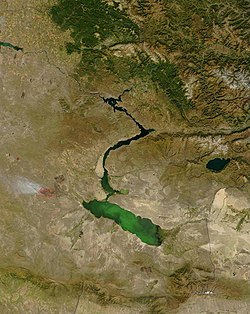
An ancient lake is a lake that has consistently carried water for more than one million years. Twelve of the 20 ancient lakes have existed for more than 2.6 million years[citation needed], the full Quaternary period. Ancient lakes continue to persist due to plate tectonics in an active rift zone. This active rift zone creates lakes that are extremely deep and difficult to naturally fill with sediment. Due to the prolonged life of ancient lakes, they serve as models for isolated evolutionary traits and speciation. Most of the world's bodies of water are less than 18,000 years old. There are only 20 ancient lakes over 1 million years old.
Lake Baikal is often considered the oldest, as clear evidence shows that it is 25–30 million years old. Lake Zaysan may be even older, of Cretaceous origin and at least 66 million years old (most likely around 70 million years), but its exact age is controversial and labeled with some uncertainty. Another contender for oldest is Lake Maracaibo, estimated to be 20–36 million years old. In ancient times it was indisputably a true lake, but today it is saline and directly connected to the sea, leading many to consider it a large lagoon or bay.
Ancient lakes vs. younger lakes
There are six major types of lakes (listed below). The majority of lakes dry up as the result of the filling with lacustrine deposits, sediment deposited from a river into a lake over thousands of years. Factors that influence the water level decreasing include fluvial-lacustrine sediment build-up, evaporation, natural drainage, and geophysical processes. Ancient lakes have a prolonged life when compared to younger, more ordinary lakes due to the local active rift zones and subsided sections of land called grabens.
For example, Lake Baikal in Russia, the deepest lake in the world, is an ancient lake created by the Baikal Rift Zone which is 25–30 million years old and 5,387 feet (1,642m) deep. This is compared to the North American Great Lakes, which were formed by the last glacial period by glacial scouring and the pooling of meltwater which are 14,000 years old and have maximum depths ranging from 200–1,300 feet (60–400m) deep.
- Rift lakes[clarification needed]
- Landslide and ice dam lakes
- Salt lakes
- Oxbow lakes
- Crater lakes
- Glacial lakes
- Subglacial lakes
Importance to evolution
Ancient lakes allow scientists to study the mechanisms of environmental changes over glacial-interglacial timescales. Evolutionary characteristics including sexual selection, adaptive radiation and punctuated equilibrium are studied in ancient lakes due to their prolonged existence and general geographic isolation. Most of the research has been associated with the endemic fauna and diatoms that exist in these isolated lakes, concentrating on Lake Baikal, the Caspian Sea and the African Great Lakes. Information is derived from the associations of the fluvial-lacustrine, fluctuating profundal and evaporative facies.[citation needed]
List of ancient lakes
These are the ancient lakes in the world that have existed for more than 1 million years, excluding the many subglacial lakes whose age is yet to be determined.
| Name | Origin | Type | Age (millions of years) | Area | Volume | Depth max | Depth average | Countries | Notes | ||||
|---|---|---|---|---|---|---|---|---|---|---|---|---|---|
| km2 | sq mi | km3 | cu mi | m | ft | m | ft | ||||||
| Lake Pingualuk | meteor impact | fresh, permanent, crater | 1.5 | 8 | 3.1 | 267 | 876 | Canada | |||||
| Lake Tahoe | tectonic | fresh, permanent | 1–2 | 499 | 193 | 156 | 37 | 505 | 1,657 | 313 | 1,027 | United States | |
| Lake Bosumtwi | meteor impact | soda, permanent, crater | 1–2 | 49 | 19 | 2.24 | 0.54 | 81 | 266 | 45 | 148 | Ghana | |
| Lake Tazawa | volcanic | caldera | 1.8 | 25.75 | 9.94 | 7.2 | 1.7 | 423.4 | 1,389 | 280.0 | 918.6 | Japan | Two lava domes on the caldera floor formed between 1.6 and 1.8 Ma. |
| Lake Lanao | volcanic | fresh, permanent | 2 | 375 | 145 | 112 | 367 | 60.3 | 198 | Philippines | |||
| Lake Titicaca | tectonic | 3 | 8,372 | 3,232 | 893 | 214 | 281 | 922 | 107 | 351 | Bolivia, Peru | ||
| Lake Prespa | 1.5–5 | 259 | 100 | 4.8 | 1.2 | 54 | 177 | 18.7 | 61 | Albania, Greece, North Macedonia | |||
| Lake Ohrid | 1.5–5 | 358.18 | 138.29 | 53.63 | 12.87 | 286.7 | 941 | 163.71 | 537.1 | Albania North Macedonia | |||
| Lake Malawi | 2–5 | 29,600 | 11,400 | 8,400 | 2,000 | 705 | 2,313 | 292 | 958 | Malawi, Mozambique, Tanzania | |||
| Lake Hovsgol | 2–5 | 2,770 | 1,070 | 381 | 91 | 267 | 876 | 138 | 453 | Mongolia | |||
| Kati Thanda–Lake Eyre | saline, intermittent, endorheic | 2.5–5 | 9,690 | 3,740 | 30.1 | 7.2 | 6 | 20 | 3 | 9.8 | Australia | ||
| Lake Tanganyika | fresh, permanent | 3–6 | 32,000 | 12,000 | 17,800 | 4,300 | 1,471 | 4,826 | 572 | 1,877 | Burundi, Congo, Tanzania, Zambia | ||
| Karakul | meteor impact | saline, permanent, endorheic, crater | 5.5 | 380 | 150 | 79.8 | 19.1 | 230 | 750 | 210 | 690 | Tajikistan | |
| Caspian Sea | tectonic | brackish, permanent, endorheic | 5–25 | 374,000 | 144,000 | 78,200 | 18,800 | 1,025 | 3,363 | 182 | 597 | Azerbaijan, Iran, Kazakhstan, Russia, Turkmenistan | |
| Aral Sea | saline, permanent | 5.5 | 64,500 | 24,900 | 625 | 150 | 67 | 220 | 16 | 52 | Kazakhstan, Uzbekistan | Formerly the fourth largest lake in the world with an area of 68,000km2 (26,300 sq mi). By 1997, it had shrunk to 10% of its original size due to water that was diverted in the Soviet Era. It is now split into 4 smaller lakes. As of 2023, the Aral Sea has become mostly desert. | |
| Lake Biwa | fresh, permanent | 5–6 | 674 | 260 | 27.5 | 6.6 | 104 | 341 | 41 | 135 | Japan | ||
| Lake Tule | 3–15 | 53 | 20 | 40 | 9.6 | United States | This lake has become intermittent in recent years. | ||||||
| Lake Maracaibo | saline, permanent, coastal bay | 20+ | 13,010 | 5,020 | 280 | 67 | 60 | 200 | 25.9 | 85 | Venezuela | Historically it was an ancient lake. Now, it is a large tidal bay/inlet rather than a lake in the traditional sense. It is saline and directly connected to the Caribbean Sea, leading many to consider it a large lagoon or bay. | |
| Lake Baikal | fresh, permanent | 25+ | 31,500 | 12,200 | 23,000 | 5,500 | 1,741 | 5,712 | 740 | 2,430 | Russia | ||
| Issyk-Kul | saline, permanent | 25 | 6,236 | 2,408 | 1,738 | 417 | 668 | 2,192 | 270 | 890 | Kyrgyzstan | ||
| Lake Vostok | subglacial | fresh, permanent, subglacial | 15–35 | 12,500 | 4,800 | 5,400 | 1,300 | 510 | 1,670 | 432 | 1,417 | Antarctica | |
| Lake Zaysan | tectonic | fresh, permanent | 65+ | 5,510 | 2,130 | 53 | 13 | 10 | 33 | 5 | 16 | Kazakhstan | The construction of the Bukhtarma dam inundated the lake, thus, in some sources, the lake is considered a reservoir. |
- Stoermer, Eugene F.; Smol, J. P. (2001). The Diatoms: Applications for the Environmental and Earth Sciences. Cambridge, UK: Cambridge UP. pp.209–212. ISBN9780521582810. OCLC. Chapter 11.1–11.2.
- Wilke, Thomas, Risto Väinölä, and F. Riedel. Patterns and Processes of Speciation in Ancient Lakes: Proceedings of the Fourth Symposium on Speciation in Ancient Lakes, Berlin, Germany, September 4–8, 2006. Dordrecht, the Netherlands: Springer, 2009. 126–28. Print.
- Vaillant, J. J., G. D. Haffner, and M. E. Cristescu. "The Ancient Lakes of Indonesia: Towards Integrated Research on Speciation." Integrative and Comparative Biology 51.4 (2011): 634–43. Web. Nov. 2015
- Carroll, Alan R.; Bohacs, Kevin M. (February 1, 1999). (PDF). Geology. 27 (2): 99–102. Bibcode:. doi:.. Download from researchgate.net.
- Hoffmann, N., K. Reicherter, T. Fernández-Steeger, and C. Grützner. "Evolution of Ancient Lake Ohrid: A Tectonic Perspective." Biogeosciences 7.10 (2010): 3377–386. Web. Nov. 2015.