Anoplotheriidae
In-game article clicks load inline without leaving the challenge.
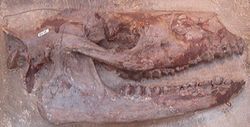
Anoplotheriidae is an extinct family of artiodactyl ungulates. They were endemic to Europe during the Eocene and Oligocene epochs about 44—30 million years ago. The name is derived from the Ancient Greek: ἂνοπλος ("unarmed") and θήριον ("beast"), translating as "unarmed beast".
Ecology
Species of Anoplotheriidae varied substantially in size. Diplobune minor is suggested to have weighted about 20 kg (44 lb), while Anoplotherium is suggested to have been up to 271 kg (597 lb) in weight. Anoplotherium is thought to have been a browser that reared up on its hind legs to feed, while Diplobune is suggested to have been an arboreal climbing animal.
Systematics and taxonomy
The family Anoplotheriidae was assigned to Belluae by Bonaparte (who named it Anoplotheriina) in 1850; to Artiodactyla by Cope in 1889, to Ruminantia by Gregory in 1910, and finally to its own superfamily Anoplotherioidea by Romer in 1966. A 2019 study considered them to be closely related to Cainotheriidae, another group of endemic European artiodactyls, with this group in turn being related to ruminants, while a 2020 study found them to be more closely related to the also European endemic Xiphodontidae, again as relatives of ruminants.
Included genera:
- Subfamily Anoplotheriinae Anoplotherium Cuvier, 1804 Diplobune Rutimeyer, 1862 Duerotherium Cuesta & Badiola, 2009 Ephelcomenus Hurzeler, 1938 Robiatherium Sudre, 1988
- Subfamily Dacrytheriinae Dacrytherium Filhol, 1876 Catodontherium Depéret, 1908