Archdiocese of New Orleans
In-game article clicks load inline without leaving the challenge.
The Archdiocese of New Orleans (Latin: Archidioecesis Novae Aureliae; French: Archidiocèse de la Nouvelle-Orléans; Spanish: Arquidiócesis de Nueva Orleans) is an archdiocese of the Catholic Church spanning Jefferson (except Grand Isle), Orleans, Plaquemines, St. Bernard, St. Charles, St. John the Baptist, St. Tammany, and Washington civil parishes of southeastern Louisiana. It is the second oldest among dioceses in the United States, coming after the Archdiocese of Baltimore. The Cathedral Basilica of Saint Louis is its mother church. The archbishop is James F. Checchio.
History
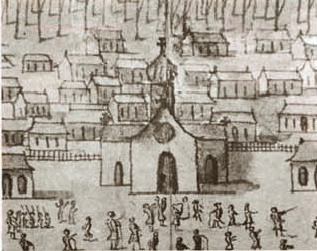
Founding (1718-1799)
The Catholic Church has had a presence in New Orleans since before the founding of the city by the French in 1718. Missionaries served the French military outposts and worked among the native peoples. The area was then under the jurisdiction of the Bishop of Quebec. In 1721 Fr. Francis-Xavier de Charlevoix, S.J., made a tour of New France from the Lakes to the Mississippi, and visiting New Orleans, he describes "a little village of about one hundred cabins dotted here and there, a large wooden warehouse in which I said Mass, a chapel in course of construction and two storehouses".
In 1722 the Capuchins were assigned ecclesiastical responsibility for the Lower Mississippi Valley, while the Jesuits maintained a mission, based in New Orleans, to serve the indigenous peoples. The Jesuit vicar-general returned to France to recruit priests and also persuaded the Ursulines of Rouen to assume charge of a hospital and school. The royal patent authorizing the Ursulines to found a convent in Louisiana was issued September 18, 1726. Ten religious from various cities sailed from Hennebont on January 12, 1727, and reached New Orleans on August 6. They opened a hospital for the care of the sick and a school for poor children.
France surrendered New Orleans and the rest of Louisiana Territory west of the Mississippi to the Spanish under the Treaty of Paris of 1763. From then until 1783, East Florida and West Florida were under British control, but both Florida colonies reverted to Spain as part of the Peace of Paris in 1783. Pope Pius VI erected the Diocese of Louisiana and the Two Floridas encompassing the pioneer parishes of New Orleans and Louisiana and both Florida colonies on April 25, 1793, taking its territory from the Diocese of San Cristóbal de la Habana, based in Havana, Cuba. The diocese originally encompassed the entire territory of the Louisiana Purchase, from the Gulf of Mexico to British North America, as well as the Florida peninsula and the Gulf Coast. This date of erection makes the present Archdiocese of New Orleans the second oldest Catholic diocese in the present United States after the Archdiocese of Baltimore. The new diocese encompassed the area claimed by Spain as Louisiana, which was all the land draining into the Mississippi River from the west, as well as Spanish territory to the east of the river in modern-day Mississippi, Alabama, and Florida.
Joining the United States (1800-1899)
In April 1803, the United States purchased Louisiana from France, which had in 1800 forced Spain to retrocede the territory in the Third Treaty of San Ildefonso. The United States took formal possession of New Orleans on December 20, 1803, and of Upper Louisiana on March 10, 1804. John Carroll, the Bishop of Baltimore, served as apostolic administrator of the diocese from 1805 to 1812. The diocese became a suffragan of the see of Baltimore, which had been elevated to a metropolitan archdiocese in 1808, during this period. Archbishop Carroll's successor as apostolic administrator would eventually be the diocese's first resident bishop of the 19th century.
In 1823, Pope Pius VII appointed Joseph Rosati to the office of coadjutor bishop of the diocese. At the diocesan bishop's suggestion, the diocesan bishop was based in New Orleans while his coadjutor was based in St. Louis.
On August 19, 1825, Pope Leo XII erected the Apostolic Vicariate of Alabama and the Floridas, taking its territory from the Archdiocese of Louisiana and the Two Floridas. Although the two Florida territories were no longer part of the diocese, he did not change its title. But soon after, Bishop Rosati abruptly resigned the office of coadjutor bishop during a trip to Rome after which the Vatican decided to split the diocese again, making St. Louis a separate see. On July 18, 1826, the same pope Cchanged the title of the Diocese of Louisiana and the Two Floridas to the Diocese of New Orleans.
On July 19, 1850, Pope Pius IX elevated the Diocese of New Orleans to a metropolitan archdiocese.
Modern Era (1900-Present)
On January 11, 1918, Pope Benedict XV erected the Diocese of Lafayette in Louisiana, taking its territory from the archdiocese making it a suffragan of the same metropolitan see.
On July 22, 1961, Pope John XXIII erected the Diocese of Baton Rouge, taking its territory from the archdiocese and making it a suffragan of the same metropolitan see.
On March 2, 1977, Pope Paul VI erected the Diocese of Houma–Thibodaux, taking its territory from the archdiocese and making it a suffragan of the same metropolitan see.
In its long history, the archdiocese and the city of New Orleans have survived several major disasters, including several citywide fires, a British invasion, the American Civil War, multiple yellow fever epidemics, the New Orleans Hurricane of 1915, Hurricane Betsy, and Hurricane Katrina.
The archdiocese sustained severe damage from Hurricane Katrina and Hurricane Rita. Numerous churches and schools were flooded and battered by hurricane-force winds. In the more heavily flooded neighborhoods, such as St. Bernard Parish, many parish structures were wiped out entirely.
In August 2025, it was reported that the Archdiocese of New Orleans was in a property insurance crisis. The archdiocese had lost substantial sums of money as a result of sex abuse lawsuits and settlements.
Sex abuse scandal and 2020 bankruptcy filing
In November 2018, after consulting with community and civic leaders, the Archdiocese of New Orleans listed 81 clergy who were "credibly accused" of committing acts of sex abuse while they were serving in the archdiocese.
On May 1, 2020, the archdiocese filed for chapter 11 bankruptcy, citing the mounting cost of litigation from sexual abuse cases and the unforeseen financial consequences of the COVID-19 pandemic. The archdiocese, which had a $45 million budget, owed $38 million in bonds to creditors and was also facing more pending sex abuse lawsuits. The pending sex abuse lawsuits, which were suspended due to the bankruptcy filing, would probably have cost the already financially struggling archdiocese millions of dollars more.
In the aftermath of the 2002 sexual abuse scandal in the Archdiocese of Boston, attorneys for the archdiocese reported Lawrence Hecker and a few other priests, to the New Orleans police. Hecker was not charged with a crime at the time, although further accusations were made over time. The Catholic church adopted transparency policies after the Boston scandal, but the New Orleans archdiocese only acknowledged that Hecker was a predator in 2018. In early 2000, despite his having confessed to child abuse, the Vatican bestowed the honorific title of monsignor on Hecker.
The diocese continued paying Hecker and other abusers retirement benefits, until a judge overseeing the diocese's bankruptcy ordered payments to stop. It was not clear in June 2023, when the documents became public, whether Hecker, aged 91, would be charged. In August 2023, Hecker acknowledged his 1999 confession in an interview conducted jointly by WWL-TV and the British newspaper The Guardian. Hecker had confessed to committing "overtly sexual acts" with at least three underage boys in the late 1960s and 1970s and revealed his close relationships with four others until the 1980s. In September 2023, a grand jury indicted Hecker on charges of aggravated kidnapping, aggravated rape, aggravated crimes against nature, and theft. This led to Hecker turning himself in. While being investigated for a separate child sexual abuse case in December 2020, Hecker confessed in a legal deposition that he still looked at child pornography.
In December 2024 Hecker pleaded guilty to kidnapping and raping a boy in the mid-1970s, and was sentenced to life imprisonment on December 18, but died just over a week later at the age of 93.
In October 2023 the archdiocese finally acknowledged that V.M. Wheeler, an attorney and church benefactor who had died that year after having been ordained a deacon despite the church receiving a report of earlier child abuse, had been a credibly accused child molester. In December 2022, Wheeler was sentenced to five years probation, but died from pancreatic cancer in April 2023.
Bishops


Bishops of Louisiana and the Two Floridas
- Luis Ignatius Peñalver y Cárdenas (1795–1801), appointed Archbishop of Guatemala
- Francisco Porró y Reinado (disputed, 1801–1803), then appointed Bishop of Tarazona in Spain
- Louis-Guillaume DuBourg (1815–1825), appointed Bishop of Montauban and later Archbishop of Besançon in France. Joseph Rosati (coadjutor bishop 1823–1825, apostolic administrator 1826–1829); resigned as coadjutor bishop 1826, appointed first Bishop of St. Louis 1827
Bishops of New Orleans
- Leo-Raymond de Neckere (1830–1833) Auguste Jeanjean (appointed in 1834; resigned before assuming office)
- Antoine Blanc (1835–1850), elevated to Archbishop
Archbishops of New Orleans
- Antoine Blanc (1850–1860) First Archbishop of New Orleans. Helped expand the number of churches from 26 to 73 and the number of priests from 27 to 92.
- Jean-Marie Odin (1861–1870) Was a Confederate sympathizer and allowed priests to serve as chaplains and nuns to serve in field hospitals.
- Napoléon-Joseph Perché (1870–1883) Expanded the Catholic school system and as a result had over 11,000 students enrolled in the Archdiocese school's. As a result of these expansions as well as charity the Archdiocese of New Orleans garnered a debt of $590,925 which, adjusted for inflation, is more than $10 million today.
- Francis Xavier Leray (1883–1887) Increased the number of schools from 36 to 70 within the Archdiocese. Reduced the debt from $590,925 to $324,759 during his tenure.
- Francis Janssens (1888–1897) Was responsible for the founding of at least 25 new schools including a new Seminary and the Catholic for the Deaf and Dumb. Was able to reduce the Archdiocese's debt from $324,759 to $130,000
- Placide-Louis Chapelle (1897–1905) Erased the Archdiocese's remaining debt. Served as a diplomat for the Vatican to both Cuba and Puerto Rico.
- James Blenk, S.M. (1906–1917) He was responsible for systemizing the Catholic school system so that there was more standardization between church parishes.
- John W. Shaw (1918–1934) Was the first American born Archbishop of New Orleans. He founded the Notre Dame Seminary.
- Joseph F. Rummel (1935–1964) Expanded the number of Parishes from 135 to 180. Ended segregation within the Archdiocese's churches and schools.
- John P. Cody (1964–1965), appointed Archbishop of Chicago (elevated to Cardinal in 1967) Served as the Coadjutor Archbishop to Joseph Rummel and helped to desegregate the church and Catholic school system.
- Philip M. Hannan (1965–1989) Was a member of the Information Council of the Americas, an Anti-Communist organization. Instituted a Social Apostolate program that to this day donates 20 million pounds of food to women, children, and the elderly. Reformed the Archdiocesan Catholic charity system which now serves as one of the largest non government social service agencies in New Orleans.
- Francis B. Schulte (1989–2002) Restructured both the church parishes and school system of the Archdiocese. Created the first process for complaints of Sexual Abuse by Priests and others employed by the church.
- Alfred C. Hughes (2002–2009) Served as Archbishop during Hurricane Katrina. Condensed the Parishes from 142 to 108 as a result of the extensive damage and exodus of nearly a fourth of the Archdiocese's parishioners.
- Gregory M. Aymond (2009–2026)
- James F. Checchio (2026-present)
Coadjutor Archbishops of New Orleans
- Napoléon-Joseph Perché (1870)
- Francis Xavier Leray (1879–1883)
- John P. Cody (1961–1964)
- Alfred C. Hughes (2001–2002)
- James F. Checchio (2025–2026)
Former auxiliary bishops
- Gustave Augustin Rouxel (1899–1908)
- John Laval (1911–1937)
- Louis Abel Caillouet (1947–1976)
- Harold R. Perry, SVD (1966–1991)
- Stanley Joseph Ott (1976–1983), appointed Bishop of Baton Rouge
- Robert William Muench (1990–1996), appointed Bishop of Covington and later Bishop of Baton Rouge
- Dominic Carmon, SVD (1993–2006)
- Gregory Michael Aymond (1997–2000), appointed Coadjutor Bishop and later Bishop of Austin and Archbishop of New Orleans
- Roger Paul Morin (2003–2009), appointed Bishop of Biloxi
- Shelton Joseph Fabre (2007–2013), appointed Bishop of Houma-Thibodaux and later Archbishop of Louisville
- Fernand J. Cheri, OFM (2015–2023), died in office
Other priests of this diocese who became bishops
- Thomas Heslin, appointed Bishop of Natchez in 1889
- Cornelius Van de Ven, appointed Bishop of Natchitoches in 1904
- Jules Jeanmard, appointed Bishop of Lafayette in Louisiana in 1918
- Robert Emmet Tracy, appointed Auxiliary Bishop of Lafayette in Louisiana in 1959 and later Bishop of Baton Rouge
- Joseph Gregory Vath, appointed Auxiliary Bishop of Mobile-Birmingham in 1966
- Gerard Louis Frey, appointed Bishop of Savannah in 1967 and later Bishop of Lafayette in Louisiana
- William Donald Borders, appointed Bishop of Orlando in 1968 and later Archbishop of Baltimore
- John Clement Favalora, appointed Bishop of Alexandria in 1986 and later Bishop of Saint Petersburg and Archbishop of Miami
- Thomas John Rodi, appointed Bishop of Biloxi in 2001 and later Archbishop of Mobile
- Joseph Nunzio Latino appointed Bishop of Jackson in 2003
- Dominic Mai Luong, appointed Auxiliary Bishop of Orange in 2003
- John-Nhan Tran, appointed Auxiliary bishop of Atlanta in 2022
Parishes
There are 108 parishes in the Archdiocese of New Orleans and they are divided into 10 deaneries. The Archdiocese encompasses 8 civil parishes: Jefferson (except for Grand Isle), Orleans, Plaquemines, St. Bernard, St. Charles, St. John the Baptist, St. Tammany, and Washington parishes.
Schools
The Archdiocese of New Orleans has five colleges and over 20 high schools. Many of the parishes operate primary schools .
Previously Catholic schools were racially segregated. In 1962 there were 153 Catholic schools; that year the archdiocese began admitting black students into schools that did not admit them; that year about 200 black children attended the archdiocese's Catholic schools previously not reserved for black children. The desegregation occurred two years after public schools had integrated. Bruce Nolan of The Times Picayune stated that because Catholic schools had a later desegregation, white liberal and African-American groups faced disappointment but that the integration had not produced as intense of a backlash.
Seminaries
- Notre Dame Seminary – New Orleans
- Saint Joseph Seminary College – Saint Benedict
Ecclesiastical province of New Orleans
See: Bishops in the ecclesiastical province of New Orleans and Ecclesiastical province of New Orleans
This article incorporates text from a publication now in the public domain: Points, Marie Louise (1911). "Archdiocese of New Orleans". In Herbermann, Charles (ed.). Catholic Encyclopedia. Vol. 11. New York: Robert Appleton Company.
External links
- at the Wayback Machine (archive index)
- Nolan, Charles E. October 4, 2006, at the Wayback Machine May 2001
- October 11, 2006, at the Wayback Machine
- , the official newspaper of the archdiocese
- John and Kathleen DeMajo. , including numerous Catholic Churches.
- Vargas, Ramon Antonio (November 29, 2023). . The Guardian. The first of a three-part series exploring how the archdiocese of New Orleans's bankruptcy stands apart from other cases of its kind.
- . Catholic-Hierarchy.org.
29°57′27″N 90°06′56″W/29.95750°N 90.11556°W/ 29.95750; -90.11556