Aztec calendar
In-game article clicks load inline without leaving the challenge.
The Aztec or Mexica calendar is the calendrical system used by the Aztecs as well as other Pre-Columbian peoples of central Mexico. It is one of the Mesoamerican calendars, sharing the basic structure of calendars from throughout the region.
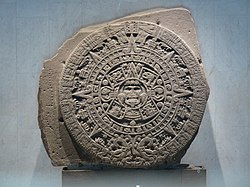
The Aztec sun stone, often erroneously called the calendar stone, is on display at the National Museum of Anthropology in Mexico City. The actual Aztec calendar consists of a 365-day calendar cycle called xiuhpōhualli (year count), and a 260-day ritual cycle called tōnalpōhualli (day count). These two cycles together form a 52-year "century", sometimes called the "calendar round". The xiuhpōhualli is considered to be the agricultural calendar, since it is based on the sun, and the tōnalpōhualli is considered to be the sacred calendar.
Tōnalpōhualli
The tōnalpōhualli ("day count") consists of a cycle of 260 days, each day signified by a combination of a number from 1 to 13, and one of the twenty day signs. With each new day, both the number and day sign would be incremented: 1. Crocodile is followed by 2. Wind, 3. House, 4. Lizard, and so forth up to 13. Reed. After Reed, the cycle of numbers would restart (though the twenty day signs had not yet been exhausted), resulting in 1. Jaguar, 2. Eagle, and so on, as the days immediately following 13. Reed. This cycle of number and day signs would continue similarly until the 20th week, which would start on 1. Rabbit, and end on 13. Flower. It would take a full 260 days (13×20) for the two cycles (of twenty day signs, and thirteen numbers) to realign and repeat the sequence back to 1. Crocodile.
Day signs
The set of day signs used in central Mexico is identical to that used by Mixtecs, and to a lesser degree similar to those of other Mesoamerican calendars. Each of the day signs bear an association with one of the four cardinal directions.
There is some variation in the way the day signs were drawn or carved. Those here were taken from the Codex Magliabechiano.
| Image | Nahuatl name | Pronunciation | English translation | Direction |
|---|---|---|---|---|
| Image Nahuatl name Pronunciation English translation Direction Cipactli [siˈpáktɬi] Crocodile Alligator Caiman Crocodilian Monster Dragon East Ehēcatl [eʔˈéːkatɬ] Wind North Calli [ˈkálːi] House West Cuetzpalin [kʷetsˈpálin̥] Lizard South Cōātl [ˈkóːwaːtɬ] Serpent Snake East Miquiztli [miˈkístɬi] Death North Mazātl [ˈmásaːtɬ] Deer Animal West Tōchtli [ˈtóːtʃtɬi] Rabbit South Ātl [ˈaːtɬ] Water East Itzcuīntli [itsˈkʷíːn̥tɬi] Dog North | Image Nahuatl name Pronunciation English translation Direction Ozomahtli [osoˈmáʔtɬi] Monkey West Malīnalli [maliːˈnálːi] Grass South Ācatl [ˈáːkatɬ] Reed East Ocēlōtl [oːˈséːloːtɬ] Ocelot Jaguar North Cuāuhtli [ˈkʷáːʍtɬi] Eagle West Cōzcacuāuhtli [koːskaˈkʷáːʍtɬi] Vulture South Ōlīn [ˈoːliːn̥] Movement Quake Earthquake East Tecpatl [ˈtékpatɬ] Flint Flint Knife North Quiyahuitl [kiˈjáwitɬ] Rain West Xōchitl [ˈʃoːtʃitɬ] Flower South | |||
| Cipactli | [siˈpáktɬi] | Crocodile Alligator Caiman Crocodilian Monster Dragon | East | |
| Ehēcatl | [eʔˈéːkatɬ] | Wind | North | |
| Calli | [ˈkálːi] | House | West | |
| Cuetzpalin | [kʷetsˈpálin̥] | Lizard | South | |
| Cōātl | [ˈkóːwaːtɬ] | Serpent Snake | East | |
| Miquiztli | [miˈkístɬi] | Death | North | |
| Mazātl | [ˈmásaːtɬ] | Deer Animal | West | |
| Tōchtli | [ˈtóːtʃtɬi] | Rabbit | South | |
| Ātl | [ˈaːtɬ] | Water | East | |
| Itzcuīntli | [itsˈkʷíːn̥tɬi] | Dog | North | |
| Image | Nahuatl name | Pronunciation | English translation | Direction |
| Ozomahtli | [osoˈmáʔtɬi] | Monkey | West | |
| Malīnalli | [maliːˈnálːi] | Grass | South | |
| Ācatl | [ˈáːkatɬ] | Reed | East | |
| Ocēlōtl | [oːˈséːloːtɬ] | Ocelot Jaguar | North | |
| Cuāuhtli | [ˈkʷáːʍtɬi] | Eagle | West | |
| Cōzcacuāuhtli | [koːskaˈkʷáːʍtɬi] | Vulture | South | |
| Ōlīn | [ˈoːliːn̥] | Movement Quake Earthquake | East | |
| Tecpatl | [ˈtékpatɬ] | Flint Flint Knife | North | |
| Quiyahuitl | [kiˈjáwitɬ] | Rain | West | |
| Xōchitl | [ˈʃoːtʃitɬ] | Flower | South |
Wind and Rain are represented by images of their associated gods, Ehēcatl and Tlāloc respectively.
Other marks on the stone showed the current world, and the worlds before this one. Each world was called a sun, and each sun had its own species of inhabitants. The Aztecs believed that they were in the Fifth Sun, and like all of the suns before them, they would also eventually perish due to their own imperfections. Every 52 years was marked out due to the belief that 52 years was a life cycle and at the end of any given life cycle, the gods could take all they had, and destroy the world.
Trecenas
The 260 days of the sacred calendar were grouped into twenty periods of 13 days each. Scholars usually refer to these thirteen-day "weeks" as trecenas, using a Spanish term derived from trece "thirteen" (just as the Spanish term docena "dozen" is derived from doce "twelve"). The original Nahuatl term was "in cencalli tonalli" (a family of days), according to Book IV of the Florentine Codex.
Each trecena is named according to the calendar date of the first day of the 13 days in that trecena. In addition, each of the twenty trecenas in the 260-day cycle had its own tutelary deity:
| Trecena | Deity | Trecena | Deity |
|---|---|---|---|
| 1 Crocodile | Tonacatecuhtli | 1 Monkey | Patecatl |
| 1 Jaguar | Quetzalcoatl | 1 Lizard | Itztlacoliuhqui |
| 1 Deer | Tepēyōllōtl | 1 Quake | Tlazōlteōtl |
| 1 Flower | Huēhuecoyōtl | 1 Dog | Xīpe Totēc |
| 1 Reed | Chalchiuhtlicue | 1 House | Ītzpāpālōtl |
| 1 Death | Tōnatiuh | 1 Vulture | Xolotl |
| 1 Rain | Tlāloc | 1 Water | Chalchiuhtotolin |
| 1 Grass | Mayahuel | 1 Wind | Chantico |
| 1 Snake | Xiuhtecuhtli | 1 Eagle | Xōchiquetzal |
| 1 Flint | Mictlāntēcutli | 1 Rabbit | Xiuhtecuhtli |
Xihuitl
In ancient times the year was composed of eighteen months, and thus it was observed by the native people. Since their months were made of no more than twenty days, these were all the days contained in a month, because they were not guided by the moon but by the days; therefore, the year had eighteen months. The days of the year were counted twenty by twenty.
Xiuhpōhualli is the Aztec year (xihuitl) count (pōhualli). One year consists of 360 named days and 5 nameless (nēmontēmi). These 'extra' days are thought to be unlucky. The year was broken into 18 periods of twenty days each, sometimes compared to the Julian month. The Nahuatl word for moon is metztli but whatever name was used for these periods is unknown. Through Spanish usage, the 20-day period of the Aztec calendar has become commonly known as a veintena.
Each 20-day period started on Cipactli (Crocodile) for which a festival was held. The eighteen veintena are listed below. The dates are from early eyewitnesses; each wrote what they saw. Bernardino de Sahagún's date precedes the observations of Diego Durán by several decades and is before recent to the surrender. Both are shown to emphasize the fact that the beginning of the Native new year became non-uniform as a result of an absence of the unifying force of Tenochtitlan after the Mexica defeat.
Veintenas of the xiuhpōhualli
| # | Glyph | Name | Gregorian range | Presiding deities | |
|---|---|---|---|---|---|
| Durán | Sahagún | ||||
| 1 | ātl cāhualo (“the water ceases”) cuahuitl ēhua (“the trees rise”) | Mar 01–Mar 20 | Feb 02–Feb 21 | Water gods | |
| 2 | tlācaxīpēhualiztli (“flaying of men”) | Mar 21–Apr 09 | Feb 22–Mar 13 | Xipe Totec | |
| 3 | tōzōztōntli (“lesser vigil”) | Apr 10–Apr 29 | Mar 14–Apr 02 | Tlaloc | |
| 4 | huēyi tōzōztli (“greater vigil”) | Apr 30–May 19 | Apr 03–Apr 22 | Cinteotl | |
| 5 | toxcatl (“dryness”) | May 20–Jun 08 | Apr 23–May 12 | Tezcatlipoca | |
| 6 | etzalcualiztli (“eating of cooked maize and beans”) | Jun 09–Jun 28 | May 13–Jun 01 | Tlaloque | |
| 7 | tēcuilhuitōntli (“lesser feast day”) | Jun 29–Jul 18 | Jun 02–Jun 21 | Huixtocihuatl | |
| 8 | huēyi tēcuilhuitōntli (“greater feast day”) | Jul 19–Aug 07 | Jun 22–Jul 11 | Xilonen | |
| 9 | tlaxōchimaco (“giving of flowers”) miccāilhuitōntli (“lesser feast day of the dead”) | Aug 08–Aug 27 | Jul 12–Jul 31 | Huitzilopochtli | |
| 10 | xocotl huetzi (“the xocotl falls”) huēyi miccāilhuitl (“greater feast day of the dead”) | Aug 28–Sep 16 | Aug 01–Aug 20 | Xiuhtecuhtli | |
| 11 | ochpaniztli (“sweeping”) | Sep 17–Oct 06 | Aug 21–Sep 09 | Teteo Innan | |
| 12 | teōtlehco (“the gods arrive”) | Oct 07–Oct 26 | Sep 10–Sep 29 | All the gods | |
| 13 | tepēilhuitl (“feast day of mountains”) | Oct 27–Nov 15 | Sep 30–Oct 19 | Mountains | |
| 14 | quechōlli (“roseate spoonbill”) | Nov 16–Dec 05 | Oct 20–Nov 8 | Mixcoatl | |
| 15 | panquetzaliztli (“raising of banners”) | Dec 06–Dec 25 | Nov 09–Nov 28 | Huitzilopochtli | |
| 16 | ātemoztli (“descent of water”) | Dec 26–Jan 14 | Nov 29–Dec 18 | Rain gods | |
| 17 | tititl (“tightening,” “contraction”) | Jan 15–Feb 03 | Dec 19–Jan 07 | Tonan | |
| 18 | izcalli (“offshoot,” “bud”) | Feb 04–Feb 23 | Jan 08–Jan 27 | Xiuhtecuhtli | |
| – | nēmontēmi (“they fill up in vain”); Not a veintena, 5-day complementary period | Feb 24–Feb 28 | Jan 28–Feb 01 | None |
Xiuhmolpilli
The Mexica counted their years by means of four signs combined with thirteen numbers, thus obtaining periods of 52 years, which are commonly known as Xiuhmolpilli, a popular but incorrect generic name; the most correct Nahuatl word for this cycle is Xiuhnelpilli. The table with the current years:
| Tlalpilli Tochtli | Tlalpilli Acatl | Tlalpilli Tecpatl | Tlalpilli Calli |
|---|---|---|---|
| 1 tochtli / 1974 | 1 acatl / 1987 | 1 tecpatl / 2000 | 1 calli / 2013 |
| 2 acatl / 1975 | 2 tecpatl / 1988 | 2 calli / 2001 | 2 tochtli / 2014 |
| 3 tecpatl / 1976 | 3 calli / 1989 | 3 tochtli / 2002 | 3 acatl / 2015 |
| 4 calli / 1977 | 4 tochtli / 1990 | 4 acatl / 2003 | 4 tecpatl / 2016 |
| 5 tochtli / 1978 | 5 acatl / 1991 | 5 tecpatl / 2004 | 5 calli / 2017 |
| 6 acatl / 1979 | 6 tecpatl / 1992 | 6 calli / 2005 | 6 tochtli / 2018 |
| 7 tecpatl / 1980 | 7 calli / 1993 | 7 tochtli / 2006 | 7 acatl / 2019 |
| 8 calli / 1981 | 8 tochtli / 1994 | 8 acatl / 2007 | 8 tecpatl / 2020 |
| 9 tochtli / 1982 | 9 acatl / 1995 | 9 tecpatl / 2008 | 9 calli / 2021 |
| 10 acatl / 1983 | 10 tecpatl / 1996 | 10 calli / 2009 | 10 tochtli / 2022 |
| 11 tecpatl / 1984 | 11 calli / 1997 | 11 tochtli / 2010 | 11 acatl / 2023 |
| 12 calli / 1985 | 12 tochtli / 1998 | 12 acatl / 2011 | 12 tecpatl / 2024 |
| 13 tochtli / 1986 | 13 acatl / 1999 | 13 tecpatl / 2012 | 13 calli / 2025 |
Reconstruction of the Calendar
In the last century scholars had tried to reconstruct the Calendar. One version was proposed by Professor Rafael Tena of the Instituto Nacional de Antropología e Historia, based on the studies of Sahagún and Alfonso Caso of the National Autonomous University of Mexico. His correlation argues that the first day of the Mexica year was February 13 of the old Julian calendar or February 23 of the current Gregorian calendar. Using the same count, it has been the date of the birth of Huitzilopochtli, the end of the year and a cycle or "Tie of the Years", and the New Fire Ceremony, day-sign 1 Tecpatl of the year 2 Acatl, corresponding to the date February 22. A correlation by independent researcher Ruben Ochoa interprets pre-Columbian codices, to reconstruct the calendar, while ignoring most primary colonial sources that contradict this idea, using a method that proposes to connect the year count to the vernal equinox and placing the first day of the year on the first day after the equinox.
José Genaro Emiliano Medina Ramos, a senior native nahua philosopher from San Lucas Atzala in the state of Puebla, proposes a multidisciplinary calendar reconstruction in náhuatl (‘centro de Puebla’ variant) according with his own nahua cosmosvision; and relying on Ochoa's correlation and on Tena's presuppositions as well. His proposal was translated to Spanish and English, and codified as an academic webpage in 2023.
Unfortunately, both Ochoa and Medina correlations go against strong evidence pointed out by scholars about the Mexica start of day and of the lack of a leap day in all Mesoamerican calendars. In this regard, some Mexican groups such as Kaltonak, are proposing a reconstruction of the calendar based on astronomical, archaeological and historical evidence.
See also
Notes
- Aguilar-Moreno, Manuel (n.d.). (PDF). Aztec Art and Architecture. Foundation for the Advancement of Mesoamerican Studies, Inc. (FAMSI). Archived from (PDF) on 2008-06-25.
- Andrews, J. Richard (2003). Introduction to Classical Nahuatl (revised ed.). Norman: University of Oklahoma Press. ISBN 0-8061-3452-6. OCLC .
- Aveni, Anthony F. (2000). Empires of Time: Calendars, Clocks, and Cultures (reprint of 1990 original ed.). London: Tauris Parke. ISBN 1-86064-602-6. OCLC .
- Boone, Elizabeth Hill (1998). (PDF). In Elizabeth Hill Boone; Tom Cubbins (eds.). Native Traditions in the Postconquest World, A Symposium at Dumbarton Oaks 2nd through 4th October 1992. Washington D.C.: Dumbarton Oaks Research Library and Collection. pp. 149–199. ISBN 0-88402-239-0. OCLC . Archived from (PDF Reprint) on 2007-09-27.
- Boone, Elizabeth Hill (2000). Stories in Red and Black: Pictorial Histories of the Aztec and Mixtec. Austin: University of Texas Press. ISBN 0-292-70876-9. OCLC .
- Boone, Elizabeth Hill (2007). Cycles of Time and Meaning in the Mexican Books of Fate. Joe R. and Teresa Lozano Long series in Latin American and Latino art and culture. Austin: University of Texas Press. ISBN 978-0-292-71263-8. OCLC .
- Clavigero, Francesco Saverio (1807) [1787]. The history of Mexico. Collected from Spanish and Mexican historians, from manuscripts, and ancient paintings of the Indians. Illustrated by charts, and other copper plates. To which are added, critical dissertations on the land, the animals, and inhabitants of Mexico, 2 vols. Translated from the original Italian, by Charles Cullen, Esq. (2nd ed.). London: J. Johnson. OCLC .
- Coe, Michael D. (1994) [1962]. (4th, Revised and Enlarged ed.). London and New York: Thames & Hudson. ISBN 0-500-27722-2. OCLC .
- Hassig, Ross (2001). Time, History, and Belief in Aztec and Colonial Mexico. Austin: University of Texas Press. ISBN 0-292-73139-6. OCLC .
- Hernández de León-Portilla, Ascención (2004). . Arqueología Mexicana (in Spanish). 12 (70). México, D.F.: Instituto Nacional de Antropología e Historia, Editorial Raíces: 20–25. ISSN . Archived from on 15 May 2008.
- Klein, Cecelia F. (2002). (PDF). Arqueología Mexicana (in Spanish). 10 (55). México, D.F.: Instituto Nacional de Antropología e Historia, Editorial Raíces: 28–35. ISSN . Archived from (PDF) on 2006-01-03.
- León-Portilla, Miguel (1963). Aztec Thought and Culture: A Study of the Ancient Náhuatl Mind. Civilization of the American Indian series, no. 67. Jack Emory Davis (trans.). Norman: University of Oklahoma Press. OCLC .
- Malmström, Vincent H. (1973-09-17). (PDF Reprinted). Science. 181 (4103). Lancaster, PA: American Association for the Advancement of Science: 939–941. Bibcode:. doi:. PMID . S2CID . (PDF) from the original on 28 May 2008.
- Medina, Genaro. (PDF). México: Meritorious Autonomous University of Puebla.
- Miller, Mary; Karl Taube (1993). . London: Thames & Hudson. ISBN 0-500-05068-6. OCLC .
- Prem, Hanns J. (2008). Manual de la antigua cronología Mexicana. Mexico: Centro de Investigaciones y Estudios Superiores en Antropología Social. ISBN 978-968-496-694-9.
- Read, Kay Almere (1998). Time and Sacrifice in the Aztec Cosmos. Bloomington: Indiana University Press. ISBN 0-253-33400-4. OCLC .
- Sahagún, Bernardino de (1950–82) [ca. 1540–85]. Florentine Codex: General History of the Things of New Spain, 13 vols. in 12. vols. I-XII. Charles E. Dibble and Arthur J.O. Anderson (eds., trans., notes and illus.) (translation of Historia General de las Cosas de la Nueva España ed.). Santa Fe, NM and Salt Lake City: School of American Research and the University of Utah Press. ISBN 0-87480-082-X. OCLC .
{{cite book}}:ISBN / Date incompatibility (help) - Smith, Michael E. (2003). The Aztecs (2nd ed.). Malden, MA: Blackwell Publishing. ISBN 0-631-23015-7. OCLC .
- Tena, Rafael (2008). El calendario mexica y la cronografía. Mexico: INAH. ISBN 978-968-03-0293-2.
- Townsend, Richard F. (2000). The Aztecs (Revised 2nd ed.). London: Thames & Hudson. ISBN 0-500-28132-7. OCLC .
- Wimmer, Alexis (2006). (online version, incorporating reproductions from Dictionnaire de la langue nahuatl ou mexicaine [1885], by Rémi Siméon). (in French and Nahuatl languages)
- Zantwijk, Rudolph van (1985). . Norman: University of Oklahoma Press. ISBN 0-8061-1677-3. OCLC .