Baozi
In-game article clicks load inline without leaving the challenge.
Baozi (Chinese: ⓘ), or simply bao, is a type of yeast-leavened filled bun in various Chinese cuisines. There are many variations in fillings (meat or vegetarian) and preparations, though the buns are most often made from wheat flour and steamed. They are a variation of mantou from Northern China.
Baozi are popular throughout China and have even made their way into the cuisines of many other countries through the Chinese diaspora.
History and etymology
Baozi were originally called mantou, and may be related to the Central Asian dumpling manti.
During the Western Jin Dynasty (266–316), Shu Xi[zh] wrote about dumplings and other wheat-based foods (at the time called bing), which he believed were from the Han dynasty (202 BC – 220 AD) or later. He described mantou as large meat-filled dumplings eaten at spring banquets. Other early sources mention the use of mantou in rituals.
In the Tang dynasty, (618–907) mantou were small, made with leavened dough, and eaten as dianxin. In the Song dynasty (960–1279), mantou could have a variety of fillings (meat, poultry, fish, vegetables) and were said to be a common snack for students. During this period, baozi emerged as an alternate word for mantou, and subsequently mantou could also be used for unfilled buns. According to a legend first recorded in the Song dynasty, Zhuge Liang invented mantou to substitute for human heads in a sacrifice to gods. In the Mongol-led Yuan dynasty (1271–1368), court recipes for baozi and mantou included Central Asian elements with fillings such as lamb, onions, ginger, and chenpi.
By the Qing dynasty (1664–1911), the words had settled into their modern meanings: bing are baked or steamed wheat cakes, baozi are buns with fillings, mantou are steamed buns without fillings, and jiao are thin-skinned dumplings with fillings. There is some regional variation in usage, mainly near Shanghai where small filled steamed dumplings are called mantou in Wu Chinese.
Types
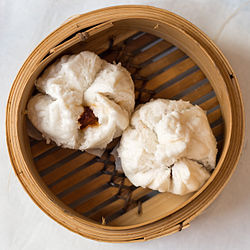
| English name | Chinese name (with romanisation) | Other names | Description |
|---|---|---|---|
| Meicai pork belly bao bun | 梅菜扣肉包 méi cài kòu ròu bāo | Steamed buns, folded like tacos, are stuffed with slices of braised pork belly flavored with dried mustard greens. | |
| Cha siu bao, charsiu bau | 叉燒包 chāshāobāo / Yue Chinese: caa1 siu1 baau1 | in Hawaii manapua, in the Philippines siopao | Filled with char siu (barbecued pork). |
| Goubuli | 狗不理 gǒu bù lǐ | A brand of baozi considered characteristic of Tianjin. | |
| Xiaolongbao | 小籠包/小笼包 xiǎo lóng bāo | A small, meat-filled baozi from Shanghai containing an aspic that reverts to a juicy broth when cooked. Because it is succulent and prepared with thin, partially leavened dough, it more closely resembles a jiaozi than a baozi. | |
| Shuijianbao | 水煎包 shuǐjiānbāo | Very similar to xiaolongbao, but pan-fried instead of steamed. | |
| Shengjian mantou | 生煎饅頭/生煎馒头 shēngjiān mántou | A small, meat-filled, fried baozi from Shanghai. | |
| Tangbao | 湯包/汤包 tāngbāo | A large soup-filled baozi from Yangzhou drunk through a straw; in other areas of China, it is small in size with a rich soup. | |
| Doushabao | 豆沙包 dòushābāo | Hokkien: tāu-se-pau | Filled with sweet bean paste. |
| Lotus seed bun | 蓮蓉包/莲蓉包 liánróngbāo | Filled with sweetened lotus seed paste. | |
| Kaya-baozi | 咖央包子 | Malay: pau kaya | Filled with kaya, a jam made from coconut, eggs, and sometimes pandan in Indonesia, Malaysia, and Singapore. |
| Naihuangbao | 奶黃包/奶黄包 nǎihuángbāo | Filled with sweet yellow custard. | |
| Siopao | 燒包 sio-pau | Filipino/Tagalog: siyopaw | Steamed, filled with either chicken, pork, shrimp or salted egg. |
| Zhimabao | 芝麻包 zhīmabāo | Steamed, filled with a black sesame paste. | |
| Yacaibao | 芽菜包 yá cài bāo | Steamed, filled with a type of pickle, spices and possibly other vegetables or meat, common in Sichuan, China. | |
| Bah-pau'm | 肉包 ròu bāo | Indonesian: bakpau / bakpao Javanese: ꦧꦏ꧀ꦥꦲꦸ, romanized:bakpauDutch: bapao | Filled with minced pork, or alternatively chocolate, strawberry, cheese, mung bean, red bean, minced beef, or diced chicken. |
| Da bao | 大包 dà bāo | Large buns filled with pork, eggs and other ingredients. | |
| Crisp stuffed bun | 破酥包 poshubao | A lard-layered bun with pork, lard, bamboo shoot, and soy sauce, or with the filling of Yunnan ham and white sugar or brown sugar. Crisp stuffed buns were created by a chef from Yuxi almost a hundred years ago.[citation needed] | |
| Tandoori baozi | 烤包子 Kao baozi | Uyghur: سامسا самса Samsa | A Uyghur specialty, cooked in a tandoor instead of being steamed. Usually filled with lamb, potatoes, and spices. |
| Gua bao | Min Nan: 割包, romanized:koah-pau, | Min Nan: 虎咬豬, romanized:hó͘-kā-ti | Made by folding over flat steamed dough, with a wide variety of fillings. Originated as Fujianese street food. |
Outside of China


In many Chinese cultures, these buns are a popular food, and widely available. While they can be eaten at any meal, baozi are often eaten for breakfast. They are also popular as a portable snack or meal.
The dish has also become commonplace throughout various regions of Northeast Asia with cultural and ethnic relationships, as well as Southeast Asia and outside Asia due to longstanding Chinese immigration.
- In Buryatia and Mongolia, variants of the recipe, often with beef or lamb, are known as buuz and buuza.
- In Malaysia, given the long history of the Chinese diaspora in Malaysia before the British colonial times, the Malays have adopted these buns (called pau in Malay) as their own with halal fillings particularly with curry (potato, chicken, or beef) similar to curry puffs; some variants have a quail egg in the middle, in addition. Other variations include sweet fillings of coconut jam (kaya) or red bean paste. These pau can be found sold in stalls by the roadside, at night markets, highway rest stops, and pasar Ramadan (Ramadan food bazaars).
- In Indonesia, the dish has also been adopted into Indonesian cuisine through the integration of Chinese culture. It has been adopted through the Hokkien language name of bakpau or bakpao. In addition to meat fillings, local variants include: chocolate, sweet potato, and marmalade fillings. Bakpau is found in Indonesia as a take away food sold by cart street hawkers. Bakpau in Indonesia is usually sold in dabao size (lit.: "big pau"), around 10 cm in diameter. To accommodate the dietary restrictions of Indonesia's Muslim majority, the original pork filling has been replaced with minced beef, diced chicken, or even sweet mung bean paste and red bean paste. Pau with non-meat fillings are still called bakpau by Indonesians, despite the lack of meat. It is usually served with sweet chili sauce.
- In the Netherlands, due to influence from Indonesia supermarkets commonly have in stock what the Dutch call bapao or sometimes bakpao. One can easily find frozen or sometimes in the bigger supermarkets cooled bapao/bakpao wrapped in plastic, ready-made to be heated inside a microwave. The most prevalent filling is chicken, although there are also pork, beef, and vegetarian variants widely available. This food is categorized as a quick snack or a fast-food item. Freshly baked forms of this steamed bun are not a staple food item in the Netherlands outside of the Chinese community living there.
- In the Philippines, the local version of baozi called siopao was brought by Chinese immigrants (Sangleys) prior to Spanish colonialism. Varieties of Filipino siopao fillings include barbecued pork, meatballs, flaked tuna, and sometimes chocolate and cheese.
- In Thailand, a similar bun is called salapao (ซาลาเปา).
- In Japan, baozi is very popular and known as chūkaman (中華まん, '"Chinese steamed bun"'). Nikuman (肉まん; derived from 肉饅頭, nikumanjū) is the Japanese name for Chinese baozi with meat fillings. Chūkaman are steamed and often sold as street food. During festivals, they are frequently sold and eaten. From about August or September, through the winter months until roughly the beginning of April, chūkaman are available at convenience stores, where they are kept hot.
- In Korea, there are two varieties of dumplings similar to baozi. One variety, a longtime staple at Korean-style Chinese restaurants, is known simply as jjinmandu, or "steamed mandu", which is typically savory and comes with meat, vegetable, and noodle fillings. Another variation is a warm snack food consisting of a completely round bun usually filled with smooth, sweetened red bean paste but also commonly sold stuffed with vegetables and meat, pizza toppings, pumpkin, or buldak. This is known as jjinppang (steamed bread or bun) or hoppang (a convenience-food version of the former).
- In Cambodia, num pao (Khmer: នំប៉ាវ), is a popular street food.
- In Vietnam, Bánh bao is the Vietnamese version of the Cantonese tai bao that was brought over by Chinese immigrants. It is usually filled with pork, mushrooms, hard-boiled eggs, and sausage.
- In Myanmar, pauk-si (ပေါက်စီ) is a popular snack available in almost every traditional tea shop.
- In Mauritius, many dishes are influenced by Sino-Mauritians; this includes baozi, simply referred to as "pao" (sometimes written as "pow" or "paw"). They are typically filled with Chinese sausage, poultry, black mushroom, and soy egg, among others.