Banate of Macsó
In-game article clicks load inline without leaving the challenge.

The Banate of Macsó or the Banate of Mačva (Hungarian: macsói bánság, Serbian: Мачванска бановина / Mačvanska banovina) was an administrative division (banate) of the medieval Kingdom of Hungary, that existed between the 13th and 15th centuries, and was located in the present-day region of Mačva, in modern Serbia.
Name
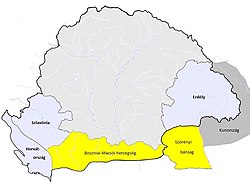
In Serbo-Croatian: Mačvanska banovina (Serbian Cyrillic: Мачванска бановина), Latin: Banatus Machoviensis, Hungarian: Macsói bánság. The banate was named after a town called Macsó (Mačva or Macho), but the location of this settlement has not been clearly established in modern times. It is suspected that the town existed a few kilometers down the river Sava from modern Šabac.[citation needed]
History
The region of Mačva or Macsó came under Hungarian administration shortly after the death of Byzantine emperor Manuel I Comnenus (1180), but it was returned to emperor Isaac II Angelos upon conclusion of Byzantine-Hungarian alliance (1185). It was retaken by Hungarians (c. 1200) and later administered as part of the feudal domain of duke John Angelos of Syrmia. During that time, the region of Mačva was also known as the Lower Syrmia (lat. Sirmia ulterior).
Further Hungarian expansion in the Balkans was interrupted by the Tatar invasion in 1241-1241. The Balkan regions only became the focus of Hungarian foreign policy after 1246-1247. Exiled Russian prince Rostislav Mikhailovich became son-in-law of Hungarian king Béla IV, and was appointed as Ban of Slavonia by 1247. From 1254 onward he was also mentioned as the Lord of Macsó (in Latin, Dominus de Macho). One of his sons, Béla of Macsó ruled as duke over Mačva, while the other son, Michael of Bosnia, ruled over Usora and Soli (regions across Drina river in today's northeastern Bosnia). By that time, Macsó became apple of discord between the Kingdom of Hungary and the Kingdom of Serbia. King Stephen Uroš I of Serbia tried to conquer it in 1268, but was defeated and captured by the Hungarians. Duke Bela ruled over Mačva until death in 1272.
The Banate
In 1272, after the death of Hungarian king Stephen V, the strengthening of the defensive character of southern borders became a priority, and several new frontier districts (banates) were established to the south of rivers Sava and Danube. The first ban of Macsó was appointed in the same year, thus marking the beginning of the Banate of Macsó, that was governed by several powerful bans, appointed by the kings of Hungary.
Already in 1284, the former king Stephen Dragutin of Serbia (1276-1282), who was married to princess Catherine of Hungary, received Belgrade and Macsó from his brother-in-law, king Ladislaus IV of Hungary, and kept those regions until death in 1316.
During the Interregnum after the death of Hungarian king Andrew III (1301), the central power in the Kingdom of Hungary collapsed, Stephen Dragutin ruled over an independent realm centered in Belgrade and Macsó, which also included regions of Usora and Soli in northern Bosnia, as well as Rudnik and Braničevo. His realm was known as the Kingdom of Syrmia (Srem), and Stephen Dragutin ruled it as king until his death in 1316.
Macsó remained in the hands of Dragutin's son Stephen Vladislaus II until 1319. The northern part of the region along the river Sava was captured by King Charles I of Hungary while the southern part remained firmly under Serbian administration.
In the 14th century, the bans of the Garai family (Paul I Garai, Nicholas I Garai and his son Nicholas II Garai) expanded their rule not only to Bosnia but also to Upper Syrmia and the last one also became the ban of Slavonia and Croatia, which were also parts of the Kingdom of Hungary at the time.
In the 1370s it was captured by Serbian Prince Lazar who in 1377–1378 donated several villages in Macsó to his newly founded monastery of Ravanica. Lazars's son despot Stefan Lazarević was officially granted with possession of Macsó by King Sigismund of Hungary in 1403 as a vassal of the Hungarian ruler. The territory got back to Hungary with Lazarević's death (1427). The Hungarian bans of Macsó existed during this period as well but only as titular holders and the title of ban was usually granted to the ispáns (counts) of southern counties of the Kingdom of Hungary.
The territory was conquered by the Ottomans around 1459, after the fall of the Serbian Despotate. The region was regained for the Kingdom of Hungary in 1476, when the fortress of Zaslon (modern Šabac) was taken. By the end of the 15th century, title of ban was transferred to commanders of Belgrade, thus creating the Banate of Belgrade, that existed until final Ottoman conquest of Belgrade and Šabac in 1521.
Administrative divisions
According to the Treaty of Tata in 1426 Macsó was divided into several districts:
- Bitva (Bytthwa),
- Gornja and Donja Obna (Felsewatna and Alsowatna),
- Rađevina (Radio, Ragy),
- Nepričava (Neprichow),
- Ljig (Ligh),
- Kolubara (Collubara),
- Ub (Ubmelek),
- Tamnava (Tamlavamelek),
- Rabas,
- Pepeljevac,
- Debrc,
- Beljin,
- Toplica and
- castle of Bela Stena (castle) near present-day Valjevo.
Population
The population was mostly Serb and Orthodox, seen in a letter of pope Gregory IX dating 1229, where the pope had ordered the Archbishop of Kalocsa to convert the Orthodox Slavs in Lower Syrmia to the Roman rite.
List of bans
| Term | Incumbent | Monarch | Notes |
|---|---|---|---|
| 1254–1262 | Rostislav | Béla IV | "dominus de Machou"; king Béla IV's son-in-law; he might have been in office since 1247 |
| 1262–1272 | Béla | Béla IV Stephen V | "dux de Machou"; son of Rostislav; murdered in 1272 |
| 1272–1273 | Roland | Ladislaus IV | gens Rátót; first ban; also palatine (1272–1273) |
| 1273 | Egidius | Ladislaus IV | first rule; gens Monoszló; also ban of Bosnia (1273) |
| 1273 | John | Ladislaus IV | |
| 1273 | Egidius | Ladislaus IV | second rule; gens Monoszló; also ban of Bosnia (1273) |
| 1275 (?) | Albert | Ladislaus IV | gens Ákos; only a non-authentic charter refers to him as ban |
| 1279 | Ugrin | Ladislaus IV | "banus et dominus"; gens Csák; also master of the treasury (1277–1279) and ban of Bosnia (1279) |
| 1279–1284 | Elizabeth the Cuman | Ladislaus IV | "ducissa de Machou [et de Bozna]"; widow of king Stephen V |
| 1284–1316 | Stefan Dragutin | Ladislaus IV Andrew III Wenceslaus Otto Charles I | vassal of the Hungarian monarch as king of Syrmia; formerly king of Serbia (1276–1282) |
| 1316–1317 | Stefan Vladislav II | Charles I | king of Syrmia |
| 1317–1319 | Stefan Milutin | king of Serbia; Mačva under Serbian rule | |
| 1320–1328 | Paul Garai | Charles I | Hungarian rule restored in 1319; also ispán of Bodrog, Valkó (1320–1328) and Syrmia Counties (1323–1328); castellan of Kőszeg |
| 1328–1334 | John Alsáni | Charles I | also ispán of Baranya, Bodrog, Syrmia, Valkó (1328–1334) and Bács Counties (1333–1334) |
| 1335–1339 | Nicholas Ostffy | Charles I | also ispán of Bács, Baranya, Bodrog, Syrmia and Valkó Counties |
| 1340–1353 | Dominic Ostffy | Charles I Louis I | brother of Nicholas Ostffy; also ispán of Bács, Baranya, Syrmia, Valkó and Veszprém Counties |
| 1353–1354 | Andrew Lackfi | Louis I | also ispán of Bács, Baranya, Syrmia and Valkó Counties |
| 1354–1359 | Nicholas Csák | Louis I | son of Ugrin Csák |
| 1359–1375 | Nicholas I Garai | Louis I | also ispán of Bács, Baranya, Bodrog, Syrmia and Valkó Counties |
| 1375–1381 | John Horvat | Louis I | first rule; also ispán of Bács, Baranya, Bodrog, Syrmia and Valkó Counties |
| 1381–1382 | Paul Liszkói | Louis I | also ispán of Bács, Baranya, Bodrog, Syrmia and Valkó Counties |
| 1382–1385 | Stephen Kórógyi | Mary | first rule; also ispán of Bács, Baranya, Bodrog, Syrmia and Valkó Counties |
| 1385–1386 | John Horvat | Mary Charles II | second rule; conspired against Mary; also ispán of Bács, Baranya, Bodrog, Syrmia and Valkó Counties; self-declared ban and regent for anti-king Ladislaus of Naples until 1387 |
| 1386–1387 | John Bánfi de Alsólendva | Mary | also ispán of Bács, Baranya, Bodrog, Syrmia and Valkó Counties |
| 1387–1390 | Nicholas II Garai | Sigismund | first rule; son of Nicholas I Garai; also ispán of Bács, Baranya, Bodrog, Syrmia, Valkó (1387–1390) and Virovitica Counties (1388) |
| 1390–1392 | Stephen Losonci | Sigismund | also ispán of Bács, Baranya, Bodrog, Syrmia, Valkó (1390–1392) and Bereg Counties (1391) |
| 1392–1393 | George Lackfi | Sigismund | also ispán of Bács, Baranya, Bodrog, Syrmia and Valkó Counties |
| 1393–1394 | Nicholas II Garai | Sigismund | second rule; also ispán of Bács, Baranya, Bodrog, Syrmia and Valkó Counties |
| 1394–1397 | Nicholas Treutel | Sigismund | also ispán of Bács, Baranya, Bodrog, Syrmia and Valkó Counties |
| Stephen Kórógyi | second rule; also ispán of Bács, Baranya, Bodrog, Syrmia and Valkó Counties | ||
| 1397 | Peter Perényi | Sigismund | first rule; also ispán of Bács, Baranya, Bodrog, Syrmia, Valkó and Zemplén Counties |
| John Maróti | first rule; also ispán of Bács, Baranya, Bodrog, Syrmia and Valkó Counties | ||
| 1397–1400 | Francis Bebek | Sigismund | together with John Maróti (1398–1402); also ispán of Bács, Baranya, Bodrog, Syrmia and Valkó Counties |
| 1398–1402 | John Maróti | Sigismund | second rule; together with Francis Bebek (1397–1400) and with Peter Perényi (1400–1401); also ispán of Bács, Baranya, Bodrog, Syrmia, Tolna and Valkó Counties |
| 1400–1401 | Peter Perényi | Sigismund | second rule; together with John Maróti (1398–1402); also ispán of Bács, Baranya, Bodrog, Syrmia and Valkó Counties |
| 1402 | Stephen Ludányi | Sigismund | together with his brother, Thomas Ludányi; also ispán of Bács, Baranya, Bodrog, Syrmia and Valkó Counties |
| Thomas Ludányi | first rule; together with his brother, Stephen Ludányi; also bishop of Eger (1400–1403); also ispán of Bács, Baranya, Bodrog, Syrmia and Valkó Counties | ||
| 1402–1403 | Ladislaus Újlaki | Sigismund | first rule; together with John Maróti (1402–1410); also ispán of Bács, Baranya, Bodrog, Syrmia, Tolna and Valkó Counties |
| 1402–1410 | John Maróti | Sigismund | third rule; together with Ladislaus Újlaki (1402–1403); also ispán of Bács, Baranya, Bodrog, Syrmia, Tolna and Valkó Counties |
| 1403 | Thomas Ludányi | Sigismund | second rule; also bishop of Eger (1400–1403); ban for anti-king Ladislaus of Naples |
| 1410–1418 | Ladislaus Újlaki | Sigismund | second rule; together with his brother, Emeric Újlaki; also ispán of Bács, Baranya, Bodrog, Syrmia, Tolna and Valkó Counties |
| Emeric Újlaki | together with his brother, Ladislaus Újlaki; also ispán of Bács, Baranya, Bodrog, Syrmia, Tolna and Valkó Counties | ||
| 1419–1427 | Desiderius Garai | Sigismund | first rule; also ispán of Bács, Baranya, Bodrog, Syrmia, Tolna and Valkó Counties |
| 1427–1428 | John Maróti | Sigismund | fourth rule; together with Peter Cseh de Léva (1427–1431); also ispán of Bács, Baranya, Bodrog, Syrmia, Tolna and Valkó Counties |
| 1427–1431 | Peter Cseh de Léva | Sigismund | together with John Maróti (1427–1428) and with Stephen Újlaki (1429–1430); also ispán of Bács, Baranya, Bars, Bodrog, Syrmia, Tolna and Valkó Counties |
| 1429–1430 | Stephen Újlaki | Sigismund | son of Ladislaus Újlaki; together with Peter Cseh de Léva (1427–1431); also ispán of Bács, Baranya, Bodrog, Syrmia, Tolna and Valkó Counties |
| 1431–1441 | Ladislaus Garai | Sigismund Albert Vladislaus I Ladislaus V | first rule; son of Nicholas II Garai; together with Desiderius Garai (1431–1438); also ispán of Bács, Baranya, Bodrog, Fejér, Syrmia, Tolna and Valkó Counties; as a supporter of Elizabeth of Luxembourg, deposed by Vladislaus I in 1441 |
| 1431–1438 | Desiderius Garai | Sigismund Albert | second rule; together with Ladislaus Garai (1431–1441); also ispán of Bács, Baranya, Bodrog, Syrmia, Tolna and Valkó Counties |
| 1438–1477 | Nicholas of Ilok | Albert Vladislaus I Ladislaus V Matthias I | first rule; son of Ladislaus of Ilok; together with Ladislaus Garai (1431–1441), with Ladislaus Maróti (1441–1443), with Emeric Hédervári (1442–1445), with Ladislaus Garai (1445–1447), with Stephen Bebek (1447–1448), with John Kórógyi (1447–1456), with Paul Herceg de Szekcső (1456), with Michael Szilágyi (1456–1458) et al.; also ispán of Bács, Baranya, Bodrog, Syrmia, Tolna, Valkó (1438–1458), Fejér (1440–1448), Csanád, Csongrád, Temes (1441–1446) and Somogy Counties (1446–1458); also voivode of Transylvania (1441–1458, 1459–1472) and captain of Belgrade (1441–1458), count of the Székelys (1441–1446), ban of Severin (1445–1446), ban of Slavonia (1457–1466) and king of Bosnia (1472–1477) |
| 1441–1443 | Ladislaus Maróti | Vladislaus I Ladislaus V | son of John Maróti; together with Nicholas of Ilok (1438–1458); also ispán of Arad, Békés and Zaránd Counties |
| 1442–1445 | Emeric Hédervári | Vladislaus I Ladislaus V | together with Nicholas of Ilok (1438–1458) and with Ladislaus Maróti (1441–1443) |
| 1445–1447 | Ladislaus Garai | Ladislaus V | second rule; together with Nicholas of Ilok (1438–1458); appointed palatine |
| 1447–1448 | Stephen Bebek | Ladislaus V | together with Nicholas of Ilok (1438–1458) and with John Kórógyi (1447–1456) |
| 1447–1456 | John Kórógyi | Ladislaus V | grandson of Stephen Kórógyi; together with Nicholas of Ilok (1438–1458) and with Stephen Bebek (1447–1448); also župan of Požega (1450–1456) and Vrbas (1453–1456) Counties |
| 1456 | Paul Herceg de Szekcső | Ladislaus V | together with Nicholas of Ilok (1438–1458) |
| 1456–1458 | Michael Szilágyi | Ladislaus V Matthias I | first rule; together with Nicholas of Ilok (1438–1458); also captain of Belgrade (1456–1458); regent in 1458 |
| 1458–1459 | Nicholas Dombai | Matthias I | |
| Peter Szokoli | first rule |