Bearpaw Formation
Bearpaw Formation
Stratigraphic range : Campanian -Maastrichtian , 75–72 Ma PreꞒ Ꞓ O S D C P T J K Pg N
Thickness Up to 350 meters (1,150 ft)
Lithology
Other Siltstone , sandstone , concretionary bedsLocation
Coordinates 48°15′0″N 109°30′0″W/48.25000°N 109.50000°W/ 48.25000; -109.50000(Bearpaw Formation)
Type section
Named by Hatcher and Stanton, 1903
The Bearpaw Formation , also called the Bearpaw Shale , is a geologic formation of Late Cretaceous (Campanian ) age. It outcrops in the U.S. state of Montana , as well as the Canadian provinces of Alberta and Saskatchewan , and was named for the Bear Paw Mountains in Montana. It includes a wide range of marine fossils , as well as the remains of a few dinosaurs . It is known for its fossil ammonites , some of which are mined in Alberta to produce the organic gemstone ammolite .
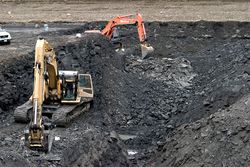
Lithology and depositional environment Bearpaw shale being excavated to recover ammonites for ammolite production. The formation was deposited in the Bearpaw Sea, which was part of the Western Interior Seaway that advanced and then retreated across the region during Campanian time. It is composed primarily of dark grey shales , claystones , silty claystones and siltstones , with subordinate silty sandstones . It also includes bedded and nodular concretions (both calcareous and ironstone concretions) and thin beds of bentonite . As the seaway retreated toward the southwest, the marine sediments of the Bearpaw became covered by the deltaic and coastal plain sediments of the overlying formations.
Relationship to other units The Bearpaw Formation conformably overlies the Dinosaur Park Formation of the Belly River Group in central Alberta, and the Judith River Formation in the plains to the east and Montana. It is overlain by the Horseshoe Canyon Formation in central Alberta; by the Blood Reserve Formation and the St. Mary River Formation in southern Alberta; by the Eastend Formation in southern Saskatchewan; and by the Fox Hills Formation in Montana. To the east, it merges into the Pierre Shale .
Fauna Color key Taxon Reclassified taxon Taxon falsely reported as present Dubious taxon or junior synonym Ichnotaxon Ootaxon Morphotaxon Notes Uncertain or tentative taxa are in small text; crossed out taxa are discredited.Taxon Reclassified taxon Taxon falsely reported as present Dubious taxon or junior synonym Ichnotaxon Ootaxon Morphotaxon
A specimen of Placenticeras ammolite from the Bearpaw Formation. A specimen of Baculities from the Bearpaw Formation with preserved nacre , housed at the University of Montana. The Bearpaw Formation is famous for its well-preserved ammonite fossils. These include Placenticeras meeki Placenticeras intercalare , Hoploscaphites Sphenodiscus baculite Baculites compressus and the bivalve Inoceramus organic gemstone ammolite.
Other fossils found in this formation include many types of shellfish , bony fish , sharks , rays , birds, and marine reptiles like mosasaurs such as Prognathodon overtoniPlioplatecarpus peckensisplesiosaurs such as Dolichorhynchops herschelensis Albertonectes Nakonanectes sea turtles . Dinosaur remains have occasionally been discovered, presumably from carcasses that washed out to sea.
Dinosaurs Dinosaurs from the Bearpaw FormationGenus Species Location Member Material Notes Images Brachylophosaurus Indeterminate Brachylophosaurus Daspletosaurus Daspletosaurus Edmontonia Indeterminate Edmontonia cf. Kritosaurus "Nearly complete skull and postcranium." A hadrosaurid Kritosaurus Prosaurolophus P. maximus Three juvenile specimens A Saurolophinae hadrosaurid , also known from the Dinosaur Park and Two Medicine Formations Prosaurolophus Stegoceras Indeterminate Stegoceras
Plesiosaurs Plesiosaurs from the Bearpaw FormationGenus Species Location Member Material Notes Images Albertonectes A. vanderveldei Alberta A complete, well-preserved postcranial specimen, missing only the skull. An elasmosaurid plesiosaur . Albertonectes has the longest neck of any known plesiosaur. Albertonectes Nakonanectes N. bradti Montana A nearly complete skeleton including the skull. A small elasmosaurid plesiosaur with an unusually short neck. Terminonatator T. ponteixensis Saskatchewan A partially articulated incomplete skeleton, including a skull. An elasmosaurid plesiosaur. Dolichorhynchops D. herschelensis Saskatchewan An incomplete skeleton One of the latest known polycotylids .
Mosasaurs Mosasaurs from the Bearpaw FormationGenus Species Location Member Material Notes Images Mosasaurus M. missouriensis Alberta and Montana Several specimens, including a near complete skeleton with stomach contents A large mosasaurine mosasaur . Mosasaurus missouriensis M. conodon Saskatchewan A large mosasaurine mosasaur. Mosasaurus conodon Prognathodon P. overtoni Alberta Several exceptionally preserved specimens A large mosasaurine mosasaur. Prognathodon overtoni Plioplatecarpus P. primaevus Saskatchewan A widespread genus of plioplatecarpine mosasaur. Plioplatecarpus P. peckensis Montana Tylosaurus T. saskatchewanensis Saskatchewan A single semi-complete skeleton A large tylosaurine mosasaur. Tylosaurus
Turtles Turtles from the Bearpaw FormationGenus Species Location Member Material Notes Images Nichollsemys N. baieri Alberta Known from skulls A basal chelonioid sea turtle . Nichollsemys
Bony fish Bony fish from the Bearpaw FormationGenus Species Location Member Material Notes Images Dercetis D. magnificus Alberta 2 articulated specimens A dercetid aulopiform . Dercetis Ursichthys U. longiparietalis Alberta Partial skeleton, recovered within a Mosasaurus specimen. An ichthyotringoid aulopiform.
Cartilaginous fish l Genus Species Location Member Material Notes Images Squalicorax S. sp Alberta Shark Meristodonoides M. montanensis Alberta Paraorthacodus P. andersoni Alberta Squalus S. worlandensis Alberta Carcharias C. cf samhammeri Alberta Odontaspis O. aculeatus Alberta Cretoxyrhina C. mantelli Alberta
Flora Plants from the Bearpaw Formation Genus Species Location Member Material Notes Images Aquilapollenites A.quadrilobus Saskatchewan Pollen from a flowering plant A.attenuatus Sequoia S.sp Montana Redwood conifer