Beaver Wars
In-game article clicks load inline without leaving the challenge.
The Beaver Wars (Mohawk:Tsianì kayonkwere, pronounced[d͡ʒanîgajũgwere]), also known as the Iroquois Wars or the French and Iroquois Wars (French:Guerres franco-iroquoises), were a series of conflicts fought intermittently during the 17th century in North America throughout the Great Lakes region and the St. Lawrence River valley which pitted the Haudenosaunee (Iroquois) – with the active support and arming by the Dutch and later the English – against neighbouring Indigenous nations such as the Wendat (Huron) who were supported by the French.
As a result of this conflict, the Haudenosaunee defeated and dispersed several confederacies and nations including the Wendat, Erie, Neutral, Petun, Susquehannock and Mahican. Several Algonquian nations were also attacked. Survivors fled to neighbouring tribes or were assimiliated. The brutal nature of Haudenosaunee warfare has led some researchers to classify the Beaver Wars as acts of genocide. Others in genocide studies argue that the Haudenosaunee practice of mass adoption—integrating thousands of captives as full members of their society—is the opposite of genocidal intent. If the goal is to "make the enemy one of us" in order to replenish a declining population, it does not meet the "intent to destroy" required by most definitions of genocide. From this perspective, the "destruction" of these nations was political (e.g., the end of the Wendat as a sovereign entity) rather than biological (the death of its people).
While the traditional view is that the Haudenosaunee sought to expand their territory in order to monopolize the fur trade with European markets, two other theories have gained acceptance: a need for the Haudenosaunee to replenish their population after suffering catastrophic epidemics in the 1630s, and a desire to impose the Great Law of Peace on other Iroquoian-speaking people.
The Haudenosaunee were a confederacy of the Mohawk, Oneida, Onondaga, Cayuga, and Seneca tribes inhabiting the lands in what is now Upstate New York south of Lake Ontario and east to Lake Champlain, Lake George and the Hudson River. They initially mobilized against the Wendat and other Iroquoian-speaking tribes of the Great Lakes region and later moved against the French and their Algonquian allies.
The Haudenosaunee were supplied with arms by their Dutch and English trading partners while the Algonquians and Wendat were backed by the French, their chief trading partner. The Haudenosaunee became dominant in the region and enlarged their territory as a result of the wars, realigning the North American tribal geography south of the Great Lakes. The Haudenosaunee gained control of the Ohio River watershed as their hunting grounds from about 1670 onward.
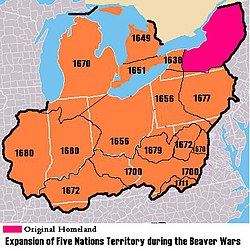
Both Algonquian and Iroquoian societies were greatly disrupted by these wars. The conflict subsided when the Haudenosaunee lost their Dutch allies in the New Netherland after the English seized the colony in 1664. The French then attempted to gain them as an ally but the Haudenosaunee transferred their allegiance to the English, and fought against the French until the Great Peace of Montreal was signed in 1701.
Background
During his three voyages to the New World in the mid-16th century, French explorer Jacques Cartier produced the first written records of Indigenous groups inhabiting the shores of the Gulf of St. Lawrence and the St. Lawrence River. Cartier wrote of encounters with the St. Lawrence Iroquoians, also known as the Laurentian Iroquois, who occupied several fortified villages along the river, including Stadacona and Hochelaga. He recorded an ongoing war between the inhabitants of Stadacona and another group known as the Toudamans.
Wars and politics in Europe distracted French efforts at colonization until the beginning of the 17th century, when Samuel de Champlain founded Quebec. Champlain found that both Stadacona and Hochelaga had disappeared and that the river valley was uninhabited, having become a contested frontier where the Haudenosaunee hunted and the Wendat traveled for trade. The causes remain unclear, although some anthropologists and ethnohistorians have suggested that the Mohawk, the easternmost nation of the Haudenosaunee Confederacy, destroyed or drove out the St. Lawrence Iroquoians.
Seeking to secure the future of his colony, Champlain accepted an invitation to join a long-standing alliance with the Innu, Algonquin, and Wendat against the Haudenosaunee. These nations provided the French with essential survival knowledge and valuable furs, while the Haudenosaunee, as their common enemy, disrupted the stability of the northern trade.

In the summer of 1609, Champlain demonstrated his willingness to support his Indigenous partners by joining them in an attack on the Haudenosaunee. Champlain wrote, "I had come with no other intention than to make war." They engaged in a pitched battle against the Mohawks on the shores of Lake Champlain. Champlain's opening shot with his arquebus killed two chiefs despite their "arrow-proof body armor made of plaited sticks." This single shot forced a Mohawk retreat but ignited a century of escalating conflict.
In 1610, Champlain helped the Algonquin defeat a large Haudenosaunee raiding party near the mouth of the Richelieu River. In 1615, while visiting the Wendat homeland, he was invited to join a war party planning to besiege a fortified Haudenosaunee village south of Lake Ontario. The attack failed, and Champlain was injured.
Despite these conflicts, Champlain was reluctant to provide his allies with firearms. Only Wendat leaders who converted to Catholicism and showed a deep commitment to the Catholic faith were rewarded with flintlock muskets. This policy eventually created a significant technological imbalance when the Haudenosaunee began acquiring firearms from Dutch traders in the late 1630s.
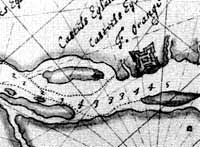
Between 1610 and 1614, the Dutch established a series of seasonal trading posts along the Hudson and Delaware Rivers, including Fort Nassau on Castle Island. This post sat within the heart of Mahican territory, which at the time straddled both banks of the Hudson. Initially, the Haudenosaunee were forced to rely on Indigenous intermediaries—primarily the Mahicans—to acquire European goods. This changed following the Mohawk-Mahican War (1624–1628), when the Mohawks defeated the Mahicans and secured direct, unhindered access to Fort Orange, built in 1624 as a replacement for Fort Nassau. By the 1630s, the Dutch were supplying the Haudenosaunee with metal tools and, eventually, firearms in exchange for beaver pelts and deer skins. The high demand for these furs, combined with a growing dependence on European iron and cloth, drove the Haudenosaunee to hunt their local territories to near depletion.
By 1640, the stage was set for widespread conflict between the Haudenosaunee Confederacy and the nations to their west and north. The Haudenosaunee, inhabiting the region south of Lake Ontario and west of the Hudson River, were increasingly hemmed in by rival Indigenous nations. While the Susquehannock to the south, the Erie to the southwest, and the Neutral to the west controlled the best remaining hunting grounds, the Wendat (Huron) and Algonquin to the north and northwest effectively blocked access to the premier fur-bearing territories of the Canadian Shield. This isolation left the Haudenosaunee with nearly depleted local territories while their rivals maintained control over critical trading routes.

Champlain's reluctance to provide his Indigenous allies with firearms eventually became official French policy and was a key factor in the defeat and dispersal of the Wendat in the late 1640s. The Dutch were also hesitant to trade firearms for furs; however, independent "free traders" ignored Dutch West India Company regulations and sold muskets to the Haudenosaunee. In 1643, as a direct result of Kieft's War—a conflict between New Netherland and the Algonquian tribes of the lower Hudson River valley—Dutch authorities decided to facilitate the acquisition of 400 muskets specifically for the Mohawk.
Although conflict between the French and the Haudenosaunee began in 1609, it did not significantly escalate until the 1640s. Hostilities were largely confined to the interior, where Haudenosaunee raiding parties targeted groups of Wendat and Algonquin bringing furs to the French. This strategy shifted in 1642 when the Haudenosaunee launched their first direct attacks against French settlements on the St. Lawrence River, specifically targeting the newly established outpost of Ville-Marie (Montreal). By striking the French inhabitants directly, the Haudenosaunee aimed to dismantle the trade network that bypassed their territory. This marked the beginning of a persistent "Petite Guerre" style of warfare, characterized by frequent small-scale raids that made farming and travel outside the walls of Montreal, Trois-Rivières, and Quebec nearly impossible for decades.
Causes
The traditional explanation for the Beaver Wars centers on the North American fur trade. As the Haudenosaunee became dependent on European goods like firearms and iron tools, they required beaver pelts to trade with the Dutch at Fort Orange. In The Wars of the Iroquois, George T. Hunt argued that because local beaver populations were exhausted by the 1630s, the Haudenosaunee launched wars to seize new hunting grounds, control transportation routes, and establish themselves as the middlemen between the western nations and the Europeans. According to this theory, the attacks on the Wendat, Erie, and Neutral nations were a strategic effort to control the fur trade by forcing the flow of pelts to the Dutch at Albany rather than to the French at Montreal.
Scholars like Bruce Trigger, however, have criticized this theory as Eurocentric. In The Children of Aataentsic, Trigger argued that Hunt’s model treats the Haudenosaunee as having been driven by Western market logic. This perspective reduces the Five Nations to surrogate Europeans and ignores their internal social and spiritual motivations. Critics suggest that the fur trade provided the means for war, but it was not the primary cause. By focusing solely on the role of middlemen, the traditional narrative overlooks the impact of epidemics and the requirements of the Great Law of Peace, the oral constitution that established the Haudenosaunee Confederacy.
While "control of the fur trade" is the traditional explanation, two other theories have gained wide acceptance. In The Ordeal of the Longhouse, Daniel Richter argues that the "mourning war" was a primary driver of Haudenosaunee military expansion during the 17th century. This cultural practice was a response to the massive loss of life caused by European diseases like smallpox in the 1630s. In Haudenosaunee society, the death of a family member often required a raid to capture a replacement from an enemy group. This captive would then be formally adopted and take the name and social role of the deceased. As epidemics decimated their population, the Haudenosaunee launched larger and more frequent raids to maintain their numbers and social stability. Richter suggests that this created a cycle of violence where the need to replace the dead led to more combat, which in turn caused more deaths that required further captives.
Francis Jennings, in The Ambiguous Iroquois Empire, proposed that the Beaver Wars were also fueled by a desire to impose the Great Law of Peace on other Iroquoian-speaking nations. The Haudenosaunee Confederacy was governed by this Great Law, which aimed to end internal conflict by uniting related tribes under a single political structure. Jennings suggests that the Confederacy viewed groups like the Wendat as wayward relatives who refused to join this union. By attacking these nations, the Haudenosaunee were not seeking to exterminate them, but to force their political submission and eventual absorption into the "Longhouse"—a process described as "extending the rafters." From this perspective, the conflict was an ideological mission to create regional stability by bringing all Iroquoian peoples under a shared set of laws and spiritual traditions.
In Your Fyre Shall Burn No More, José António Brandão provides quantitative evidence that Haudenosaunee policy was driven by these internal needs rather than commercial gain. He argues that the "middleman" thesis is unsupported by the record of raids, which consistently prioritized the capture of people over the seizure of pelts. By "extending the rafters" to include adopted peoples, the Confederacy transformed a crisis of survival into a period of territorial expansion.
Modern historians generally view these three theories as interlocking rather than mutually exclusive. The economic demand for furs provided the firearms and iron tools necessary to wage high-stakes warfare; the demographic crisis caused by European diseases fueled the "mourning wars" to replace lost population; and the Great Law provided the legal and spiritual framework to absorb those captives into the Confederacy. Together, these factors explain how the Haudenosaunee managed to maintain their sovereignty and expand their influence during a century of extreme upheaval.
Course of the war
With the decline of the beaver population, the Haudenosaunee began to attack their neighbors. They forced the Wenro to disperse in 1638. Most of the Wenro took refuge with the Wendat. The Wenro had served as a buffer between the Haudenosaunee and the Neutral and Erie allies to the west. In 1647, the Haudenosaunee turned their attention to the northwest and the Dutch encouraged them in this strategy. At that time, the Dutch were the Haudenosaunee's primary European trading partners, with their goods passing through Dutch trading posts on the Hudson River. As the supply of furs declined, however, so did the income of the trading posts.
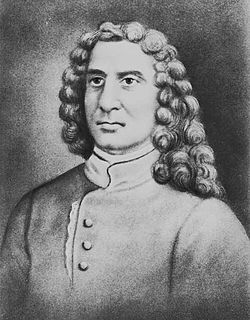
In 1641, the Mohawks traveled to Trois-Rivières in New France to propose peace with the French and their allied tribes, and they asked the French to set up a trading post in Iroquoia. Governor Montmagny rejected this proposal because it would imply abandonment of their Wendat allies.
In the early 1640s, the war began in earnest with Haudenosaunee attacks on frontier Wendat villages along the St. Lawrence River in order to disrupt the trade with the French. In 1645, the French called the tribes together to negotiate a treaty to end the conflict, and Haudenosaunee leaders Deganaweida and Koiseaton traveled to New France to take part in the negotiations. The French agreed to most of the Haudenosaunee demands, granting them trading rights in New France. The next summer, a fleet of 80 canoes traveled through Haudenosaunee territory carrying a large harvest of furs to be sold in New France. When they arrived, however, the French refused to purchase the furs and told the Iroquois to sell them to the Wendat, who would act as a middleman. The Haudenosaunee were outraged and resumed the war.
The French decided to become directly involved in the conflict. The Wendat and the Haudenosaunee had an estimated 25,000 to 30,000 members each. The Wendat and Susquehannocks formed an alliance to counter Iroquois aggression in 1647, and their warriors greatly outnumbered those of the Haudenosaunee. The Wendat tried to break the Haudenosaunee Confederacy by negotiating a separate peace with the Onondaga and Cayuga tribes, but the other tribes intercepted their messengers and ended the negotiations. During the summer of 1647, there were several small skirmishes between the tribes, but a more significant battle occurred in 1648 when the two Algonquin tribes passed a fur convoy through a Haudenosaunee blockade. They succeeded and inflicted high casualties on the Haudenosaunee.
Defeat of the Wendat

In 1648, the Dutch authorized selling guns directly to the Mohawks rather than through traders, and promptly sold 400 to the Iroquois. The Confederacy sent 1,000 newly armed warriors through the woods to Wendat territory with the onset of winter, and they launched a devastating attack into the heart of Wendat territory, destroying several key villages, killing many warriors, and taking thousands of people captive for later adoption into the tribe. Among those killed were Jesuit missionaries Jean Brebeuf, Charles Garnier, and Gabriel Lallemant, each of whom is considered a martyr of the Roman Catholic Church. The surviving Wendat fled and were dispersed from their territory, some taking refuge with the Jesuits at Quebec, some assimilated and adopted by the Iroquois, others joined the Petun or Tobacco nation, another Iroquoian people to become the Wyandot. The Ottawa tribe temporarily halted Iroquois expansion further northwest, but the Iroquois controlled a fur-rich region and had no more tribes blocking them from the French settlements in Canada.
Diseases had taken their toll on the Iroquois and neighbors in the years preceding the war, however, and their populations had drastically declined. To replace lost warriors, they worked to integrate many of their captured enemies by adoption into their own tribes. They invited Jesuits into their territory to teach those who had converted to Christianity. The Jesuits also reached out to the Iroquois, many of whom converted to Roman Catholicism or intermingled its teachings with their own traditional beliefs.
Despite these battles looking like massive successes for the Iroquois, such victories brought issues to the nation. The Iroquois had taken more captives than they could assimilate, which led to divisions and factions within the nation. Many captives held onto their prior beliefs instead of assimilating as well. Large divisions went on to embrace a French alliance and migrated north towards Montreal to trade with the French. The Iroquois accidentally aided the French through their destruction and captivity of the Wendat.
Defeat of the Erie and Neutral
The Iroquois attacked the Neutrals in 1650, and they completely drove the tribe from traditional territory by the end of 1651, killing or assimilating thousands. The Neutrals had inhabited a territory ranging from the Niagara Peninsula westward to the Grand River valley.
In 1654, the Iroquois attacked the Erie tribe, but with less success. The war lasted for two years, and the Iroquois destroyed the Erie confederacy by 1656, whose members refused to flee to the west. The Erie territory was located on the southeastern shore of Lake Erie and was estimated to have 12,000 members in 1650. The Iroquois were greatly outnumbered by the tribes that they subdued, but they achieved their victories through the use of firearms purchased from the Dutch.
New France: The Years of Survival (1649–1665)
While the Seneca and Onondaga had focused on defeating the nations to their west, the Mohawk had targeted New France. They blockaded the Ottawa River preventing Algonquian trappers from bringing beaver pelts to the French, and pressured the Wendat refugees living near Montreal, Trois-Rivières and Quebec to join them. A raid on the Île d'Orléans in 1656 caused the surviving Wendat to flee the island and seek safety within the walls of Quebec.
In 1653, a force of 600 Mohawk warriors besieged Trois-Rivières. The settlement was vulnerable after losing 22 soldiers and settlers to an ambush the year before. 40 French militia and their Wendat and Algonquin allies successfully defended the town for nine days from behind a strong palisade. The siege ended when negotiations led by militia captain Pierre Boucher resulted in a truce.
After negotiations with the Onondaga, the French built a mission called Sainte-Marie de Gannentaha on Onondaga Lake. This was an insult to the Mohawk, the Confederacy's "Keepers of the Eastern Door," who believed they should handle all negotiations with Europeans. They were also concerned that they might lose their status as the only Haudenosaunee nation with direct access to European goods. In 1658, however, the Jesuit missionaries at Gannentaha fled after realizing that they were effectively hostages.
An important figure during this period was Canaqueese, a Mohawk leader of Dutch and Haudenosaunee descent. Known to the French as Bâtard Flamand (Flemish Bastard), Canaqueese led diplomatic missions to Quebec to return prisoners and propose truces. These truces were often delaying tactics that allowed the Mohawk to go to the Dutch at Albany and rearm.
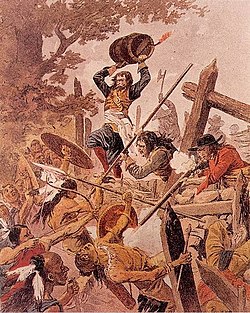
In 1660, the French thwarted a major attack on Montreal at the Battle of Long Sault. Although Adam Dollard des Ormeaux and all of sixteen militia were killed, along with a number of Wendat and Algonquins, the heavy losses they inflicted convinced the combined Mohawk, Oneida, and Onondaga forces to call off the attack.
French counterattack

The following year was one of the bloodiest for New France. Haudenosaunee war parties killed or captured over 100 settlers. This led Pierre Boucher, now Governor of Trois-Rivières, to travel to France and beg King Louis XIV for help. The king took several steps to ensure the survival of the colony. He dispatched the professional soldiers of the Le Régiment de Carignan-Salières to New France and appointed Alexandre de Prouville de Tracy as Lieutenant Général of the Americas with orders to take the war to the Haudenosaunee. Permission was also granted to sell arms to New France's Indigenous allies.
In 1664, the Dutch surrendered control of New Netherland to the English who were not as inclined to support the Haudenosaunee militarily. Following the arrival of Le Régiment de Carignan-Salières in the summer of 1665, the Onondaga, Seneca, Cayuga, and Oneida began peace talks with the French. The Mohawk, however, remained unwilling to negotiate.
In January 1666, Governor Daniel de Rémy de Courcelle attempted to attack the Mohawk homeland. The invasion force of 500 regulars and volunteers briefly skirmished with the Mohawk but failed to reach their villages as the French soldiers were ill-equipped to operate in the cold and deep snow.
A subsequent invasion of Mohawk territory was led by Tracy. Roughly 1,300 men set out September 1666 and reached the Mohawk villages in mid-October. The villages had been hastily abandoned. Tracy ordered the longhouses and fields of crops destroyed, and the expedition returned to French territory. A peace settlement was reached with the Mohawk and Oneida in July 1667.
Peace with France and Iroquois expansion

Once peace was achieved with the French, the Iroquois returned to their westward conquest in their continued attempt to take control of all the land between the Algonquins and the French. Eastern tribes such as the Lakotas were pushed across the Mississippi onto the Great Plains in the early 18th century, where they adopted the horse culture and nomadic lifestyle for which they later became known. Other refugees flooded the Great Lakes area, resulting in a conflict with existing tribes in the region. In the Ohio Country, the Shawnee and Miami tribes were dominant. The Iroquois quickly overran Shawnee holdings in central Ohio, forcing them to flee into Miami territory. The Miamis were a powerful tribe and brought together a confederacy of their neighboring allies, including the Pottawatomie and the Illini confederation who inhabited Michigan and Illinois. The majority of the fighting was between the Anishinaabeg Confederacy and the Iroquois Confederacy.
The Iroquois improved on their warfare as they continued to attack even farther from their home. War parties often traveled by canoes at night, and they would sink their canoes and fill them with rocks to hold them on the river bottom. They would then move through the woods to a target and burst from the wood to cause the greatest panic. After the attack, they returned to their boats and left before any significant resistance could be put together. The lack of firearms caused the Algonquin tribes the greatest disadvantage. Despite their larger numbers, they were not centralized enough to mount a united defense and were unable to withstand the Iroquois. Several tribes ultimately moved west beyond the Mississippi River, leaving much of the Ohio Valley, southern Michigan, and southern Ontario depopulated. Several Anishinaabe forces numbering in the thousands remained to the north of Lakes Huron and Superior, and they were later decisive in rolling back the Iroquois advance. From west of the Mississippi, displaced groups continued to arm war parties and attempt to retake their land.
Beginning in the 1670s, the French began to explore and settle the Ohio and Illinois Country from the Mississippi and Ohio rivers, and they established the post of Tassinong to trade with the western tribes. The Iroquois destroyed it to retain control of the fur trade with the Europeans. The Iroquois also drove the Mannahoac tribe out of the northern Virginia Piedmont region in 1670, and they claimed the land by right of conquest as a hunting ground. The English acknowledged this claim in 1674 and again in 1684, but they acquired the land from the Iroquois by a 1722 treaty.
During a raid into the Illinois Country in 1689, the Iroquois captured numerous prisoners and destroyed a sizable Miami settlement. The Miami asked for aid from others in the Anishinaabeg Confederacy, and a large force gathered to track down the Iroquois. Using their new firearms, the Confederacy laid an ambush near South Bend, Indiana, and they attacked and destroyed most of the Iroquois party, and a large part of the region was left depopulated. The Iroquois were unable to establish a permanent presence, as their tribe was unable to colonize the large area, and the Iroquois' brief control over the region was lost. Many of the former inhabitants of the territory began to return.
Defeat of the Susquehannocks
With the tribes destroyed to the north and west, the Iroquois turned their attention southward to the Susquehannock. The Susquehannock attained the peak of their influence in the 1650s, and they were able to use that to their advantage in the following decades. In the winter of 1652, the Susquehannock were attacked by the Mohawk, and although the attack was repulsed, it led to the Susquehannock negotiating Articles of Peace and Friendship with Maryland.
An Oneida raid on the Piscataway in 1660 led Maryland to expand its treaty with the Susquehannock into an alliance. The Maryland assembly authorized armed assistance, and described the Susquehannock as "a Bullwarke and Security of the Northern Parts of this Province." 50 men were sent to help defend the Susquehannock village. Muskets, lead and powder were acquired from both Maryland and New Netherland. Despite suffering a smallpox epidemic in 1661, the Susquehannock easily withstood a siege by 800 Seneca, Cayuga and Onondaga in May 1663, and destroyed an Onondaga war party in 1666.
War between the Iroquois and Susquehannock continued intermittently until 1674 when the Maryland colonists changed their Indian policy, negotiated peace with the Iroquois, and terminated their alliance with the Susquehannocks. Most historians believe that the Haudenosaunee inflicted a major defeat on the Susquehannock c.1674 since the Jesuit Relations for 1675 reports that the Seneca "utterly defeated ... their ancient and redoubtable foes."
In 1675, the Susquehannock moved south into Maryland. Later that year the militias of Virginia and Maryland besieged the Susquehannock fort, and assassinated the Susquehannock chiefs during a parley. The survivors of the siege were eventually absorbed by the Iroquois.
Resumption of war with France

English settlers began to move into the former Dutch territory of upper New York State, and the colonists began to form close ties with the Iroquois as an alliance in the face of French colonial expansion. They began to supply the Iroquois with firearms as the Dutch had. At the same time, New France's governor Louis de Buade tried to revive the western fur trade. His efforts competed with those of the Iroquois to control the traffic and they started attacking the French again. The war lasted ten years.


In 1681, René-Robert Cavelier, Sieur de La Salle, negotiated a treaty with the Miami and Illinois tribes. France lifted the ban on the sale of firearms to the Indians, and colonists quickly armed the Algonquin tribes, evening the odds between the Iroquois and their enemies.
With the renewal of hostilities, the militia of New France was strengthened after 1683 by a small force of regular French navy troops in the Compagnies Franches de la Marine, who constituted the longest serving unit of French regular troops in New France. In June 1687, Governor Denonville and Pierre de Troyes set out with a well organized force to Fort Frontenac. Denonville captured 58 male prisoners and 36 of these were later shipped to Marseille, France to be galley slaves. (13 men survived and eventually returned to Canada.) He then travelled down the shore of Lake Ontario and built Fort Denonville at the site where the Niagara River meets Lake Ontario. This site was previously used by La Salle for Fort Conti from 1678 to 1679, and was later used for Fort Niagara which still exists. The Iroquois retaliated by destroying farmsteads and slaughtering entire families. They burned Lachine to the ground on August 4, 1689. Frontenac replaced Denonville as governor for the next nine years (1689–1698).
During King William's War (1688–1697), the French formed raiding parties with Indian allies to attack English settlements, (as the English had allied themselves with the Iroquois against the French) perpetrating the Schenectady massacre in the colony of New York, the Raid on Salmon Falls in New Hampshire, and the Battle of Fort Loyal in Portland, Maine. The French and their allies killed settlers in the raids and kidnapped some and took them back to Canada. Settlers in New England raised money to redeem the captives, but some were adopted into the tribes. The French government generally did not intervene when the Indians kept the captives. Throughout the 1690s, the French and their allies also continued to raid deep into Iroquois territory, destroying Mohawk villages in 1692 and raiding Seneca, Oneida, and Onondaga villages. The English and Iroquois banded together for operations aimed against the French, but these were largely ineffective. The most successful incursion resulted in the 1691 Battle of La Prairie. The French offensive was not halted by the 1697 Treaty of Ryswick that brought peace between France and England, ending English participation in that conflict.
Peace
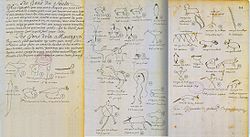
The Iroquois eventually began to see the emerging Thirteen Colonies as a greater threat than the French in 1698. The colony of Pennsylvania was founded in 1681, and the continued growth there began to encroach on the southern border of the Iroquois. The French policy began to change towards the Iroquois after nearly fifty years of warfare, and they decided that befriending them would be the easiest way to ensure their monopoly on the northern fur trade. The Thirteen Colonies heard of the treaty and immediately set about to prevent it from being agreed upon. These conflicts would result in the loss of Albany's fur trade with the Iroquois and, without their protection, the northern flank of the Thirteen Colonies would be open to French attack. Nevertheless, the French and Indians signed the treaty.
The French and 39 Indian chiefs signed the Great Peace of Montreal in 1701. The Iroquois agreed to stop marauding and to allow refugees from the Great Lakes to return east. The Shawnee eventually regained control of the Ohio Country and the lower Allegheny River. The Miami tribe returned to take control of Indiana and northwest Ohio. The Pottawatomie went to Michigan, and the Illini to Illinois. The peace lasted into the 1720s.
Aftermath
In 1768, several of the Thirteen Colonies purchased the "Iroquois claim" to the Ohio and Illinois Country and created the Indiana Land Company to hold the claim to all of the Northwest. It maintained a claim to the region using the Iroquois right of conquest until the company was dissolved in 1798 by the United States Supreme Court.
Many of the Iroquois people allied with the British during the American Revolutionary War, particularly warriors from the Mohawk, Cayuga, Onondaga and Seneca nations. These nations had longstanding trade relations with the British and hoped they might stop American encroachment on their lands. After the Americans emerged triumphant, the British parliament agreed to cede control over much of its territory in North America to the newly formed United States and worked to resettle American loyalists in Canada and provide some compensation for lands the Loyalists and Native Americans had lost to the United States. Mohawk Chief Joseph Brant led a large group of Iroquois out of New York to what became the reserve of the Six Nations of the Grand River in Ontario. The new lands granted to Six Nations reserves were all near Canadian military outposts and placed along the border to prevent any American incursions.
The coalition of Native American tribes, known as the Western Confederacy, was forced to cede extensive territory, including much of present-day Ohio, in the Treaty of Greenville in 1795.
New France's involvement with the Iroquois and other native tribes in the Great Lakes region greatly impacted the future of French colonies, as well as the native tribes in the region. New France was far less profitable and much more violent than Champlain and other French leaders had hoped. The French involvement in native trade caused the French to entangle with complex native alliances, which pitted tribes against the French, and each other. French involvement also introduced disease, weapons, and war, which led to the further destruction of tribes in the region.
See also
- American Indian Wars
- Colonial American military history
- Fox Wars
- Military history of Canada
- Military history of the Mi'kmaq people
- Military of New France
- List of genocides
Notes
Sources
- Funk, Arville (1964). A Sketchbook of Indiana History. Christian Book Press.
- Hine, Robert V.; Faragher, John Mack (2000). . Yale University Press. ISBN0-300-07835-8.
- Lupold, Harry Forrest; Haddad, Gladys (1988). Ohio's Western Reserve. Kent State University Press. ISBN0-87338-372-9.
- Johansen, Bruce E. (2006). . Rutgers University Press. ISBN0-8135-3899-8.
- Morgan, Lewis H. (1922). . Classic Textbooks. ISBN1404751602.
{{cite book}}:ISBN / Date incompatibility (help) - Schmalz, Peter S. (1991). . University of Toronto Press. ISBN0-8020-2736-9.
- Salvucci, Claudio R.; Schiavo, Anthony P. Jr. (2003). Iroquois Wars II: Excerpts from the Jesuit Relations and Other Primary Sources. Bristol, Pennsylvania: Evolution Publishing. ISBN1-889758-34-5.
- Sciavo, Anthony P. Jr.; Salvucci, Claudio R. (2003). Iroquois Wars I: Excerpts from the Jesuit Relations and Primary Sources 1535–1650. Bristol, Pennsylvania: Evolution Publishing. ISBN1-889758-37-X.
- Taylor, Alan (2002). American Colonies: the Settling of North America. Penguin Books. pp.111–113. ISBN9780142002100.
- Thompson, Maurice (1898). . New York, Cincinnati, Chicago: American Book Company.