Brčko District
In-game article clicks load inline without leaving the challenge.
Brčko District (Serbo-Croatian: Brčko distrikt / Брчко дистрикт), officially the Brčko District of Bosnia and Herzegovina (Serbo-Croatian: Brčko distrikt Bosne i Hercegovine / Брчко дистрикт Босне и Херцеговине), is a self-governing administrative unit in north-eastern Bosnia and Herzegovina.
Officially a condominium of the Federation of Bosnia and Herzegovina and Republika Srpska, it was formed in 1999 to reflect the multi-ethnic nature of Brčko and the surrounding areas and their special status within the newly independent Bosnia and Herzegovina. In reality, it functions as a local self-government area, much like the other municipalities in the country. The seat of the district is the city of Brčko.
History
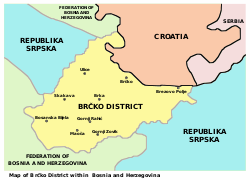
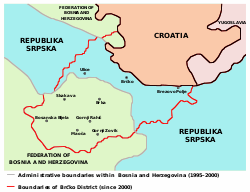
The Brčko District was established after an arbitration process undertaken by the High Representative for Bosnia and Herzegovina. According to the Dayton Peace Accords, however, the process could only arbitrate the disputed portion of the Inter-Entity Boundary Line (IEBL). The Brčko District was formed of the entire territory of the former Brčko municipality, of which 48% (including Brčko city) was in the newly formed Republika Srpska, while 52% was in the old Federation of Bosnia and Herzegovina.
Brčko was the only element in the Dayton Peace Agreement that was not finalized at the time. The arbitration agreement was later finalized in March 1999, resulting in a "district" that was to be administrated by an American Brčko International Supervisor. Since 2006, Principal Deputy High Representative has taken over the Brcko supervisor role.
In the 1990s, the Arizona Market was created at the intersection of the IFOR north-south "Arizona" road and the east–west Posavina Corridor roads, bordering today's district, and became a commercial success.
The first Brčko International Supervisor arrived in April 1997. Up to that time, the Organization for Security and Co-operation in Europe (OSCE) had a modest office headed by Randolph Hampton. During the interim time before the District of Brčko could be represented post-arbitration agreement, local elections were held, and humanitarian relief was provided with cooperation from the United States Agency for International Development (USAID) and ECHO. The District became known as a center for different state-building programs run by foreign governments, particularly the United States.
In 2006, under the Supervisory Order, all "Entity legislation in Brčko District and the IEBL" was abolished. The ruling made by the Brčko Supervisor Susan Johnson abolished all Entity Laws in the District, as well as the Entity Border Line. The ruling made the Laws of the District paramount within the District, and the Laws of the State of Bosnia and Herzegovina, both Federation and Serb Republic, including the laws of the former Socialist Republic of Bosnia and Herzegovina ceased to have legal effect there.
Following a Peace Implementation Council (PIC) meeting on 23 May 2012, it was decided to suspend, not terminate, the mandate of the Brčko International Supervisor. The Brčko Arbitral Tribunal, together with the suspended Brčko Supervision, continues to exist. Also in 2012, the legislature of Bosnia and Herzegovina passed a law that required citizens to declare which entity (Federation or Republika Srpska) they belonged to before they could vote in national elections. This was problematic in Brčko District as many people did not wish to belong to either.
The government of Republika Srpska resumed operation in the district in 2012. Despite actions of the government of Republika Srpska, change of the autonomous status of Brčko District would require a change in the constitution of Bosnia and Herzegovina, an event unlikely to occur.
Settlements
- Bijela
- Boće
- Boderište
- Brčko
- Brezik
- Brezovo Polje
- Brka
- Brod
- Bukovac
- Bukvik Donji
- Bukvik Gornji
- Buzekara
- Cerik
- Čađavac
- Čande
- Čoseta
- Donji Rahić
- Donji Zovik
- Dubrave
- Dubravice Donje
- Dubravice Gornje
- Gajevi
- Gorice
- Gornji Rahić
- Gornji Zovik
- Grbavica
- Gredice
- Islamovac
- Krbeta
- Ivici
- Krepšić
- Laništa
- Lukavac
- Maoča
- Marković Polje
- Ograđenovac
- Omerbegovača
- Palanka
- Popovo Polje
- Potočari
- Rašljani
- Ražljevo
- Repino Brdo
- Sandići
- Skakava Donja
- Skakava Gornja
- Slijepčevići
- Stanovi
- Šatorovići
- Štrepci
- Trnjaci
- Ulice
- Ulović
- Vitanovići Donji
- Vitanovići Gornji
- Vučilovac
- Vujičići
- Vukšić Donji
- Vukšić Gornji
Demographics
Brčko District comprises 1% of the land area of Bosnia and Herzegovina, and is home to 2.37% of the country's total population.
Population
| Population of settlements – Brčko District | ||||||||
|---|---|---|---|---|---|---|---|---|
| Settlement | 2013. | 1991. | 1981. | 1971. | 1961. | 1953. | 1948. | |
| Total | 83,516 | 87,627 | 82,768 | 74,771 | 62,952 | 65,078 | 49,969 | |
| 1 | Bijela | 1,923 | 2,539 | |||||
| 2 | Boće | 1,270 | 1,253 | |||||
| 3 | Boderište | 661 | 965 | |||||
| 4 | Brčko | 39,893 | 41,406 | 31,437 | 25,337 | 17,949 | ||
| 5 | Brezik | 601 | 413 | |||||
| 6 | Brezovo Polje | 1,292 | 1,393 | |||||
| 7 | Brezovo Polje Selo | 251 | 335 | |||||
| 8 | Brka | 2,234 | 2,044 | |||||
| 9 | Brod | 1,286 | 1,042 | |||||
| 10 | Bukovac | 104 | 364 | |||||
| 11 | Bukvik Donji | 97 | 212 | |||||
| 12 | Bukvik Gornji | 121 | 378 | |||||
| 13 | Buzekara | 268 | 430 | |||||
| 14 | Cerik | 233 | 280 | |||||
| 15 | Čađavac | 72 | 74 | |||||
| 16 | Čande | 321 | 377 | |||||
| 17 | Čoseta | 732 | 507 | |||||
| 18 | Donji Rahić | 366 | 647 | |||||
| 19 | Donji Zovik | 494 | 481 | |||||
| 20 | Dubrave | 1,463 | 1,338 | |||||
| 21 | Dubravice Donje | 315 | 396 | |||||
| 22 | Dubravice Gornje | 161 | 319 | |||||
| 23 | Gajevi | 103 | 196 | |||||
| 24 | Gorice | 654 | 1,097 | |||||
| 25 | Gornji Rahić | 3,403 | 2,167 | |||||
| 26 | Gornji Zovik | 1,408 | 1,569 | |||||
| 27 | Grbavica | 1,527 | 557 | |||||
| 28 | Gredice | 1,109 | 303 | |||||
| 29 | Islamovac | 64 | 105 | |||||
| 30 | Krbeta | 175 | 244 | |||||
| 31 | Krepšić | 696 | 1,156 | |||||
| 32 | Laništa | 450 | 656 | |||||
| 33 | Lukavac | 52 | 225 | |||||
| 34 | Maoča | 3,030 | 2,886 | |||||
| 35 | Marković Polje | 370 | 470 | |||||
| 36 | Ograđenovac | 815 | 734 | |||||
| 37 | Omerbegovača | 1,074 | 895 | |||||
| 38 | Palanka | 1,439 | 1,394 | |||||
| 39 | Popovo Polje | 155 | 248 | |||||
| 40 | Potočari | 1,063 | 893 | |||||
| 41 | Rašljani | 1,078 | 1,155 | |||||
| 42 | Ražljevo | 233 | 341 | |||||
| 43 | Repino Brdo | 247 | 246 | |||||
| 44 | Sandići | 430 | 420 | |||||
| 45 | Skakava Donja | 2,037 | 2,272 | |||||
| 46 | Skakava Gornja | 1,352 | 1,737 | |||||
| 47 | Slijepčevići | 298 | 371 | |||||
| 48 | Stanovi | 238 | 353 | |||||
| 49 | Šatorovići | 1,472 | 1,238 | |||||
| 50 | Štrepci | 712 | 861 | |||||
| 51 | Trnjaci | 245 | 313 | |||||
| 52 | Ulice | 892 | 1,266 | |||||
| 53 | Ulovići | 752 | 912 | |||||
| 54 | Vitanovići Donji | 396 | 419 | |||||
| 55 | Vitanovići Gornji | 159 | 286 | |||||
| 56 | Vučilovac | 254 | 700 | |||||
| 57 | Vujičić | 45 | 284 | |||||
| 58 | Vukšić Donji | 352 | 644 | |||||
| 59 | Vukšić Gornji | 579 | 821 |
Ethnic groups
The ethnic composition of Brčko District:
| Ethnic group | 1961 census | 1971 census | 1981 census | 1991 census | 2013 census | |||||
|---|---|---|---|---|---|---|---|---|---|---|
| Number | % | Number | % | Number | % | Number | % | Number | % | |
| Bosniaks | 16,484 | 26.19% | 30,181 | 40.36% | 32,434 | 39.19% | 38,617 | 44.07% | 35,381 | 42.36% |
| Serbs | 17,897 | 28.43% | 17,709 | 23.68% | 16,707 | 20.19% | 18,128 | 20.69% | 28,884 | 34.58% |
| Croats | 21,994 | 34.94% | 24,925 | 33.34% | 23,975 | 28.97% | 22,252 | 25.39% | 17,252 | 20.66% |
| Yugoslavs | 5,904 | 9.38% | 1,086 | 1.45% | 8,342 | 10.08% | 5,731 | 6.54% | ||
| Others | 673 | 1.07% | 870 | 1.16% | 1,310 | 1.58% | 2,899 | 3.31% | 1,999 | 2.39% |
| Total | 62,952 | 74,771 | 82,768 | 87,627 | 83,516 |
1961 census
- Ethnic structure of Brčko by settlements 1961
- Ethnic structure of Brčko by settlements 1961
- Share of Bosniaks in Brčko by settlements 1961
- Share of Croats in Brčko by settlements 1961
- Share of Serbs in Brčko by settlements 1961
1971 census
- Ethnic structure of Brčko by settlements 1971
- Ethnic structure of Brčko by settlements 1971
- Share of Bosniaks in Brčko by settlements 1971
- Share of Croats in Brčko by settlements 1971
- Share of Serbs in Brčko by settlements 1971
1981 census
- Ethnic structure of Brčko by settlements 1981
- Ethnic structure of Brčko by settlements 1981
- Share of Bosniaks in Brčko by settlements 1981
- Share of Croats in Brčko by settlements 1981
- Share of Serbs in Brčko by settlements 1981
1991 census
- Ethnic structure of Brčko by settlements 1991
- Ethnic structure of Brčko by settlements 1991
- Share of Bosniaks in Brčko by settlements 1991
- Share of Croats in Brčko by settlements 1991
- Share of Serbs in Brčko by settlements 1991
2013 census
- Ethnic structure of Brčko by settlements 2013
- Ethnic structure of Brčko by settlements 2013
- Share of Bosniaks in Brčko by settlements 2013
- Share of Croats in Brčko by settlements 2013
- Share of Serbs in Brčko by settlements 2013
Politics
Assembly of Brčko District
There are 31 seats in the Assembly of the Brčko District. The seats are divided as follows as of 2024:
| Council | Mayor elected by Council | |||||||
|---|---|---|---|---|---|---|---|---|
| Party | Popular vote | % | Seats | Mayor | Votes | % | ||
| Party of Democratic Action | 5,735 | 16.16 | 5 | |||||
| SNSD—SPS | 5,626 | 15.85 | 5 | |||||
| SP—DNS—PUP | 3,326 | 9.37 | 3 | |||||
| United Srpska | 3,186 | 8.98 | 3 | |||||
| Croatian Democratic Union | 2,834 | 7.98 | 2 | |||||
| Party of Democratic Progress | 2,219 | 6.25 | 2 | |||||
| Union for a Better Future | 2,178 | 6.14 | 2 | |||||
| People and Justice | 2,112 | 5.95 | 2 | |||||
| Social Democratic Party | 1,929 | 5.43 | 1 | |||||
| Our Party | 1,925 | 5.42 | 1 | |||||
| Serb Democratic Party | 1,687 | 4.75 | 1 | |||||
| Party for Bosnia and Herzegovina | 1,329 | 3.74 | 1 | |||||
| Croatian Democratic Union 1990 | 1,088 | 3.07 | 1 | |||||
| Minority candidate Alija Denjagić | (273) | - | 1 | |||||
| Minority candidate Radoslav Subotić | (149) | - | 1 | |||||
| Total | 37,173 | 31 |
Notable people
- Edo Maajka (birth name Edin Osmić) – rapper
- Edvin Kanka Ćudić – Human rights activist
- Esed Kadrić – Mayor of Brčko
- Lepa Brena (birth name Fahreta Jahić) – pop-folk singer
- Mladen Petrić – Croatian international football player
- NiKo – Counter-Strike: Global Offensive player
- Vesna Pisarović – pop singer