Isotopes of calcium
In-game article clicks load inline without leaving the challenge.
Calcium (20Ca) has 26 known isotopes, ranging from 35Ca to 60Ca. There are five stable isotopes (40Ca, 42Ca, 43Ca, 44Ca and 46Ca), plus one isotope (48Ca) with such a long half-life that it is for all practical purposes stable. The most abundant isotope, 40Ca, as well as the rare 46Ca, are theoretically unstable on energetic grounds, but their decay has not been observed. Calcium also has a cosmogenic isotope, 41Ca, with half-life 99,400 years. Unlike cosmogenic isotopes produced in the air, 41Ca is produced by neutron activation of solid 40Ca in rock and soil. Most of its production is in the upper metre of the soil column, where the cosmogenic neutron flux is still strong enough. The most stable artificial isotopes are 45Ca with half-life 162.61 days and 47Ca with half-life 4.536 days. All other calcium isotopes have half-lives of minutes or less.
40Ca comprises about 97% of natural calcium and is mainly created by nucleosynthesis in stars (alpha process). Like 40Ar, however, some 40Ca is radiogenic, created by radioactive decay of 40K. While K–Ar dating has been used extensively in the geological sciences, the prevalence of 40Ca in nature initially impeded the proliferation of K-Ca dating in early studies, with only a handful of studies in the 20th century. Modern techniques using increasingly precise Thermal-Ionization (TIMS) and Collision-Cell Multi-Collector Inductively-coupled plasma mass spectrometry (CC-MC-ICP-MS) techniques, however, have been used for successful K–Ca dating similar in method to Rb-Sr dating, as well as determining K losses from the lower continental crust and for source-tracing calcium contributions from various geologic reservoirs.
Stable isotope variations of calcium (most typically 44Ca/40Ca or 44Ca/42Ca, denoted 'δ44Ca' and 'δ44/42Ca' in delta notation) are also widely used across the natural sciences for a number of applications, ranging from early determination of osteoporosis to quantifying volcanic eruption timescales. Other applications include: quantifying carbon sequestration efficiency in CO2 injection sites and understanding ocean acidification, exploring both ubiquitous and rare magmatic processes, such as formation of granites and carbonatites, tracing modern and ancient trophic webs including in dinosaurs, assessing weaning practices in ancient humans, and a plethora of other emerging applications.
List of isotopes
| Nuclide | Z | N | Isotopic mass (Da) | Discovery year | Half-life | Decay mode | Daughter isotope | Spin and parity | Natural abundance (mole fraction) | |
|---|---|---|---|---|---|---|---|---|---|---|
| Normal proportion | Range of variation | |||||||||
| 35Ca | 20 | 15 | 35.00557(22)# | 25.7(2) ms | β+, p (95.8%) | 34Ar | 1/2+# | |||
| β+, 2p (4.2%) | 33Cl | |||||||||
| β+ (rare) | 35K | |||||||||
| 36Ca | 20 | 16 | 35.993074(43) | 100.9(13) ms | β+, p (51.2%) | 35Ar | 0+ | |||
| β+ (48.8%) | 36K | |||||||||
| 37Ca | 20 | 17 | 36.98589785(68) | 181.0(9) ms | β+, p (76.8%) | 36Ar | 3/2+ | |||
| β+ (23.2%) | 37K | |||||||||
| 38Ca | 20 | 18 | 37.97631922(21) | 443.70(25) ms | β+ | 38K | 0+ | |||
| 39Ca | 20 | 19 | 38.97071081(64) | 860.3(8) ms | β+ | 39K | 3/2+ | |||
| 40Ca | 20 | 20 | 39.962590850(22) | Observationally stable | 0+ | 0.9694(16) | 0.96933–0.96947 | |||
| 41Ca | 20 | 21 | 40.96227791(15) | 9.94(15)×104 y | EC | 41K | 7/2− | Trace | ||
| 42Ca | 20 | 22 | 41.95861778(16) | Stable | 0+ | 0.00647(23) | 0.00646–0.00648 | |||
| 43Ca | 20 | 23 | 42.95876638(24) | Stable | 7/2− | 0.00135(10) | 0.00135–0.00135 | |||
| 44Ca | 20 | 24 | 43.95548149(35) | Stable | 0+ | 0.0209(11) | 0.02082–0.02092 | |||
| 45Ca | 20 | 25 | 44.95618627(39) | 162.61(9) d | β− | 45Sc | 7/2− | |||
| 46Ca | 20 | 26 | 45.9536877(24) | Observationally stable | 0+ | 4×10⁻⁵ | 4×10⁻⁵–4×10⁻⁵ | |||
| 47Ca | 20 | 27 | 46.9545411(24) | 4.536(3) d | β− | 47Sc | 7/2− | |||
| 48Ca | 20 | 28 | 47.952522654(18) | 5.6(10)×1019 y | β−β− | 48Ti | 0+ | 0.00187(21) | 0.00186–0.00188 | |
| 49Ca | 20 | 29 | 48.95566263(19) | 8.718(6) min | β− | 49Sc | 3/2− | |||
| 50Ca | 20 | 30 | 49.9574992(17) | 13.45(5) s | β− | 50Sc | 0+ | |||
| 51Ca | 20 | 31 | 50.96099566(56) | 10.0(8) s | β− | 51Sc | 3/2− | |||
| 52Ca | 20 | 32 | 51.96321365(72) | 4.6(3) s | β− (>98%) | 52Sc | 0+ | |||
| β−, n (<2%) | 51Sc | |||||||||
| 53Ca | 20 | 33 | 52.968451(47) | 461(90) ms | β− (60%) | 53Sc | 1/2−# | |||
| β−, n (40%) | 52Sc | |||||||||
| 54Ca | 20 | 34 | 53.972989(52) | 90(6) ms | β− | 54Sc | 0+ | |||
| 55Ca | 20 | 35 | 54.97998(17) | 22(2) ms | β− | 55Sc | 5/2−# | |||
| 56Ca | 20 | 36 | 55.98550(27) | 11(2) ms | β− | 56Sc | 0+ | |||
| 57Ca | 20 | 37 | 56.99296(43)# | 8# ms [>620 ns] | 5/2−# | |||||
| 58Ca | 20 | 38 | 57.99836(54)# | 4# ms [>620 ns] | 0+ | |||||
| 59Ca | 20 | 39 | 59.00624(64)# | 5# ms [>400 ns] | 5/2−# | |||||
| 60Ca | 20 | 40 | 60.01181(75)# | 2# ms [>400 ns] | 0+ | |||||
| 61Ca | 20 | 41 | 61.02041(86)# | (2025) | 1# ms | 1/2−# | ||||
| This table header & footer: view |
Calcium-48
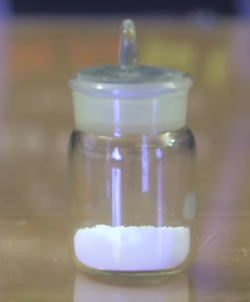
Calcium-48 is a doubly magic nucleus with 28 neutrons; unusually neutron-rich for a light primordial nucleus. It decays via double beta decay with an extremely long half-life of about 5.6×10¹⁹ years, though single beta decay is also theoretically possible. This decay can analyzed with the sd nuclear shell model, and it is more energetic (4.27 MeV) than any other double beta decay. It is used as a precursor for neutron-rich and superheavy isotopes.
Calcium-60
Calcium-60 is the heaviest known isotope as of 2020[update]. First observed in 2018 at Riken alongside 59Ca and seven isotopes of other elements, its existence suggests that there are additional even-N isotopes of calcium up to at least 70Ca, while 59Ca is probably the last bound isotope with odd N. Earlier predictions had estimated the heaviest even isotope to be at 60Ca, and 59Ca unbound.
In the neutron-rich region, N = 40 becomes a magic number, so 60Ca was considered early on to be a possibly doubly magic nucleus, as is observed for the 68Ni isotone. However, subsequent spectroscopic measurements of the nearby nuclides 56Ca, 58Ca, and 62Ti instead predict that it should lie on the island of inversion known to exist around 64Cr.
See also
Daughter products other than calcium
Further reading
- C. Michael Hogan. 2010.
External links
- [permanent dead link]