Camelidae
In-game article clicks load inline without leaving the challenge.
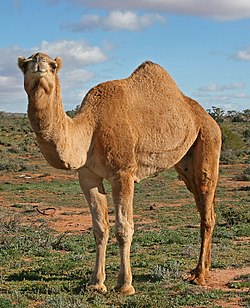
Camelidae is a family of mammals belonging to the ungulate order Artiodactyla (even-toed ungulates) and the only living family in the suborder Tylopoda. The seven extant species of camelid are divided into two tribes, Camelini, including dromedary camels, Bactrian camels and wild Bactrian camels, and Lamini, including llamas, alpacas, vicuñas, and guanacos.
Characteristics

Camelids are large, strictly herbivorous animals with slender necks and long legs. They differ from ruminants in a number of ways. Their dentition show traces of vestigial central incisors in the incisive bone, and the third incisors have developed into canine-like tusks. Camelids also have true canine teeth and tusk-like premolars, which are separated from the molars by a gap. As in ruminants, the upper incisors are largely absent and are replaced by a dental pad consisting of connective tissue covered with epithelium. The musculature of the hind limbs differs from those of other ungulates in that the legs are attached to the body only at the top of the thigh, rather than attached by skin and muscle from the knee upwards. Because of this, camelids have to lie down by resting on their knees with their legs tucked underneath their bodies. They have three-chambered stomachs, rather than four-chambered ones; their upper lips are split in two, with each part separately mobile; and, uniquely among mammals, their red blood cells are elliptical. They also have a unique type of antibodies, which lack the light chain, in addition to the normal antibodies found in other mammals. These so-called heavy-chain antibodies are being used to develop single-domain antibodies with potential pharmaceutical applications.
Camelids do not have hooves; rather, they have two-toed feet with toenails and soft foot pads (Tylopoda is Greek for "padded foot"). Most of the weight of the animal rests on these tough, leathery sole pads. The South American camelids have adapted to the steep and rocky terrain by adjusting the pads on their toes to maintain grip. The surface area of camels' foot pads can increase with increasing velocity in order to reduce pressure on the feet and larger members of the camelid species will usually have larger pad area, which helps to distribute weight across the foot. Many fossil camelids were unguligrade and probably hooved, in contrast to all living species.
Camelids are behaviorally similar in many ways, including their walking gait, in which both legs on the same side are moved simultaneously. While running, camelids engage a unique "running pace gait" in which limbs on the same side move in the same pattern they walk, with both left legs moving and then both right, which ensures that the fore and hind limb will not collide while in fast motion. During this motion, all four limbs momentarily are off the ground at the same time. Consequently, camelids large enough for human beings to ride have a typical swaying motion.
Dromedary camels, bactrian camels, llamas, and alpacas are all induced ovulators.
The three Afro-Asian camel species have developed extensive adaptations to their lives in harsh, near-waterless environments. Wild populations of the Bactrian camel are even able to drink brackish water, and some herds live in nuclear test areas.
Comparative table of the seven extant species in the family Camelidae:
| Species | Image | Natural range | Weight |
|---|---|---|---|
| Camelus | |||
| Bactrian camel (Camelus bactrianus) | Central and Inner Asia (entirely domesticated) | 300 to 1,000 kg (660 to 2,200 lb) | |
| Dromedary or Arabian camel (Camelus dromedarius) | South Asia and Middle East (entirely domesticated) | 300 to 600 kg (660 to 1,320 lb) | |
| Wild Bactrian camel (Camelus ferus) | China and Mongolia | 300 to 820 kg (660 to 1,800 lb) | |
| Lama | |||
| Llama (Lama glama) | (domestic form of guanaco) | 130 to 200 kg (290 to 440 lb) | |
| Guanaco (Lama guanicoe) | South America | about 90 to 120 kg (200 to 260 lb) | |
| Alpaca (Lama pacos) | (domestic form of vicuña) | 48 to 84 kg (106 to 185 lb) | |
| Vicuña (Lama vicugna) | South American Andes | 35 to 65 kg (77 to 143 lb) |
Evolution
| Camelid Lamini Lama L. glama L. guanicoe L. vicugna L. pacos Camelini Camelus C. bactrianus C. dromedarius C. ferus †Camelops ⊞C. kansanus C. hesternus C. minodokae⊟ | ||
| Camelid | Lamini Lama L. glama L. guanicoe L. vicugna L. pacos Camelini Camelus C. bactrianus C. dromedarius C. ferus †Camelops ⊞C. kansanus C. hesternus C. minodokae⊟ | |
| Lamini | Lama L. glama L. guanicoe L. vicugna L. pacos | |
| Lama | L. glama L. guanicoe L. vicugna L. pacos | |
| L. glama | ||
| L. guanicoe | ||
| L. vicugna | ||
| L. pacos | ||
| Camelini | Camelus C. bactrianus C. dromedarius C. ferus †Camelops ⊞C. kansanus C. hesternus C. minodokae⊟ | |
| Camelus | C. bactrianus C. dromedarius C. ferus | |
| C. bactrianus | ||
| C. dromedarius | ||
| C. ferus | ||
| †Camelops | ⊞C. kansanus C. hesternus C. minodokae⊟ | |
| ⊞ | C. kansanus C. hesternus C. minodokae | ⊟ |
| C. kansanus | ||
| C. hesternus | ||
| C. minodokae | ||
| A family tree indicating different species within the Camelidae family |

Camelids are unusual in that their modern distribution is almost the inverse of their area of origin. Camelids first appeared very early in the evolution of the even-toed ungulates, around 50 to 40 million years ago during the middle Eocene,[citation needed] in present-day North America. Among the earliest camelids was the rabbit-sized Protylopus, which still had four toes on each foot. By the late Eocene, around 35 million years ago, camelids such as Poebrotherium had lost the two lateral toes, and were about the size of a modern goat.
The family diversified and prospered, with the two living tribes, the Camelini and Lamini, diverging in the late early Miocene, about 17 million years ago, but remained restricted to North America until about 6 million years ago, when Paracamelus crossed the Bering land bridge into Eurasia, giving rise to the modern camels, and about 3–2 million years ago, when Hemiauchenia emigrated into South America (as part of the Great American Interchange), giving rise to the modern llamas. A population of Paracamelus continued living in North America and evolved into the high arctic camel, which survived until the middle Pleistocene.
The original camelids of North America remained common until the quite recent geological past, but then disappeared, possibly as a result of hunting or habitat alterations by the earliest human settlers, and possibly as a result of changing environmental conditions after the last ice age, or a combination of these factors. Three species groups survived—the dromedary of northern Africa and southwest Asia; the Bactrian camel of central Asia; and the South American group, which has now diverged into a range of forms that are closely related, but usually classified as four species—llamas, alpacas, guanacos, and vicuñas. Camelids were domesticated by early Andean peoples, and remain in use today.
Fossil camelids show a wider variety than their modern counterparts. One North American genus, Titanotylopus, stood 3.5 m (11 ft) at the shoulder, compared with about 2.0 m (6 ft 7 in) for the largest modern camelids. Other extinct camelids included small, gazelle-like animals, such as Stenomylus. Finally, a number of very tall, giraffe-like camelids were adapted to feeding on leaves from high trees, including such genera as Aepycamelus and Oxydactylus. The word Carnyx (pl.Carnices) has been proposed as a generic common name for these giraffe-like camelids.
Whether the wild Bactrian camel (Camelus ferus) is a distinct species or a subspecies (C. bactrianus ferus) is still debated. The divergence date is 0.7 million years ago, long before the start of domestication.
Scientific classification

Family Camelidae
- †Subfamily Poebrotheriinae
- †Subfamily Miolabinae
- †Subfamily Stenomylinae
- Subfamily Camelinae Tribe Lamini Genus: Lama Llama, Lama glama Guanaco, Lama guanicoe Alpaca, Lama pacos Vicuña, Lama vicugna Genus: Hemiauchenia †Hemiauchenia macrocephala †Hemiauchenia minima †Hemiauchenia blancoensis †Hemiauchenia vera †Hemiauchenia paradoxa Genus Palaeolama †Palaeolama mirifica Tribe Camelini Genus: Camelus Bactrian camel, Camelus bactrianus Dromedary, Camelus dromedarius Wild Bactrian camel, Camelus ferus †Greater Syrian camel, Camelus moreli †Lesser Syrian camel, Camelus concordieae †Camelus sivalensis †Camelus knoblochi Genus: Camelops †Camelops hesternus Genus: Paracamelus †Paracamelus gigas
Phylogeny
Extinct genera
| Genus name | Epoch | Remarks |
|---|---|---|
| Aepycamelus | Miocene | Tall, s-shaped neck, true padded camel feet |
| Aguascalientia | Earliest Miocene | A small, primitive, narrow-snouted floridatraguline camel from Mexico, Texas, and Panama |
| Camelops | Pliocene-Pleistocene | Large, with true camel feet and hump. Status uncertain |
| Eulamaops | Pleistocene | From South America |
| Floridatragulus | Early Miocene | An unusual species of camel with a long snout |
| Hemiauchenia | Miocene-Pleistocene | A North and South American lamine genus |
| Megatylopus | Miocene-Early Pleistocene | Large camelid from North America |
| Megacamelus | Miocene-Pleistocene | The largest species of camelid |
| Michenia | Early-Middle Miocene | A cameline that existed for 10 million years in North America |
| Oxydactylus | Early Miocene | The earliest member of the "giraffe camel" family |
| Palaeolama | Pleistocene | A North and South American lamine genus |
| Poebrotherium | Oligocene | This species of camel took the place of deer and antelope in the White River Badlands. |
| Procamelus | Miocene | Ancestor of extinct Titanolypus and modern Camelus |
| Protylopus | Late Eocene | Earliest member of the camelids |
| Stenomylus | Early Miocene | Small, gazelle-like camel that lived in large herds on the Great Plains |
| Stevenscamelus | Late Eocene | Long-snouted primitive relative of Floridatragulus |
| Titanotylopus | Miocene-Pleistocene | Tall, humped, true camel feet |
International Year of Camelids
In October 2017 the United Nations declared 2024 to be the International Year of Camelids in order to show how camelids are important for food security, economics and culture for many pastoral communities.