Chiltern Main Line
In-game article clicks load inline without leaving the challenge.
The Chiltern Main Line is a railway line which links London (Marylebone) and Birmingham (Moor Street and Snow Hill) on a 112-mile (180 km) route via High Wycombe, Bicester, Banbury, Leamington Spa and Solihull in England.
It is currently one of two main line railway routes between London and Birmingham; the other is the West Coast Main Line between London Euston and Birmingham New Street, which is the principal inter-city route between the two cities. A third main line, High Speed 2, is currently under construction.
The name Chiltern Line was invented as a marketing name for the line by Network SouthEast in 1985, with reference to the Chiltern Hills that the route passes through near its southern end. The route was originally part of the Great Western Railway's main line from London Paddington to Birmingham Snow Hill, Wolverhampton Low Level and Birkenhead Woodside. Most main line services between London and Birmingham on this route were discontinued in 1967 after the West Coast Main Line was electrified, and Snow Hill station was closed.
Services were resumed between London and the reopened Snow Hill in 1993; however, they were routed into Marylebone, formerly the London terminus of the now-closed Great Central Main Line, instead of the historic terminus at Paddington.
Since the privatisation of British Rail in the 1990s, the main operator has been Chiltern Railways, which has continued to develop the route and services. In the early 2010s, the line underwent a major upgrade which saw much of the line cleared for 100 mph (160 km/h) running, resulting in significant reductions in journey times from 2013. The line is not electrified, although electrification is an aspiration.
The line forms part of the suburban rail networks in both cities. The majority of towns towards the London end of the route are prosperous suburbs or commuter-belt towns, such as Ruislip, Gerrards Cross and Beaconsfield; these have a journey time of 30 minutes or less to London Marylebone. In the West Midlands, it is one of the Snow Hill Lines. Commuter trains operated by West Midlands Trains run between Birmingham Snow Hill, Solihull and Leamington Spa, also to Stratford-upon-Avon.
History
Early history and construction
What is now the Chiltern Main Line was built in three key phases by the Great Western Railway (GWR) between 1852 and 1910:
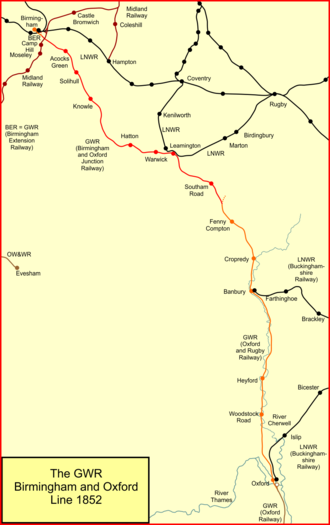
- The first phase was the Birmingham and Oxford Junction Railway opened in 1852. The route ran from London Paddington to Birmingham Snow Hill; in 1854, it was extended to Wolverhampton Low Level and, connecting with other GWR lines, became the southern leg of a longer distance route to Shrewsbury, Chester and Birkenhead. It ran via the Great Western Main Line to Didcot and then via Oxford, Banbury and Leamington Spa. This route was circuitous and was 16 miles (26 km) longer between London and Birmingham than the rival London and North Western Railway's Euston-New Street route via Rugby, meaning that the GWR could not compete on journey times.
- The second phase was completed in 1906. In order to create a more direct route, the GWR collaborated with the Great Central Railway (GCR) to create a new railway known as the Great Western and Great Central Joint Railway between Northolt (in north-west London) and Ashendon Junction (west of Aylesbury) via High Wycombe.
- Thirdly, as a final development, the GWR opened the Bicester cut-off line in 1910; this was an 18+1⁄4 mi (29.4 km) connection between the Great Western and Great Central Joint Railway at Ashendon Junction, via Bicester North, to Aynho Junction on the Birmingham line south of Banbury. This shortened the route between London and Birmingham by 18+1⁄2 miles (29.8 km), compared to the original Oxford route, and reduced the fastest London-Birmingham journey times by 20 minutes (from 140 to 120 minutes). Most of the through trains were immediately transferred to the new route, although the original route via Oxford continued in use and is now known as the Cherwell Valley line.
GWR era
Once the route between Birmingham and London was completed in 1852, the GWR introduced its first expresses between the two cities, timed at 2 hours 45 minutes, however this was soon revised to three hours, which matched the timings of the rival LNWR service. There was relatively little improvement for the rest of the 19th century, and three-hour expresses remained the standard timing of both companies until 1905, when the LNWR introduced new, more powerful Precursor Class locomotives, which allowed them to introduce two-hour expresses. The GWR could not compete with this, and it spurred the shortening of its route, as detailed above, which allowed them to introduce a matching timing of two hours once the works were completed in 1910.
Heyday, decline and rationalisation


During the heyday of the route, many prestigious trains ran from Paddington to the north-west of England, via the Joint Line; these reached Wolverhampton, Shrewsbury, Wrexham General, Chester and Birkenhead Woodside. Various through services from Marylebone to the GCR network also ran via the Joint Line between London and Ashendon Junction.
At nationalisation in 1948, the line passed to the Western Region of British Railways, which continued to operate Paddington-Birmingham-Wolverhampton-Birkenhead fast trains through the 1950s in competition with the London Midland Region's (LMR) from Euston via the West Coast Main Line (WCML).
The Paddington-Birmingham-Wolverhampton-Birkenhead fast service was increased sharply in frequency to up to 15 trains a day each way from the 1959–60 timetable to compensate for the withdrawal of most London Midlands Region trains during electrification of the WCML. For the same reason, the Chiltern line was used by many trains between Paddington and Birkenhead from 1965.
All local trains were diverted to Marylebone in 1963 and operated by four-car Class 115 diesel multiple units (DMUs) and the main-line platforms at Greenford, on the New North route between Old Oak Common and Northolt Junction, were closed.
After the GCR main line was closed between Calvert and Rugby Central in September 1966, some trains from the South Coast were diverted north of Banbury via the route. These became the forerunners of today's CrossCountry services between Birmingham and Bournemouth.

On 6 March 1967, after completion of the WCML electrification, express trains from Paddington to Birmingham/Wolverhampton/Birkenhead were discontinued under The Reshaping of British Railways. The route was downgraded to secondary status, with all but one of the main-line services between London and Birmingham diverted via Oxford. In 1968, the line between Princes Risborough and Aynho Junction was reduced to single track and only a basic two-hourly DMU service between Marylebone and Banbury remained to serve Bicester. Through lines were removed from most of those stations which had them, including Denham in 1965, Beaconsfield in 1973 and Gerrards Cross in 1989; the relief lines were lifted between Lapworth and Tyseley. The tunnel between Birmingham Moor Street and Snow Hill was closed on 2 March 1968. Local services from Leamington and Stratford terminated at Moor Street; the remaining services from Paddington and the South Coast were diverted into New Street. Snow Hill closed completely, along with most of the line to Wolverhampton, on 4 March 1972.
On 24 March 1974, the line from Marylebone to Banbury transferred from the Western Region to the London Midland Region; all stations between South Ruislip and Bicester were also transferred to LMR, giving LMR the responsibility of all passenger services out of Marylebone.
In 1977, the Parliamentary Select Committee on Nationalised Industries recommended considering electrification of more of the rail network and, by 1979, BR presented a range of options to electrify numerous routes by 2000. Some of these options included the Banbury–Birmingham section of the line, plus the Cherwell Valley Line and the Coventry to Leamington line. Under the 1979–90 Conservative governments that succeeded the 1976–79 Labour government, the proposals were not implemented.
The route was considered for partial closure between Marylebone and Northolt Junction in the early 1980s. All services would have run to Paddington, via the New North route; Marylebone station, and all lines leading to it, would have been closed and converted into a bus station. Services to and from Aylesbury would have been taken over by London Underground and run into Baker Street. However, these proposals proved impractical and Marylebone was formally reprieved in 1986 (with a press announcement made on 30 April 1986) and the closure proposals rescinded.
Rejuvenation

With the sectorisation of British Rail in the mid-1980s, operations south of Banbury fell under the control of Network SouthEast in 1986, under the Thames & Chiltern sub-sector; this was split later into two constituent parts. In 1987, a new station was opened at Haddenham & Thame Parkway. Birmingham Snow Hill reopened in 1987, on a much smaller scale than the original, beneath a multi-storey car park; its tunnel was reinstated and new platforms added to the through lines at Moor Street, where the terminus was taken out of use. Leamington/Stratford services were diverted to Snow Hill.
The opening of the extension of the parallel M40 motorway from Oxford to Birmingham in 1991 spawned development in towns along the northern section of the route, notably Bicester, Banbury, Leamington Spa and Warwick. This generated additional patronage for train services in the corridor.
Between 1988 and 1992, British Rail used the Chiltern Line as a test bed for total route modernisation; this included resignalling from Marylebone to Aynho Junction, and both Marylebone to Aylesbury routes, from the new Marylebone Integrated Control Centre, with full Automatic Train Protection provided. The track was renewed and Marylebone was refurbished. Much of this work was funded by selling part of Marylebone for development, which meant that the station lost two of its platforms; the central cab road at Marylebone was removed and two replacement platforms inserted in its place.
New Class 165 Networker Turbo trains were introduced in 1991, replacing the ageing 1960s diesels. These improved passenger comfort and enabled journey times to be reduced; frequencies were increased, with an hourly stopping service to/from High Wycombe and hourly semi-fast service to/from Banbury. In 1993, Marylebone-Banbury services were extended to Snow Hill, calling at Leamington Spa, Warwick, Solihull and Moor Street, initially on a two-hourly frequency; these were increased to hourly in the following year. In 1995, the Jewellery Line was reopened, to allow Worcester line services to be diverted from New Street to Snow Hill; this resulted in some of Chiltern's weekday peak-period services to be extended beyond Snow Hill, first to Stourbridge Junction and then to Kidderminster.
Chiltern Railways era
Upon railway privatisation in 1996, the Chiltern Railways franchise was won by M40 Trains, a consortium of a management buyout, Laing Rail (a subsidiary of construction company and PFI specialist John Laing plc) and venture capitalist 3i. In 1998, the line between Princes Risborough and Bicester North was redoubled by the company; this included the total reconstruction of Haddenham and Thame Parkway at platform level, with two side platforms instead of the single platform constructed in 1987, and a new down platform at Princes Risborough, together with the raising of the speed limit. Also in 1998, the first Class 168 Clubman trains, with a maximum speed of 100 miles per hour (160 km/h), were introduced to reduce journey times.

In 2000, Chiltern Railways opened a new station at Warwick Parkway, to the west of the town next to the A46 and close to M40 Junction 15. This was intended to be a railhead for nearby towns without a station, such as Kenilworth, and for towns south of Birmingham close to the M42 with no direct rail link to London, such as Redditch and Bromsgrove. Construction was funded by Chiltern Railways, with some support from Warwickshire County Council. At first, only Chiltern services called there but it is now also served by West Midlands Railway.
In 2002, after Chiltern won its 20-year franchise, the line between Bicester North and Aynho Junction was also redoubled. Chiltern took over Hatton to Stratford-upon-Avon services from Thames Trains and Central Trains, with direct services between Marylebone (rather than Paddington) and Stratford. Also at this time, Chiltern took over the operation of Leamington Spa, Warwick, Hatton and Lapworth stations from Central Trains, as the latter's services (now operated by London Midland) no longer operated beyond Dorridge except during weekday peak periods.
John Laing plc acquired 84% ownership of M40 Trains in 1999, buying out 3i; it was itself bought out by Henderson Investments in 2006, resulting in the sale of Laing Rail to the German national railway operator Deutsche Bahn in 2007.
The Cherwell Valley line between Banbury and Leamington Spa was resignalled during 2004, with the closure of Fenny Compton signal box and the removal of its remaining semaphore signals. The new signalling and the existing signalling in the Leamington Spa station area is controlled from the box at Leamington via a new Westcad workstation. More recently, the Leamington to Birmingham section has been resignalled and is controlled from the new West Midlands ICC at Saltley (taking over the old signalling centre at Saltley), with new 4-aspect LED signals throughout. But the manual signal boxes at Banbury North and South remained, along with some GWR lower-quadrant signals controlling the bay platforms and sidings at the station. In 2016, the station was remodelled and resignalled, being incorporated into the West Midlands ICC take over control as Oxford (exclusive) in 2016.
Most of the route from Birmingham Snow Hill to Wolverhampton is now used by the West Midlands Metro light-rail system, which diverges from Network Rail's Jewellery Line at The Hawthorns.
The route between Marylebone and Leamington/Bordesley was used by open access operator Wrexham & Shropshire's services from London to Wrexham, via Tame Bridge, Wolverhampton and Shrewsbury; this consisted of three Mark 3 coaches, powered by Class 67 diesel locomotives. Since these were neither Sprinters nor High Speed Trains, they were restricted to lower line speeds, e.g. 60 miles per hour (97 km/h) between Princes Risborough and Bicester, and 70 miles per hour (110 km/h) between Leamington and Bordesley; they were permitted to travel at 85 miles per hour (137 km/h) between Bicester and Aynho. Wrexham & Shropshire had negotiated with Network Rail to allow its trains to travel at higher speeds on these sections, which required it to show that they had sufficient brake force to stop from such speeds within the signal spacings.
Only the little-used line from Northolt Junction to Paddington has not been improved.
In September 2006, Chiltern completed its Evergreen 2 upgrade project, carried out by Carillion, which realigned the track through Beaconsfield to increase non-stop speeds from 40 to 75 miles per hour (64 to 121 km/h), installed additional signals between High Wycombe and Bicester North and between Princes Risborough and Aylesbury, and added two platforms (Nos 5 and 6) at Marylebone, on the site of the daytime carriage sidings, replaced by the new Wembley Light Maintenance Depot, just south and west of Wembley Stadium station. The new platforms and partial resignalling of the station throat made it possible to run 20 trains per hour in and out of the station.
At weekends during 2008, when major engineering works were taking place on the WCML, the line was used by Virgin Trains' London Euston – Birmingham International Blockade Buster service via Willesden, Acton Main Line, Ealing Broadway, Greenford, High Wycombe, Banbury and Coventry, using pairs of five-car Class 221 Super Voyager sets.
Infrastructure
Tunnels and viaducts

There are several major civil engineering structures along the route of the Chiltern Main Line.
The viaduct (Chalfonts No. 1 (Misbourne) Viaduct) crossing the M25 between Denham Golf Club and Gerrard's Cross is especially noted as a local landmark, as for many years it has borne a graffiti slogan, "give peas a chance" painted in large white letters on the south-facing parapet. The graffiti was partially removed in 2018.
| Railway Structure | Length | ELR | Location |
|---|---|---|---|
| Snow Hill Tunnel | 635 yards (581 m) | DCL | South of Snow Hill station |
| Bordesley Viaduct | 38 chains (760 m) | South of Moor Street station | |
| Goods Yard Approach & Corporation Yard Viaducts | 18 chains (360 m) | Bordesley station | |
| River Avon Viaduct | 3 chains (60 m) | Between Warwick and Leamington Spa stations | |
| Leamington Viaducts / Neilson Street Viaduct | 18 chains (360 m) | East of Leamington Spa station | |
| Harbury Tunnel | 70 yards (64 m) | Between Leamington Spa and Banbury stations | |
| Aynho Flyover (Down line) | NAJ3 | Between Kings Sutton and Bicester North stations | |
| Souldern No. 2 Viaduct | 400 yards (366 m) | Between Aynho junction and Bicester North station | |
| Souldern No. 1 Viaduct | 580 yards (530 m) | ||
| Ardley Tunnel | 1,155 yards (1,056 m) | ||
| Brill Tunnel | 191 yards (175 m) | Between Bicester North and Haddenham and Thame Parkway stations | |
| River Thame Viaduct | 4 chains (80 m) | NAJ2 | North of Haddenham and Thame Parkway station |
| Saunderton Tunnel (Up line) | 83 yards (76 m) | South of Princes Risborough station | |
| Hughenden Road Viaduct | 77 yards (70 m) | North of High Wycombe station | |
| Gordon Road Viaduct | 47 yards (43 m) | Between High Wycombe and Beaconsfield stations | |
| Sir Philip Rose's Viaduct | 66 yards (60 m) | ||
| Whitehouse Tunnel | 352 yards (322 m) | ||
| 'Tesco' Covered Way (also known as Gerrards Cross Tunnel) | 350 yards (320 m) | South of Gerrards Cross station | |
| Chalfonts No. 2 Viaduct | 165 yards (151 m) | Between Gerrards Cross and Denham Golf Club stations | |
| Chalfonts No. 1 (Misbourne) Viaduct (also M25 under) | 114 yards (104 m) | ||
| River Colne Viaduct | 121 yards (111 m) | South of Denham station | |
| Grand Union Canal Viaduct | 198 yards (181 m) | ||
| South Harrow Tunnel | 204 yards (187 m) | NAJ1 | West of Sudbury Hill Harrow station |
| Kilburn Viaduct | 23 chains (460 m) | MCJ1 | North of Marylebone station |
| Hampstead Tunnel | 694 yards (635 m) | ||
| St John's Wood Tunnel | 1,606 yards (1,469 m) |
Oxford Connection
A quarter of a mile (about 0.3 km) of double track has been constructed joining the Oxford to Bicester Line at Bicester Village to the Chiltern line, allowing a new Oxford to London Marylebone service to operate, calling at Bicester Village and High Wycombe. The track between Wolvercote Tunnel (on the outskirts of Oxford) and Bicester Village has been rebuilt and a new station constructed at Water Eaton, named Oxford Parkway. The scheme includes additional platforms at Bicester, Islip and Oxford. The Oxford line was reopened in stages during 2015 and 2016; services from London Marylebone to Oxford Parkway began in October 2015. Services through to Oxford started on 11 December 2016. The delay to the full service was due to works in the Wolvercote tunnel, which were specifically scheduled to minimise disruption to roosting bats. The upgraded track has two bi-directional tracks and headroom in the tunnel for overhead electrification to be installed at a later date.
Main Line upgrade
The second part of the project upgraded the line to 100 miles per hour (160 km/h) running on 50 miles (80 km) more of track, with junctions at Neasden, Northolt and Aynho rebuilt to permit higher speeds. The up through track was restored at Princes Risborough and signalled for bidirectional use, the existing 'up' line becoming a bidirectional platform loop. A new turnback siding was provided at Gerrards Cross and a new 'down' through track built from Northolt Junction to Ruislip Gardens, running alongside the up line to the east of the waste transfer station; the down line will continue to serve South Ruislip. Speed restrictions through Bicester North were raised to permit 100-mile-per-hour (160 km/h) running, with a new up alignment and platform. Two of the original terminal platforms at Birmingham Moor Street were reopened for Chiltern services in December 2010. Accelerated services started in September 2011, after being postponed due to concerns about whether the works would be completed in time.
Thanks to the speed increases, journey times have been reduced significantly. From Marylebone, the fastest journey time to Birmingham Moor Street is now 94 minutes instead of 117 minutes. The table below outlines the originally proposed peak timetable improvements as indicated by Network Rail. This compares to roughly 85 minutes for the fastest Euston-Birmingham New Street trains, via the West Coast Main Line.
Chiltern Railways chairman Adrian Shooter said, "This is the biggest passenger rail project for several generations not to call on the taxpayer for support. Working closely with Network Rail, we are going to create a new main line railway for the people of Oxfordshire and the Midlands. This deal demonstrates that real improvements to rail services can be paid for without public subsidy by attracting people out of their cars and on to trains."
Network Rail said its investment will be reimbursed by a 'facility charge' over the next 30 years, by Chiltern Railways, whose franchise expires in December 2021, and then by the future franchisee. The infrastructure upgrade was carried out by main contractor BAM Nuttall, in partnership with Jarvis and WS Atkins.
| Previous | Evergreen 3 | |
|---|---|---|
| Gerrards Cross | 21 | 18 |
| High Wycombe | 34 | 23 |
| Princes Risborough | 41 | 32 |
| Bicester | 56 | 44 |
| Banbury | 67 | 50 |
| Leamington Spa | 85 | 67 |
| Solihull | 107 | 84 |
| Birmingham Moor Street | 117 | 92 |
Passenger services
While Chiltern Railways is the main operator of the route, parts of the line carry services by other operators:
- West Midlands Trains operates local services in the West Midlands area between Birmingham, Dorridge and Leamington Spa, as part of the Snow Hill Lines
- CrossCountry operates some services from either Birmingham (joining the line at Bordesley junction) or Leamington (joining from the Coventry-Leamington line) and running as far as Aynho Junction where they diverge towards Oxford
- Great Western Railway also operates a route between Didcot Parkway to Banbury
Weekday off-peak service pattern
At December 2025:
| Service | Type | Trains per hour | Notes |
|---|---|---|---|
| Chiltern Railways, over the whole line | |||
| London Marylebone – Birmingham Moor Street | Fast | 2 | 1 TPH usually is extended to Birmingham Snow Hill. One morning and one evening service extended to Stourbridge Junction. |
| London Marylebone – Banbury | Semi fast | 1 | |
| London Marylebone – Bicester North | Semi-fast | 1 | |
| London Marylebone – Princes Risborough | Semi-fast | 1 | |
| London Marylebone – High Wycombe | local | 1 | |
| London Marylebone – Gerrards Cross | local | 1 | |
| Leamington Spa – Birmingham Moor Street | local | 2 | |
| West Midlands Trains, between Birmingham Moor Street and Leamington Spa | |||
| Service | Type | Trains Per Hour | Stations on Chiltern Main Line called at |
| Stratford-upon-Avon – Worcester Foregate Street via Dorridge | local | 1 | Lapworth, Dorridge, Widney Manor, Solihull, Olton, Acocks Green, Small Heath, Birmingham Moor Street |
| Stratford-upon-Avon – Kidderminster via Whitlocks End | local | 1 | Tyseley, Small Heath, Birmingham Moor Street |
| Whitlocks End – Kidderminster | local | 1 | Tyseley, Small Heath, Birmingham Moor Street |
| Dorridge – Worcester Foregate Street | local | 1 | Dorridge, Widney Manor, Solihull, Olton, Acocks Green, Tyseley, Birmingham Moor Street |
| Leamington Spa – Nuneaton | local | 1 | Leamington Spa |
| Cross Country, between Birmingham Moor Street and Leamington Spa | |||
| Bournemouth – Manchester Piccadilly | Inter-city | 1 | Banbury, Leamington Spa |
| Reading – Newcastle | Inter-city | 4 tpd | Banbury, Leamington Spa |
| Birmingham New Street - Nottingham | Inter-city | 1 southbound tpd | Banbury, Leamington Spa |
| GWR, between Banbury and Aynho Junction | |||
| Didcot Parkway to Banbury | local | 1tp2h | Banbury |
Rolling stock
Passenger trains are operated by:
| Chiltern Railways | ||||||
|---|---|---|---|---|---|---|
| Class | Image | Type | Top speed | Cars per set | Built | |
| mph | km/h | |||||
| Class 165/0 Network Turbo | Diesel multiple unit | 75 | 120 | 2 or 3 | 1990–1992 | |
| Class 168/0 Clubman | Diesel multiple unit | 100 | 160 | 4 | 1998 | |
| Class 168/1 Turbostar Clubman | Diesel multiple unit | 100 | 160 | 3 or 4 | 2000 | |
| Class 168/2 Turbostar Clubman | Diesel multiple unit | 100 | 160 | 3 or 4 | 2004 | |
| Class 168/3 Turbostar Clubman | Diesel multiple unit | 100 | 160 | 3 or 4 | 2000 | |
| Class 68 | Diesel Locomotive | 100 | 160 | N/A | 2013–2014 | |
| Mark 3 Coach | Passenger Coach | 125 | 200 | N/A | 1975–1984 | |
| Driving Van Trailer | 125 | 200 | N/A | 1988 | ||
| Mark 5A Coach | Passenger Coach | 125 | 200 | N/A | 2017-2018 | |
| Driving Trailer | ||||||
| West Midlands Trains | ||||||
| Class | Image | Type | Top speed | Cars per set | Built | |
| mph | km/h | |||||
| Class 172/2 Turbostar | Diesel multiple unit | 100 | 161 | 2 | 2011 | |
| Class 172/3 Turbostar | 100 | 161 | 3 | |||
| Class 196/0 Civity | Diesel multiple unit | 100 | 161 | 2 | 2019-2022 | |
| Class 196/1 Civity | 4 | |||||
| CrossCountry | ||||||
| Class | Image | Type | Top speed | Cars per set | Built | |
| mph | km/h | |||||
| Class 220 Voyager | Diesel-electric multiple unit | 125 | 200 | 4 | 2001 | |
| Class 221 Super Voyager | Diesel-electric multiple unit | 125 | 200 | 4 or 5 | 2001 | |
| Great Western Railway | ||||||
| Class | Image | Type | Top speed | Cars per set | Built | |
| mph | km/h | |||||
| Class 165/1 Network Turbo | Diesel multiple unit | 90 | 145 | 2 or 3 | 1992 |
Former rolling stock
| Chiltern Railways | |||||||
|---|---|---|---|---|---|---|---|
| Class | Image | Type | Top Speed | Cars per set | Built | Year Withdrawn | |
| mph | km/h | ||||||
| Class 172/1 Turbostar | Diesel multiple unit | 100 | 160 | 2 | 2011 | 2021 | |
| West Midlands Railway | |||||||
| Class | Image | Type | Top speed | Cars per set | Built | Year Withdrawn | |
| mph | km/h | ||||||
| Class 153 Super Sprinter | Diesel multiple unit | 75 | 121 | 1 | 1987–1988 | 2020 | |
| Class 170/5 Turbostar | Diesel multiple unit | 100 | 161 | 2 | 1999–2000 | 2021-2023 | |
| Class 170/6 Turbostar | Diesel multiple unit | 100 | 161 | 3 | 1999–2000 | 2021-2023 |
Connections
These are available at:
- Birmingham Snow Hill, to Kidderminster and Worcester, and Midland Metro to West Bromwich and Wolverhampton.
- Birmingham Moor Street, to Stratford-upon-Avon
- Leamington Spa, to Stratford-upon-Avon, Coventry, Birmingham International, and The North
- Banbury, to Oxford, Reading, and Southampton Central
- Princes Risborough, to Aylesbury
- West Ruislip/South Ruislip, to the LU Central line to Oxford Circus
- London Marylebone, to Aylesbury and the LU Bakerloo line to Oxford Circus
Birmingham New Street, the city's main station, is a five-minute walk from Moor Street; Baker Street, where several London Underground lines call, is a five-minute walk from London Marylebone.
Future
Battery/diesel trains
In September 2021, Class 168/3 HybridFlex battery/diesel trains were introduced, with lower emissions. The trains operate on batteries, giving zero emissions when in stations or sensitive urban areas. However, the trains were removed from service in September 2023 as the diesel engine emitted high pollutants in stations.
Electrification
No section of the line is electrified but, in 2010, the then chairman of Chiltern Railways, Adrian Shooter, indicated that electrification was being considered, though not in the immediate future. He added: "We could do some very interesting things with high-acceleration electric multiple units and possibly some further infrastructure work."
Other plans
There are several proposals:
- The restoration of the quadruple track between South Ruislip and West Ruislip, allowing trains to call at both stations without blocking the line.[citation needed] Triple track currently exists at West Ruislip, with the up platform loop still in situ, and at South Ruislip, with the Down Main through line in situ. This would involve the reconstruction of the down platform at West Ruislip, the reconstruction of the up platform at South Ruislip and the demolition of West Ruislip signal box.
- Building of a new combined West Hampstead Interchange, bringing together what are currently three close by, but physically separated stations to allow easy interchange with the London Overground (Mildmay Line), London Underground (Jubilee line) and Thameslink (Thameslink line) and Chiltern Railways, with new Metropolitan line platforms possible.