Classical Wiener space
In-game article clicks load inline without leaving the challenge.
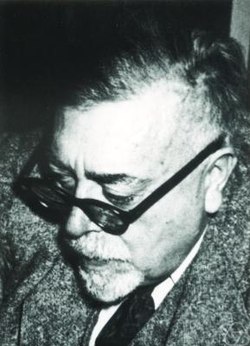
In mathematics, classical Wiener space is the collection of all continuous functions on a given domain (usually a subinterval of the real line), taking values in a metric space (usually n-dimensional Euclidean space). Classical Wiener space is useful in the study of stochastic processes whose sample paths are continuous functions. It is named after the American mathematician Norbert Wiener.
Definition
Consider E ⊆ R n {\displaystyle E\subseteq \mathbb {R} ^{n}} and a metric space ( M , d ) {\displaystyle (M,d)}. The classical Wiener space C ( E , M ) {\displaystyle C(E,M)} is the space of all continuous functions f : E → M . {\displaystyle f:E\to M.} That is, for every fixed t ∈ E , {\displaystyle t\in E,}
d ( f ( s ) , f ( t ) ) → 0 {\displaystyle d(f(s),f(t))\to 0} as | s − t | → 0. {\displaystyle |s-t|\to 0.}
In almost all applications, one takes E = [ 0 , T ] {\displaystyle E=[0,T]} or E = R + = [ 0 , + ∞ ) {\displaystyle E=\mathbb {R} _{+}=[0,+\infty )} and M = R n {\displaystyle M=\mathbb {R} ^{n}} for some n ∈ N . {\displaystyle n\in \mathbb {N} .} For brevity, write C {\displaystyle C} for C ( [ 0 , T ] ) ; {\displaystyle C([0,T]);} this is a vector space. Write C 0 {\displaystyle C_{0}} for the linear subspace consisting only of those functions that take the value zero at the infimum of the set E . {\displaystyle E.} Many authors refer to C 0 {\displaystyle C_{0}} as "classical Wiener space".
Properties of classical Wiener space
Uniform topology
The vector space C {\displaystyle C} can be equipped with the uniform norm
‖ f ‖ := sup t ∈ [ 0 , T ] | f ( t ) | {\displaystyle \|f\|:=\sup _{t\in [0,\,T]}|f(t)|}
turning it into a normed vector space (in fact a Banach space since [ 0 , T ] {\displaystyle [0,T]} is compact). This norm induces a metric on C {\displaystyle C} in the usual way: d ( f , g ) := ‖ f − g ‖ {\displaystyle d(f,g):=\|f-g\|}. The topology generated by the open sets in this metric is the topology of uniform convergence on [ 0 , T ] , {\displaystyle [0,T],} or the uniform topology.
Thinking of the domain [ 0 , T ] {\displaystyle [0,T]} as "time" and the range R n {\displaystyle \mathbb {R} ^{n}} as "space", an intuitive view of the uniform topology is that two functions are "close" if we can "wiggle space slightly" and get the graph of f {\displaystyle f} to lie on top of the graph of g {\displaystyle g}, while leaving time fixed. Contrast this with the Skorokhod topology, which allows us to "wiggle" both space and time.
If one looks at the more general domain R + {\displaystyle \mathbb {R} _{+}} with
‖ f ‖ := sup t ≥ 0 | f ( t ) | , {\displaystyle \|f\|:=\sup _{t\geq 0}|f(t)|,}
then the Wiener space is no longer a Banach space, however it can be made into one if the Wiener space is defined under the additional constraint
lim s → ∞ s − 1 | f ( s ) | = 0. {\displaystyle \lim \limits _{s\to \infty }s^{-1}|f(s)|=0.}
Separability and completeness
With respect to the uniform metric, C {\displaystyle C} is both a separable and a complete space:
- Separability is a consequence of the Stone–Weierstrass theorem;
- Completeness is a consequence of the fact that the uniform limit of a sequence of continuous functions is itself continuous.
Since it is both separable and complete, C {\displaystyle C} is a Polish space.
Tightness in classical Wiener space
Recall that the modulus of continuity for a function f : [ 0 , T ] → R n {\displaystyle f:[0,T]\to \mathbb {R} ^{n}} is defined by
ω f ( δ ) := sup { | f ( s ) − f ( t ) | : s , t ∈ [ 0 , T ] , | s − t | ≤ δ } . {\displaystyle \omega _{f}(\delta ):=\sup \left\{|f(s)-f(t)|:s,t\in [0,T],\,|s-t|\leq \delta \right\}.}
This definition makes sense even if f {\displaystyle f} is not continuous, and it can be shown that f {\displaystyle f} is continuous if and only if its modulus of continuity tends to zero as δ → 0 : {\displaystyle \delta \to 0:}
f ∈ C ⟺ ω f ( δ ) → 0 as δ → 0 {\displaystyle f\in C\iff \omega _{f}(\delta )\to 0{\text{ as }}\delta \to 0}.
By an application of the Arzelà-Ascoli theorem, one can show that a sequence ( μ n ) n = 1 ∞ {\displaystyle (\mu _{n})_{n=1}^{\infty }} of probability measures on classical Wiener space C {\displaystyle C} is tight if and only if both the following conditions are met:
lim a → ∞ lim sup n → ∞ μ n { f ∈ C : | f ( 0 ) | ≥ a } = 0 , {\displaystyle \lim _{a\to \infty }\limsup _{n\to \infty }\mu _{n}\{f\in C:|f(0)|\geq a\}=0,} and
lim δ → 0 lim sup n → ∞ μ n { f ∈ C : ω f ( δ ) ≥ ε } = 0 {\displaystyle \lim _{\delta \to 0}\limsup _{n\to \infty }\mu _{n}\{f\in C:\omega _{f}(\delta )\geq \varepsilon \}=0} for all ε > 0. {\displaystyle \varepsilon >0.}
Classical Wiener measure
There is a "standard" measure on C 0 , {\displaystyle C_{0},} known as classical Wiener measure (or simply Wiener measure). Wiener measure has (at least) two equivalent characterizations:
If one defines Brownian motion to be a Markov stochastic process B : [ 0 , T ] × Ω → R n , {\displaystyle B:[0,T]\times \Omega \to \mathbb {R} ^{n},} starting at the origin, with almost surely continuous paths and independent increments
B t − B s ∼ N o r m a l ( 0 , | t − s | ) , {\displaystyle B_{t}-B_{s}\sim \,\mathrm {Normal} \left(0,|t-s|\right),}
then classical Wiener measure γ {\displaystyle \gamma } is the law of the process B . {\displaystyle B.}
Alternatively, one may use the abstract Wiener space construction, in which classical Wiener measure γ {\displaystyle \gamma } is the radonification of the canonical Gaussian cylinder set measure on the Cameron-Martin Hilbert space corresponding to C 0 . {\displaystyle C_{0}.}
Classical Wiener measure is a Gaussian measure: in particular, it is a strictly positive probability measure.
Given classical Wiener measure γ {\displaystyle \gamma } on C 0 , {\displaystyle C_{0},} the product measure γ n × γ {\displaystyle \gamma ^{n}\times \gamma } is a probability measure on C {\displaystyle C}, where γ n {\displaystyle \gamma ^{n}} denotes the standard Gaussian measure on R n . {\displaystyle \mathbb {R} ^{n}.}
Coordinate maps for the Wiener measure
For a stochastic process { X t , t ∈ [ 0 , T ] } : ( Ω , F , P ) → ( M , B ) {\displaystyle \{X_{t},t\in [0,T]\}:(\Omega ,{\mathcal {F}},P)\to (M,{\mathcal {B}})} and the function space M E ≡ { E → M } {\displaystyle M^{E}\equiv \{E\to M\}} of all functions from E {\displaystyle E} to M {\displaystyle M}, one looks at the map φ : Ω → M E {\displaystyle \varphi :\Omega \to M^{E}}. One can then define the coordinate maps or canonical versions Y t : M E → M {\displaystyle Y_{t}:M^{E}\to M} defined by Y t ( ω ) = ω ( t ) {\displaystyle Y_{t}(\omega )=\omega (t)}. The { Y t , t ∈ E } {\displaystyle \{Y_{t},t\in E\}} form another process. For M = R {\displaystyle M=\mathbb {R} } and E = R + {\displaystyle E=\mathbb {R} _{+}}, the Wiener measure is then the unique measure on C 0 ( R + , R ) {\displaystyle C_{0}(\mathbb {R} _{+},\mathbb {R} )} such that the coordinate process is a Brownian motion.
Subspaces of the Wiener space
Let H ⊂ C 0 ( [ 0 , R ] ) {\displaystyle H\subset C_{0}([0,R])} be a Hilbert space that is continuously embbeded and let γ {\displaystyle \gamma } be the Wiener measure then γ ( H ) = 0 {\displaystyle \gamma (H)=0}. This was proven in 1973 by Smolyanov and Uglanov and in the same year independently by Guerquin. However, there exists a Hilbert space H ⊂ C 0 ( [ 0 , R ] ) {\displaystyle H\subset C_{0}([0,R])} with weaker topology such that γ ( H ) = 1 {\displaystyle \gamma (H)=1} which was proven in 1993 by Uglanov.
See also
- Abstract Wiener space
- Gaussian probability space
- Malliavin calculus
- Malliavin derivative
- Skorokhod space, a generalization of classical Wiener space, which allows functions to be discontinuous
- Wiener process