Combined approval voting
In-game article clicks load inline without leaving the challenge.
Combined approval voting (CAV) is an electoral system where each voter may express approval, disapproval, or indifference toward each candidate. The winner is the candidate with the highest score, which is determined by subtracting the number of disapproval votes from the number of approval votes.
It is a cardinal system and a variant of score voting. It has also been referred to as dis&approval voting, balanced approval voting (BAV), approval with abstention option (AWAO), true weight voting (TWV1), or evaluative voting (EV) (though the latter can also be used for variants with more than 3 values.) It has also been called net approval voting (though this term has a different definition in the context of approval-based committee selection).
Procedure

Ballots contain a list of candidates, with three options next to each: "approve"/"disapprove"/"abstain", "for"/"against"/"neutral", or similar. The ballot warns that blanks for a candidate are scored as "indifferent" votes. Voters express their opinion of each candidate, and the votes are summed, with support = +1 and opposition = −1. The candidate with the largest score is the winner.
It is also possible to use ballots with two options, "approve"/"disapprove" and treat blanks as abstentions.
Unlike approval voting, in which non-approval could mean either disapproval or indifference, CAV allows explicit expression of disapproval, which is hoped to increase turnout, and reduce spoiled/blank ballots and insincere votes for unviable candidates. Some jurisdictions allow a "none of the above" option to express disapproval of all candidates, but ballots that allow disapproval of specific candidates are otherwise rare.
Example
| 42% of voters | 26% of voters | 15% of voters | 17% of voters |
|---|---|---|---|
| Ʌ V ⚫ ⚪ Memphis ⚪ ⚪ Nashville ⚪ ⚫ Chattanooga ⚪ ⚫ Knoxville | Ʌ V ⚪ ⚫ Memphis ⚫ ⚪ Nashville ⚪ ⚪ Chattanooga ⚪ ⚫ Knoxville | Ʌ V ⚪ ⚫ Memphis ⚪ ⚪ Nashville ⚫ ⚪ Chattanooga ⚪ ⚪ Knoxville | Ʌ V ⚪ ⚫ Memphis ⚪ ⚪ Nashville ⚫ ⚪ Chattanooga ⚫ ⚪ Knoxville |
| Ʌ | V | ||
| ⚫ | ⚪ | Memphis | |
| ⚪ | ⚪ | Nashville | |
| ⚪ | ⚫ | Chattanooga | |
| ⚪ | ⚫ | Knoxville | |
| Ʌ | V | ||
| ⚪ | ⚫ | Memphis | |
| ⚫ | ⚪ | Nashville | |
| ⚪ | ⚪ | Chattanooga | |
| ⚪ | ⚫ | Knoxville | |
| Ʌ | V | ||
| ⚪ | ⚫ | Memphis | |
| ⚪ | ⚪ | Nashville | |
| ⚫ | ⚪ | Chattanooga | |
| ⚪ | ⚪ | Knoxville | |
| Ʌ | V | ||
| ⚪ | ⚫ | Memphis | |
| ⚪ | ⚪ | Nashville | |
| ⚫ | ⚪ | Chattanooga | |
| ⚫ | ⚪ | Knoxville |
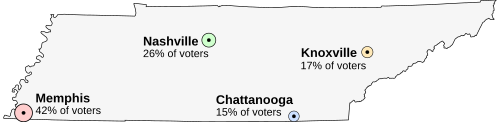
Suppose Tennessee is holding an election on the location of its capital. The population is split between four cities, and all the voters want the capital to be as close to them as possible. The options are:
- Memphis, large but far to the west
- Nashville, medium, near the center
- Chattanooga, small and in the east
- Knoxville, small and isolated
Suppose that 100 voters each decided to approve their city and disapprove the cities furthest from theirs.
| Voter from/ City choice | Memphis | Nashville | Chattanooga | Knoxville | Total |
|---|---|---|---|---|---|
| Memphis | 42 | -26 | -15 | -17 | -16 |
| Nashville | 0 | 26 | 0 | 0 | 26 |
| Chattanooga | -42 | 0 | 15 | 17 | -10 |
| Knoxville | -42 | -26 | 0 | 17 | -51 |
Nashville, the capital in real life, receives 26 approvals from its citizens and zero disapprovals from everyone else, so it wins with a net approval of 26. In this particular case, there is no way for any single city of voters to get a better outcome through tactical voting; however, Memphis voters could vote against Nashville to reduce its net approval down to as low as -16 and make Chattanooga win, while Nashville voters could prevent that by abstaining from voting on Memphis so that it wins with a net approval of up to 10.
History
CAV has been independently invented many times. It was originally proposed by Dan Felsenthal in 1989. Alcantud and Laruelle gave it the name "Dis&approval voting" in 2012.
Properties
As this is mathematically equivalent to 3-level score voting, it shares the same properties. For instance, it is always safe for a voter to approve their honest favorite (the favorite betrayal criterion).
While a (-1, 0, +1) scale is mathematically identical to a (0, 1, 2) scale, there are psychological differences between the two, and the introduction of negative ratings (combined with the change in scoring blanks as middle grades rather than lowest grades) changes the scores that candidates receive in each system. Studies of French voters in 2012 found that, while the highest-rated candidate was the same under either system, and the grades of "exclusive" (polarizing) candidates were relatively unchanged, there were slight increases in the scores of "inclusive" (broadly-liked) candidates, and large increases in the scores of lesser-known candidates.
Unlike other score voting scales, CAV is compatible with existing voting machines that can handle voting for/against ballot initiatives.