Royal Victorian Order
In-game article clicks load inline without leaving the challenge.
The Royal Victorian Order (French: Ordre royal de Victoria) is a dynastic order of knighthood established in 1896 by Queen Victoria. It recognises distinguished personal service to the monarch, members of the royal family, or to any viceroy or senior representative of the monarch. The present monarch, King Charles III, is the sovereign of the order. The order's motto is Victoria. The order's official day is 20 June. The order's chapel is the Savoy Chapel in London.
There is no limit on the number of individuals honoured at any grade. Admission is at the sole discretion of the monarch. Each of the order's five grades represent different levels of service, as does the medal, which has three levels of service. While all those honoured may use the prescribed styles of the order – the top two grades grant titles of knighthood, and all grades accord distinct post-nominal letters – the Royal Victorian Order's precedence amongst other honours differs from realm to realm and admission to some grades may be barred to citizens of those realms by government policy.
History

Prior to the close of the 19th century, most general honours within the British Empire were bestowed by the sovereign on the advice of her British ministers, who sometimes forwarded advice from ministers of the Crown in the Dominions and colonies (appointments to the then most senior orders of chivalry, the Order of the Garter and the Order of the Thistle, had been made on ministerial advice since the 18th century and were not restored to the personal gift of the sovereign until 1946 and 1947, respectively). Queen Victoria thus established on 21 April 1896 the Royal Victorian Order as a junior and personal order of knighthood that allowed her to bestow directly to an empire-wide community honours for personal services. The organisation was founded a year before Victoria's Diamond Jubilee, so as to give the Queen time to complete a list of first inductees. The order's official day was made 20 June of each year, marking the anniversary of Queen Victoria's accession to the throne.
In 1902, King Edward VII created the Royal Victorian Chain "as a personal decoration for royal personages and a few eminent British subjects" and it was the highest class of the Royal Victorian Order. It is today distinct from the order, though it is officially issued by the chancery of the Royal Victorian Order.
The order was open to foreigners from its inception, with the Prefect of Alpes-Maritimes and the Mayor of Nice being the first foreigners to receive the honour in 1896. Commanders of the order had precedence immediately after knights bachelor and ahead of the companions of all the senior orders until 1917, when they were treated like the companions of senior orders and ranked after companions of the Order of the Indian Empire. The order was opened to women by King Edward VIII in 1936.
Composition
The reigning monarch is at the apex of the Royal Victorian Order as its Sovereign, followed by the Grand Master; the latter position was created in 1937 and was occupied by Queen Elizabeth (later the Queen Mother) from that date until her death in 2002. Queen Elizabeth II then appointed her daughter, Anne, Princess Royal, to the position in 2007. Below the Grand Master are five officials of the organisation: the Chancellor, held by the Lord Chamberlain; the Secretary, held by the Keeper of the Privy Purse and Treasurer to the King; the Registrar, held by the Secretary to the Central Chancery of the Orders of Knighthood; the Chaplain, held by the Chaplain of the King's Chapel of the Savoy; and the Genealogist.
Thereafter follow those honoured with different grades of the order, divided into five levels: the highest two conferring accolades of knighthood and all having post-nominal letters and, lastly, the holders of the Royal Victorian Medal in gold, silver or bronze. Foreigners may be admitted as honorary members. There are no limits to the number of any grade, and promotion is possible. The styles of knighthood are not used by princes, princesses, or peers in the uppermost ranks of the society, save for when their names are written in their fullest forms for the most official occasions. Retiring Deans of the Royal Peculiars of St. George's Chapel, Windsor Castle and Westminster Abbey are customarily inducted as Knights Commander; clergymen appointed to the higher levels of the Royal Victorian Order do not use the associated styles, however, and honorary members are not permitted to hold them at all.
Prior to 1984, the grades of Lieutenant and Member were classified as Members (fourth class) and Members (fifth class), respectively, but both with the post-nominals MVO. On 31 December of that year, Queen Elizabeth II declared that those in the grade of Member (fourth class) would henceforth be Lieutenants with the post-nominals LVO.
| Grades of the Royal Victorian Order | ||||||||
|---|---|---|---|---|---|---|---|---|
| Grade | Knight Grand Cross | Dame Grand Cross | Knight Commander | Dame Commander | Commander | Lieutenant | Member | Royal Victorian Medal |
| Prefix | Sir | Dame | Sir | Dame | — | — | — | — |
| Post-nominals | GCVO | KCVO | DCVO | CVO | LVO | MVO | RVM | |
| Insignia |
Insignia and vestments

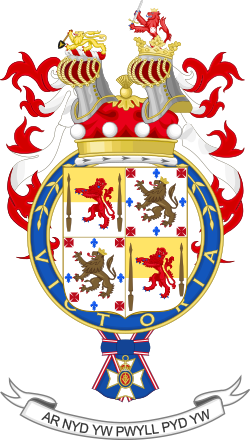
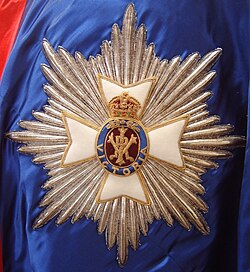
Upon admission into the Royal Victorian Order, members are given various insignia. Common for all members is the badge, which is a Maltese cross with a central medallion depicting on a red background the Royal Cypher of Queen Victoria surrounded by a blue ring bearing the motto of the order – victoria (victory) – and surmounted by a Tudor crown. However, there are variations on the badge for each grade of the order: Knights and Dames Grand Cross on certain formal occasions (see below) wear the badge suspended from the Order's collar (chain), but otherwise on a sash passing from the right shoulder to the left hip; Knight Commanders and male Commanders wear the badge on a ribbon at the neck; male Lieutenants and Members wear the badge from a ribbon on the left chest; and women in all grades below Dame Grand Cross wear the badge on a bow pinned at the left shoulder. For Knights and Dames Grand Cross, Commanders, and Lieutenants, the Maltese cross is rendered in white enamel with gold edging, while that for Knights and Dames Commander (on the star) and Members (the badge itself) is in silver. Further, the size of the badge varies by rank, that for the higher classes being larger, and Knights and Dames Grand Cross and Knights and Dames Commander have their crosses surrounded by a star: for the former, an eight-pointed silver star, and for the latter, an eight-pointed silver Maltese cross with silver rays between each arm.

The medal bears the effigy and name of the reigning sovereign at the time of its awarding, as well as the phrase DEI • GRATIA • REX (or REGINA) • F.D. (by the grace of God, King (or Queen), Defender of the Faith), and on the reverse is the Royal Cypher upon an ornamental shield within a laurel wreath. Bars may be awarded to each class of medal for further services, and should recipients be awarded a higher level of medal or be appointed to a grade of the order itself, they may continue to wear their original medal along with the new insignia.
The order's ribbon is blue with red-white-red stripe edging, the only difference being that for foreigners appointed into the society, their ribbon bears an additional central white stripe. For Knights Grand Cross, the ribbon is 82.5 millimetres (3.25 in) wide, for Dames Grand Cross 57.1 millimetres (2.25 in), for Knights and Dames Commander 44.4 millimetres (1.75 in), and for all other members 31.7 millimetres (1.25 in).
At formal events, or collar days, of which there are 34 throughout the year, such as New Year's Day and royal anniversaries, Knights and Dames Grand Cross wear the Royal Victorian Order's livery collar, consisting of an alternating string of octagonal gold pieces depicting a gold rose on a blue field and gold oblong frames within which are one of four inscriptions: Victoria, Britt. Reg. (Queen of the Britons), Def. Fid. (fidei defensor, or Defender of the Faith), and Ind. Imp. (Empress of India). The chain supports a larger octagonal medallion with a blue enamel surface edged in red and charged with a saltire, over which is an effigy of Queen Victoria; members of the order suspend from this medallion their insignia as a badge apendant. Though after the death of a Knight or Dame Grand Cross their insignia may be retained by their family, the collar must be returned. Knights and Dames Grand Cross also wear a mantle of dark blue satin edged with red satin and lined with white satin, bearing a representation of the order's star on the left side.
Chapel

Since 1938, the chapel of the Royal Victorian Order has been the King's Chapel of the Savoy, in central London, England. However, the population of the order has grown to the point that the Savoy chapel can no longer accommodate the gathering of members held every four years, and St. George's Chapel, Windsor Castle is now employed for the event.
The Sovereign and Knights and Dames Grand Cross of the order are allotted stalls in the Savoy chapel's choir, and on the back of each stall is affixed a brass plate displaying the occupant's name, coat of arms, and date of admission into the organisation. Upon the occupant's death, the plate is retained, leaving the stalls festooned with a record of the order's Knights and Dames Grand Cross since 1938. The only heraldic banners normally on display in the chapel are those of the Sovereign of the Royal Victorian Order and of the Grand Master of the Royal Victorian Order as there is insufficient space in the chapel for more knights' and dames' banners or other heraldic devices.
The Chaplain of the King's Chapel of the Savoy is ex officio the Chaplain to the Royal Victorian Order. The current incumbent is Canon Thomas Woodhouse.
Eligibility and appointment

Membership in the Royal Victorian Order is conferred by the monarch without ministerial advice on those who have performed personal service for the sovereign.
Foreign members will generally be admitted as honorary members of the Royal Victorian Order when the sovereign is making a state visit to the individual's country or a head of state is paying a state visit to the United Kingdom.
Canadians
As admission to the top two levels of the organisation provides for an honorary prefix, Canadians are not normally appointed to these levels as long as the monarch's Canadian ministry adheres to the Nickle Resolution of 1919.
As it was deemed by the Canadian Cabinet to be an honour within the gift of the monarch, the appointment of Canadians to the order resumed in 1972 and eligibility was extended to those who render services to the monarch's representatives in the country; officials within the provincial spheres being included after 1984. Originally, the sovereign chose inductees personally, though the Governor General of Canada and the Canadian Secretary to the King could provide suggestions, some passed to them by the lieutenant governors. The practice of notifying the Prime Minister of Canada of nominees ended in 1982, to distance the order as far from politics as possible.
It was reported in 2008 that some in the Chancellery of Honours at Rideau Hall wished to eliminate the Royal Victorian Order from the Canadian honours system and sometimes contested when a Canadian was appointed; however, no formal changes were ever planned. In Canada, the order has come to be colloquially dubbed as the "Royal Visit Order", as the majority of appointments had been made by the then sovereign during her tours of the country.
Association
The Royal Victorian Order Association of Canada exists for all Canadians appointed to the order or who have received the Royal Victorian Medal; it is the only such organisation in the Commonwealth realms. Founded by D. Michael Jackson (1940–2022), the group has, since 2008, gathered biennially.
Australians
As with Canada, the order remains open for award to Australians, as it is considered a personal gift of the sovereign, and appointments have continued beyond the end of Australia's use of the wider imperial honours system in 1994. The highest grades of GCVO and KCVO/DCVO have been awarded sparingly and, although nominally still open to Australians, have not been awarded since 1990, when Sir William Heseltine was made GCVO and Sir David Smith was made KCVO; Governors-General are now typically appointed CVO, when prior to the 1990s, the higher grades would have been conferred, such as the GCVO to governors-general Sir Zelman Cowen (1980) and Sir Ninian Stephen (1982), and the KCVO to governors of states on the occasion of a visit by then Queen. Awards are generally made following a royal visit to Australia, to vice-regal representatives at the Commonwealth, state and territory level, or more generally in "acknowledgment of exceptional service to Vice Regal representatives" (such as to the staff assisting royal visits, or of the various viceregal offices and households).
Precedence
As the Royal Victorian Order is open to the citizens of fifteen countries, each with their own system of orders, decorations, and medals, the RVO's place of precedence varies from country to country. Some are as follows:
| Country | Preceding | RVO grade | Following | |
|---|---|---|---|---|
| Australia Australia Order of precedence | Knight/Dame of the Order of Australia (AK/AD) | Knight/Dame Grand Cross | Companion of the Order of Australia (AC) | |
| Companion of the Order of Australia (AC) | Knight/Dame Commander | Officer of the Order of Australia (AO) | ||
| Officer of the Order of Australia (AO) | Commander | Star of Gallantry (SG) | ||
| Member of the Order of Australia (AM) | Lieutenant | Member of the Royal Victorian Order (MVO) | ||
| Lieutenant of the Royal Victorian Order (LVO) | Member | Conspicuous Service Cross (CSC) | ||
| Australian Antarctic Medal (AAM) | Medal | Commendation for Gallantry | ||
| Canada Canada Order of precedence | Commander of the Order of Merit of the Police Forces (COM) | Commander | Officer of the Order of Military Merit (OMM) | |
| Officer of the Order of Merit of the Police Forces (OOM) | Lieutenant | Member of the Order of Military Merit (MMM) | ||
| Member of the Order of Merit of the Police Forces (MOM) | Member | Venerable Order of Saint John (GC/K/D/C/O/M/SB/SSStJ) | ||
| Meritorious Service Medal (MSM) | Medal | Sacrifice Medal | ||
| New Zealand New Zealand Order of precedence | Knight/Dame Grand Cross of the Order of St Michael and St George (GCMG) | Knight/Dame Grand Cross | Knight/Dame Grand Cross of the Order of the British Empire (GBE) | |
| Knight/Dame Commander of the Order of St Michael and St George (KCMG/DCMG) | Knight/Dame Commander | Knight/Dame Commander of the Order of the British Empire (KBE/DBE) | ||
| Companion of the Order of St Michael and St George (CMG) | Commander | Commander of the Order of the British Empire (CBE) | ||
| Companion of the Distinguished Service Order (DSO) | Lieutenant | Companion of the Queen's Service Order (QSO) | ||
| Companion of the Imperial Service Order (ISO) | Member | Member of the New Zealand Order of Merit (MNZM) | ||
| New Zealand Bravery Medal (NZBM) | Medal | Queen's Service Medal (QSM) | ||
| United Kingdom United Kingdom | England England and Wales Wales Order of precedence | Knight/Dame Grand Commander of the Order of the Indian Empire (GCIE) | Knight/Dame Grand Cross | Knight/Dame Grand Cross of the Order of the British Empire (GBE) |
| Knight/Dame Commander of the Order of the Indian Empire (KCIE/DCIE) | Knight/Dame Commander | Knight/Dame Commander of the Order of the British Empire (KBE/DBE) | ||
| Companion of the Order of the Indian Empire (CIE) | Commander | Commander of the Order of the British Empire (CBE) | ||
| Companion of the Distinguished Service Order (DSO) | Lieutenant | Officer of the Order of the British Empire (OBE) | ||
| Eldest son of Knight Bachelor | Member | Member of the Order of the British Empire (MBE) | ||
| Scotland Scotland Order of precedence | Knight/Dame Grand Commander of the Order of the Indian Empire (GCIE) | Knight/Dame Grand Cross | Knight/Dame Grand Cross of the Order of the British Empire (GBE) | |
| Knight/Dame Commander of the Order of the Indian Empire (KCIE/DCIE) | Knight/Dame Commander | Knight/Dame Commander of the Order of the British Empire (KBE/DBE) | ||
| Sheriffs | Commander | Companion of the Order of the Bath (CB) | ||
| Commander of the Order of the British Empire (CBE) | Lieutenant | Companion of the Distinguished Service Order (DSO) | ||
| Eldest son of Knight Commander of the Order of the British Empire | Member | Member of the Order of the British Empire (MBE) | ||
| Northern Ireland Order of precedence | Knight/Dame Grand Commander of the Order of the Indian Empire (GCIE) | Knight/Dame Grand Cross | Knight/Dame Grand Cross of the Order of the British Empire (GBE) | |
| Knight/Dame Commander of the Order of the Indian Empire (KCIE/DCIE) | Knight/Dame Commander | Knight/Dame Commander of the Order of the British Empire (KBE/DBE) | ||
| Companion of the Order of the Indian Empire (CIE) | Commander | Commander of the Order of the British Empire (CBE) | ||
| Companion of the Distinguished Service Order (DSO) | Lieutenant | Officer of the Order of the British Empire (OBE) | ||
| Eldest son of Knight Commander of the Order of the British Empire | Member | Member of the Order of the British Empire (MBE) | ||
In the United Kingdom, the wives of male members of all classes also feature on the order of precedence, as do sons, daughters and daughters-in-law of Knights Grand Cross and Knights Commanders; relatives of Dames, however, are not assigned any special precedence. As a general rule, individuals can derive precedence from their fathers or husbands, but not from their mothers or wives.
Current Knights and Dames Grand Cross
Sovereign and Grand Master
| Name | Year of appointment | Present age |
|---|---|---|
| Charles III (ex officio) | Sovereign since 2022 | 77 |
| Anne, Princess Royal | 1974 as Dame Grand Cross; Grand Master since 2007 | 75 |
Knights and Dames Grand Cross
Honorary Knights and Dames Grand Cross
| Country | Name | Known for | Year of appointment | Present age | Notes |
|---|---|---|---|---|---|
| Japan | Emperor Akihito of Japan | Emperor of Japan | 1953 as Crown Prince; Emperor from 1989; abdicated 2019 | 92 | |
| Norway | King Harald V of Norway | King of Norway | 1955 as Prince Harald; King since 1991 | 89 | Recipient of the Royal Victorian Chain; also Honorary Colonel in the Royal Marines and Honorary General in the British Army |
| Netherlands | Princess Beatrix of the Netherlands | Queen of the Netherlands | 1958 as Princess Beatrix; Queen from 1980; abdicated 2013 | 88 | Recipient of the Royal Victorian Chain |
| Ethiopian Empire | Prince Mengesha Seyoum | Prince of Ethiopia | 1965 | 98 | |
| Belgium | King Albert II of Belgium | King of the Belgians | 1966 as Prince of Liège; King from 1993; abdicated 2013 | 91 | |
| Luxembourg | Grand Duke Henri of Luxembourg | Grand Duke of Luxembourg | 1976 as Hereditary Grand Duke; Grand Duke from 2000; abdicated 2025 | 71 | |
| Morocco | King Mohammed VI of Morocco | King of Morocco | 1980 as Crown Prince; King since 1999 | 62 | |
| Princess Lalla Meryem of Morocco | Princess of Morocco | 1980 | 63 | ||
| Malawi | Cecilia Kadzamira | Official Hostess of Malawi | 1985 | 87 | |
| Morocco | Princess Lalla Asma of Morocco | Princess of Morocco | 1987 | 60 | |
| Prince Moulay Rachid of Morocco | Prince of Morocco | 55 | |||
| Spain | King Felipe VI of Spain | King of Spain | 1988 as Prince of Asturias; King since 2014 | 58 | |
| Kuwait | Khaled Al-Duwaisan | Kuwaiti diplomat | 1995 | 78 | |
| Thailand | King Vajiralongkorn of Thailand | King of Thailand | 1996 as Crown Prince; King since 2016 | 73 | |
| Princess Sirindhorn, Princess Royal of Thailand | Princess Royal of Thailand | 1996 | 71 | ||
| Princess Chulabhorn of Thailand | Princess of Thailand | 68 | |||
| Brunei | Prince Al-Muhtadee Billah, Crown Prince of Brunei | Crown Prince of Brunei | 1998 | 52 | |
| Nigeria | Emeka Anyaoku | Secretary-General of the Commonwealth of Nations | 2000 | 93 | |
| Oman | Sultan Haitham bin Tariq of Oman | Sultan of Oman | 2010 as Sayyid Haitham bin Tariq bin Taimur Al Said; Sultan since 2020 | 70 | |
| India | Kamalesh Sharma | Secretary-General of the Commonwealth of Nations | 2016 | 84 | |
| Jordan | King Abdullah II of Jordan | King of Jordan | 2024 | 64 | |
| Bahrain | King Hamad bin Isa of Bahrain | King of Bahrain | 76 |
Honorary Knights and Dames Commander
| Country | Name | Known for | Year of appointment | Present age | Notes |
|---|---|---|---|---|---|
| Indonesia | Teuku Mohammad Hamzah Thayeb KCVO | Ambassador to the United Kingdom | 2012 | 73 | |
| South Korea | Lim Sung-nam KCVO | Ambassador to the United Kingdom | 2013 | ||
| Singapore | Foo Chi Hsia DCVO | High Commissioner to the United Kingdom | |||
| France | Bernard Émié KCVO | Ambassador to the United Kingdom | 2014 | 67 | |
| Mexico | Diego Gómez Pickering KCVO | Ambassador to the United Kingdom | 2015 | 48 |
Officers
- Chaplain: The Reverend Canon Thomas Woodhouse, as Chaplain of the King's Chapel of the Savoy, since 2019
- Chancellor: Richard Benyon, Baron Benyon GCVO, PC, as Lord Chamberlain, since November 2024
- Secretary: James Chalmers, as Keeper of the Privy Purse, since July 2025
- Registrar: Lieutenant Colonel Stephen Segrave, as Secretary of the Central Chancery of the Orders of Knighthood, since 2019
See also

- List of knights grand cross of the Royal Victorian Order appointed by Victoria
- List of knights commander of the Royal Victorian Order appointed by Victoria
- List of knights grand cross of the Royal Victorian Order appointed by Edward VII
- List of knights commander of the Royal Victorian Order appointed by Edward VII
- List of knights grand cross of the Royal Victorian Order appointed by George V
- List of knights commander of the Royal Victorian Order appointed by George V
- List of knights and dames of the Royal Victorian Order appointed by Edward VIII
- List of knights and dames grand cross of the Royal Victorian Order appointed by George VI
- List of knights and dames commander of the Royal Victorian Order appointed by George VI
- List of knights and dames grand cross of the Royal Victorian Order appointed by Elizabeth II (1952–1977)
- List of knights and dames grand cross of the Royal Victorian Order appointed by Elizabeth II (1978–2002)
- List of knights and dames grand cross of the Royal Victorian Order appointed by Elizabeth II (2003–2022)
- List of knights and dames commander of the Royal Victorian Order appointed by Elizabeth II (1952–1977)
- List of knights and dames commander of the Royal Victorian Order appointed by Elizabeth II (1978–2002)
- List of knights and dames commander of the Royal Victorian Order appointed by Elizabeth II (2003–2022)
- List of knights and dames grand cross of the Royal Victorian Order appointed by Charles III
- List of knights and dames commander of the Royal Victorian Order appointed by Charles III
- Royal Victorian Chain
- Royal Victorian Medal
- List of people who have declined a British honour
Notes
Citations
Sources
- McCreery, Christopher (2008). . Toronto: Dundurn Press. ISBN 978-1-55002-742-6.
Further reading
- Galloway, P.; Stanley, D.; Martin, S. (1996). Royal Service. Vol. I. London: Victorian Publishing. ISBN 0-9528527-0-5.
- Galloway, Peter (2016). The Royal Victorian Order. Spink Books. ISBN 978-1907427763.
- Weatherly, Cecil Octavius (1911). "Knighthood and Chivalry". In Chisholm, Hugh (ed.). Encyclopædia Britannica. Vol. 15 (11th ed.). Cambridge University Press. pp. 851–867, see page 856. The United Kingdom has eight orders of knighthood....
External links
- – Central Chancery of the Orders of Knighthood
- – UK Cabinet Office
- – Royal Household website
- – UK Government