Concrete ship
In-game article clicks load inline without leaving the challenge.
Concrete ships are ships with hulls built primarily with concrete reinforced with steel rather than steel or wood. There are also similar ships made of ferrocement. The advantages of concrete construction are that materials are cheaper and readily available, maintenance is easier, they are fire-resistant, and the ships experience fewer vibrations. The disadvantages are that their labor and operating costs are higher, the ships weigh more, and they are less durable than steel.
During the late 19th century, there were concrete river barges and pleasure craft in Europe, and during both World War I and World War II, steel shortages led the US military to order the construction of small fleets of ocean-going concrete ships. Few concrete ships were completed in time to see wartime service during World War I, but concrete ships and barges were used to support Allied forces in World War II.
History


First efforts
The oldest known example is a rowboat built by Joseph-Louis Lambot in France in 1849. Lambot's boat was featured in the Exposition Universelle held in Paris in 1855.
Over the next sixty years, concrete barges and small ships were built for use on canals and rivers, including in Canada, England, France, Germany, Holland, Italy, Panama, Norway, Norway, and the United States. Ferrocement craft were also built for recreational use.
Based on experience with a concrete lighter in Manilla, Nicolay Fougner of Norway launched the Namsenfjord, the first seagoing concrete ship, on August 2, 1917. With the success of this ship, about twenty more concrete vessels were produced by him, including the Staal-Beton, the first concrete tug and icebreaker; the first concrete floating dock; and the Ildjemsflu, the first concrete lightship. In 1918, Fougner incorporated an American shipbuilding company, which constructed a number of concrete ships. These include the first concrete oil tanker, on behalf of Standard Oil, the Socony 200, the first concrete harbor barge; and the SS Polias, for the Emergency Fleet Corporation.
In 1917, California businessman William Leslie Comyn began looking into building concrete ships. He formed the San Francisco Shipbuilding Company and hired Alan Macdonald and Victor Poss to design the first concrete ship in the United States, a 5,000 DWT steamer named the SS Faith. The Faith was launched March 14, 1918. She was used to carry bulk cargo for trade until 1921.
World War I
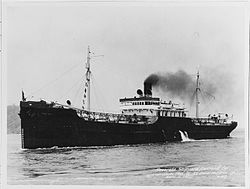
In October 1917, the U.S. government consulted with Fougner on the building of concrete ships in the United States. On April 12, 1918, President Woodrow Wilson authorized the Emergency Fleet Corporation concrete ship program, which oversaw the construction of concrete ships for the war. The builders of concrete ships had to prepare their own yards instead of converted existing ones for wooden ship, so their deployment was delayed. When the war ended, none had yet been completed, and any of the ships that were not significantly far along in their construction were canceled, leaving only twelve of them. These twelve ships were eventually completed, but soon sold to private companies who used them for trading, storage, and scrap. They amounted to 69,000 DWT of the 560,000 DWT that were ordered.
The United Kingdom's Ministry of Shipping also had an extensive concrete ship program. It had ordered 250,000 DWT of concrete ships, though with the war's end, only 2,000 DWT were delivered. Their first seagoing concrete vessel was the 1,150 DWT freighter SS Armistice.
Other countries that pursued concrete ship construction during this period included Denmark, Italy and Sweden.
Interwar
With the surplus of WWI ships and the uncompetitive operation of concrete ships, there was little interest in the construction of new concrete cargo ships. Those completed as a result of World War I programs continued to be used for various purposes.
World War II
In 1942, after the U.S. entered World War II, the U.S. military found that its contractors had steel shortages. Consequently, the U.S. government contracted McCloskey & Company of Philadelphia, Pennsylvania to build 24 self-propelled concrete ships. Construction started in July 1943. The shipyard was at Hookers Point in Tampa, Florida, and at its peak, it employed 6,000 workers. The U.S. government also contracted with two companies in California for the construction of eighty concrete barges. A total capacity of 488,000 DWT was produced.
In Europe, concrete ships played a role in World War II operations, where they were used for cargo transportation and as corncobs during the Normandy landings. The United Kingdom produced hundreds of concrete barges, and some 4,000 DWT of seagoing concrete ships. To save on steel, Germany also experimented with prestressed concrete in barges and produced 18,000 DWT of large seagoing concrete ships. Scandinavian shipyards produced 2,000 DWT of seagoing concrete ships.
Some concrete barges were fitted with engines and used as mobile canteens and troop carriers. Some of these vessels survive as abandoned wrecks or sea defenses (against storm surges) in the Thames Estuary including near Rainham Marshes. Two remain in civil use as moorings at Westminster.
Concrete barges also served in the Pacific during 1944 and 1945.
In 1944, a concrete firm in California proposed a submarine-shaped freighter which was projected to achieve speeds of 75 knots (139 km/h; 86 mph), a claim which Popular Science called "seemingly extravagant".
One wartime barge, previously beached at Canvey Island, was removed in 2005 by the local sailing club, whose land it was on, for fear it was a "danger to children using it as a playground".
One concrete barge under tow by Jicarilla (ATF-104) was lost off Saipan during a typhoon, and another barge damaged the Moreton Bay Pile Light in Brisbane, but the rest served admirably.
Post-war
After the war, concrete vessels have been used as pontoons, barges, and offshore concrete structures around the world, but no further large ships were produced.
Modern concrete ships

Hobbyists build ferrocement boats (ferroboats), as their construction methods do not require special tools, and the materials are comparatively cheap. Since the 1960s, the American Society of Civil Engineers has sponsored the National Concrete Canoe Competition.
In Europe, especially the Netherlands, concrete is still used to build some of the barges on which houseboats are built.
Remaining wartime ships
Surviving wartime concrete ships are no longer in use as ships. Several continue in use in various forms, mostly as museums or breakwaters.
Europe
One of the concrete ships built for the first Ministry of Shipping, the SS Creteboom, lies abandoned in the River Moy, 54°08′08″N 9°08′18″W/54.135515°N 9.138452°W/ 54.135515; -9.138452 just outside the town of Ballina, County Mayo, Ireland.
A concrete barge, the Cretetree, is beached in the harbour of the Isle of Scalpay near Tarbert, Harris, Scotland, 57°52′37″N 6°42′00″W/57.876873°N 6.699965°W/ 57.876873; -6.699965. It was built by Aberdeen Concrete Ships, and completed in 1919.
The Purton Hulks, a collection of vessels intentionally beached at Purton during the first half of the twentieth century as a method to prevent coastal erosion, includes eight ferro-concrete barges.
The remains of a British coaster, Violette, can be seen at Hoo, Kent, England.
A large collection of abandoned concrete barges are seen at River Thames in Rainham, London. 51°29′55″N 0°10′55″E/51.498608°N 0.18202°E/ 51.498608; 0.18202
The wreckage of the Ulrich Finsterwalder, a small Nazi-era German tanker, is visible in Dąbie Lake, near Szczecin, Poland. It was sunk during a Soviet air raid on 20 March 1945. In the late 1950s Polish authorities decided to lift it and tow it to another location to be converted into swimming pools, but during that operation it began sinking again, so it was abandoned in shallow water, where it has remained since.
During the German occupation of Greece (1942–1944) during World War II, the German Army built 24 concrete cargo vessels for transporting goods to various Greek islands, including Crete. These were constructed in the Perama shipbuilding area of Piraeus. After the war, many of the vessels were used as piers (e.g., in Rafina, 38°01′19″N 24°00′37″E/38.022056°N 24.010368°E/ 38.022056; 24.010368) and breakwaters (e.g., in Agios Georgios, Methana, 37°38′18″N 23°23′40″E/37.638340°N 23.394544°E/ 37.638340; 23.394544).
Due to the need to deliver necessary raw materials (such as oil, weapons, ammunition, food and drugs) through mined river currents, Adolf Hitler ordered the production of fifty concrete ships for different purposes. Most were concrete barges made for oil transportation from Romania, and needed raw materials that were driven to the Baltic front. A smaller number of ships was intended for transporting food (specializing in cold storages). The most valuable ships were the specialized ship-hospitals, which evacuated seriously wounded and "important" soldiers to German hospitals along rivers.[citation needed]
Japan
Several concrete ships were grounded on the west beach of Iwo To (Iwo Jima) in Japan, 24°46′57″N 141°17′35″E/24.78238°N 141.293095°E/ 24.78238; 141.293095, to make a breakwater by the US forces in 1945. Most of them were broken by typhoons but one was used as a pier.
Japan built four concrete ships named Takechi Maru (武智丸) during World War II. After the war, two of them turned into a breakwater in Kure, Hiroshima, 34°16′48″N 132°45′23″E/34.280089°N 132.756295°E/ 34.280089; 132.756295.
- At Iwo To
- Takechi Maru No.2
North America
The largest collection is at Powell River, British Columbia, 49°51′55″N 124°33′21″W/49.865238°N 124.555821°W/ 49.865238; -124.555821, where a lumber mill uses ten floating concrete ships as a breakwater, known as The Hulks.
The Kiptopeke Breakwater in Chesapeake Bay, Virginia, 37°09′51″N 75°59′29″W/37.164267°N 75.991402°W/ 37.164267; -75.991402, is formed by nine sunken concrete ships built in World War II.
SS San Pasqual, a former oil tanker, lies abandoned off the coast of Cayo Las Brujas, Cuba, 22°37′24″N 79°13′24″W/22.623439°N 79.22327°W/ 22.623439; -79.22327, where it served as a hotel, then as a base for divers.
The wreckage of SS Atlantus is visible off Sunset Beach near Cape May, New Jersey, 38°56′40″N 74°58′19″W/38.944322°N 74.972083°W/ 38.944322; -74.972083.
The tanker SS Selma is located northwest of the fishing pier at Seawolf Park in Galveston, 29°20′39″N 94°47′11″W/29.344249°N 94.786343°W/ 29.344249; -94.786343. The ship was launched the same day Germany signed the Treaty of Versailles, ending the war, so it never saw wartime duty and instead was used as an oil tanker in the Gulf of Mexico.
The tanker SS Palo Alto was purchased and turned into an amusement pier, and is still visible at Seacliff State Beach, near Aptos, California, 36°58′11″N 121°54′50″W/36.969704°N 121.913947°W/ 36.969704; -121.913947. It broke up during a January 2017 storm.
The SS McKittrick, launched in 1921 in Wilmington, North Carolina, later became the SS Monte Carlo, a gambling ship off Coronado, California, that ran aground on December 31, 1936. The wreck is periodically exposed by strong storm tides.
The vessel aground in the surf at Shipwreck Beach on the north shore of Lanai, Hawaii is the wreck of YOG-42, 20°55′17″N 156°54′37″W/20.921299°N 156.910139°W/ 20.921299; -156.910139, a concrete gasoline barge built for the US Navy in 1942 and placed in service in 1943. The wreck is often misidentified as a Liberty ship.
The remains of the Col. J. E. Sawyer can be seen near the USS Yorktown in Charleston Harbor, 32°47′56″N 79°54′25″W/32.798761°N 79.906863°W/ 32.798761; -79.906863, South Carolina.
The wreckage of the SS Sapona is visible slightly south of Bimini Island in the Bahamas, 25°39′02″N 79°17′36″W/25.65063°N 79.29337°W/ 25.65063; -79.29337. It is a popular snorkeling site and boating landmark in the area.
See also
- Capella (concrete ship)
- Concrete canoe
- Concrete Ship, former concrete hospital ship
- Trefoil-class concrete barge
Footnotes
External links
- , February 1919 Popular Science
- , June 1943, Popular Science