Tōseiha
In-game article clicks load inline without leaving the challenge.
The Tōseiha or Control Faction(統制派) was a loose political coalition in the Imperial Japanese Army active in the 1920s and 1930s. The term Tōseiha was not a self-designated name; it was a pejorative label coined by their rivals in the revolutionary Kōdōha (Imperial Way Faction) to describe the generally conservative officers who opposed their spiritual radicalism and aggressive anti-modernization ideals, instead favoring maintaining Japanese imperialism under the rule of law and prioritizing military modernization with the existing state bureaucracy to prepare for total war.
The coalition was initially centered around the efforts of Major General Tetsuzan Nagata, who organized the military's diverse interests such as the Reform bureaucrats, against domain-based cliques like the Chōshū. After Nagata's assassination in 1935, the Tōseiha was co-opted by Hideki Tojo, who consolidated a fascist faction that monopolized the military's authority after the failed February 26 Incident of 1936.
Background
The Empire of Japan had enjoyed economic growth during The First World War but this ended in the early 1920s with the Shōwa financial crisis. Social unrest increased with the growing polarization of society and inequalities, with the labor unions increasingly influenced by socialism, communism and anarchism, but the industrial and financial leaders of Japan continued to get wealthier through their inside connections with politicians and bureaucrats. The military was considered "clean" in terms of political corruption, and elements within the army were determined to take direct action to eliminate the perceived threats to Japan created by the weaknesses of liberal democracy and political corruption.
The roots of the Tōseiha lie in the Baden-Baden Pact[jp] of 1921, where Tetsuzan Nagata, Yasuji Okamura, and Toshiro Obata[jp] agreed to modernize the army and end domain-based cliques.
However, the coalition fractured over the strategy for Japan’s expansion. Toshiro Obata and his followers (the emerging Kōdōha) argued for the hokushin-ron ("Northern Expansion Doctrine") against the Soviet Union in the belief that Siberia was in Japan's sphere of interest, believing that a conflict in China would drain the resources necessary for a pre-emptive strike. Conversely, Tetsuzan Nagata and the Tōseiha argued that Japan must have a cautious defense expansion to secure resources and industrial capacity of China and Manchuria.
An ultranationalist faction within the army called the Kōdōha (Imperial Way) was formed by General Sadao Araki and his protégé, Jinzaburō Masaki, who envisioned a return to an idealized pre-industrialized, pre-westernized Japan. The Tōseiha and Kōdōha both adopted ideas from totalitarian and fascist political philosophies, and shared the fundamental ideals that national defense must be strengthened through a reform of national politics and espoused a strong skepticism for political party politics and representative democracy. Although the factions shared key ideals, opposition was based on how to achieve them.
Institutional Realignment under Nagata (1929-1935)
Rather than representing a monolithic faction, the Tōseiha was originally an effort by Tetsuzan Nagata to synthesize competing interests within the army into a professional, staff-led center. Nagata formed the One Day Meeting[jp] in 1929 from the merger of the Futaba-kai and Mokuyō-kai. The ODM's central objective was the innovation of army personnel to dismantle the traditional dominance of the Chōshū clique, which Nagata viewed as a hindrance to modern total war mobilization. The Tōseiha was initially a non-regional coalition, as opposed to Araki's reintroduction of regional politics into army promotions and policy decisions. Many Tōseiha members were promising graduates of the Imperial Japanese Army Academy and Army Staff College, and were concerned about Araki's emphasis of the spiritual morale of the army instead of modernization and mechanization. Nagata acted as the linchpin who bridged the gap between the radical younger officers seeking state reform and the senior staff who prioritized institutional stability. He pooled the abilities of officers like Hitoshi Imamura, Hideki Tojo, and Yasuji Okamura to focus on long-term industrial planning rather than immediate spiritual revolution. Nagata established the consensus of the graduates of the War College, unified by a shared rationalist worldview and a commitment to bureaucratic process over ideological fanaticism.
Conspiracy Theory and Opposition
The name Tōseiha was a pejorative exonym coined exclusively by Kōdōha members and their sympathizers. Officers assigned to this "faction" never characterized themselves as such, and it lacked any formal organization or self-identified membership. It was an institutional alignment of staff officers within the Ministry of War and the General Staff who adhered to bureaucratic procedures and modern military planning. Rather than the confrontational approach of the Kōdōha, which wanted to bring about the Showa Restoration through violence and revolution, the Tōseiha sought reform by working within the existing system. The Tōseiha foresaw that a future war would be a total war, and to maximize Japan's industrial and military capacity would require the cooperation of Japan's bureaucracy and the zaibatsu conglomerates which the Kōdōha despised.
In late 1931, the Manchurian Incident and the subsequent Japanese invasion of Manchuria saw the two factions struggle against each other for greater influence over the military's strategic direction. While the Kōdōha were initially dominant ue to General Sadao Araki's popularity, but their influence began to wane following Araki's resignation in 1934 due to ill health.
As the Chief of the Military Affairs Bureau, Tetsuzan Nagata was viewed by radicals as the mastermind of a conspiracy whose institutional power stifled the Kōdōha. His role in the forced retirement of the Kōdōha leader General Jinzaburō Masaki led to Masaki himself encouraging the view that his dismissal was a conspiracy engineered by Nagata, a claim the rebels accepted as fact. This culminated in the Aizawa Incident in August 1935, when Lieutenant Colonel Saburō Aizawa assassinated Nagata in his office, claiming he was slaying a traitor who was corrupting the army. Aizawa's trial was transformed into a platform for supporters of the Kōdōha to justify his actions and further spread the myth of a Toseiha conspiracy.
During the February 26 Incident in 1936, the Kōdōha junior officers targeted high-ranking statesmen and the moderate Navy Treaty Faction leadership in an attempt to trigger the Shōwa Restoration. General Watanabe Jōtarō was the only Tōseiha-aligned military target. The attempt to start a revolution failed; the Kōdōha was dissolved and its leadership was purged from the military.
Consolidation of National Defense State under Tōjō (1936-1941)
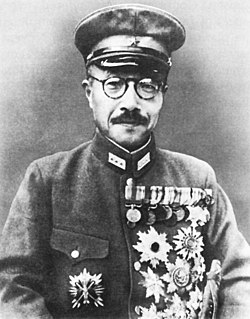
The transition from Nagata's structural organizational efforts to the Tōseiha as a faction occurred after Nagata's assassination in 1935. Hideki Tojo emerged as the senior figure of the "Control" officers. Unlike Nagata, who sought to balance various factions, Tojo capitalized on the institutional void to consolidate a personal power base.
The Tōseiha capitalized on the February 26 incident; the assassination of liberal leaders like Saitō Makoto and Takahashi Korekiyo decapitated the state's moderate opposition, and the subsequent military suppression of the coup provided a pretext to purge the radical Kōdōha, alongside most other factions, permanently.
Tojo transformed the Tōseiha by institutionalizing the fascist-leaning "National Defense State" that Nagata had only envisioned as a theoretical blueprint. Tojo effectively solidified control of the state bureaucracy under this faction through the Ni-Ki-San-Suke[jp] power bloc that he had established during his time in Manchukuo.
Legacy
After Hideki Tojo solidified Tōseiha as the dominant influence in the Japanese military and became Prime Minister in 1941, the faction essentially completed its goals and lost most of its raison d'être and gradually disbanded.
See also
- Buruma, Ian (2004). . Modern Library. ISBN 0-8129-7286-4.
- Harries, Meirion (1994). Soldiers of the Sun: The Rise and Fall of the Imperial Japanese Army (reprint ed.). Random House. ISBN 0-679-75303-6.
- Samuels, Richard J (2007). Securing Japan: Tokyo's Grand Strategy and the Future of East Asia. Cornell University Press. ISBN 978-0-8014-4612-2.