Decapod
In-game article clicks load inline without leaving the challenge.
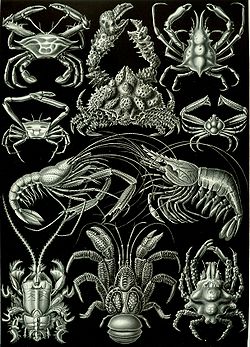
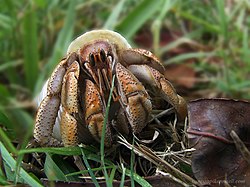
A decapod is a crustacean in the large order of Decapoda (from Ancient Greek δεκάς (dekás), meaning "ten", and πούς (poús), meaning "foot"), within the class Malacostraca, including crabs, lobsters, crayfish, shrimp, and prawns. Most decapods are scavengers. The order is estimated to contain nearly 15,000 extant species in around 2,700 genera, with around 3,300 fossil species. Nearly half of these species are crabs, with the shrimp (about 3,000 species) and Anomura including hermit crabs, king crabs, porcelain crabs, squat lobsters (about 2500 species) making up the bulk of the remainder. The earliest fossils of the group date to the Devonian.
Anatomy
Decapods can have as many as 38 appendages, arranged in one pair per body segment. As the name Decapoda (from the Greek δέκα, deca-, "ten", and πούς / ποδός, -pod, "foot") implies, ten of these appendages are considered legs. They are the pereiopods, found on the last five thoracic segments. In many decapods, one pair of these "legs" has enlarged pincers, called chelae, with the legs being called chelipeds. In front of the pereiopods are three pairs of maxillipeds that function as feeding appendages. The head has five pairs of appendages, including mouthparts, antennae, and antennules. There are five more pairs of appendages on the abdomen. They are called pleopods. There is one final pair called uropods, which, with the telson, form the tail fan.
Evolution
A 2019 molecular clock analysis suggested decapods originated in the Late Ordovician around 455 million years ago, with the Dendrobranchiata (prawns) being the first group to diverge. The remaining group, called Pleocyemata, then diverged between the swimming shrimp groupings and the crawling/walking group called Reptantia, consisting of lobsters and crabs. High species diversification can be traced to the Jurassic and Cretaceous periods, which coincides with the rise and spread of modern coral reefs, a key habitat for the decapods. Despite the inferred early origin, the oldest fossils of the group such as Palaeopalaemon only date to the Late Devonian.
The cladogram below shows the internal relationships of Decapoda, from analysis by Wolfe et al. (2019).
| Decapoda | Dendrobranchiata (prawns) Pleocyemata Stenopodidea (boxer shrimp) Procarididea Caridea ("true" shrimp) Reptantia Achelata (spiny lobsters and slipper lobsters) Polychelida (benthic crustaceans) Astacidea (lobsters and crayfish) Axiidea (mud shrimp, ghost shrimp, and burrowing shrimp) Gebiidea (mud lobsters and mud shrimp) Anomura (hermit crabs and allies) Brachyura ("true" crabs) (crawling / walking decapods) |
| Dendrobranchiata (prawns) | |
| Dendrobranchiata (prawns) | |
| Pleocyemata | Stenopodidea (boxer shrimp) Procarididea Caridea ("true" shrimp) Reptantia Achelata (spiny lobsters and slipper lobsters) Polychelida (benthic crustaceans) Astacidea (lobsters and crayfish) Axiidea (mud shrimp, ghost shrimp, and burrowing shrimp) Gebiidea (mud lobsters and mud shrimp) Anomura (hermit crabs and allies) Brachyura ("true" crabs) (crawling / walking decapods) |
| Stenopodidea (boxer shrimp) Procarididea Caridea ("true" shrimp) | |
| Stenopodidea (boxer shrimp) | |
| Procarididea Caridea ("true" shrimp) | |
| Procarididea | |
| Caridea ("true" shrimp) | |
| Reptantia | Achelata (spiny lobsters and slipper lobsters) Polychelida (benthic crustaceans) Astacidea (lobsters and crayfish) Axiidea (mud shrimp, ghost shrimp, and burrowing shrimp) Gebiidea (mud lobsters and mud shrimp) Anomura (hermit crabs and allies) Brachyura ("true" crabs) |
| Achelata (spiny lobsters and slipper lobsters) Polychelida (benthic crustaceans) Astacidea (lobsters and crayfish) | |
| Achelata (spiny lobsters and slipper lobsters) | |
| Polychelida (benthic crustaceans) Astacidea (lobsters and crayfish) | |
| Polychelida (benthic crustaceans) | |
| Astacidea (lobsters and crayfish) | |
| Axiidea (mud shrimp, ghost shrimp, and burrowing shrimp) Gebiidea (mud lobsters and mud shrimp) Anomura (hermit crabs and allies) Brachyura ("true" crabs) | |
| Axiidea (mud shrimp, ghost shrimp, and burrowing shrimp) | |
| Gebiidea (mud lobsters and mud shrimp) Anomura (hermit crabs and allies) Brachyura ("true" crabs) | |
| Gebiidea (mud lobsters and mud shrimp) | |
| Anomura (hermit crabs and allies) Brachyura ("true" crabs) | |
| Anomura (hermit crabs and allies) | |
| Brachyura ("true" crabs) | |
| (crawling / walking decapods) | |
In the cladogram above, the clade Glypheidea is excluded due to lack of sufficient DNA evidence, but is likely the sister clade to Polychelida, within Reptantia.
Classification
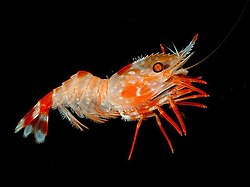
Classification within the order Decapoda depends on the structure of the gills and legs, and the way in which the larvae develop, giving rise to two suborders: Dendrobranchiata and Pleocyemata. The Dendrobranchiata consist of prawns, including many species colloquially referred to as "shrimp", such as the "white shrimp", Litopenaeus setiferus. The Pleocyemata include the remaining groups, including "true shrimp". Those groups that usually walk rather than swim (Pleocyemata, excluding Stenopodidea and Caridea) form a clade called Reptantia.
This classification to the level of superfamilies follows De Grave et al.




Order Decapoda Latreille, 1802
- Suborder Dendrobranchiata Bate, 1888 Penaeoidea Rafinesque, 1815 Sergestoidea Dana, 1852
- Suborder Pleocyemata Burkenroad, 1963 Infraorder Stenopodidea Bate, 1888 Infraorder Caridea Dana, 1852 Procaridoidea Chace & Manning, 1972 Galatheacaridoidea Vereshchaka, 1997 Pasiphaeoidea Dana, 1852 Oplophoroidea Dana, 1852 Atyoidea De Haan, 1849 Bresilioidea Calman, 1896 Nematocarcinoidea Smith, 1884 Psalidopodoidea Wood-....., 1874 Stylodactyloidea Bate, 1888 Campylonotoidea Sollaud, 1913 Palaemonoidea Rafinesque, 1815 Alpheoidea Rafinesque, 1815 Processoidea Ortmann, 1896 Pandaloidea Haworth, 1825 Physetocaridoidea Chace, 1940 Crangonoidea Haworth, 1825 Infraorder Astacidea Latreille, 1802 Enoplometopoidea de Saint Laurent, 1988 Nephropoidea Dana, 1852 Astacoidea Latreille, 1802 Parastacoidea Huxley, 1879 Infraorder Glypheidea Winckler, 1882 Glypheoidea Winckler, 1882 Infraorder Axiidea de Saint Laurent, 1979b Infraorder Gebiidea de Saint Laurent, 1979 Infraorder Achelata Scholtz & Richter, 1995 Infraorder Polychelida Scholtz & Richter, 1995 Infraorder Anomura MacLeay, 1838 Aegloidea Dana, 1852 Galatheoidea Samouelle, 1819 Hippoidea Latreille, 1825a Chirostyloidea Ortmann, 1892 Lomisoidea Bouvier, 1895 Paguroidea Latreille, 1802 Infraorder Brachyura Linnaeus, 1758 Section Dromiacea De Haan, 1833 Dromioidea De Haan, 1833 Homolodromioidea Alcock, 1900 Homoloidea De Haan, 1839 Section Raninoida De Haan, 1839 Section Cyclodorippoida Ortmann, 1892 Section Eubrachyura de Saint Laurent, 1980 Subsection Heterotremata Guinot, 1977 Aethroidea Dana, 1851 Bellioidea Dana, 1852 Bythograeoidea Williams, 1980 Calappoidea De Haan, 1833 Cancroidea Latreille, 1802 Carpilioidea Ortmann, 1893 Cheiragonoidea Ortmann, 1893 Corystoidea Samouelle, 1819 Dairoidea Serène, 1965 Dorippoidea MacLeay, 1838 Eriphioidea MacLeay, 1838 Gecarcinucoidea Rathbun, 1904 Goneplacoidea MacLeay, 1838 Hexapodoidea Miers, 1886 Leucosioidea Samouelle, 1819 Majoidea Samouelle, 1819 Orithyioidea Dana, 1852c Palicoidea Bouvier, 1898 Parthenopoidea MacLeay, Pilumnoidea Samouelle, 1819 Portunoidea Rafinesque, 1815 Potamoidea Ortmann, 1896 Pseudothelphusoidea Ortmann, 1893 Pseudozioidea Alcock, 1898 Retroplumoidea Gill, 1894 Trapezioidea Miers, 1886 Trichodactyloidea H. Milne-Edwards, 1853 Xanthoidea MacLeay, 1838 Subsection Thoracotremata Guinot, 1977 Cryptochiroidea Paul'son, 1875 Grapsoidea MacLeay, 1838 Ocypodoidea Rafinesque, 1815 Pinnotheroidea De Haan, 1833
See also
External links
- Data related to Decapod at Wikispecies
- "Tree of Life" page at the Natural History Museum of Los Angeles County