Originalism
In-game article clicks load inline without leaving the challenge.

Originalism is a legal theory in the United States which bases constitutional, judicial, and statutory interpretation of text on the original understanding at the time of its adoption. Originalism consists of a family of different theories of constitutional interpretation and can refer to original intent or original meaning. Critics of originalism often turn to the competing concept of the Living Constitution, which asserts that a constitution should evolve and be interpreted based on the context of current times. Originalism should not be confused with strict constructionism or textualism.
Although some scholars argue that originalism has always been a part of American law, contemporary originalism emerged during the 1980s and greatly influenced American legal culture, practice, and academia, Over time, originalism became more popular and gained mainstream acceptance by 2020.
Originalism was advocated most prominently by Justice Antonin Scalia, whose opinion in District of Columbia v. Heller (2008) became a defining—and divisive—statement of originalist reasoning. Critics, including many professional historians, have argued that Heller relied on selective or flawed historical analysis. Despite such criticism, originalism has grown in prominence since Scalia’s tenure, especially with the appointments of Justices Neil Gorsuch, Brett Kavanaugh, and Amy Coney Barrett during the Trump administration. The philosophy played a central role in major rulings such as Dobbs v. Jackson Women's Health Organization (2022), which overturned Roe v. Wade. In response, some scholars and jurists, including Justice Ketanji Brown Jackson, have advanced ideas of “progressive originalism.” Meanwhile, critics contend that the Court’s reliance on history has become inconsistent and politically driven, with Justice Sonia Sotomayor remarking that “history matters to this Court only when it is convenient.”
History
Proponents of originalism argue that originalism was the primary method of legal interpretation in America from the time of its founding until the time of the New Deal, when competing theories of interpretation grew in prominence.
Modern
Jurist Robert Bork is credited with proposing the first modern theory of originalism in his 1971 law review article, Neutral Principles and Some First Amendment Problems, published in The Yale Law Journal. He noted that without specification in a constitutional text, judges are free to input their own values while interpreting a constitution. Bork proposed one principled method to avoid this: for judges to "take from the document rather specific values that text or history show the framers actually to have intended and which are capable of being translated into principled rules." By following the original meaning, an originalist Supreme Court would therefore "need make no fundamental value choices," and its rulings would be restrained.
Law professor Raoul Berger expanded on the theory in Government by Judiciary (1977), positing that the rulings by the Warren and Burger Courts were illegitimate, as they deviated from the Constitution's original intent. In 1985, Edwin Meese, United States Attorney General under President Ronald Reagan, advanced a constitutional jurisprudence based on original intent in a speech before the American Bar Association, a jurisprudence that "would produce defensible principles of government that would not be tainted by ideological predilection." A few months after the speech, Justice William Brennan rejected Meese's view, claiming that the original intent of the Founding Fathers of the United States was indiscernible, and that text could only be understood in present terms. Later, in 1988 Ronald Reagan would advocate in favor of originalism during a speech at the Federalist Society for Law and Public Policy Studies.
During the 1980s, liberal members of the legal academy criticized the original intent formulated by Bork, Berger, and Meese. Serious opposition, beginning in law schools, evolved from debates in singular law review articles to books. In 1980, Paul Brest, who later became the dean of Stanford Law School, published "The Misconceived Quest for the Original Understanding," an article whose criticism of originalism proved formative and influential. Brest argued that a collective intent among the Founding Fathers of the United States was nonexistent and attempting to do so would be extremely difficult. He also posited that historical changes between the time of adoption to the present made originalism inapplicable in areas such as free speech, freedom of religion, federalism, and gender discrimination. Other scholars of the period adopted and expanded Brest's critiques, including H. Jefferson Powell and Ronald Dworkin. Brest and Powell suggested versions of originalism that sought higher purposes than a specific framer's intent, leading to a shift in the dominant form of originalism from original intent to the original public understanding.
The debate grew more heated with the failed Supreme Court nomination of Robert Bork in 1986, with originalism in the 1990s becoming broadly endorsed in the conservative legal movement. In the 1980s, during the Reagan administration, the Department of Justice played an important role in lending legitimacy, in some eyes, to originalism.
Types
Original intent
The historical arguments made by Hugo Black in Everson v. Board of Education relied entirely on historical evidence of the views of Madison and Jefferson and the appropriateness of interpreting the Establishment Clause based on that evidence. Edwin Meese once remarked that Black's record was evidence that "jurisprudence of original intention is not some recent conservative ideological creation".
Original public understanding
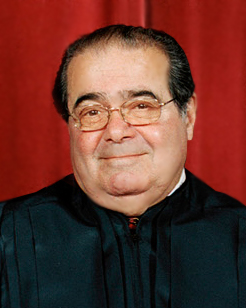
Original public understanding originalism bases the meaning of a constitutional provision on how the public which ratified it would have generally understood it to mean. Antonin Scalia was one of its most prominent theorists.
The conservative originalist movement spearheaded by Raoul Berger in the 1980s was a call for judicial restraint but over the years important differences have developed among originalist scholars. Justice Amy Coney Barrett explains:
A faithful judge resists the temptation to conflate the meaning of the Constitution with the judge’s own political preference; judges who give into that temptation exceed the limits of their power by holding a statute unconstitutional when it is not. That was the heart of the originalist critique of the Warren and Burger Courts. At the same time, fidelity will inevitably require a court to hold some statutes unconstitutional.
Barrett, who has been described as a protégé of Scalia's, said at her confirmation hearing that she interprets the Constitution "as text, and I understand it to have the meaning that it had at the time people ratified it."
Original law
Drawing on the insights of H. L. A. Hart’s legal positivism, original law originalism locates the authority of the Constitution in the social facts of the American legal system. Championed by legal scholars Stephen Sachs and William Baude, this theory posits that the "original law" of the Constitution—the legal rules and standards in force at the time of its enactment—remains binding today unless lawfully changed (e.g., by amendment). Unlike original public meaning originalism, which focuses on the communicative content or "linguistic meaning" of the text to an ordinary citizen, original law originalism focuses on the "legal meaning" or the specific legal rules the text invoked for lawyers and judges at the time (which may or may not include its original public meaning).
Debate
The originalism debate has divided the American public since the school desegregation decision in Brown v. Board of Education.
According to Calvin Terbeek, originalism's appeal in modern times is rooted in conservative political resistance to the Brown v. Board of Education Supreme Court decision and opposition to some civil rights legislation. Segregationist Sam Ervin was an early proponent of originalism as he used the theory to argue in opposition to civil rights legislation during the 1960s.
Justices Antonin Scalia, Amy Coney Barrett, Clarence Thomas and Neil Gorsuch describe themselves as originalists in scholarly writings and public speeches.
Critics
Supreme Court Justice Elena Kagan, a frequent critic of conservative originalism, argues that some aspects of the Constitution were intentionally broad and vague to allow for future generations to interpret them as appropriate for the times.
Michael Waldman argues that originalism is a new concept and not one espoused by the Founders.
According to a 2021 paper in the Columbia Law Review, the Founding Fathers did not include a nondelegation doctrine in the Constitution and saw nothing wrong with delegations as a matter of legal theory, contrary to the claims of some originalists.
Columbia Law School legal scholar Jamal Greene argues that originalism is remarkably unpopular outside the United States (including Canada, South Africa, India, Israel, and most of Europe), where judicial minimalism or textualism are the typical responses to judicial activism.
Supreme Court Justice William J. Brennan Jr. described originalism as "arrogance cloaked as humility" during a 1985 speech at Georgetown University. In this speech, he also stated “It is arrogant to pretend that from our vantage we can gauge accurately the intent of the framers", and that politicians that claim to do so are motivated purely by political reasons, as they “have no familiarity with the historical record."
Harvard Law School legal scholar Richard H. Fallon Jr. argues that the Supreme Court justices who claim to be originalists actually apply originalism in a highly selective manner "which typically abets substantively conservative decisionmaking."
Related positions
International law and originalism
Antonin Scalia, one of the best known conservative orignalists, rejected any consideration of International law for interpreting the U.S. Constitution: "We must never forget that it is a Constitution for the United States of America that we are expounding. . . . Where there is not first a settled consensus among our own people, the views of other nations, however enlightened the Justices of this Court may think them to be, cannot be imposed upon Americans through the Constitution."
Strict constructionism
Scalia averred that he was "not a strict constructionist, and no-one ought to be"; he goes further, calling strict constructionism "a degraded form of textualism that brings the whole philosophy into disrepute".
Legal scholar Randy Barnett asserts that originalism is a theory of interpretation and that constructionism is only appropriate when deriving the original intent proves difficult.
Declarationism
Declarationism is a legal philosophy that incorporates the United States Declaration of Independence into the body of case law on level with the United States Constitution. It holds that the Declaration is a natural law document and so that natural law has a place within American jurisprudence. During the 1860s, Senator Charles Sumner heralded declarationism as justifying all human rights legislation without the need for the ultimately ratified Reconstruction Amendments. Harry V. Jaffa and Clarence Thomas have been cited as proponents of this school of thought.
See also
References
- Barnett, Randy E. (2004). Restoring the Lost Constitution: The Presumption of Liberty. Princeton, New Jersey: Princeton University Press. ISBN 978-0691115856.
- Baude, William; Sachs, Stephen E. (August 2019). "Originalism and the Law of the Past". Law and History Review. 37 (3). American Society for Legal History: 809–820. doi:. JSTOR .
- Baude, William (2017). "Originalism as a Constraint on Judges". The University of Chicago Law Review. 84 (3): 2213–2229. JSTOR .
- Calabresi, Steven G., ed. (2007). . Washington, DC: Regnery Pub. Inc. ISBN 978-1-59698-050-1.
- Chemerinsky, Erwin (2022). . Yale University Press. ISBN 978-0300259902.
- Cross, Frank (2013). The Failed Promise of Originalism. Stanford University Press.
- Drakeman, Donald L. (2010). Church, State and Original Intent. Cambridge University Press.
- Fontana, David (February 1, 2011). "Comparative Originalism". Texas Law Review. 88: 189–199. SSRN .
- Kesavan, Vasan and Paulsen, Michael Stokes. , 91 Georgetown Law Journal 1113 (2003).
- Lawson, Gary S. , 85 Georgetown Law Journal 1823 (1997).
- Levinson, Sanford (1988). "Law as Literature". In Mailloux, Steven; Levinson, Sanford (eds.). Interpreting Law and Literature: A Hermeneutic Reader. Northwestern University Press.
- Maltz, Earl (2000). "Brown v. Board of Education and "Originalism"". In George, Robert P. (ed.). Great Cases in Constitutional Law. Princeton University Press.
- O'Neill, Jonathan (September 17, 2007). Originalism in American Law and Politics: A Constitutional History. The Johns Hopkins Constitutional Thought. Johns Hopkins University Press. ISBN 978-0801887604.
- Rakove, Jack N. (1996). . New York: Alfred A. Knopf. ISBN 0-394-57858-9.
- Sawyer, Logan E. (August 2019). . Law and History Review. 37 (3). Cambridge University Press: 847–860. doi:.
- Segall, Eric J. (2018). Originalism as Faith. Cambridge University Press. doi:. ISBN 9781108105316.
- Whittington, Keith E. (1999). . Lawrence, Kansas: University Press of Kansas. ISBN 0-7006-0969-5.
- Whittington, Keith E. (2013). . Fordham Law Review. 82 (2): 375–409.
- Wurman, Ilan (August 2017). A Debt Against the Living: An Introduction to Originalism. Cambridge University Press. doi:. ISBN 978-1108412162.
- Strang, Lee J. (2019). . Cambridge University Press. doi:. ISBN 978-1108475631. LCCN .
- Solum, Lawrence B. (2011). . Georgetown Law Journal: 1–41. doi:.
- Huscroft, Grant; Miller, Bradley W., eds. (October 2011). The Challenge of Originalism: Theories of Constitutional Interpretation. Cambridge University Press. doi:. ISBN 9781139003926.
- Yarbrough, Tinsley E. (1988). Mr. Justice Black and his critics. Duke University Press.
Further reading
- Amar, Akhil Reed. Slate, September 21, 2005.
- Barnett, Randy. , May 4, 2005.
- Barrett, Amy Coney; Nagle, John Copeland (October 2016). . Journal of Constitutional Law. 19 (1). Philadelphia, Pennsylvania: University of Pennsylvania: 5–42.
- Ellis, Joseph J. (2018). American Dialogue: The Founders and Us. Knopf. ISBN 978-0385353427.
- Gienapp, Jonathan (2024). Against Constitutional Originalism: A Historical Critique. Yale University Press. ISBN 978-0-300-26585-9.
- Posner, Eric A.. , The New Republic, January 13, 2011.
- Sunstein, Cass. Book Review of The Bill of Rights by Akhil Reed Amar & For the People by Akhil Reed Amar and Alan Hirsch The New Republic, September 28, 1998, p. 31.
- Yale Law School. . Papers published at
External links
- at the Center for the Study of Constitutional Originalism at the University of San Diego School of Law
- by Antonin Scalia at Woodrow Wilson Center via Center for Individual Freedom comparing and contrasting originalism from the "living constitution" approach (2005)