Defense Meteorological Satellite Program
In-game article clicks load inline without leaving the challenge.
The Defense Meteorological Satellite Program (DMSP) monitors meteorological, oceanographic, and solar-terrestrial physics for the United States Department of Defense. The program is managed by the United States Space Force with on-orbit operations provided by the National Oceanic and Atmospheric Administration (NOAA). The (originally classified) mission of the satellites was revealed in March 1973. They provide cloud cover imagery from polar orbits that are Sun-synchronous at nominal altitude of 830 km (520 mi).
All data ingestion, processing, and distribution by Fleet Numerical Meteorology and Oceanography Center (FNMOC) was set to be permanently terminated as of June 30, 2025 due to a "significant cybersecurity risk." However, the Earth Science Division Director at NASA, Dr. Karen St. Germain, requested that the decommission be delayed due to the short notice provided. FNMOC now expects to continue to ingest and disseminate data until July 31, 2025.
History

Early in 1963 The Aerospace Corporation recommended that the U.S. Air Force develop a dedicated military meterological satellite, and the Defense Department agreed. The main emphasis would be on cloud-cover photography, but planners expected to add more sophisticated equipment when it became available. Later, when civilian weather satellites improved their capabilities and could satisfy most military requirements, the Defense Department continued to prefer a separate system responsive to the "dynamic" needs of the military. As a result, the Air Force embarked on the first segment of what became known initially as the Defense Satellite Applications Program (DSAP), or Program 417.
During the 1960s, one of the most important projects that the United States civil space program was involved in dealt with meteorology and weather forecasting. Unbeknownst to many, the U.S. military services were also starting up a weather satellite program. This program, the DMSP, would relay important weather and climate data to the military for more effective operations. From the onset of the DMSP program, knowledge of its existence was limited to "need-to-know" personnel. The United States Congress had assigned a substantial budget towards the civil weather satellite program; if knowledge of a second military program came out, it would have been hard for the military to justify it.[citation needed]

Initial operations of early DMSP systems provided radio return of cloud-cover imagery for planning of U.S. high-resolution photographic reconnaissance and surveillance missions, which utilized film-return systems. DMSP satellites operated in a Sun-synchronous orbit; passing over the north and south poles, the satellite would see different strips of the Earth at the same local time each day. The DMSP satellites had periods of roughly 101.0 minutes, so they would orbit the Earth 14.3 times in 24 hours. This period combined with the Sun-synchronous orbit would have the satellite pass over the whole surface of the planet twice a day.

The images acquired were relayed to the Earth and received by two command and readout stations during each pass over the continental United States, established at retired Nike missile sites located near Fairchild Air Force Base in Washington State and Loring Air Force Base in Maine. From these sites, the images were then sent to Air Force Global Weather Central (AFGWC) located at Offutt Air Force Base, Nebraska. Images would then be processed, forming a mosaic representing the cloud patterns that were observed from the orbiting satellites. Meteorologists could then provide flight crews and other commanders with up-to-date observations for their particular missions. Further advancements enabled data to be collected in the visual spectrum, down to a half-moonlit scene. Infrared processing enabled night viewing. Other enhancements increased on-board processing; this includes multiple on-board computers and expanded power requirements.[citation needed]


Now in its fifth decade of service, the DMSP program has proven itself to be a valuable tool in scheduling and protecting military operations on land, at sea, and in the air. Because the Air Force weather satellite program began with the mission of providing weather data for Strategic Air Command and National Reconnaissance Office (NRO), DSAP remained classified until 17 April 1973, when Secretary of the Air Force Dr. John L. McLucas decided that the Defense Department's decision to use satellite weather data in the Vietnam conflict and to provide it to both the Commerce Department and the general scientific community warranted declassification of the DSAP mission and release of some of its performance data. In December 1973 the Defense Department changed the name to the Defense Meteorological Satellite Program (DMSP). On 1 June 1998, the control and maintenance of the satellites were transferred to National Oceanic and Atmospheric Administration (NOAA) in order to reduce costs.
DMSP was to be replaced by the Defense Weather Satellite System (DWSS) but that was cancelled in 2012. In 2017, the Air Force awarded a contract to build the first of the new defense weather satellites, the Weather System Follow-on Microwave (WSF-M) satellite.
Losses of satellites
2004 explosion
In 2004 the USAF weather satellite DMSP Block 5D-2 F-11 (S-12) or DMSP-11, launched in 1991 and retired in 1995, exploded in orbit with debris objects generated. It seems likely the fragmentation was due to either a battery explosion or to residual fuel in the attitude control system. Later, propulsion was identified as the "assessed cause" of DMSP-11 explosion.
2015 explosion and debris field
On 3 February 2015, the 13th DMSP satellite — DMSP-F13 launched in 1995 — exploded while in a Sun-synchronous polar orbit leaving a debris field of at least 43 to 100 large fragments and more than 50,000 pieces smaller than 1 millimeter. The Joint Space Operations Center at Vandenberg Space Force Base, Lompoc, California is monitoring the expanding debris field, and "will issue conjunction warnings if necessary". The cause of the explosion was the rupturing of an onboard battery due to a design flaw (no collision with another object took place).
2016 failure of DMSP 19 without replacement
On 11 February 2016, a power failure left both the command-and-control subsystem and its backup without the ability to reach the satellite's processor, according to the U.S. Air Force Space Command investigation released in July 2016 that also announced that DMSP 5D-3/F19 was considered to be 'lost'. The satellite's data can still be used, until it ceases pointing the sensors towards the Earth. The satellite was the most recent on-orbit, having been launched on 3 April 2014.
The failure only left F16, F17 and F18 – all significantly past their expected 3–5 year lifespan – operational. F19's planned replacement was not carried out because Congress ordered the destruction of the already constructed F20 probe to save money by not having to pay its storage costs. It is unlikely that a new DMSP satellite would be launched before 2023; by then the three remaining satellites should no longer be operational.
2016 explosion
In October 2016, the 12th DMSP satellite - DMSP-F12 launched in 1994 - exploded in orbit. The satellite had similar battery as the one that exploded in the DMSP-13 satellite, thus raising suspicions that DMSP-12 explosion was also caused by battery problems. At the time the cause of DMSP-12's explosion was however unknown, although a collision with another object did not seem to be the cause. Apparently, very little debris (just one trackable piece) was generated in DMSP-12 explosion. DMSP-12 was decommissioned in 2008.
Near collision
In January 2017, the Joint Space Operations Center announced that two non-maneuverable satellites would come dangerously close, with a collision probability as high as 44%. DMSP F15 and Meteor 1-26 were considered to be the prime candidates for the encounter. The operations center, which announced the possible collision, didn't identify the satellites involved but third party observers determined the most likely candidates. The two did not collide.
NOAA 16 and 17
The NOAA-16 and NOAA-17 weather satellites were based on the same technology as DMSP satellites. NOAA-16 broke up in November 2015, and NOAA-17 disintegrated in orbit on 10 March 2021.
2024 explosion
The DMSP 5D-2/F14 (USA-131), launched 4 Apr 1997 and decommissioned in 2020, exploded in orbit in December 2024.
Launch history

DMSP was initially known as Program 35. The first successful launch of a Program 35 spacecraft used a Scout X-2 rocket lifting off from Point Arguello near Vandenberg Space Force Base on 23 August 1962. This was P35-2, the earlier P35-1 launch on 24 May 1962 had failed to reach orbit. All five Program 35 launch attempts using Scout launch vehicle, including the two successes, were made from Vandenberg SLC-5. Other early launches were conducted using Thor-Burner launch vehicles, with Altair or Burner II upper stages. Program 35 had by this time been renamed the Data Acquisition and Processing Program, and the DAPP acronym is sometimes used for these satellites. Eight satellites were launched using Atlas E launch vehicles between 1982 and 1995. Three were launched aboard Titan II vehicles between 1997 and 2003. One has been launched on a Delta IV rocket.
The most recent launch of a DMSP satellite, DMSP-F19, occurred on 3 April 2014, from Vandenberg aboard an Atlas V launch vehicle.
Block 1

The DSAP-1 (Defense Satellite Application Program Block 1) satellites series, also known as P-35, was the first series of military meteorological satellites of the United States. The project designation P-698BH was used concurrently with P-35 from June 1962 and P-35 became P-417 in October 1962. The designation DMSP-1 (Defense Meteorological Satellite Program Block 1) was retroactively assigned to these satellites.
| Block 1 | |||||||||||
|---|---|---|---|---|---|---|---|---|---|---|---|
| Name | ID NORAD # | Launch date | Launch vehicle | Launch site | Mass (kg) | Period (min) | Perigee (km) | Apogee (km) | Inclination (degrees) | Status | Alt. names |
| DMSP-1 F1 | 23 May 1962 | Scout | Va LC-D | 45-55 | Failed to orbit; 2nd stage exploded | Program 35 F-1, P-698BH F1, DSAP-1 F1 | |||||
| DMSP-1 F2 | 1962-039A 00369 | 23 August 1962 | Scout | Va LC-D | 45-55 | 97 | 557 | 694 | 98.4 | Success; EOM 11 Jun 1963 | Program 35 F-2, P-698BH F2, DSAP-1 F2 |
| DMSP-1 F3 | 1963-005A 00533 | 19 February 1963 | Scout | Va LC-D | 45-55 | Improper orbit; first DMSP with infrared system | Program 35 F-3, P-417 F3, DSAP-1 F3 | ||||
| DMSP-1 F4 | 26 April 1963 | Scout | Va LC-D | 45-55 | Failed to orbit; 3rd stage exploded | Program 35 F-4, P-417 F4, DSAP-1 F4 | |||||
| DMSP-1 F5 | 27 September 1963 | Scout | Va LC-D | 45-55 | Failed to orbit; 3rd stage failure | Program 35 F-5, P-417 F5, DSAP-1 F5 | |||||
| DMSP-1 F6 | 1964-002B 00734 | 19 January 1964 | Thor-DM21 Agena-D | Va 75-1-2 | 45-55 | 100 | 785 | 807 | 99 | EOM 10 July 1964 | Program 35 F-6, DSAP-1 F6, OPS 3367A, P-417 F6 |
| DMSP-1 F7 | 1964-002C 00735 | 19 Jan 1964 | Thor-DM21 Agena-D | Va 75-1-2 | 45-55 | 100 | 788 | 811 | 99 | EOM 17 Mar 1965 | Program 35 F-7, DSAP-1 F7, OPS 3367B, P-417 F7 |
| DMSP 1 F8 | 1964-031A 00812 | 17 Jun 1964 | Thor-DM21 Agena-D | Va 75-3-4 | 45-55 | 101 | 809 | 817 | 99.7 | EOM 16 Feb 1966 | Program 35 F-8, DSAP-1 F8, OPS 4467A, P-417 F8 |
| DMSP-1 F9 | 1964-031B 00813 | 17 Jun 1964 | Thor-Agena D | Va 75-3-4 | 45-55 | 101 | 811 | 820 | 99.7 | EOM 15 Oct 1965 | Program 35 F-9, DSAP-1 F9, OPS 4467B, P-417 F9 |
| DMSP-1 F10 | 1965-003A 00973 | 19 Jan 1965 | Thor-LV2D Burner-1(1), (Thor-DSV2S MG-18) | Va 4300-B6 | 45-55 | failed to separate from upper stage | Program 35 F-10, DSAP-1 F10, OPS 7040, P-417 F10 | ||||
| DMSP-1 F11 | 1965-021A 01273 | 18 Feb 1965 | Thor-LV2D Burner-1(1), (Thor-DSV2S MG-18) | Va 4300-B6 | 45-55 | EOM 15 Oct 1965 | Program 35 F-11, DSAP-1 F11, OPS 7353, P-417 F11 |
Block 2
The DSAP-2 (Defense Satellite Application Program Block 2) satellites series consisted of three modified DSAP-1 satellites, retaining the shape and dimension of the earlier series, featuring improved infrared radiometers. The designation DMSP-2 (Defense Meteorological Satellite Program Block 2) was retroactively assigned to these satellites.
| Block 2 | |||||||||||
|---|---|---|---|---|---|---|---|---|---|---|---|
| Name | ID NORAD # | Launch date | Launch vehicle | Launch site | Mass (kg) | Period (min) | Perigee (km) | Apogee (km) | Inclination (deg) | Status | Alt. name |
| DMSP-2 F1 | 1965-072A 01580 | 10 Sep 1965 | Thor-LV2D Burner-1(2), (Thor-DSV2S Altair-3) | Va 4300-B6 | 73 | 100 | 632 | 971 | 98.7 | DSAP-2 F1, OPS 8068 | |
| DMSP-2 F2 | 6 Jan 1966 | Thor-LV2D Burner-1(2), (Thor-DSV2S Altair-3) | Va 4300-B6 | 73 | Launch failed | DSAP-2 F2, OPS 2394 | |||||
| DMSP-2 F3 | 1966-026A 02125 | 31 Mar 1966 | Thor-LV2D Burner-1(2), (Thor-DSV2S Altair-3) | Va 4300-B6 | 73 | 98 | 594 | 820 | 98.3 | DSAP-2 F3, OPS 0340 |
Block 3
The single DSAP-3 (Defense Satellite Application Program Block 3) was a modified DSAP-2 satellite to provide experimental tactical access to weather data, for which a tactical readout station was built near Saigon. The designation DMSP-3 (Defense Meteorological Satellite Program Block 3) was retroactively assigned to this satellite.
| Block 3 | |||||||||||
|---|---|---|---|---|---|---|---|---|---|---|---|
| Name | ID NORAD # | Launch date | Launch vehicle | Launch site | Mass (kg) | Period (min) | Perigee (km) | Apogee (km) | Inclination (deg) | Status | Alt. name |
| DMSP-3 F1 | 1965-038A 01377 | 20 May 1965 | Thor-LV2D Burner-1(2), (Thor-DSV2S Altair-3) | Va 4300-B6 | Tactical orientation for use over Vietnam | DSAP-3 F1, OPS 8386 |
Block 4A
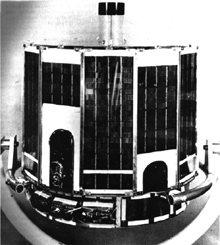
The DSAP-4A (Defense Satellite Application Program Block 4A) satellites series consisted of ten satellites, launched between 1965 and 1967. The designation DMSP-4A (Defense Meteorological Satellite Program Block 4A) was retroactively assigned to these satellites.
| Block 4A | ||||||||||
|---|---|---|---|---|---|---|---|---|---|---|
| Name | ID/Reference NORAD # | Launch date | Launch vehicle | Mass (kg) | Period (min) | Perigee (km) | Apogee (km) | Inclination (deg) | Status | Alt. name |
| DMSP 4A 1 | 1965-003A 00973 | 19 Jan 1965 | Thor-Altair | 250 | 97.7 | 471 | 822 | 98.8 | Decayed 13 Jul 1979; 1st use of Thor-Altair | OPS-7040 |
| DMSP 4A 2 | 1965-021A 01273 | 18 Mar 1965 | Thor-Altair | 250 | 94.4 | 442 | 533 | 99.0 | Decayed 31 Dec 1989 | OPS-7353 |
| DMSP 4A 3 | 1965-038A 01377 | 20 May 1965 | Thor-Altair | 250 | 98.7 | 527 | 829 | 98.2 | Decayed 09 Mar 2012 | OPS-8386 |
| DMSP 4A 4 | 1965-072A 01580 | 10 Sep 1965 | Thor-Altair | 250 | 101.5 | 639 | 1,013 | 99.0 | In orbit | OPS-8068 |
| DMSP 4A 5 | None | 6 Jan 1966 | Thor-Altair | 250 | ----- | ----- | ----- | ----- | Failed to orbit | ----- |
| DMSP 4A 6 | 1966-026A 02125 | 30 Mar 1966 | Thor-Altair | 250 | 99.9 | 613 | 883 | 98.5 | In orbit | OPS-0340 |
| DMSP 4A 7 | 1966-082A 02418 | 16 Sep 1966 | Thor-Burner II | 420 | 100.4 | 680 | 872 | 98.8 | In orbit; 1st use of Burner II | OPS-6026 |
| DMSP 4A 8 | 1967-010A 02669 | 8 Feb 1967 | Thor-Burner II | 420 | 101.3 | 778 | 854 | 98.9 | In orbit | OPS-6073 |
| DMSP 4A 9 | 1967-080A 02920 | 23 Aug 1967 | Thor-Burner II | 420 | 102.2 | 822 | 878 | 98.8 | In orbit | OPS-7202 |
| DMSP 4A 10 | 1967-096A 02980 | 11 Oct 1967 | Thor-Burner II | 420 | 99.5 | 650 | 822 | 99.2 | In orbit | OPS-1264 |
Block 5A


The DSAP-5A (Defense Satellite Application Program Block 5A) satellites series consisted of six satellites, launched between 1968 and 1971. The designation DMSP-5A (Defense Meteorological Satellite Program Block 5A) was retroactively assigned to these satellites.
| Block 5A | ||||||||||
|---|---|---|---|---|---|---|---|---|---|---|
| Name | ID/Reference NORAD # | Launch date | Launch vehicle | Mass (kg) | Period (min) | Perigee (km) | Apogee (km) | Inclination (deg) | Status | Alt. name |
| DMSP 5A 1 | 1968-042A 03266 | 23 May 1968 | Thor-Burner II | 420 | 101.9 | 809 | 888 | 98.8 | In orbit | OPS-7869 |
| DMSP 5A 2 | 1968-092A 03510 | 23 Oct 1968 | Thor-Burner II | 420 | 101.2 | 792 | 838 | 98.5 | In orbit | OPS-4078 |
| DMSP 5A 3 | 1969-062A 04047 | 23 Jul 1969 | Thor-Burner II | 420 | 101.1 | 775 | 844 | 98.5 | In orbit | OPS-1127 |
| DMSP 5A 4 | 1970-012A 04331 | 11 Feb 1970 | Thor-Burner II | 420 | 101.1 | 759 | 850 | 98.8 | In orbit | OPS-0054 |
| DMSP 5A 5 | 1970-070A 04512 | 3 Sep 1970 | Thor-Burner II | 420 | 101.9 | 764 | 874 | 99.1 | Reentered 21 Sep 1970 | OPS-0203 |
| DMSP 5A 6 | 1971-012A 04953 | 17 Feb 1971 | Thor-Burner II | 420 | 100.6 | 755 | 817 | 98.3 | In orbit | OPS-5268 |
Block 5B
The DSAP-5B (Defense Satellite Application Program Block 5B) satellites series consisted of five satellites, launched between 1971 and 1974. The designation DMSP-5B (Defense Meteorological Satellite Program Block 5B) was assigned to these satellites.
| Block 5B | ||||||||||
|---|---|---|---|---|---|---|---|---|---|---|
| Name | ID NORAD # | Launch date | Launch vehicle | Mass (kg) | Period (min) | Perigee (km) | Apogee (km) | Inclination (deg) | Status | Alt. name |
| DMSP 5B 1 | 05557 | 14 Oct 1971 | Thor-Burner II | 513 | 101.4 | 782 | 865 | 99.1 | In orbit | OPS-4311 |
| DMSP 5B 2 | 05903 | 24 Mar 1972 | Thor-Burner II | 513 | 101.5 | 787 | 868 | 99.1 | In orbit | OPS-5058 |
| DMSP 5B 3 | 06275 | 9 Nov 1972 | Thor-Burner II | 513 | 101.4 | 797 | 855 | 98.8 | In orbit | OPS-7323 |
| DMSP 5B 4 | 06787 | 17 Aug 1973 | Thor-Burner II | 513 | 101.2 | 795 | 839 | 98.5 | In orbit | OPS-8364 |
| DMSP 5B 5 | 07218 | 16 Mar 1974 | Thor-Burner IIA | 513 | 101.2 | 767 | 859 | 99.0 | In orbit | OPS-8579 |
Block 5C
The DSAP-5C (Defense Satellite Application Program Block 5C) satellites series consisted of three satellites, launched between 1974 and 1976. The designation DMSP-5C (Defense Meteorological Satellite Program Block 5C) was assigned to these satellites.
| Block 5C | |||||||||||
|---|---|---|---|---|---|---|---|---|---|---|---|
| Name | ID NORAD # | Launch date | Launch vehicle | Mass (kg) | Period (min) | Perigee (km) | Apogee (km) | Inclination (deg) | Status | Alt. name | End of Mission |
| DMSP 5C 1 | 07411 | 9 Aug 1974 | Thor-Burner IIA | 513 | 101.5 | 792 | 862 | 98.7 | In orbit | OPS-6983 | 1 Dec 1977 |
| DMSP 5C 2 | 07816 | 24 May 1975 | Thor-Burner II | 513 | 101.7 | 797 | 881 | 98.7 | In orbit | OPS-6229 | 30 November 1977 |
| DMSP 5C 3 | 08696 | 19 Feb 1976 | Thor-Burner II | 513 | 89.0 | 90 | 355 | 98.9 | Decayed 19 Feb 1976 | OPS-5140 | Failed to orbit. Improper Fuel Loading |
Block 5D


The DSAP-5D (Defense Satellite Application Program Block 5D) satellites series consisted of nineteen satellites, launched between 1976 and 2014. The designation DMSP-5D (Defense Meteorological Satellite Program Block 5D) was assigned to these satellites.
In 2015, Congress voted to terminate the DMSP program and to scrap the DMSP 5D-3/F20 satellite, ordering the Air Force to move on to a next-generation system. The Air Force had intended to keep DMSP F20 in climate-controlled storage at a Lockheed Martin clean room in Sunnyvale, California, for a time in case it needed to be called up for launch in the coming years, and in the aftermath of the failure of DMSP 5D-3/F19, the USAF was reconsidering the future of DMSP-5D3 F-20. However, in late 2016, the USAF began scrapping DMSP-5D3 F-20.
| Block 5D | ||||||||||
|---|---|---|---|---|---|---|---|---|---|---|
| Name | ID NORAD # | Launch date | Launch vehicle | Mass (kg) | Period (min) | Perigee (km) | Apogee (km) | Inclination (deg) | Status | Alt. name |
| DMSP 5D-1/F1 | 09415 | 11 Sep 1976 | Thor-Burner II | 513 | 101.3 | 806 | 834 | 98.6 | In orbit; aka AMS 1 | OPS-5721 |
| DMSP 5D1/F2 | 10033 | 5 Jun 1977 | Thor-Burner II | 513 | 101.3 | 789 | 853 | 99.0 | In orbit; aka AMS 2 | OPS-5644 |
| DMSP 5D-1/F3 | 10820 | 1 May 1978 | Thor-Burner II | 513 | 101.1 | 804 | 817 | 98.6 | In orbit; aka AMS 3 | OPS-6182 |
| DMSP 5D-1/F4 | 11389 | 6 Jun 1979 | Thor-Burner II | 513 | 101.2 | 806 | 828 | 98.7 | In orbit; aka AMS 4 | OPS-5390 |
| DMSP 5D-1/F5 | None | 14 July 1980 | Thor | 513 | ----- | ----- | ----- | ----- | Failed to orbit | ----- |
| DMSP 5D-2/F6 | 13736 | 21 Dec 1982 | Atlas E | 751 | 101.2 | 811 | 823 | 98.7 | In orbit; aka AMS 5 | OPS-9845 |
| DMSP 5D-2/F7 | 14506 | 18 Nov 1983 | Atlas E | 751 | 101.4 | 815 | 832 | 98.7 | In orbit | OPS-1294 |
| DMSP 5D-2/F8 | 18123 | 20 Jun 1987 | Atlas E | 823 | 96.89 | 564 | 653 | 97.6 | In orbit; first to carry SSM/I microwave imaging sensor to see through clouds | USA-26 |
| DMSP 5D-2/F9 | 18822 | 3 Feb 1988 | Atlas E | 823 | 101.3 | 815 | 826 | 98.7 | In orbit | USA-29 |
| DMSP 5D-2/F10 | 20978 | 1 Dec 1990 | Atlas E | 823 | 100.6 | 729 | 845 | 98.9 | Operational, but not in desired orbit | USA-68 |
| DMSP 5D-2/F11 | 21798 | 28 Nov 1991 | Atlas E | 823 | 101.9 | 835 | 855 | 98.9 | Exploded in orbit in 2004 | USA-73 |
| DMSP 5D-2/F12 | 23233 | 29 Aug 1994 | Atlas E | 830 | 101.9 | 839 | 856 | 98.9 | Exploded in orbit in 2016 | USA-106 |
| DMSP 5D-2/F13 | 23533 | 24 March 1995 | Atlas E | 830 | 101.9 | 845 | 854 | 98.8 | Exploded in orbit in February 2015 | USA-109 |
| DMSP 5D-2/F14 | 24753 | 4 Apr 1997 | Titan 23G | 830 | 101.9 | 842 | 855 | 98.9 | Decommissioned in 2020. Exploded in orbit in December 2024 | USA-131 |
| DMSP 5D-3/F15 | 25991 | 12 Dec 1999 | Titan 23G | 101.8 | 837 | 851 | 98.9 | In orbit and decommissioned in 2020 (5D-2 suite of instruments) | USA-147 | |
| DMSP 5D-3/F16 | 28054 | 18 Oct 2003 | Titan 23G | 101.9 | 843 | 853 | 98.9 | In orbit | USA-172 | |
| DMSP 5D-3/F17 | 29522 | 04 Nov 2006 | Delta IV | 102 | 841 | 855 | 98.8 | In orbit | USA-191 | |
| DMSP 5D-3/F18 | 35951 | 18 Oct 2009 | Atlas V | 1200 | 101.9 | 843 | 857 | 98.9 | In orbit. Included a 2.4 hour post-spacecraft mission test of cryogenic fluid management on the Centaur upper stage. | USA-210 |
| DMSP 5D-3/F19 | 39630 | 3 Apr 2014 | Atlas V | 101.85 | 840 | 853 | 98.85 | F19 stopped responding to commands on 11 February 2016 due to a power failure affecting an encrypted command-and-control system. The satellite continued to report telemetry and some real-time weather data, but could no longer be commanded. The data was reported as tactical data to field units. The attitude control was lost in October 2017, thus ending the mission. F19 has started to break apart, creating several pieces of debris. | USA-249 |
See also
- NPOESS - the National Polar-orbiting Operational Environmental Satellite System
- Space debris
External links
- (dead-link)
- (dead-link)
- 2008-04-04 at the Wayback Machine