Disaster film
In-game article clicks load inline without leaving the challenge.

A disaster film or disaster movie is a film genre that has an impending or ongoing disaster as its subject and primary plot device. Such disasters may include natural disasters, accidents, military/terrorist attacks, alien invasions, or global catastrophes such as a pandemic. A subgenre of action films, these films usually feature some degree of build-up, the disaster itself, and sometimes the aftermath, usually from the point of view of specific individual characters or their families or portraying the survival tactics of different people.
The genre came to particular prominence during the 1970s with the release of high-profile films such as Airport (1970), followed in quick succession by The Poseidon Adventure (1972), Earthquake (1974) and The Towering Inferno (1974). It experienced a renewal in the 1990s, starting with Twister and Independence Day, both in 1996. Boosted by computer-generated imagery and larger studio budgets which allowed for greater spectacle, this revival culminated in the cinematic phenomenon that was James Cameron's Titanic in 1997. This revival continued into the 2000s and 2010s with films like The Day After Tomorrow (2004), 2012 (2009), and San Andreas (2015).
Characteristics
Disaster films are a subgenre of action films. The essence of the genre has been described as combining "melodramatic elements with 'extensive action sequences' exhibiting the 'efforts of a number of characters to escape a man-made or natural disaster'." Common narrative elements include "a scenario disrupted by violent events, a hero figure, a diverse range of characters, and a series of obstacles".
These films often feature large casts of actors and multiple plot lines, focusing on the characters' attempts to avert, escape or cope with the disaster and its aftermath. Recurring character types include the specialist, scientists or professors whose knowledge "provides the basic factual framework" of the drama. There is usually someone of "ominous complacency", sometimes the scientist, or maybe a businessman or politician whose confidence represents "the extreme form of the security which the audience brings into the theatre". The hero is "usually a layman with practical sense but without specialized knowledge", or if a specialist then his knowledge "leavened by his rusticity" like Paul Newman's architect in The Towering Inferno. There is often a romantic subplot, with romance being a "vital aspect of the tension between social instinct and selfishness".
Disaster films can be said to address "issues pertinent to the times in which they are made". In the genre, poetic justice can be derived from the "assumption that there is some relationship between a person's due and his or her doom"; characters are often "selfish, complacent figures" who "generally deserve to be shaken up".
Maurice Yacowar's essay The Bug in the Rug: Notes on the Disaster Genre lists different types of disaster films. These are "Natural Attack", by regular-sized or giant animals, atomic mutants, or the elements; "The Ship of Fools", travel disasters whether on planes, boats, trains, or cars; "The City Fails" where people are punished for their hubris in creating a great structure, "The Monster", from outer space, zombies, aliens, or constructed like in Frankenstein or a golem; "Survival", a great journey or the aftermath of a battle; "War", when carnage overshadows human conflict or atomic weapons threaten the end of the world; "Historical", in the distant past or future; and "The Comic" with the disaster film containing absurdity, a happy-ending, or parody.
In the introduction to The Golden Age of Disaster Cinema: A Guide to the Films, 1950-1979, Nik Havert states several things that he says disqualify a film from being part of the disaster genre. These are war, giant creatures such as kaiju, lone animals as found in such films as Jaws or Grizzly, and aliens or alien invasions.
Origins

Disaster films were made before the phrase was coined in the early 1970s, one of the earliest being Fire! (1901) made by James Williamson in Britain. The silent film portrayed a burning house and the firemen who arrive to quench the flames and rescue the inhabitants.
Several Roman epics produced in Italy between 1908 and 1914 are the first notable run of disaster films; The Last Days of Pompeii (from both 1908 and 1913), The Fall of Troy (1910), Quo Vadis (1913), and Cabiria (1914). The disaster sequences in The Last Days of Pompeii were so effective that they would be recycled in later remakes.
Origins of the genre can also be found in In Nacht und Eis (1912), about the sinking of the Titanic; Atlantis (1913), also about the Titanic; the Danish The End of the World (1916), (about a comet); Noah's Ark (1928), the Biblical story from Genesis about the great flood; Deluge (1933), about tidal waves devastating New York City; King Kong (1933), with a gigantic gorilla rampaging through New York City; and The Last Days of Pompeii (1935), again dealing with the Mount Vesuvius volcanic eruption in 79 AD.
John Ford's The Hurricane (1937) concluded with the striking sequence of a tropical cyclone ripping through a fictional South Pacific island. The drama San Francisco (1936) depicted the historic 1906 San Francisco earthquake, while In Old Chicago (1937) recreated The Great Chicago Fire which burned through the city in 1871. Carol Reed's 1939 film, The Stars Look Down, examines a catastrophe at a coal mine in North-East England.

After the end of World War II and the beginning of the Atomic Age, science fiction films became popular, and focused on possible devastations due to atomic warfare and mutant monsters caused by radiation. Films featuring the latter included: The Beast from 20,000 Fathoms (1953), Them! (1954), It Came from Beneath the Sea (1955), Attack of the Crab Monsters (1957), and the Pacific Nuclear weapons testing birthed monsters in Godzilla (1954),
Alien invasions were covered in The War of the Worlds (1953) and Earth vs. the Flying Saucers (1956), as well as those with whole world disasters used as plot elements; such as a star and a planet on a crash course for Earth in When Worlds Collide (1951),
The sinking of the Titanic was depicted again in Werner Klingler and Herbert Selpin's Titanic (1943). The film was soon banned in Germany as the scenes of panic were considered too potent while wartime air-raids were ongoing. The ship was sunk again in Titanic (1953), and A Night to Remember (1958) (which re-used shots from the German film). The British action-adventure film The Last Voyage (1960), while not about the Titanic disaster but a predecessor to The Poseidon Adventure, starred Robert Stack as a man desperately attempting to save his wife (Dorothy Malone) and child trapped in a sinking ocean liner. The film, concluding with the dramatic sinking of the ship, was nominated for an Oscar for Best Visual Effects.

Additional precursors to the popular disaster films of the 1970s include The High and the Mighty (1954), starring John Wayne and Robert Stack as pilots of a crippled airplane attempting to cross the ocean; Zero Hour! (1957), written by Arthur Hailey (who also penned the 1968 novel Airport) about an airplane crew that succumbs to food poisoning; Jet Storm and Jet Over the Atlantic, two 1959 films both featuring attempts to blow up an airplane in mid-flight; The Crowded Sky (1960) which depicts a mid-air collision; and The Doomsday Flight (1966), written by Rod Serling and starring Edmond O'Brien as a disgruntled aerospace engineer who plants a barometric pressure bomb on an airliner built by his former employer set to explode when the airliner descends for landing.[better source needed]
Volcanic disasters would also feature in films such as Krakatoa, East of Java (1969) starring Maximilian Schell.
1970s peak
The golden age of the disaster film began in 1970 with the release of Airport. A huge financial success, earning $100,489,151 at the box office in the United States and Canada ($833million in 2025-adjusted dollars), the film was directed by George Seaton and starred Burt Lancaster, Dean Martin, George Kennedy, Jacqueline Bisset and Helen Hayes. While strictly not even a disaster—an airplane crippled by the explosion of a bomb—the film established the classic blueprint of the genre: a headline emergency story and multiple plotlines acted out by an all-star cast. Airport was nominated for 10 Academy Awards, including Best Picture, winning Best Supporting Actress for Hayes.
The success of the film ushered in other disaster films, often with large casts of big name stars. A combination of "sentimental relationship-based plots and antagonists who put pride and profit above concern for human life" were common elements. Disaster movies of the 1970s can mostly be split into 'travel' or 'natural' disasters.

The 1972 release of The Poseidon Adventure was another huge financial success, taking $84,563,118 in the US/Canada ($651million in 2025-adjusted dollars). Directed by Ronald Neame and starring Gene Hackman, Ernest Borgnine, Shelley Winters and Red Buttons, the film detailed survivors' attempts at escaping a sinking ocean liner overturned by a giant wave triggered by an earthquake. The Poseidon Adventure was nominated for eight Academy Awards, including Best Supporting Actress for Shelley Winters, and winning for Original Song and receiving a Special Achievement Award for visual effects.
Submersion of Japan (1973) by Toho was a major financial success in Japan, where it was the highest-grossing film in 1973 and 1974. It was released in the U.S.A in 1975 by New World Pictures in a recut, and with additional American footage, dubbed version as Tidal Wave.
The trend reached its zenith in 1974 with the release of The Towering Inferno, Earthquake, and Airport 1975 (the first Airport sequel). The competing films enjoyed staggering success at the box office, with The Towering Inferno earning $116million ($757million in 2025-adjusted dollars), Earthquake earning $79million ($516million in 2025-adjusted dollars), and Airport 1975 earning $47million ($281million in 2025-adjusted dollars) in theatrical rentals.
Arguably the greatest of the 1970s disaster films, The Towering Inferno was a joint venture of 20th Century Fox and Warner Bros. and was produced by Irwin Allen (eventually known as "The Master of Disaster", as he had previously helmed The Poseidon Adventure and later produced The Swarm, Beyond the Poseidon Adventure and When Time Ran Out...). Directed by John Guillermin and starring Paul Newman, Steve McQueen, William Holden and Faye Dunaway, the film depicts a huge fire engulfing the tallest building in the world and firefighters' attempts at rescuing occupants trapped on the top floor. It was nominated for eight Academy Awards including Best Picture, winning for Best Cinematography, Best Film Editing and Best Original Song.
Earthquake was also honored with four Academy Award nominations including for its special effects, winning for Best Sound and receiving a Special Achievement Award for visual effects. The film was directed by Mark Robson and starred Charlton Heston, Ava Gardner, Geneviève Bujold, George Kennedy and Lorne Greene. It was noted as the first film to utilize Sensurround, where massive subwoofer speakers were installed in theaters to recreate the vibrating sensation of an earthquake with low frequency tones played during those scenes.
The trend continued with The Hindenburg (1975), starring George C. Scott; The Cassandra Crossing (1976), starring Burt Lancaster; Two-Minute Warning (1976), starring Charlton Heston; Black Sunday (1977), starring Robert Shaw; Rollercoaster in Sensurround (1977), starring George Segal; Damnation Alley (1977), starring Jan-Michael Vincent;[citation needed] Avalanche (1978), starring Rock Hudson; Gray Lady Down (1978), also starring Charlton Heston; Hurricane (a 1979 remake of John Ford's 1937 film), starring Jason Robards; and City on Fire (1979), starring Barry Newman.[citation needed] The Airport series continued with Airport '77 (1977) and The Concorde ... Airport '79 (1979), with George Kennedy portraying the character Joe Patroni in each sequel, and The Poseidon Adventure was followed by Beyond the Poseidon Adventure in 1979.
The release of Steven Spielberg's Jaws (1975), though combining elements of multiple genres, has been called the creation of "a new kind of disaster film" which was "trimmed down and turned into pure mechanism". David A. Cook says that it is in the late 1970s disaster films that the influence of Jaws is most felt.
The Bullet Train (1975), based on the Japanese Shinkansen train, was Toei Company's response to the popularity of the American disaster films. It was also influential on later disaster films such as Runaway Train (1985) and Speed (1994).
Several made-for-TV movies, beginning in the wake of Airport and The Poseidon Adventure, also capitalized on the trend. These included Heatwave! (1974), with Bonnie Bedelia and Ben Murphy looking for water for their infant; Hurricane (1974), a different movie than John Ford's 1937 film and the 1979 remake of the same title listed above; as well as Flood! (1976) and Fire! (1977), both executive produced by Irwin Allen. Allen's success with the genre did not last, as both The Swarm (1978) and Beyond the Poseidon Adventure (1979) were critical and box-office failures.
This wave of disaster films fizzled out by about 1980 due to the amount of repetition, imitation, and overexposure. Although there had been an earlier disaster film parody The Big Bus (1976), the end of the trend was marked by the 1980 comedy Airplane!, which fondly spoofed the clichés of the genre.
1990s revival
The resurgence of big-budget productions of the genre in the 1990s—aided by advancements in CGI technology—included such films as Speed (1994), Twister (1996), Independence Day (1996), Daylight (1996), Dante's Peak (1997), Volcano (1997), Hard Rain (1998), Firestorm (1998), Deep Impact (1998) and Armageddon (1998). The revival was initiated by the commercial success of Twister (earning $241 million) and Independence Day ($306 million), the top two domestic grossing films of 1996.
Twister (1996) was directed by Jan de Bont, written by Michael Crichton and his wife Anne-Marie Martin, and starred Helen Hunt, Cary Elwes, Bill Paxton, and Jami Gertz. The film focuses on a group of people that seek out tornadoes in the American Midwest. It was a streamlined update on previous disaster films, with a more rural setting and concentrating on a smaller group of characters. Part of its promotion was the novelty of having photorealistic tornadoes created with CGI.
Independence Day (1996), directed by Roland Emmerich and starred Will Smith, Bill Pullman, Jeff Goldblum, Mary McDonnell, and Judd Hirsch, depicts aliens invading and attacking the planet, leaving only a group of soldiers and scientists to save the day. The film is a hybrid of multiple genres, combining science-fiction, action-adventure, war film, and disaster movie. It was the top grossing film of the year in the USA, demonstrating audience appetite for special effects-driven disaster movies. After directing Independence Day, Emmerich went on to make multiple other movies focused on a catastrophe of some kind, including a Godzilla remake in 1998, and gained a reputation as a "master of disaster".
These movies both recycled 1950's and 1970's precedents and tapped into anxieties surrounding the build-up to the end of the millenium, their main rationale being to face up to the end of the world. Stephen Keane says that 1990s disaster movies worked through issues of race, class, and gender more than in any previous era, and were "explicitly representative of national and even international concerns".
Hoping to capitalize on the success of Independence Day, several studios then also released large-scale disaster films. This led to different studios planning separate disaster films with similar subject matter. These include two movies about volcanos, Dante's Peak and Volcano (both 1997), and three about comets on a collison course with Earth. These were DreamWorks Pictures' Deep Impact (1998, directed by Mimi Leder), Touchstone Pictures' Armegeddon (1998, directed by Michael Bay), and a Peter Hyams written and James Cameron helmed film by 20th Century Fox. Hyam and Cameron's film, Bright Angel Falling ended up not being produced.
In 1997, James Cameron co-produced, wrote and directed a version of the story of the Titanic. It was a massive success, becoming the highest-grossing film of all time for twelve years with over $2.2 billion worldwide, and won 11 Academy Awards including Best Picture and Best Director.
The 1990's were also characterized by a number of 'virus' themed films; including Outbreak (1995), Twelve Monkeys (1995) and The X-Files (1998).
2000s - 2010s
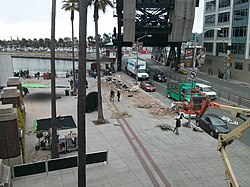
Disaster movies continued into the 2000s, including The Sum of All Fears (2002) and The Day After Tomorrow (2004). With other entries including The Perfect Storm (2000), The Core (2003), The Happening (2008), Knowing (2009), 2012 (2009), The Impossible (2012), Noah (2014) and San Andreas (2015).
These films can be considered an extension of the revival that started in the 1990s, with it reviving again just as it was beginning to wane. This is generally credited to the threat of terrorism after the September 11 attacks on New York.
After the attacks, the campy thrill-rides of the earlier films seemed insensitive, after many commentators described the sight of the attacks as reminiscent of the decimated cities in films like Godzilla and Independence Day. Ken Feil says that films produced after the attacks reinstated the "hegemonic constructions of gender as a correlate to reconstructing U.S. strength". That by proving the "durability of traditional gender roles in the face of disaster", post-9/11 disaster movies affirmed the United States' own durability after the terrorist attacks.
After the attacks, disasters remained in the public awareness, and disaster films continued to be made, with violent images of destruction rendered even more realistic with digital technology. Two films directly about September 11, United 93 and World Trade Center (both from 2006) had reasonable success; but otherwise the connection between spectacle, visual effects, and terror in the pre-9/11 disaster film was mostly maintained in the post-9/11 fantasy film. Sites of "sudden urban destruction" are the setting for many blockbusters of the 2000s and 2010s.
In The Day After Tomorrow, directed by Roland Emmerich and released in 2004, climate change causes flooding and tornadoes in a USA with a president who is skeptical of the theory. Emmerich has stated the film is partly a critique of the environmental policies of the Bush administration, and it sparked political discussion about global warming. It made $68.44 million in its opening weekend. For twenty years it would hold the record for the highest opening weekend for a natural disaster film, until 2024 when it was dethroned by Twisters. At the end of its theatrical run, the film had grossed $186,740,799 domestically and $552,639,571 worldwide.
The "quintessential disaster film" 2012, also directed by Emmerich, was released in 2009. In it the Earth's core overheats and the resulting pressure release threatens to end life on earth in a year specifically predicted by the ancient Mayans and written into their calendar. It grossed $166.1 million in North America and $603.5 million in other territories for a worldwide total of $769.6 million against a production budget of $200 million.
Contagion, directed by Steven Soderbergh and written by Scott Z. Burns about a global pandemic, was released in 2011. It's worldwide box-office was $136.5 million. During the early days of the COVID-19 pandemic in 2020, various news articles and social media posts used the movie as a way of framing societal reactions to similar real life events.
New Line and Warner Bros. Pictures' San Andreas (2015) was directed by Brad Peyton and produced by Beau Flynn, from a screenplay by Carlton Cuse with a story by Andre Fabrizio and Jerry Passmore. It starred Dwayne Johnson, Carla Gugino and Paul Giamatti. Johnson plays a helicopter pilot called upon to execute multiple rescues during an earthquake. It grossed $155.2 million in the United States and Canada and $319.4 million in other territories, for a worldwide total of $475 million.
See also
Further reading
- Annan, David (1975). . Bounty Books. ISBN 0-517-52420-1.
- Broderick, Mick (January 1992). Nuclear Movies: A Critical Analysis and Filmography of International Feature Length Films Dealing With Experimentation, Aliens, Terrorism, Holocaust. McFarland & Co. ISBN 0-89950-543-0.
- Dixon, Wheeler Winston (1999). Disaster and Memory. Columbia University Press. ISBN 0-231-11316-1.
- Keane, Stephen (2006). Disaster Movies: The Cinema of Catastrophe. Wallflower Press. ISBN 1-905674-03-1.
- Newman, Kim (February 2000). Apocalypse Movies: End of the World Cinema. St. Martin's Press. ISBN 0-312-25369-9.