Tiffany glass
In-game article clicks load inline without leaving the challenge.


Tiffany glass refers to the many types of art glass developed and produced from 1878 to 1932 at the Tiffany Studios in New York City, by Louis Comfort Tiffany and a team of other designers, including Clara Driscoll, Agnes F. Northrop, Frederick Wilson, and Alice Carmen Gouvy. They made stained glass windows, Tiffany lamps with glass shades, glass mosaics, vases and other blown glass items, and other decorative art for homes, churches, and businesses such as hotels. This was part of a larger movement of Art Nouveau glass.
In 1865, Tiffany traveled to Europe, and in London he visited the Victoria and Albert Museum, whose extensive collection of Roman glass and Syrian glass made a deep impression on him.[citation needed] He admired the coloration of medieval glass and was convinced that the quality of contemporary glass could be improved upon because the production of art glass in America during this time was not close to what Europeans were creating. In his own words, the "Rich tones are due in part to the use of pot metal full of impurities, and in part to the uneven thickness of the glass, but still more because the glass maker of that day abstained from the use of paint".
Tiffany was an interior designer, and in 1878 his interest turned toward the creation of stained glass. He opened his own studio and glass foundry because he was unable to find the types of glass that he desired in interior decoration. His inventiveness both as a designer of windows and as a producer of the material with which to create them was to become renowned. Tiffany wanted the glass itself to transmit texture and rich colors, and he developed a type of glass he called "Favrile".
Tiffany Studios
Tiffany was intrigued by glass production in medieval Europe, and was disappointed by the type of glass produced in the 19th century in The United States. According to Rachel Bradshaw, "Tiffany came to realize that the nineteenth century windows lacked the brilliance and quality of this medieval glass. Instead, nineteenth century artisans placed more emphasis on naturalistic detail rather than on color, using enamels to create the effects of drapery, hair, facial features, and foliage." Although the United States did not have many experts in the field of glass at the time, Tiffany started doing experiments with glass and color. He was able to modernize some of the glassworks he has seen in textbooks about medieval glass, and those he had seen in Europe.
From there Tiffany started conducting more experiments and established a new era for what is known to be glasswork. An article by the Metropolitan Museum of Art said, "Of all of Tiffany's artistic endeavors, leaded-glass brought him the greatest recognition. Tiffany and his early rival, John La Farge, revolutionized the look of stained glass, which had remained essentially unchanged since medieval times when craftsmen utilized flat panes of white and colored glass with details painted with glass paints before firing and leading."
Tiffany's favrile glass was manufactured at the Tiffany factory located at 96–18 43rd Avenue in Corona, Queens from 1901 to 1932. The Louis Tiffany School, New York City P.S. (public school) 110Q, was built on the old site.
Closing
The closing of the factory has been a matter of some controversy. Tiffany's glass fell out of favor in the 1910s, and by the 1920s a foundry had been installed for a separate bronze company. Tiffany's leadership and talent, as well as his father's money and old firm allowed Tiffany to relaunch Tiffany Studios as a marketing strategy in order for his business to thrive. In 1932, Tiffany Studios filed for bankruptcy. Ownership of the complex passed back to the original owners of the factory — the Roman Bronze Works — which had served as a subcontractor to Tiffany for many years." John Polachek, founder of the General Bronze Corporation —who had worked at the Tiffany Studios earlier— purchased the Roman Bronze Works (the old Tiffany Studios). General Bronze then became the largest bronze fabricator in New York City formed through the merger of his own companies and Tiffany's Corona factory. Louis Tiffany subsequently died in 1933.
Types

Opalescent glass
The term "opalescent glass" is commonly used to describe glass where more than one color is present, being fused during the manufacture, as against flashed glass in which two colors may be laminated, or silver stained glass where a solution of silver nitrate is superficially applied, turning red glass to orange and blue glass to green. Some opalescent glass was used by several stained glass studios in England from the 1860s and 1870s onwards, notably Heaton, Butler and Bayne. Its use became increasingly common. Opalescent glass is the basis for the range of glasses created by Tiffany.
Opalescent glass comes in three main types. The first type is exemplified by blue-tinged semi-opaque or clear glass with milky opalescence in the center, seen in creations by Lalique, Sabino, and Jobling's. This effect is achieved through slower cooling, causing crystallization. The glass glows golden when backlit and a beautiful blue when front-lit. Many French companies in the 1920s and 1930s, such as Lalique and Sabino, produced opalescent art deco pieces. The second type features a milky white edge or raised pattern on colored pressed glass. Reheating sections during the cooling process turns them white, creating a decorative effect. This method was employed by various companies, including Barolac in Bohemia, Jobling's in England, and Val St Lambert in Belgium. The third type involves hand-blown glass with two layers, containing heat-reactive components like bone ash. The glass is blown into a mold with a raised pattern, and reheating turns the heat-sensitive glass milky white, creating a contrasting silhouette against the clear background.
Favrile glass

Tiffany patented Favrile glass in 1892. Favrile glass often has a distinctive characteristic that is common in some glass from classical antiquity: it possesses a superficial iridescence. Tiffany said "Favrile glass is distinguished by...brilliant or deeply toned colors, usually iridescent like the wings of certain American butterflies, the necks of pigeons and peacocks, the wing covers of various beetles." This iridescence causes the surface to shimmer, but also causes a degree of opacity. This iridescent effect of the glass was obtained by mixing different colors of glass together while hot.
Streamer glass

Streamer glass refers to a sheet of glass with a pattern of glass strings affixed to its surface. Tiffany made use of such textured glass to represent, for example, twigs, branches and grass. Streamers are prepared from very hot molten glass, gathered at the end of a punty (pontil) that is rapidly swung back and forth and stretched into long, thin strings that rapidly cool and harden. These hand-stretched streamers are pressed on the molten surface of sheet glass during the rolling process, and become permanently fused.
Fracture glass

Fracture glass refers to a sheet of glass with a pattern of irregularly shaped, thin glass wafers affixed to its surface. Tiffany made use of such textured glass to represent, for example, foliage seen from a distance. The irregular glass wafers, called fractures, are prepared from very hot, colored molten glass, gathered at the end of a blowpipe. A large bubble is forcefully blown until the walls of the bubble rapidly stretch, cool and harden. The resulting glass bubble has paper-thin walls and is immediately shattered into shards. These hand blown shards are pressed on the surface of the molten glass sheet during the rolling process, to which they become permanently fused.
Fracture-streamer glass

Fracture-streamer glass refers to a sheet of glass with a pattern of glass strings, and irregularly shaped, thin glass wafers, affixed to its surface. Tiffany made use of such textured glass to represent, for example, twigs, branches and grass, and distant foliage. The process is as above except that both streamers and fractures are applied to sheet glass during the rolling process.
Ring mottle glass

Ring mottle glass refers to sheet glass with a pronounced mottle created by localized, heat-treated opacification and crystal-growth dynamics. Ring mottle glass was invented by Tiffany in the early 20th century. Tiffany's distinctive style exploited glass containing a variety of motifs such as those found in ring mottle glass, and he relied minimally on painted details.
When Tiffany Studios closed in 1932, the secret formula for making ring mottle glass was forgotten and lost. Ring mottle glass was re-discovered in the late sixties by Eric Lovell of Uroboros Glass. Traditionally used for organic details on leaves and other natural elements, ring mottles also find a place in contemporary work when abstract patterns are desired.
Ripple glass

Ripple glass refers to textured glass with marked surface waves. Tiffany made use of such textured glass to represent, for example, water or leaf veins. The texture is created during the glass sheet-forming process. A sheet is formed from molten glass with a roller that spins on itself while travelling forward. Normally the roller spins at the same speed as its own forward motion, much like a steam roller flattening tarmac, and the resulting sheet has a smooth surface. In the manufacture of rippled glass, the roller spins faster than its own forward motion. The rippled effect is retained as the glass cools.
Drapery glass

Drapery glass refers to a sheet of heavily folded glass that suggests fabric folds. Tiffany made abundant use of drapery glass in ecclesiastical stained glass windows to add a three-dimensional effect to flowing robes and angel wings, and to imitate the natural coarseness of magnolia petals. The making of drapery glass requires skill and experience. A small diameter hand-held roller is manipulated forcefully over a sheet of molten glass to produce heavy ripples, while folding and creasing the entire sheet. The ripples become rigid and permanent as the glass cools. Each sheet produced from this artisanal process is unique.
Locations and collections


Museums
- England Haworth Art Gallery
- United States Florida Charles Hosmer Morse Museum of American Art, Winter Park Illinois Art Institute of Chicago Halim Time and Glass Museum, Evanston Louisiana Newcomb Art Museum, Tulane University, New Orleans Michigan Ella Sharp Museum of Art and History, Jackson Meadow Brook Hall, Rochester University of Michigan Museum of Art, Ann Arbor New York Brooklyn Museum Metropolitan Museum of Art, Manhattan, New York City Neustadt Collection of Tiffany Glass, Queens Museum, Queens, New York City New-York Historical Society, Manhattan, New York City Pennsylvania Allentown Art Museum Texas Dallas Museum of Art Museum of Fine Arts, Houston Virginia Virginia Museum of Fine Arts, Richmond Wisconsin Charles Allis Art Museum, Milwaukee
Stained glass in situ

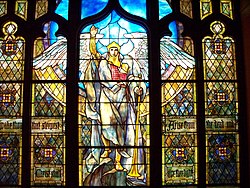

- Canada Ontario London – St Paul's Cathedral, four windows, two signed by Tiffany Quebec Montreal – Montreal Museum of Fine Arts, Bourgie Pavilion (formerly Erskine and American United Church), twenty windows signed by Tiffany
- Mexico Mexico City – Palacio de Bellas Artes Mexico City – Gran Hotel Ciudad de México
- Scotland Aberdeenshire – St Peter's Kirk, Fyvie Dunfermline – Dunfermline Abbey Edinburgh – Parish Church of Saint Cuthbert
- United States Alabama Mobile – Christ Church Cathedral Arizona Douglas – Gadsden Hotel California Vallejo – St. Peter's Chapel, Mare Island, 25 windows by Tiffany Colorado Colorado Springs – First United Methodist Church Connecticut Southport Pequot Library Association Hartford First Church of Christ and Ancient Burial Ground Mark Twain House New London St. James Episcopal Church New Haven – Center Church on the Green Trinity Lutheran Church Florida St. Augustine – Flagler College Georgia Atlanta – All Saints' Episcopal Church Jekyll Island – Faith Chapel Macon – St. Paul's Episcopal Church Savannah – Gryphon Tea Room Thomasville – St. Thomas Episcopal Church Illinois Chicago – Macy's on State Street, formerly Marshall Field's Second Presbyterian Church on South Michigan Avenue Chicago Cultural Center Springfield – First Presbyterian Church Tinley Park – St. Andrew's Anglican Church Indiana Indianapolis – Second Presbyterian Church Richmond – Reid Center, formerly Reid Memorial Presbyterian Church Iowa Dubuque – St. Luke's United Methodist Church Kansas Topeka – First Presbyterian Church Kentucky Covington – Trinity Episcopal Church Louisiana Baton Rouge - St. James Episcopal Church New Orleans – Tulane University Maine Portland – Masonic Temple Maryland Baltimore – Brown Memorial Presbyterian Church Massachusetts Boston – Arlington Street Church Church of the Covenant Wellesley – Houghton Memorial Chapel at Wellesley College Nantucket – St. Pauls Episcopal Church Michigan Ann Arbor – Unitarian Universalist Church (Hobbs & Black) Newberry Hall (Kelsey Museum of Archeology) Grand Rapids – Ladies Literary Club Temple Emanuel Marquette – The Resurrection Window, Morgan Chapel, St. Paul's Episcopal Church Minnesota Stillwater – Mississippi University – Ventress Hall at The University of Mississippi Tribute to the University Greys Missouri Kansas City – St. Mary's Episcopal Church Kirkwood – Grace Episcopal Church Clayton – Central Presbyterian Church New Hampshire Bretton Woods – Mount Washington Hotel New Jersey Hackensack – Second Reformed Church Maplewood – Morrow Memorial United Methodist Church New Brunswick – Kirkpatrick Chapel at Rutgers, The State University of New Jersey New York Albany – First Presbyterian Church of Albany Albion – Pullman Memorial Universalist Church Auburn – Willard Chapel Bath – First Presbyterian Church Beacon – St. Andrew's Church Briarcliff Manor – Congregational Church Buffalo – St. Paul's Episcopal Cathedral Irvington – Irvington Presbyterian Church Irvington Town Hall – Clock face and reading room Lockport – First Presbyterian Church New York City – Brooklyn – Brown Memorial Baptist Church and church house Flatbush Reformed Church and church house First Unitarian Congregational Society and Rev. Donald McKinney chapel Manhattan – Grand Central Terminal – 13-foot (4.0 m) clock face on south facade[disputed – discuss] West End Collegiate Church, West End Avenue St. Michael's Church, New York City, Amsterdam Avenue at 99th Street Holy Trinity Lutheran Church Roslyn – Trinity Episcopal Church Roxbury – Jay Gould Memorial Reformed Church Saugerties – St. Mary of the Snow, 36 Cedar Street Troy – Troy Public Library St. Joseph's Catholic Church – St. Paul's Episcopal Church Tuxedo Park – St. Mary's-in-Tuxedo Episcopal Church Garden City – St Paul's School, endangered glass Washingtonville – Moffat Library Ohio Cleveland – Wade Memorial Chapel in Lake View Cemetery Dayton – Westminster Presbyterian Church, 125 N. Wilkinson Street Historic Woodland Cemetery & Arboretum, 118 Woodland Avenue Pennsylvania Altoona – St. Lukes Episcopal Church Brownsville – Christ Church Erie – Cathedral of St. Paul First Presbyterian Church Franklin – St. John's Episcopal Church Franklin – Christ's Church Kittanning – Grace Presbyterian Church Lancaster – First Presbyterian Church Lewistown – St. Mark's Episcopal Church[failed verification] First United Methodist Church[failed verification] Montgomery Township – Robert Kennedy Memorial Presbyterian Church New Castle – St. Jude's Episcopal Church, formerly known as Trinity Episcopal Church Philadelphia – Calvary Center for Culture and Community Church of the Holy Trinity The Curtis Center formerly The Curtis Building - See The Dream Garden First Presbyterian Church St. Stephen's Episcopal Church Tenth Presbyterian Church Pittsburgh – Calvary United Methodist Church Emmanuel Episcopal Church Shadyside Presbyterian Church First Presbyterian Church Third Presbyterian Church St. Andrews Episcopal Church Sewickley – First Presbyterian Church St. Stephen's Episcopal Church Sharon – Buhl Mausoleum Titusville – St. James Memorial Episcopal Church Uniontown – Trinity United Presbyterian Church St. Peter's Anglican Church Whitemarsh Township – St. Thomas' Church Williamsport – Christ Community Worship Center, formerly the Presbyterian Church of the Covenant Tennessee Chattanooga – Basilica of Sts. Peter and Paul Memphis – Grace-St. Luke's Episcopal Church Texas Galveston – Trinity Episcopal Church Houston – Christ Church Cathedral Utah Salt Lake City – Salt Lake Temple St. Mark's Episcopal Cathedral Vermont St. Johnsbury – Grace United Methodist Church Virginia Newport News – St. Paul's Episcopal Church Norfolk – St. Paul's Episcopal Church Richmond – Congregation Beth Ahabah Petersburg – Blandford Church Staunton – Trinity Episcopal Church Washington Seattle – Pierre P. Ferry House Wisconsin Menomonie – Mabel Tainter Memorial Building Milwaukee – Charles Allis Art Museum Milwaukee – St. Paul's Episcopal Church Oshkosh – Oshkosh Public Museum
See also
Informational notes
Citations
Further reading
- Eidelberg, Dr. Martin (2007). . New York: Lillian Nassau LLC. ISBN 978-0-615-16761-9.
- Frelinghuysen, Alice Cooney (2006). . New York: The Metropolitan Museum of Art. ISBN 1588392015.
External links
- from Tiffany Studios, Tiffany Glass & Decorating Company, Tiffany and Company, and the Louis Comfort Tiffany Foundation – held by the Metropolitan Museum of Art