The righteous perishes
In-game article clicks load inline without leaving the challenge.
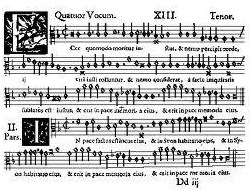
The righteous perishes are the words with which the 57th chapter of the Book of Isaiah start. In Christianity, Isaiah 57:1–2 is associated with the death of Christ, leading to liturgical use of the text at Tenebrae: the 24th responsory for Holy Week, "Ecce quomodo moritur justus" (See how the just dies), is based on this text. More generally, the text is associated with the death of loved ones and is used at burials. As such, and in other versions and translations, the Bible excerpt has been set to music.
Text
Isaiah57:1–2 shifts between singular and plural, contrasting a group whom the prophetic tradition approves and others who are strongly condemned.
1 The righteous perishes,
And no man takes it to heart;
Merciful men are taken away,
While no one considers
That the righteous is taken away from evil.
2 He shall enter into peace;
They shall rest in their beds,
Each one walking in his uprightness.
- "The righteous" (KJV, NASB, NIV, NKJV, NLT, NRSV): or "the just man" (NAB); "Good people" (TEV); "The godly" (NET Bible).
- "Evil" or "the face of evil"
These verses complain the (apparently violent) death of the righteous that went 'unnoticed and unlamented'.
Responsory "Ecce quomodo moritur justus"
"Ecce quomodo moritur justus", in the pre-Vatican II Catholic Church the 24th of 27 Tenebrae responsories, or the sixth responsory for Holy Saturday, is based on Isaiah57:1–2. In the Tenebrae service of the Holy Week this responsory is preceded by a reading taken from Saint Augustine's Commentary on Psalm 64 (63) § 13, interpreting Psalms64:8 (Vulgate Ps. 63:9 – "Their own tongues shall ruin them") in the light of Matthew28:12–13 (the soldiers at Jesus' grave bribed to lie about the whereabouts of the corpse). The Versus of the responsory derives from Isaiah53:7–8.
| Vulgate | Responsory | Translation |
|---|---|---|
| From Isaias 57:1–2: iustus perit et nemo est qui recogitet in corde suo et viri misericordiae colliguntur quia non est qui intellegat a facie enim malitiae collectus est iustus veniat pax requiescat in cubili suo qui ambulavit in directione sua. From Isaias 53:7–8: quasi agnus coram tondente obmutescet et non aperiet os suum de angustia et de iudicio sublatus est | Responsorium: Ecce quomodo moritur justus et nemo percipit corde: et viri justi tolluntur et nemo considerat. A facie iniquitatis sublatus est justus et erit in pace memoria eius. Versus: Tamquam agnus coram tondente se obmutuit et non aperuit os suum de angustia et de judicio sublatus est. | Responsorium: Behold how the just man dies, and nobody takes it to heart; and just men are taken away, and nobody considers it. The just man is taken away from the face of iniquity, and his memory shall be in peace. Versus: He was dumb as a lamb before his shearer, and opened not his mouth; he was taken away from distress, and from judgment. |
Settings of the responsory are included in Tomás Luis de Victoria's Officium Hebdomadae Sanctae, Carlo Gesualdo's Responsoria et alia ad Officium Hebdomadae Sanctae spectantia, Jan Dismas Zelenka's Responsoria pro hebdomada sancta (ZWV 55) and Franz Liszt's Responsorien und Antiphonen (S.30).
A 16th century motet by Marc'Antonio Ingegneri on the Latin text was published around 1967 in an arrangement by Maynard Klein and with "Behold how the righteous perish" as English translation. Palestrina set the responsory for two sopranos, alto and choir.
Jacob Handl (Jacobus Gallus) published his setting of Ecce quomodo moritur justus as No. VIII under the heading "De Passione Domini Nostri Iesv Christi" (On the Passion of Jesus Christ our Lord) in his Opus Musicum II. The subtitle of the 1587 publication reads "Qvae Ex Sancto Catholicae Ecclesiae Vsv Ita Svnt Dispositae, vt omni tempore inseruire queant" (Which are herewith offered for use in the Catholic Church, in such fashion that they can be adopted throughout the liturgical year). The Versus in Handl's setting is different from the Versus of the 24th Tenebrae responsory.
| Versus (Handl's setting) | Translation |
|---|---|
| II. Pars. In pace factus est locus ejus et in Sion habitatio ejus. | Part II His place is made in peace, he resides in Sion. |
As in 17th century France the Tenebrae services, including the Répons de ténèbres, were held at the vespers of the preceding evening, for example Marc-Antoine Charpentier's Ecce quomodo, H 131 is part of his Répons de ténèbres du Vendredi saint (Tenebrae responsories of Good Friday).
In the 18th century Georg Reutter produced a SATB setting of the responsory for the ceremonies of the Holy Week in the Wiener Hofburgkapelle (Vienna court chapel). Another SATB setting was composed by Franz Joseph Aumann, to which an accompaniment by three trombones was added by Bruckner in 1879.
In the 20th century Francis Poulenc included "Ecce quomodo moritur justus" as the last in his Sept répons des ténèbres, FP 181, composed 1961.[citation needed]
The Episcopal Church provides a single Tenebrae service on Wednesday evening, the day before Maundy Thursday. That service reduces the total number of Tenebrae lessons, each followed by a responsory, to nine. Ecce quomodo moritur is the sixth responsory, and it follows after a reading from Augustine's commentary on Psalm 55 (54).
In Lutheranism
Isaiah 57:1–2 was a theme for funeral sermons of the Reformation, among others at a funeral service for Martin Luther in Eisleben. It also, along with Isaiah 53 and Isaiah 63: 1–3, was used in the context of the Passion story.
Handl's Ecce quomodo moritur justus
Jacob Handl's Ecce quomodo moritur justus motet was sung at Protestant burials in the 16th century. In 1682, Gottfried Vopelius published Handl's motet with a singable German translation ("Siehe, wie dahin stirbt der Gerechte") in the Neu Leipziger Gesangbuch, for performance on Good Friday. Handl's motet was performed on Good Friday in Protestant churches in Wrocław and Leipzig. The music of Handl's setting, by that time perceived as a Protestant funeral motet, is quoted in George Frideric Handel's Funeral Anthem for Queen Caroline, HWV264.
Der Gerechte kömmt um
Der Gerechte kömmt um, a chorus appearing in a pasticcio Passion oratorio from the early 1750s, has a German version of Isaiah 57:1–2 as text. It is an arrangement attributed to Johann Sebastian Bach of a SSATB setting of Tristis est anima mea, a motet attributed to Johann Kuhnau. The arrangement may have been a stand-alone funeral motet.
Sources
Bible quotes
- Vulgate: Isaias 57:1–2 and 53:7–8 at Wikisource.
- World English Bible (WEB): Isaiah57:1–2 at Wikisource
Other
- Augustine of Hippo. at
- Catholic Church Benziger brothers, 1875
- Church Publishing New York, 2004. ISBN089869664X ISBN9780898696646
- Clifford Bartlett (editor). Carus Verlag No. 55.264, 2008.
- Coggins, R (2007). "22. Isaiah". In Barton, John; Muddiman, John (eds.). (first (paperback)ed.). Oxford University Press. pp.433–486. ISBN978-0199277186.
- Coogan, Michael David (2007). Coogan, Michael David; Brettler, Marc Zvi; Newsom, Carol Ann; Perkins, Pheme (eds.). (Augmented 3rded.). Oxford University Press. ISBN9780195288810.
- CPDL. Ecce quomodo moritur justus by Jacob Handl at Choral Public Domain Library (ChoralWiki)
- Jacobus Gallus (Jacob Handl). (Secvndvs Tomvs. Mvsici Operis, Harmoniarvm Qvatvor, Qvinqve, Sex, Octo Et Plvrivm Vocvm: Qvae Ex Sancto Catholicae Ecclesiae Vsv Ita Svnt Dispositae, vt omni tempore inseruire queant. Ad Dei Opt: Max: laudem, et Ecclesiae sanctae decus / Avthore Iacobo Hándl / Pragae, Typis Nigrinianis. Anno M.D.LXXXVII). Georgius Nigrinus, Prague, 1587.
- Carlo Gesualdo. Ecce quomodo moritur justus (1611): Scores at theInternational Music Score Library Project
- Harold Gleason, Warren Becker, Catherine Gleason. Alfred Music Publishing, 1988. ISBN0882843796 ISBN9780882843797
- Prosper Guéranger, translated by Laurence Shepherd. Dublin, 1870.
- Jacob Handl (Jacobus Gallus). Ecce, quomodo moritur iustus by Jacob Handl: Scores at theInternational Music Score Library Project
- Uwe Harten, Anton Bruckner. Ein Handbuch. Residenz Verlag[de], Salzburg, 1996. ISBN3-7017-1030-9.
- Tomasz Jeż. in De musica disserenda III/2, 2007, pp.37–48
- Reinhold Kainhofer (editor). Ecce quomodo moritur by Georg Reutter. Vienna: Edition Kainhofer, 2009.
- Maynard Klein. at the website of the National Library of Australia
- Franz Liszt. Sabbato sancto, Respons. VI in Responsorien und Antiphonen (S.30 – composed 1860, published 1936): Scores at theInternational Music Score Library Project
- Elsie Anne McKee. BRILL, 1999. ISBN9004111255 ISBN9789004111257
- Melamed, Daniel R. (1995). . Cambridge University Press. pp.148–149. ISBN0-52-141864-X.
- Morton, Wyant (1992). (PDF). University of Arizona.
- Giovanni Pierluigi da Palestrina. Ecce, quomodo moritur: Scores at theInternational Music Score Library Project
- Melvin P. Unger. Scarecrow Press, 2010. ISBN0810873923 ISBN9780810873926
- Tomás Luis de Victoria Ecce quomodo moritur justus (1585): Scores at theInternational Music Score Library Project
- Carl Ferdinand Wilhelm Walther. Joel Baseley, 2008. ISBN0982252323 ISBN9780982252321
- Jan Dismas Zelenka at
External links
- Free scores and text (Latin, translations) of "Ecce quomodo moritur"in theChoral Public Domain Library(ChoralWiki)