Glossary of lichen terms
In-game article clicks load inline without leaving the challenge.
This glossary provides an overview of terms used in the description of lichens, composite organisms arising from algae or cyanobacteria living symbiotically among filaments of multiple fungus species.

Erik Acharius, known as the "father of lichenology," coined many lichen terms still in use today around the turn of the 18th century. Before that, only a couple of lichen-specific terms had been proposed. Johann Dillenius introduced scyphus in 1742 to describe the cup-shaped structures associated with genus Cladonia, while in 1794 Michel Adanson used lirella for the furrowed fruitbodies of the genus Graphis. Acharius introduced numerous terms to describe lichen structures, including apothecium, cephalodium, cyphellae, podetium, proper margin, soredium, and thallus. In 1825, Friedrich Wallroth published the first of his multi-volume work Naturgeschichte der Flechten ("Natural History of Lichens"), in which he proposed an alternative terminology based largely on roots from the Greek language. His work, presented as an alternative to that of Acharius (of whom he was critical) was not well received, and the only terms he proposed to gain widespread acceptance were epi- and hypophloeodal, hetero- and homoiomerous, and gonidium, the last of which remained in use until the 1960s. Until about 1850, there were 21 terms for features of the lichen thallus that remain in use today.
The increasing availability of the optical microscope as an aid to identifying and characterizing lichens led to the creation of new terms to describe structures that were previously too small to be visualized. Contributions were made by Julius von Flotow (e.g. epithecium), Edmond Tulasne (e.g pycnidium), and William Nylander (e.g. pseudocyphella, thecium). Gustav Wilhelm Körber, an early proponent of using spore structure as a character in lichen taxonomy, introduced amphithecium, muriform, and "polari-dyblastae", later anglicized to "polari-bilocular" and then shortened to polarilocular. In the next five decades that followed, many other additions were made to the repertoire of lichen terms, subsequent to the increased understanding of lichen anatomy and physiology made possible by microscopy. For whatever reasons, there were not any new terms (still currently used) introduced from the period 1906 to 1945, when Gustaf Einar Du Rietz proposed replacing epi- and hypothecium with epi- and subhymenium; all four terms remain in use. In some cases, older terminology became obsolete as better understanding of the nature of the fungal–algal relationship led to changes in their terminology. For example, after Gunnar Degelius objected to the use of gonidia for the algal partner, George Scott proposed the use of mycobiont and phycobiont for lichen components, recommendations that were generally accepted by lichenologists.
This glossary includes terms defining features of lichens unique to their composite nature, such as the major components the two major components of lichens (mycobiont and photobiont); specialized structures in lichen physiology; descriptors of types of lichens; two- and three-dimensional shapes used to describe spores and other lichen structures; terms of position and shape; prefixes and suffixes commonly used to form lichen terms; terminology used in methods for the chemical identification of lichens; the names of 22 standard insoluble lichen pigments and their associated reference species; and "everyday" words that have a specialized meaning in lichenology. The list also includes a few historical terms that have been supplanted or are now considered obsolete. Familiarity with these terms is helpful for understanding older literature in the field.
a-
Also an-. A prefix meaning "not having" or "without".
ab-
A prefix meaning "positioned away from".
abortive
Referring to a developmental process in lichens where certain structures, such as spores or reproductive organs, fail to reach full development or maturity, often resulting in non-viable or malformed structures.
abraded
Having a worn or eroded thallus surface.
accessory substance
A lichen product that is sometimes present, sometimes not present in a species. In literature, these are usually indicated with a ± symbol, e.g. ±usnic acid.
-aceae
A suffix used to indicate the taxonomic rank of family.
-aceous
A suffix used to indicate a relation or similarity to something.
acervulate
Shaped like a saucer.
acicular
Also aciculiform. Needle-shaped; long and slender with a taper at both ends. Typically used to describe spore shape.
acro-
Also acr-. A prefix used to indicate that something is positioned on the end or the upper part.
acrogenous
Developing on the apex of a structure.
acroton
A needle-shaped structure with lateral branches.
actinolichen
A lichen-like association between an actinobacterium (Streptomyces) and a green alga (Chlorella xantha).
acuminate
Gradually tapering to a point.
ad-
A prefix used to indicate positioning at the end or on an extremity.
adglutinated
Stuck together.
adnate
Having a tight attachment to a surface.
adventive branching
Referring to fruticose lichens, a branching pattern that is unusual or abnormal, like that which sometimes occurs after the original branches are damaged in Cladonia.
-al
A suffix used to indicate a relation to, or having the form and character of something.
alectorioid lichen
An informal growth form category used for lichens that are fruticose, typically with beard-like thalli that are pendant or clustered; this group of features is characteristic of lichens now classified in the genera Alectoria, Bryoria, Oropogon, Pseudephebe, and Sulcaria.
algal layer
Also photobiont layer. The layer of tissue in a heteromerous lichen thallus that contains the photobiont; it is typically located between the upper cortex and the medulla.
alcobiosis
Plural alcobioses. A form of symbiosis involving algae and corticioid fungi, primarily occurring on bark and wood surfaces. In this relationship, algae form a layer beneath the fungal basidiomata—structures akin to the photobiont layer in lichens. This association, unlike in lichens, does not render the fungal partner nutritionally dependent on the algae, thus all involved fungal species are capable of surviving without the algal partner. Alcobiosis represents a diverse interaction, seen in various stages of coevolution, involving multiple species across the Agaricomycetes fungal group and three algal species from the class Trebouxiophyceae.
alveolate
Used to describe a surface that has a pattern similar to a honeycomb (i.e. with more or less 6-sided hollows), where the surface appears to be composed of small pits or cavities like alveoli. Compare: faveolate, foveolate, scrobiculate.
amphi-
A prefix used to indicate on both sides, or on all sides.
amphithecium
Plural amphithecia. The thalline margin of a lecanorine apothecium; equivalent to the thalline exciple. The amphithecium usually contains algal cells. The term was coined by Wilhelm Körber in 1855, but languished in obscurity until 1898, when Otto Darbishire used it in a monograph of the genus Roccella.
ampliotremoid
A morphotype of corticolous thelotremoid lichens used to describe characteristics of apothecial and thallus morphology. Ampliotremoid lichens have prominent apothecia with wide pores, black walls (viewed in microscopic section), and a smooth, more or less shiny thallus; this morphotype occurs in the genera Ampliotrema and Ocellularia.
ampulliform
Bottle-shaped, i.e., with a narrow neck and swollen base.
amyloid
Turn a purple or blue color upon reaction with Melzer's reagent.
anisotomic
Also anisotomous. Having branches of unequal length; if the branching is anisotomic, one branch is typically stouter than the other, forming a main stem while the other appears like a lateral branch, as in the species Alectoria ochroleuca. Contrast: dichotomous.
annulotremoid
A morphotype of corticolous thelotremoid lichens used to describe characteristics of apothecial and thallus morphology. Annulotremoid lichens have prominent apothecia with wide pores, pores with an inner ring, and a smooth, more or less shiny thallus; this morphotype occurs in the genera Myriotrema and Thelotrema.
anticlinal
Perpendicular to a surface; used to refer to hyphal alignment.
apical
Located at the highest point (the apex), the tip, or the end of something.
apiculate
Having a short projection (an apicule) at one end; typically used to describe spore morphology.
apothecium
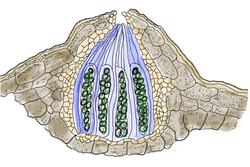
Plural apothecia. A type of ascocarp that is open, saucer-shaped or cup-shaped, and in which the hymenium is exposed at maturity. The term was first used by Erik Acharius in 1803.
appressed
Lying flat; flattened down on a surface.
arachnoid
Also arachnoidal, araneose, araneous. Having a cobweb-like form, like that of the irregularly oriented and loosely interwoven hyphae of the medullary layer of some lichens.
Arceutina-yellow
A pale yellow insoluble lichen pigment, associated with the reference species Bacidia arceutina.
arcuate
A shape or structure that is curved or arched like a bow.
ardella
Plural ardellae. A type of apothecium, typical of lichens in the family Arthoniaceae, which is small and round. Elongated ardellae are called lirellae. The term was first used by William Allport Leighton in 1854, who described an ardella as resembling a "sprinkled spot".
areole
Plural areoles. Also areola with plural areolae. A small area, typically rounded to polygonal or irregular in shape, and often with a distinct texture. In a lichen thallus, the areolae are often separated from the rest of the thallus by fissures or cracks.
areolate
Also areolar. The condition of being made of or covered with areolae, such as the areolate lichens.
Arnoldiana-brown
A reddish-brown insoluble lichen pigment, associated with the reference species Bacidina arnoldiana.
ascigerous
Having asci.
asco-
A prefix meaning "ascus".
ascocarp
Also ascoma, plural ascomata. The fruiting body of an ascomycete fungus, containing the asci and ascospores.
ascoconidium
Plural ascoconidia. A conidium that is formed directly from an ascospore.
ascogenous
Also ascogenic. Producing or supporting the growth of an ascus.
ascogonium
Plural ascogonia. The cell or group of cells within an ascocarp from which the asci (spore-producing cells) ultimately develop.
ascolichen
A lichen in which the fungal partner (the mycobiont) is a member of the Ascomycota. About 98% of lichens are ascolichens. See related: basidiolichen.
ascospore
A sexual, haploid spore produced in an ascus.
ascus
Plural asci. A sexual, fungal spore-bearing structure, typically sac-like.
aseptate
Lacking septa.
aspicilioid
Referring to lecanorine apothecia that are (at least initially) partially to completely immersed in the thallus.
astomate
Also astomous. Lacking an opening, or ostiole.
astrothelioid
Referring to a type of ascospore morphology prevalent in the genus Astrothelium; characterized by thick-walled distosepta and diamond-shaped lumina.
-ate
A suffix, added to nouns, used to indicate having the appearance or characteristics of that noun.
Atra-brown
A matt brown insoluble lichen pigment, associated with the reference species Opegrapha atra.
Atra-red
A dark red insoluble lichen pigment, associated with the reference species Tephromela atra.
aulaxinoid
A morphotype of corticolous thelotremoid lichens used to describe characteristics of apothecial and thallus structure. This term refers to a morphotype of lichen where the apothecia are partially embedded and partially protruding, having a dark, hardened thalline margin that forms irregular cracks. This morphotype is uniquely seen in "Thelotrema" dislaceratum, a species with uncertain taxonomic placement.
- Top
- A
- B
- C
- D
- E
- F
- G
- H
- I
- J
- K
- L
- M
- N
- O
- P
- Q
- R
- S
- T
- U
- V
- W
- Y
- Z
- See also
- Citations
- Sources
B


- Top
- A
- B
- C
- D
- E
- F
- G
- H
- I
- J
- K
- L
- M
- N
- O
- P
- Q
- R
- S
- T
- U
- V
- W
- Y
- Z
- See also
- Citations
- Sources
C


- Top
- A
- B
- C
- D
- E
- F
- G
- H
- I
- J
- K
- L
- M
- N
- O
- P
- Q
- R
- S
- T
- U
- V
- W
- Y
- Z
- See also
- Citations
- Sources
D

- Top
- A
- B
- C
- D
- E
- F
- G
- H
- I
- J
- K
- L
- M
- N
- O
- P
- Q
- R
- S
- T
- U
- V
- W
- Y
- Z
- See also
- Citations
- Sources
E


- Top
- A
- B
- C
- D
- E
- F
- G
- H
- I
- J
- K
- L
- M
- N
- O
- P
- Q
- R
- S
- T
- U
- V
- W
- Y
- Z
- See also
- Citations
- Sources
F


- Top
- A
- B
- C
- D
- E
- F
- G
- H
- I
- J
- K
- L
- M
- N
- O
- P
- Q
- R
- S
- T
- U
- V
- W
- Y
- Z
- See also
- Citations
- Sources
G


- Top
- A
- B
- C
- D
- E
- F
- G
- H
- I
- J
- K
- L
- M
- N
- O
- P
- Q
- R
- S
- T
- U
- V
- W
- Y
- Z
- See also
- Citations
- Sources
H


- Top
- A
- B
- C
- D
- E
- F
- G
- H
- I
- J
- K
- L
- M
- N
- O
- P
- Q
- R
- S
- T
- U
- V
- W
- Y
- Z
- See also
- Citations
- Sources
I

- Top
- A
- B
- C
- D
- E
- F
- G
- H
- I
- J
- K
- L
- M
- N
- O
- P
- Q
- R
- S
- T
- U
- V
- W
- Y
- Z
- See also
- Citations
- Sources
J
- Top
- A
- B
- C
- D
- E
- F
- G
- H
- I
- J
- K
- L
- M
- N
- O
- P
- Q
- R
- S
- T
- U
- V
- W
- Y
- Z
- See also
- Citations
- Sources
K
L


- Top
- A
- B
- C
- D
- E
- F
- G
- H
- I
- J
- K
- L
- M
- N
- O
- P
- Q
- R
- S
- T
- U
- V
- W
- Y
- Z
- See also
- Citations
- Sources
M


- Top
- A
- B
- C
- D
- E
- F
- G
- H
- I
- J
- K
- L
- M
- N
- O
- P
- Q
- R
- S
- T
- U
- V
- W
- Y
- Z
- See also
- Citations
- Sources
N
- Top
- A
- B
- C
- D
- E
- F
- G
- H
- I
- J
- K
- L
- M
- N
- O
- P
- Q
- R
- S
- T
- U
- V
- W
- Y
- Z
- See also
- Citations
- Sources
O

- Top
- A
- B
- C
- D
- E
- F
- G
- H
- I
- J
- K
- L
- M
- N
- O
- P
- Q
- R
- S
- T
- U
- V
- W
- Y
- Z
- See also
- Citations
- Sources
P




- Top
- A
- B
- C
- D
- E
- F
- G
- H
- I
- J
- K
- L
- M
- N
- O
- P
- Q
- R
- S
- T
- U
- V
- W
- Y
- Z
- See also
- Citations
- Sources
R

- Top
- A
- B
- C
- D
- E
- F
- G
- H
- I
- J
- K
- L
- M
- N
- O
- P
- Q
- R
- S
- T
- U
- V
- W
- Y
- Z
- See also
- Citations
- Sources
S


- Top
- A
- B
- C
- D
- E
- F
- G
- H
- I
- J
- K
- L
- M
- N
- O
- P
- Q
- R
- S
- T
- U
- V
- W
- Y
- Z
- See also
- Citations
- Sources
T


- Top
- A
- B
- C
- D
- E
- F
- G
- H
- I
- J
- K
- L
- M
- N
- O
- P
- Q
- R
- S
- T
- U
- V
- W
- Y
- Z
- See also
- Citations
- Sources
U

- Top
- A
- B
- C
- D
- E
- F
- G
- H
- I
- J
- K
- L
- M
- N
- O
- P
- Q
- R
- S
- T
- U
- V
- W
- Y
- Z
- See also
- Citations
- Sources
V

- Top
- A
- B
- C
- D
- E
- F
- G
- H
- I
- J
- K
- L
- M
- N
- O
- P
- Q
- R
- S
- T
- U
- V
- W
- Y
- Z
- See also
- Citations
- Sources
X

- Top
- A
- B
- C
- D
- E
- F
- G
- H
- I
- J
- K
- L
- M
- N
- O
- P
- Q
- R
- S
- T
- U
- V
- W
- Y
- Z
- See also
- Citations
- Sources
Z
- Top
- A
- B
- C
- D
- E
- F
- G
- H
- I
- J
- K
- L
- M
- N
- O
- P
- Q
- R
- S
- T
- U
- V
- W
- Y
- Z
- See also
- Citations
- Sources
See also
- Glossary of biology
- Glossary of mycology
- Glossary of scientific naming
- List of common names of lichen genera
- List of Latin and Greek words commonly used in systematic names
Citations
Sources
- . Australian National Botanic Gardens - Botanical Web Portal. Australian National Herbarium. 20 October 2009.
- . Collins English Dictionary. 2022a.
- . Collins English Dictionary. 2022b.
- Ahmadjian, Vernon; Hale, Mason E. (1973). The Lichens. New York: Academic Press. ISBN 978-0-12-044950-7.
- Ahti, T. (1982). "The morphological interpretation of cladoniiform thalli in lichens". The Lichenologist. 14 (2): 105–113. doi:.
- Aptroot, André; Lücking, Robert (2016). . The Lichenologist. 48 (6): 763–982. doi:.
- Breuss, Othmar (2010). "An updated world-wide key to the catapyrenioid lichens (Verrucariaceae)". Herzogia. 23 (2): 205–216. doi:.
- Brodo, Irwin M.; Sharnoff, Sylvia Duran; Sharnoff, Stephen (2001). . New Haven, Connecticut: Yale University Press. ISBN 0-300-08249-5.
- Brodo, Irwin (2016). "Glossary". Keys to Lichens of North America: Revised and Expanded. New Haven, Connecticut: Yale University Press. pp. 369–382. ISBN 978-0-300-19573-6.
- Cannon, Paul F.; Kirk, Paul M. (2007). Fungal Families of the World. Wallingford: CABI. ISBN 978-0-85199-827-5. OCLC .
- Diederich, Paul; Lawrey, James D.; Ertz, Damien (2018). . The Bryologist. 121 (3): 340–425. doi:.
- Dobson, Frank S. (2011). Lichens: An Illustrated Guide to the British and Irish Species. Slough, UK: Richmond Publishing. ISBN 978-0-85546-315-1.
- Ferraro, Lidia Itatí (2004). (PDF). Fungal Diversity. 15: 153–169.
- Fjelde, Markus Osaland; Timdal, Einar; Haugan, Reidar; Bendiksby, Mika (2024). "Paraphyly and cryptic diversity unveils unexpected challenges in the "naked lichens" (Calvitimela, Lecanoromycetes, Ascomycota)". Molecular Phylogenetics and Evolution. 190 107944. doi:. hdl:.
- Fraser, Robert H.; Pouliot, Darren; van der Sluijs, Jurjen (2021). "UAV and high resolution satellite mapping of forage lichen (Cladonia spp.) in a rocky Canadian Shield landscape". Canadian Journal of Remote Sensing. 48 (1): 5–18. doi:.
- Galloway, D.J. (6 June 2022). . Australian Biological Resources Study.
- Garrido-Benavent, Isaac; Pérez-Ortega, Sergio (2017). . American Journal of Botany. 104 (11): 1660–1674. doi:.
- . British Lichen Society. 2022.
- Goward, Trevor (1986). "Brodoa, a new lichen genus in the Parmeliaceae". The Bryologist. 89 (3): 219–223. doi:. JSTOR .
- Grube, Martin; Hawksworth, David L. (2007). "Trouble with lichen: the re-evaluation and re-interpretation of thallus form and fruit body types in the molecular era". Mycological Research. 111 (9): 1116–1132. doi:. PMID .
- Hafellner, Josef; Kalb, Klaus (1995). "Studies in Trichotheliales ordo novus". Studies in Lichenology with Emphasis on Chemotaxonomy, Geography and Phytochemistry. Festschrift Ch. Leuckert. Bibliothecia Lichenologica. Vol. 57. Berlin-Stuttgart: J. Cramer in der Gebrüder Borntraeger Verlagsbuchhandlung. pp. 161–186. ISBN 978-3-44-358036-0.
- Hawksworth, D. L. (1988). "The variety of fungal-algal symbioses, their evolutionary significance, and the nature of lichens". Botanical Journal of the Linnean Society. 96 (1): 3–20. doi:.
- Hertel, Hannes (2009). "A new key to cryptothalline species of the genus Lecidea (Lecanorales)". In Aptroot, A.; Seaward, M.R.D.; Sparrius, L.B. (eds.). Biodiversity and Ecology of Lichens – Liber Amicorum Harrie Sipman. Bibliotheca Lichenologica. Vol. 99. Berlin/Stuttgart: J.Cramer in der Gebrüder Borntraeger Verlagsbuchhandlung. pp. 185–204. ISBN 978-3-443-58078-0.
- Honegger, Rosmarie (1991). "Functional aspects of the lichen symbiosis". Annual Review of Plant Physiology and Plant Molecular Biology. 42 (1): 553–578. doi:.
- Jagtap, Vineeta; Tripathi, Manish; Joshi, Yogesh (2013). (PDF). Journal of Applied and Natural Science. 5 (2): 342–344. doi:.
- Kantvilas, G. & Jarman, S.J. (1999). Lichens of rainforest in Tasmania. Canberra, ACT, Australia: Australian Biological Resources Study. ISBN 0-642-56802-2.
- Kantvilas, Gintaras (2023). "Three new species of siphuloid lichens, with a first key to the genus Parasiphula". The Lichenologist. 55 (1): 17–25. doi:.
- Kitaura, Marcos J.; Marcelli, Marcelo P. (2013). "A revision of Leptogium species with spherical-celled hairs (section Mallotium p.p.)". The Bryologist. 116 (1): 15–27. doi:.
- Kirk, Paul M.; Cannon, Paul F.; Minter, David W.; Stalpers, Joost A., eds. (2008). Dictionary of the Fungi. Vol. 10. CAB International. ISBN 978-1-84593-933-5.
- Kistenich, Sonja; Timdal, Einar; Bendiksby, Mika; Ekman, Stefan (2018). "Molecular systematics and character evolution in the lichen family Ramalinaceae (Ascomycota: Lecanorales)". Taxon. 67 (5): 871–904. doi:. hdl:.
- Korf, Richard P. (1962). . Mycotaxon. 54 (1): 12–33.
- Krzewicka, Beata (2004). . Polish Botanical Studies. 17: 1–88.
- Lange, Otto L.; Wagenitz, Gerhard (2003). "What is a 'phycolichen'? Differences and changes in the meaning of an old lichenological term". The Lichenologist. 35 (4): 341–345. doi:.
- Laundon, Jack R. (1995). "On the classification of lichen photomorphs". Taxon. 44 (3): 387–389. doi:. JSTOR .
- Lendemer, James C.; Buck, William R.; Harris, Richard C. (September 2016). "Two new host-specific hepaticolous species of Catinaria (Ramalinaceae)". The Lichenologist. 48 (5): 441–449. doi:.
- Lücking, Robert; Leavitt, Steven D.; Hawksworth, David L. (2021). . Fungal Diversity. 109 (1): 99–154. doi:.
- . North American Mycological Association.
- Lumbsch, H. Thorsten; Huhndorf, Sabine M. (2007). "Whatever happened to the pyrenomycetes and loculoascomycetes?". Mycological Research. 111 (9): 1064–1074. doi:. PMID .
- MacKenzie Lamb, I. (1968). "Appendix II. Glossary of Technical Terms". Antarctic Lichens. II. The Genera Buellia and Rinodina (Report). British Antarctic Survey Scientific Reports. British Antarctic Survey.
- McCune, B.; Wang, L.S. (2014). . Mycosphere. 5 (1): 27–76. doi:.
- Mercado-Díaz, Joel A.; Gould, William A.; González, Grizelle; Lücking, Robert (2015). (Report). San Juan, Puerto Rico: United States Department of Agriculture, Forest Service, International Institute of Tropical Forestry.
- Meyer, Barbara; Printzen, Christian (2000). "Proposal for a standardized nomenclature and characterization of insoluble lichen pigments". The Lichenologist. 32 (6): 571–583. doi:.
- Mitchell, M.E. (2014). (PDF). Huntia. 15 (1): 5–22.
- Moncada, Bibiana; Lücking, Robert; Betancourt-Macuase, Luisa (2013). . The Lichenologist. 45 (2): 203–263. doi:.
- Moncada, Bibiana; Rincón-Murillo, Diego; Lücking, Robert (2023). . Revista de la Academia Colombiana de Ciencias Exactas, Físicas y Naturales. 47 (184): 619–640. doi:.
- Nelsen, Matthew P.; Plata, Eimy Rivas; Andrew, Carrie J.; Lücking, Robert; Lumbsch, H. Thorsten (2011). . Journal of Phycology. 47 (2): 282–290. doi:. PMID .
- Orange, A.; James, P.W.; White, F.J. (2001). Microchemical Methods for the Identification of Lichens. British Lichen Society. ISBN 978-0-9540418-0-9.
- Øvstedal, D.O.; Lewis Smith, R.I. (2001). "Glossary". Lichens of Antarctica and South Georgia. A Guide to Their Identification and Ecology. Cambridge, UK: Cambridge University Press. pp. 367–374. ISBN 978-0-521-66241-3.
- Poelt, J. (1980). "Physcia opuntiella spec. nov. und die Lebeusform der Sprosseuden Flechten" [Physcia opuntiella spec. nov. and the life form of the branching lichens]. Flora. 169 (1): 23–31. doi:.
- Poelt, J.; Obermayer, W. (1990). [On thallospores in some crustose lichens]. Herzogia (in German). 8 (3–4): 273–288. doi:.
- Rikkinen, Jouko (April 2015). "Cyanolichens". Biodiversity and Conservation. 24 (4): 973–993. doi:.
- Nash III, Thomas H., ed. (2008). (2nd ed.). Cambridge, UK: Cambridge University Press. ISBN 978-0-521-69216-8.
Nash, T.H. III (2008). "1. Introduction". In Nash III, Thomas H. (ed.). Lichen Biology (2nd ed.). Cambridge, UK: Cambridge University Press. pp. 1–8. ISBN 978-0-521-69216-8. Honegger, R. (2008). "3.Mycobionts". In Nash III, Thomas H. (ed.). Lichen Biology (2nd ed.). Cambridge, UK: Cambridge University Press. pp. 27–39. ISBN 978-0-521-69216-8. Büdel, B.; Scheidegger, C. (2008). "4.Thallus morphology and anatomy". In Nash III, Thomas H. (ed.). Lichen Biology (2nd ed.). Cambridge, UK: Cambridge University Press. pp. 40–68. ISBN 978-0-521-69216-8.
- Nelsen, Matthew P.; Lücking, Robert; Aptroot, André; Andrew, Carrie J.; Cáceres, Marcela; Plata, Eimy Rivas; Gueidan, Cécile; da Silva Canêz, Luciana; Knight, Allison; Ludwig, Lars R.; Mercado-Díaz, Joel A.; Parnmen, Sittiporn; Lumbsch, H. Thorsten (2014). "Elucidating phylogenetic relationships and genus-level classification within the fungal family Trypetheliaceae (Ascomycota: Dothideomycetes)". Taxon. 63 (5): 974–992. doi:.
- Nelsen, Matthew P.; Lücking, Robert; Boyce, C. Kevin; Lumbsch, H. Thorsten; Ree, Richard H. (2020). . Proceedings of the National Academy of Sciences. 117 (35): 21495–21503. doi:. PMC . PMID .
- Papong, Khwanruan; Boonpragob, Kansri; Mangold, Armin; Divakar, Pradeep K.; Lumbsch, H. Thorsten (2010). "Thelotremoid lichen species recently described from Thailand: a re-evaluation". The Lichenologist. 42 (2): 131–137. doi:.
- Randlane, Tiina; Tõrra, Tiiu; Saag, Andres; Saag, Lauri (2009). "Key to European Usnea species". In Thell, Arne; Seaward, Mark R. D.; Feuerer, Tassilo (eds.). Diversity of Lichenology – Anniversary Volume. Bibliotheca Lichenologica. Vol. 100. Stuttgart: J. Kramer. pp. 419–462. ISBN 978-3-443-58079-7.
- Rapai, Sean B.; McMullin, Richard Troy; Newmaster, Steven G. (2012). "The importance of macrolichen traits and phylogeny in forest community assemblage along a high elevation gradient in southwestern British Columbia". Forest Ecology and Management. 274: 231–240. doi:.
- Rivas Plata, Eimy; Lücking, Robert; Sipman, Harrie J. M.; Mangold, Armin; Kalb, Klaus; Lumbsch, H. Thorsten (2010). "A world-wide key to the thelotremoid Graphidaceae, excluding the Ocellularia-Myriotrema-Stegobolus clade". The Lichenologist. 42 (2): 139–185. doi:.
- Ryan, B.D.; Bungartz, F.; Hagedorn, G.; Rambold, G., eds. (2022). . LIAS Glossary.
- Sanders, William B. (2004). "Bacteria, algae, and phycobionts: maintaining useful concepts and terminology". The Lichenologist. 36 (5): 269–275. doi:.
- Scott, G.D. (1957). "Lichen terminology". Nature. 179 (4557): 486–487. doi:. PMID .
- Sérusiaux, E.; Lücking, R. (2007). "Gallaicolichen, a new genus of foliicolous lichen with unique diaspores". In Kärnefelt, Ingvar; Thell, Arne (eds.). Lichenological Contributions in Honour of David Galloway. Bibliotheca Lichenologica. Vol. 95. Berlin/Stuttgart: J. Cramer. pp. 509–516. ISBN 978-3-443-58074-2.
- Smith, C.W.; Aptroot, A.; Coppins, B.J.; Fletcher, A.; Gilbert, O.L.; James, P.W.; Wolseley, P.A., eds. (2009). "Glossary". The Lichens of Great Britain and Ireland. London: British Lichen Society. pp. 21–39.
- Suryanarayanan, Trichur S.; Thirunavukkarasu, Nagamani (2017). . Mycology. 8 (3): 189–196. doi:. PMC . PMID .
- Upreti, Dalip K.; Rai, Himanshu, eds. (2013). Terricolous Lichens in India. Vol. 1: Diversity Patterns and Distribution Ecology. New York: Springer. ISBN 978-1-4614-8736-4.
- Silverstein, Alvin; Silverstein, Virginia B.; Silverstein, Robert A. (1996). . New York: Twenty-First Century Books. ISBN 0-8050-3520-6.
- Smith, Annie Lorrain (1921). . London: Cambridge University Press. pp. 1–504.
- Thell, Arne; Crespo, Ana; Divakar, Pradeep K.; Kärnefelt, Ingvar; Leavitt, Steven D.; Lumbsch, H. Thorsten; Seaward, Mark R.D. (2012). "A review of the lichen family Parmeliaceae – history, phylogeny and current taxonomy". Nordic Journal of Botany. 30 (6): 641–664. doi:.
- Thüs, Holger; Schultz, Matthias (2009). "Glossary". In Büdel, Burkhard; Gärtner, Georg; Krienitz, Lothar; Preisig, Hans R.; Schagerl, Michael (eds.). Fungi. Part 1: Lichens. Süßwasserflora von Mitteleuropa [Freshwater Flora of Central Europe]. Vol. 21/1. Heidelberg: Spektrum Akademischer Verlag. pp. 14–23. doi:. ISBN 978-3-8274-1594-3.
- Tripp, Erin (2017). Field Guide to the Lichens of White Rocks (Boulder, Colorado). University Press of Colorado. ISBN 978-1-60732-554-3.
- Ulloa, Miguel; Hanlin, Richard T. (2012). Illustrated Dictionary of Mycology (2nd ed.). St. Paul, Minnesota: The American Phytopathological Society. ISBN 978-0-89054-400-6.
- Vondrák, Jan; Svoboda, Stanislav; Zíbarová, Lucie; Štenclová, Lenka; Mareš, Jan; Pouska, Václav; Košnar, Jiří; Kubásek, Jiří (2023). . Scientific Reports. 13 (2957): 2957. doi:. PMC . PMID .
- Weber, Bettina; Büdel, Burkhard (2011). "Endoliths". Encyclopedia of Geobiology. Dordrecht: Springer Netherlands. pp. 348–355. doi:. ISBN 978-1-4020-9211-4.
- Wirth, M.; Hale Jr., M.E. (1978). . Smithsonian Contributions to Botany. Vol. 40. pp. 1–64.