Economy of Canada
In-game article clicks load inline without leaving the challenge.
Canada has a highly developed mixed economy. As of 2025, it is the ninth-largest in the world, with a nominal GDP of approximately US$2.39 trillion. Its GDP per capita in purchasing power parity (PPP) international dollars is about 27.5% lower than that of the highest-ranking G7 country. Canada is one of the world's largest trading nations, with a highly globalized economy. In 2021, Canadian trade in goods and services reached $2.016 trillion. Canada's exports totalled over $637 billion, while its imported goods were worth over $631 billion, of which approximately $391 billion originated from the United States. In 2018, Canada had a trade deficit in goods of $22 billion and a trade deficit in services of $25 billion. The Toronto Stock Exchange is the tenth-largest stock exchange in the world by market capitalization, listing over 1,500 companies with a combined market capitalization of over US$3 trillion.
Canada has a strong cooperative banking sector, with the world's highest per-capita membership in credit unions. It ranks low in the Corruption Perceptions Index (12th in 2023) and "is widely regarded as among the least corrupt countries of the world." It ranks high in the Global Competitiveness Report (11th in 2025) and Global Innovation Indexes (14th in 2025). Canada's economy ranks above most Western nations on The Heritage Foundation's Index of Economic Freedom and experiences a relatively low level of income disparity. The country's average household disposable income per capita is "well above" the OECD average. Canada ranks low amongst the most developed countries for housing affordability and foreign direct investment. Among OECD members, Canada has a highly efficient and strong social security system; social expenditure stood at roughly 23.1% of GDP.
Since the early 20th century, the growth of Canada's manufacturing, mining, and service sectors has transformed the nation from a largely rural economy to an urbanized, industrial one. Like many other developed countries, the Canadian economy is dominated by the service industry, which employs about three-quarters of the country's workforce. Among developed countries, Canada has an unusually important primary sector, of which the forestry and petroleum industries are the most prominent components. Many towns in northern Canada, where agriculture is difficult, are sustained by nearby mines or sources of timber. Canada spends around 1.70% of GDP on advanced research and development across various sectors of the economy.
Canada's economic integration with the United States has increased significantly since World War II. The Automotive Products Trade Agreement of 1965 opened Canada's borders to trade in the automobile manufacturing industry. In the 1970s, concerns over energy self-sufficiency and foreign ownership in the manufacturing sectors prompted the federal government to enact the National Energy Program (NEP) and the Foreign Investment Review Agency (FIRA). The government abolished the NEP in the 1980s and changed the name of FIRA to Investment in Canada to encourage foreign investment. The Canada – United States Free Trade Agreement (FTA) of 1988 eliminated tariffs between the two countries, while the North American Free Trade Agreement (NAFTA) expanded the free-trade zone to include Mexico in 1994 (later replaced by the Canada–United States–Mexico Agreement). As of 2023, Canada is a signatory to 15 free trade agreements with 51 countries.
Canada is one of the few developed nations that are net exporters of energy. Atlantic Canada possesses vast offshore deposits of natural gas, and Alberta hosts the fourth-largest oil reserves in the world. The vast Athabasca oil sands and other oil reserves give Canada 13% of global oil reserves, constituting the world's third or fourth-largest. Canada is additionally one of the world's largest suppliers of agricultural products; the Canadian Prairies are one of the most important global producers of wheat, canola, and other grains. The country is a leading exporter of zinc, uranium, gold, nickel, platinoids, aluminum, steel, iron ore, coking coal, lead, copper, molybdenum, cobalt, and cadmium. Canada has a sizeable heavy manufacturing sector centred in southern Ontario and Quebec, with automobiles and aeronautics representing particularly important industries. The country's fishing and tourism industries are also key contributors to the economy.
History
Canadian historians until the 1990s tended to focus on the history of Canada's economy because of the far fewer political, economic, religious and military conflicts present in Canadian history than in other societies. Many of the most prominent English Canadian historians from this period were economic historians, such as Harold Innis, Donald Creighton and Arthur R. M. Lower.

Scholars of Canadian economic history were heirs to the traditions that developed in Europe and the United States, but frameworks of study that worked well elsewhere often failed in Canada. For example, the monetarist school that is powerful in the United States has been weakly represented.
Instead, the study of economic history in Canada is highly focused on economic geography, and for many years the dominant school of thought has been the staples thesis. This school of thought bases the study of the Canadian economy on the study of natural resources. This approach has been used to study the early European history of the Canadian economy, arguing that the Canadian economy during that time developed through exploitation of a series of staples which were then exported to Europe. The staples thesis has since also become used outside of Canada, such as Australia and many developing nations.
Before the arrival of Europeans, the First Nations of what would become Canada had a large and vibrant trade network. Furs, tools, decorative items, and other goods were often transported thousands of kilometres, mostly by canoe throughout the many rivers and lakes of the region.
Overview
With the exception of a few island nations in the Caribbean, Canada is the only North American country to use the parliamentary system of government. As a result, Canada has developed its own social and political institutions, distinct from most other countries in the world. Though the Canadian economy is closely integrated with the American economy, it has developed unique economic institutions.
The Canadian economic system generally combines elements of private enterprise and public enterprise. Many aspects of public enterprise, most notably the development of an extensive welfare spending system to redress social and economic inequities, were adopted after the end of World War II in 1945.
Approximately 89% of Canada's land is Crown land. Canada has one of the highest levels of economic freedom in the world. Workers can experience protection and labor regulation which is established both federally and throughout the provinces. Unionization is very common as around 30% of workers can be found in a union, ensuring safe working standards and sufficient pay. Canada also allows for the freedom of immigrant workers through its “Express Entry System”. This is an online system that allows skilled workers who are looking to become permanent residents an easy way to apply and become official Canadians. Throughout Canada, there is a minimal barrier when it comes to pursuing an entrepreneurship as a Canadian resident. When looking at the Heritage Foundation index of economic freedom, Canada ranks fourteenth out of over one hundred different countries being scored. Canada closely resembles the U.S. in its market-oriented economic system and pattern of production. As of 2019, Canada has 56 companies in the Forbes Global 2000 list, ranking ninth just behind South Korea and ahead of Saudi Arabia. International trade makes up a large part of the Canadian economy, particularly of its natural resources. In 2009, agriculture, energy, forestry and mining exports accounted for about 58% of Canada's total exports. Machinery, equipment, automotive products and other manufactures accounted for a further 38% of exports in 2009. In 2009, exports accounted for about 30% of Canada's GDP. The United States is by far its largest trading partner, accounting for about 73% of exports and 63% of imports as of 2009. Canada's combined exports and imports ranked 8th among all nations in 2006.
About 4% of Canadians are directly employed in primary resource fields, and they account for 6.2% of GDP. They are still paramount in many parts of the country. Many, if not most, towns in northern Canada, where agriculture is difficult, exist because of a nearby mine or source of timber. Canada is a world leader in the production of many natural resources such as gold, nickel, uranium, diamonds, lead, and in recent years, crude petroleum, which, with the world's second-largest oil reserves, is taking an increasingly prominent position in natural resources extraction. Several of Canada's largest companies are based in natural resource industries, such as Cameco, Goldcorp, and Barrick Gold. The vast majority of these products are exported, mainly to the United States. There are also many secondary and service industries that are directly linked to primary ones. For instance one of Canada's largest manufacturing industries is the pulp and paper sector, which is directly linked to the logging business.
The reliance on natural resources has several effects on the Canadian economy and Canadian society. While manufacturing and service industries are easy to standardize, natural resources vary greatly by region. This ensures that differing economic structures developed in each region of Canada, contributing to Canada's strong regionalism. At the same time the vast majority of these resources are exported, integrating Canada closely into the international economy. Howlett and Ramesh argue that the inherent instability of such industries also contributes to greater government intervention in the economy, to reduce the social impact of market changes.
Natural resource industries also raise important questions of sustainability. Despite many decades as a leading producer, there is little risk of depletion. Large discoveries continue to be made, such as the massive nickel find at Voisey's Bay. Moreover, the far north remains largely undeveloped as producers await higher prices or new technologies as many operations in this region are not yet cost effective. In recent decades Canadians have become less willing to accept the environmental destruction associated with exploiting natural resources. High wages and Aboriginal land claims have also curbed expansion. Instead, many Canadian companies have focused their exploration, exploitation and expansion activities overseas where prices are lower and governments more amenable. Canadian companies are increasingly playing important roles in Latin America, Southeast Asia, and Africa.
The depletion of renewable resources has raised concerns in recent years. After decades of escalating overutilization the cod fishery all but collapsed in the 1990s, and the Pacific salmon industry also suffered greatly. The logging industry, after many years of activism, has in recent years moved to a more sustainable model, or to other countries.
Measuring productivity
Productivity measures are key indicators of economic performance and a key source of economic growth and competitiveness. OECD's Compendium of Productivity Indicators, published annually, presents a broad overview of productivity levels and growth in member nations, highlighting key measurement issues. It analyses the role of "productivity as the main driver of economic growth and convergence" and the "contributions of labour, capital and MFP in driving economic growth". According to the definition above "MFP is often interpreted as the contribution to economic growth made by factors such as technical and organisational innovation". Measures of productivity include the gross domestic product (GDP) and total factor productivity.
Multifactor productivity
Another productivity measure, used by OECD, is the long-term trend in multifactor productivity (MFP) also known as total factor productivity (TFP). This indicator assesses an economy's "underlying productive capacity ('potential output'), itself an important measure of the growth possibilities of economies and of inflationary pressures". MFP measures the residual growth that cannot be explained by the rate of change in the services of labour, capital and intermediate outputs, and is often interpreted as the contribution to economic growth made by factors such as technical and organisational innovation.
According to OECD's annual economic survey of Canada in June 2012, Canada has experienced weak growth of multi-factor productivity (MFP) and has been declining further since 2002. One of the ways MFP growth is raised is by boosting innovation and Canada's innovation indicators such as business R&D and patenting rates were poor. Raising MFP growth is "needed to sustain rising living standards, especially as the population ages".
Since 2010, productivity growth has picked up, almost entirely driven by above average multifactor productivity growth. However, productivity on the whole still lags behind the upper half of OECD countries such as the United States. Canada's productivity is now around the median OECD productivity, close to that of Australia. More can be done to increase productivity, such as increasing the productivity of capital through improving the capital stock to output ratio and capital quality. This could be achieved through the liberalization of internal trade barriers, as suggested in the OECD's latest Canadian economic survey.
Bank of Canada
The mandate of the central bank—the Bank of Canada—is to conduct monetary policy that "preserves the value of money by keeping inflation low and stable".
Monetary Policy Report
The Bank of Canada issues its bank rate announcement through its Monetary Policy Report which is released eight times a year. The Bank of Canada, a federal crown corporation, has the responsibility of Canada's monetary system. Under the inflation-targeting monetary policy that has been the cornerstone of Canada's monetary and fiscal policy since the early 1990s, the Bank of Canada sets an inflation target The inflation target was set at 2 per cent, which is the midpoint of an inflation range of 1 to 3 per cent. They established a set of inflation-reduction targets to keep inflation "low, stable and predictable" and to foster "confidence in the value of money", contribute to Canada's sustained growth, employment gains and improved standard of living.
In a January 9, 2019, statement on the release of the Monetary Policy Report, Bank of Canada Governor Stephen S. Poloz summarized major events since the October report, such as "negative economic consequences" of the US-led trade war with China. In response to the ongoing trade war "bond yields have fallen, yield curves have flattened even more and stock markets have repriced significantly" in "global financial markets". In Canada, low oil prices will impact Canada's "macroeconomic outlook". Canada's housing sector is not stabilizing as quickly as anticipated.
Inflation targeting
During the period that John Crow was Governor of the Bank of Canada—1987 to 1994—there was a worldwide recession and the bank rate rose to around 14% and unemployment topped 11%. Although since that time inflation-targeting has been adopted by "most advanced-world central banks", in 1991 it was innovative and Canada was an early adopter when the then-Finance Minister Michael Wilson approved the Bank of Canada's first inflation-targeting in the 1991 federal budget. The inflation target was set at 2 per cent. Inflation is measured by the total consumer price index (CPI). In 2011 the Government of Canada and the Bank of Canada extended Canada's inflation-control target to December 31, 2016. The Bank of Canada uses three unconventional instruments to achieve the inflation target: "a conditional statement on the future path of the policy rate", quantitative easing, and credit easing.
As a result, interest rates and inflation eventually came down along with the value of the Canadian dollar. From 1991 to 2011 the inflation-targeting regime kept "price gains fairly reliable".
Following the Great Recession, the narrow focus of inflation-targeting as a means of providing stable growth in the Canadian economy was questioned. By 2011, the then-Bank of Canada Governor Mark Carney argued that the central bank's mandate would allow for a more flexible inflation-targeting in specific situations where he would consider taking longer "than the typical six to eight quarters to return inflation to 2 per cent".
On July 15, 2015, the Bank of Canada announced that it was lowering its target for the overnight rate by another one-quarter percentage point, to 0.5 per cent "to try to stimulate an economy that appears to have failed to rebound meaningfully from the oil shock woes that dragged it into decline in the first quarter". According to the Bank of Canada announcement, in the first quarter of 2015, the total Consumer price index (CPI) inflation was about 1 per cent. This reflects "year-over-year price declines for consumer energy products". Core inflation in the first quarter of 2015 was about 2 per cent with an underlying trend in inflation at about 1.5 to 1.7 per cent.
In response to the Bank of Canada's July 15, 2015, rate adjustment, Prime Minister Stephen Harper explained that the economy was "being dragged down by forces beyond Canadian borders such as global oil prices, the European debt crisis, and China's economic slowdown" which has made the global economy "fragile".
The Chinese stock market had lost about US$3 trillion of wealth by July 2015 when panicked investors sold stocks, which created declines in the international markets of commodities, which in turn negatively impacted resource-producing countries like Canada.
The Bank's main priority has been to keep inflation at a moderate level. As part of that strategy, interest rates were kept at a low level for almost seven years. Since September 2010, the key interest rate (overnight rate) was 0.5%. In mid 2017, inflation remained below the Bank's 2% target, (at 1.6%) mostly because of reductions in the cost of energy, food and automobiles; as well, the economy was in a continuing spurt with a predicted GDP growth of 2.8 percent by year end. Early on July 12, 2017, the bank issued a statement that the benchmark rate would be increased to 0.75%.
Following the COVID-19 pandemic impact on the Canadian economy, critics have pointed out that the Bank of Canada's inflation-targeting has had unintended consequences, such as fuelling an increase in home prices and contributing to wealth inequalities by supporting higher equity values.
Key industries
In 2024, the Canadian economy had the following relative weighting by the industry as a percentage value of GDP:
| Industry | Share of GDP |
|---|---|
| Real estate and rental and leasing | 13.16% |
| Manufacturing | 8.96% |
| Health care and social assistance | 8.03% |
| Finance and insurance | 7.42% |
| Professional, scientific and technical services | 7.33% |
| Construction | 7.23% |
| Public administration | 7.21% |
| Educational services | 5.44% |
| Wholesale trade | 5.42% |
| Retail trade | 5.26% |
| Mining, quarrying, and oil and gas extraction | 5.02% |
| Transportation and warehousing | 4.44% |
| Information and cultural industries | 3.47% |
| Administrative and support, waste management, and remediation services | 2.66% |
| Accommodation and food services | 2.22% |
| Utilities | 2.04% |
| Other services (except public administration) | 1.95% |
| Agriculture, forestry, fishing, and hunting | 1.89% |
| Arts, entertainment and recreation | 0.82% |
| Management of companies and enterprises | 0.04% |
Real estate, rental, and leasing
Canada's real estate market is the backbone of the economy, comprising over 13% of the GDP by sector in 2024. In 2024, housing investment accounted for 25% of national wealth, up from 21% in 2021. It is difficult to discern the actual contribution of other sectors (such as construction, Investment and financial services, manufacturing, and forestry) to real estate, rental and leasing, as these industries are intrinsically linked in a complex economy. The Bank of Canada has increased its mortgage bond holdings to target 50% of the fixed-rate primary issuances.
Defence
Service sector
The service sector in Canada is vast and multifaceted, employing about three quarters of Canadians and accounting for 70% of GDP. The largest employer is the retail sector, employing almost 12% of Canadians. The retail industry is concentrated mainly in a small number of chain stores clustered together in shopping malls. In recent years, there has been an increase in the number of big-box stores, such as Walmart (of the United States), Real Canadian Superstore, and Best Buy (of the United States). This has led to fewer workers in this sector and the migration of retail jobs to the suburbs.

The second-largest portion of the service sector is the business service, and it employs only a slightly smaller percentage of the population. This includes financial services, real estate, and communications industries. This portion of the economy has been rapidly growing in recent years. It is largely concentrated in the major urban centres, especially Toronto, Montreal and Vancouver.
The education and health sectors are two of Canada's largest, but both are primarily under the influence of the government. The health care industry has been quickly growing and is the third-largest in Canada.
Canada has an important high tech industry, and a burgeoning film, television, and entertainment industry creating content for local and international consumption (see Media in Canada). Tourism attracts millions of visitors and supports approximately 10% of the national labor force. In recent years, statistics show that Canada has received over 20 million international tourists annually. The summer months are especially popular for travelers both domestically and internationally. Tourism and supporting industries contributed over $100 billion to the Canadian national economy in 2024. The sector supports nearly 1.8 million Canadians working in tourism-related fields.
Banking and finance

Banking in Canada is one of Canada's most important industries with several banks being among its largest and most profitable companies.
It is dominated by a small number of large banks, with the six largest combining for 93% of the banking assets. The two largest, the Royal Bank of Canada and the Toronto Dominion Bank are among the world's 25 largest banks. It has been considered to be one of the safest and soundest banking systems in the world, and avoided major problems in the 2008 financial crisis.
Canada's banks have high service levels and investments in technology. A report released by the office of the Minister of Finance in 2002 states "Canada has the highest number of ATMs per capita in the world and benefits from the highest penetration levels of electronic channels such as debit cards, Internet banking and telephone banking". More recent data published by the World Bank shows that as of 2017[update] Canada has 227.82 ATMs per 100,000 adults, which ranks the country third worldwide.
Education
Education in Canada is for the most part provided publicly, funded and overseen by federal, provincial, and local governments. Education is within provincial jurisdiction and the curriculum is overseen by the province. Education in Canada is generally divided into primary education, followed by secondary education and post-secondary. Education in both English and French is available in most places across Canada. Canada has a large number of universities, almost all of which are publicly funded. Established in 1663, Université Laval is the oldest post-secondary institution in Canada. The largest university is the University of Toronto with over 85,000 students. Four universities are regularly ranked among the top 100 world-wide, namely University of Toronto, University of British Columbia, McGill University, and McMaster University, with a total of 18 universities ranked in the top 500 worldwide.
According to a 2022 report by the Organisation for Economic Co-operation and Development (OECD), Canada is the most educated country in the world; the country ranks first worldwide in the percentage of adults having tertiary education, with over 57 percent of Canadian adults having attained at least an undergraduate college or university degree. Canada spends an average of about 5.3 percent of its GDP on education. The country invests heavily in tertiary education (more than US$20,000 per student). As of 2022[update], 89 percent of adults aged 25 to 64 have earned the equivalent of a high-school degree, compared to an OECD average of 75 percent.
The mandatory education age ranges between 5–7 to 16–18 years, contributing to an adult literacy rate of 99 percent. Just over 60,000 children are homeschooled in the country as of 2016. The Programme for International Student Assessment indicates Canadian students perform well above the OECD average, particularly in mathematics, science, and reading, ranking the overall knowledge and skills of Canadian 15-year-olds as the sixth-best in the world, although these scores have been declining in recent years. Canada is a well-performing OECD country in reading literacy, mathematics, and science, with the average student scoring 523.7, compared with the OECD average of 493 in 2015.
Healthcare
Healthcare in Canada is delivered through the provincial and territorial systems of publicly funded health care, informally called Medicare. It is guided by the provisions of the Canada Health Act of 1984, and is universal. The 2002 Royal Commission, known as the Romanow Report, revealed that Canadians consider universal access to publicly funded health services as a "fundamental value that ensures national health care insurance for everyone wherever they live in the country".
Canadian Medicare provides coverage for approximately 70 percent of Canadians' healthcare needs, and the remaining 30 percent is paid for through the private sector. The 30 percent typically relates to services not covered or only partially covered by Medicare, such as prescription drugs, eye care, medical devices, gender care, psychotherapy, physical therapy and dentistry. About 65-75 percent of Canadians have some form of supplementary health insurance related to the aforementioned reasons; many receive it through their employers or use secondary social service programs related to extended coverage for families receiving social assistance or vulnerable demographics, such as seniors, minors, and those with disabilities.
According to the Canadian Institute for Health Information (CIHI), by 2019, Canada's aging population represents an increase in healthcare costs of approximately one percent a year, which is a modest increase. In a 2020 Statistics Canada Canadian Perspectives Survey Series (CPSS), 69 percent of Canadians self-reported that they had excellent or very good physical health—an improvement from 60 percent in 2018. In 2019, 80 percent of Canadian adults self-reported having at least one major risk factor for chronic disease: smoking, physical inactivity, unhealthy eating or excessive alcohol use. Canada has one of the highest rates of adult obesity among Organisation for Economic Co-operation and Development (OECD) countries attributing to approximately 2.7 million cases of diabetes (types 1 and 2 combined). Four chronic diseases—cancer (a leading cause of death), cardiovascular diseases, respiratory diseases and diabetes account for 65 percent of deaths in Canada. There are approximately 8 million individuals aged 15 and older with one or more disabilities in Canada.
In 2021, the Canadian Institute for Health Information reported that healthcare spending reached $308billion, or 12.7 percent of Canada's GDP for that year. In 2022 Canada's per-capita spending on health expenditures ranked 12th among healthcare systems in the OECD. Canada has performed close to the average on the majority of OECD health indicators since the early 2000s, and ranks above average for access to care, but the number of doctors and hospital beds are considerably below the OECD average. The Commonwealth Funds 2021 report comparing the healthcare systems of 11 high-income countries ranked Canada second-to-last. Identified weaknesses of Canada's system were comparatively higher infant mortality rate, the prevalence of chronic conditions, long wait times, poor availability of after-hours care, and a lack of prescription drugs coverage. An increasing problem in Canada's health system is a shortage of healthcare professionals and hospital capacity.
Telecommunications
Present-day telecommunications in Canada include telephone, radio, television, and internet usage. In the past, telecommunications included telegraphy available through Canadian Pacific and Canadian National.
Tourism
Tourism in Canada is a major economic driver in the service sector, attracting millions of visitors and supporting approximately 10% of the national labor force. In recent years, statistics show that Canada has received over 20 million international tourists annually. The summer months are especially popular for travellers both domestically and internationally. Tourism and supporting industries contributed over $100 billion to the Canadian national economy in 2024. The sector supports nearly 1.8 million Canadians working in tourism-related fields.
Domestic tourism in Canada is the principal economic driver of the sector, with statistics indicating that, in 2024, about 70% of all tourism spending came from Canadian residents exploring their own country. Domestic statistics also indicate that travel within provinces is prevalent, with residents supporting local businesses and attractions. Land border crossings by United States citizens has historically been the largest source of inbound tourists, followed by international airline travel from the United Kingdom and other European countries. Visitors from Asia have become more popular in recent decades. Passport holders from over 50 visa-exempt countries and nationals who require a visa can visit Canada for up to six months at a time.
Federal, provincial, municipal and local government initiatives aimed at promoting sustainable tourism and attracting foreign tourists play a major role in the industry. Canada is known for its safety and security, attracting tourists through its natural features (e.g., Niagara Falls), festivals (e.g., Calgary stampede), arts (e.g., Toronto International Film Festival), heritage sites, (e.g., Quebec city) sporting events (e.g.,Grey Cup), amusement parks (e.g., Canada's Wonderland) and its diverse culture (e.g., Caribbean Carnival).
Canada's national parks like Banff and Jasper see millions of visitors annually, drawn by their landscapes and outdoor activities. Provincial parks including Algonquin Provincial Park, Bow Valley Provincial Park and Cabot Beach Provincial Park also attract a multitude of visitors annually. Natural wonders such as, Great Bear Rainforest, the Northern Lights, Hopewell Rocks, Sandbanks and Moraine Lake attract a variety of international and domestic tourist throughout the year. The country is home to numerous historical and cultural national museums and galleries, such as the Canadian Museum of History, Canadian Museum for Human Rights and National Gallery of Canada. Provincial museums that attract significance amount of tourist include, the Royal Ontario Museum, the Royal British Columbia Museum and the Nova Scotia museum system.
Manufacturing

The general pattern of development for wealthy nations was a transition from a raw material production-based economy to a manufacturing-based economy and then to a service-based economy. At its World War II peak in 1944, Canada's manufacturing sector accounted for 29% of GDP, declining to 10.37% in 2017. Canada has not suffered as greatly as most other rich, industrialized nations from the pains of the relative decline in the importance of manufacturing since the 1960s. A 2009 study by Statistics Canada also found that, while manufacturing declined as a relative percentage of GDP from 24.3% in the 1960s to 15.6% in 2005, manufacturing volumes between 1961 and 2005 kept pace with the overall growth in the volume index of GDP. Manufacturing in Canada declined significantly during the Great Recession. As of 2017, manufacturing accounts for 10% of Canada's GDP, a relative decline of more than 5% of GDP since 2005.
Central Canada is home to branch plants to all the major American and Japanese automobile makers and many parts factories owned by Canadian firms such as Magna International and Linamar Corporation.
Automotive
The automotive industry in Canada consists primarily of assembly plants of foreign automakers, most with headquarters in the United States or Japan, along with hundreds of manufacturers of automotive parts and systems.
Canada is currently the thirteenth-largest auto-producing nation in the world, and seventh largest auto exporter by value, producing 1.4 million vehicles and exporting $32 billion worth of vehicles in 2020. Canada's highest rankings ever were the second-largest producer in the world between 1918 and 1923 and third-largest after World War II.
Automotive manufacturing is one of Canada's largest industrial sectors, accounting for 10% of manufacturing GDP and 23% of manufacturing trade. Canada produces passenger vehicles, trucks and buses, auto parts and systems, truck bodies and trailers, as well as tires and machine, tools, dies and molds (MTDM). The auto industry directly employs more than 125,000 people in vehicle assembly and auto parts manufacturing, and another 380,000 in distribution and aftermarket sales and service.
Pharmaceutical
The pharmaceutical industry in Canada employs approximately 30,000 people. It supplies about one third of the domestic pharmaceutical consumer market of $27 billion annually. This accounts for ~16% of yearly health expenditures. Canada had a pharmaceutical trade deficit of $8.5 billion in 2018 with exports of $11 billion and imports of $19.5 billion. The majority of large pharmaceutical companies are headquartered in Montreal, Quebec. Both Toronto and Montreal have healthy pharmaceutical industries.
Pulp and paper
Steel

Canada was the world's nineteenth-largest steel exporter in 2018. In year-to-date 2019 (through March), further referred to as YTD 2019, Canada exported 1.39 million metric tons of steel, a 22 percent decrease from 1.79 million metric tons in YTD 2018. Based on available data, Canada's exports represented about 1.5 percent of all steel exported globally in 2017. By volume, Canada's 2018 steel exports represented just over one-tenth the volume of the world's largest exporter, China. In value terms, steel represented 1.4 percent of the total goods Canada exported in 2018. The growth in exports in the decade since 2009 has been 29%. The largest producers in 2018 were ArcelorMittal, Essar Steel Algoma, and the first of those alone accounted for roughly half of Canadian steel production through its two subsidiaries. The top two markets for Canada's exports were its NAFTA partners, and by themselves accounted for 92 percent of exports by volume. Canada sent 83 percent of its steel exports to the United States in YTD 2019. The gap between domestic demand and domestic production increased to −2.4 million metric tons, up from −0.2 million metric tons in YTD 2018. In YTD 2019, exports as a share of production decreased to 41.6 percent from 53 percent in YTD 2018.
In 2017, heavy industry accounted for 10.2% of Canada's greenhouse gas emissions.
Mining
Canada is one of the largest producers of metals (as of 2019):
| Metal | World rank | Ref. |
|---|---|---|
| Platinum | 4 | |
| Gold | 5 | |
| Nickel | 5 | |
| Copper | 10 | |
| Iron (ore) | 8 | |
| Titanium | 4 | |
| Potash | 1 | |
| Niobium | 2 | |
| Molybdenum | 7 | |
| Cobalt | 7 | |
| Lithium | 8 | |
| Zinc | 8 |
In 2019, the country was also the 4th largest world producer of sulfur; the 13th largest world producer of gypsum; the 14th worldwide producer of antimony; the world's 10th largest producer of graphite; in addition to being the 6th largest world producer of salt. It was the 2nd largest producer in the world of uranium in 2018.
Energy
Canada has access to cheap sources of energy because of its geography. This has enabled the creation of several important industries, such as the large aluminum industries in British Columbia and Quebec. Canada is also one of the world's highest per capita consumers of energy.
Electricity
The electricity sector in Canada has played a significant role in the economic and political life of the country since the late 19th century. The sector is organized along provincial and territorial lines. In a majority of provinces, large government-owned integrated public utilities play a leading role in the generation, transmission and distribution of electricity. Ontario and Alberta have created electricity markets in the last decade in order to increase investment and competition in this sector of the economy. In 2017, the electricity sector accounted for 10% of total national greenhouse gas emissions. Canada has substantial electricity trade with the neighbouring United States amounting to 72 TWh exports and 10 TWh imports in 2017.
Hydroelectricity accounted for 59% of all electric generation in Canada in 2016, making Canada the world's second-largest producer of hydroelectricity after China. Since 1960, large hydroelectric projects, especially in Quebec, British Columbia, Manitoba and Newfoundland and Labrador, have significantly increased the country's generation capacity.
The second-largest single source of power (15% of the total) is nuclear power, with several plants in Ontario generating more than half of that province's electricity and one generator in New Brunswick. This makes Canada the world's sixth-largest electricity producer generated by nuclear power, producing 95 TWh in 2017.
Fossil fuels provide 19% of Canadian electric power, about half as coal (9% of the total), and the remainder a mix of natural gas and oil. Only five provinces use coal for electricity generation. Alberta, Saskatchewan, and Nova Scotia rely on coal for nearly half of their generation, while other provinces and territories use little or none. Alberta and Saskatchewan also use a substantial amount of natural gas. Remote communities, including all of Nunavut and much of the Northwest Territories, produce most of their electricity from diesel generators at high economic and environmental costs. The federal government has set up initiatives to reduce dependence on diesel-fired electricity.
Non-hydro renewables are a fast-growing portion of the total, at 7% in 2016.[citation needed]
Oil and gas

Canada possesses extensive oil and gas resources centred in Alberta, and the Northern Territories but is also present in neighboring British Columbia and Saskatchewan. The vast Athabasca oil sands give Canada the world's third-largest reserves of oil after Saudi Arabia and Venezuela, according to USGS. The oil and gas industry represents 27% of Canada's total greenhouse gas emissions, an increase of 84% since 1990, mostly due to the development of the oil sands.
Historically, an important issue in Canadian politics is the interplay between the oil and energy industry in Western Canada and the industrial heartland of Southern Ontario. Foreign investment in Western oil projects has fueled Canada's rising dollar. This has raised the price of Ontario's manufacturing exports and made them less competitive, a problem similar to the decline of the manufacturing sector in the Netherlands.
The National Energy Policy of the early 1980s attempted to make Canada oil-sufficient and to ensure equal supply and price of oil in all parts of Canada, especially for the eastern manufacturing base. This policy proved deeply divisive as it forced Alberta to sell low-priced oil to eastern Canada. The policy was eliminated 5 years after it was first announced amid a collapse of oil prices in 1985. The new Prime Minister Brian Mulroney had campaigned against the policy in the 1984 Canadian federal election. One of the most controversial sections of the Canada–United States Free Trade Agreement of 1988 was a promise that Canada would never charge the United States more for energy than fellow Canadians.
Agriculture, fishing, livestock and forestry

Canada is one of the world's largest suppliers of agricultural products, particularly wheat and other grains. Canada is a major exporter of agricultural products, to the United States and Asia. As with all other developed nations, the proportion of the population and GDP devoted to agriculture fell dramatically over the 20th century. The agriculture and agri-food manufacturing sector created $49.0 billion to Canada's GDP in 2015, accounting for 2.6% of total GDP. This sector also accounts for 8.4% of Canada's Greenhouse gas emissions.
The Canadian agriculture industry receives significant government subsidies and support as with other developed nations. However, Canada has strongly supported reducing market influencing subsidies through the World Trade Organization.[citation needed] In 2000, Canada spent approximately CDN$4.6 billion on support for the industry.[citation needed] $2.32 billion was classified under the WTO designation of "green box" license, meaning it did not directly influence the market, such as money for research or disaster relief.[citation needed] All but $848.2 million were subsidies worth less than 5% of the value of the crops they were provided for.[citation needed]
Infrastructure
Transportation
Canada, the world's second-largest country in total area, is dedicated to having efficient, high-capacity multimodal transportation spanning often vast distances between natural resource extraction sites, agricultural and urban areas. Canada's transportation system includes more than 1,400,000 kilometres (870,000 mi) of roads, 10 major international airports, 300 smaller airports, 72,093 km (44,797 mi) of functioning railway track, and more than 300 commercial ports and harbours that provide access to the Pacific, Atlantic and Arctic oceans as well as the Great Lakes and the St. Lawrence Seaway. In 2005, the transportation sector made up 4.2% of Canada's GDP, compared to 3.7% for Canada's mining and oil and gas extraction industries.
Transport Canada oversees and regulates most aspects of transportation within federal jurisdiction, including interprovincial transport. This primarily includes rail, air and maritime transportation. Transport Canada is under the direction of the federal government's Minister of Transport. The Transportation Safety Board of Canada is responsible for maintaining transportation safety in Canada by investigating accidents and making safety recommendations.
Water supply and sanitation

Water supply and sanitation in Canada is nearly universal and generally of good quality, but a lack of clean drinking water in many First Nations communities remains a problem. Water use in Canada is high compared to Europe, since water tariffs are low and 44% of users are not metered.
Despite a commitment by the federal government to promote increased cost recovery, only 50% of the cost of maintaining and operating water infrastructure is actually being recovered from users through tariffs, the rest being financed through taxes.
Science and technology
Science and technology in Canada consists of three distinct but closely related phenomena:
- the diffusion of technology in Canada
- scientific research in Canada
- innovation, invention and industrial research in Canada
In 2019, Canada spent approximately CA$40.3 billion on domestic research and development, of which over $7 billion was provided by the federal and provincial governments. In 2018, Canada spent approximately C$34.5 billion on domestic research and development, of which around $2 billion was spent directly by the federal government in-house and an additional $5.7 billion was provided by provincial and federal sources in the form of grants. This investment corresponds to about 1.57% of Canada's gross domestic product, a decline from 1.72% in 2014. Canada was ranked 17th in the Global Innovation Index in 2025.
As of 2020[update], the country has produced fifteen Nobel laureates in physics, chemistry, and medicine, and was ranked fourth worldwide for scientific research quality in a major 2012 survey of international scientists. It is furthermore home to the headquarters of a number of global technology firms. Canada has one of the highest levels of Internet access in the world, with over 33 million users, equivalent to around 94 percent of its total 2014 population.
Some of the most notable scientific developments in Canada include the creation of the modern alkaline battery and the polio vaccine and discoveries about the interior structure of the atomic nucleus. Other major Canadian scientific contributions include the artificial cardiac pacemaker, mapping the visual cortex, the development of the electron microscope, plate tectonics, deep learning, multi-touch technology and the identification of the first black hole, Cygnus X-1. Canada has a long history of discovery in genetics, which include stem cells, site-directed mutagenesis, T-cell receptor and the identification of the genes that cause Fanconi anemia, cystic fibrosis and early-onset Alzheimer's disease, among numerous other diseases.
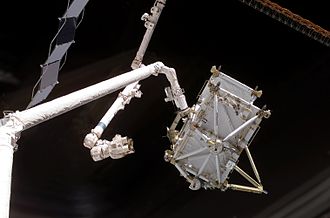
The Canadian Space Agency operates a highly active space program, conducting deep-space, planetary, and aviation research, and developing rockets and satellites. Canada was the third country to design and construct a satellite after the Soviet Union and the United States, with the 1962 Alouette 1 launch. Canada is a participant in the International Space Station (ISS), and is a pioneer in space robotics, having constructed the Canadarm, Canadarm2 and Dextre robotic manipulators for the ISS and NASA's Space Shuttle. Since the 1960s, Canada's aerospace industry has designed and built numerous marques of satellite, including Radarsat-1 and 2, ISIS and MOST. Canada has also produced one of the world's most successful and widely used sounding rockets, the Black Brant; over 1,000 Black Brants have been launched since the rocket's introduction in 1961.
Foreign trade
Free-trade agreements

Free-trade agreements in force
Source:
- Canada–Israel Free Trade Agreement (Entered into force January 1, 1997, modernization ongoing)
- Canada–Chile Free Trade Agreement (Entered into force July 5, 1997)
- Canada–Costa Rica Free Trade Agreement (Entered into force November 1, 2002, modernization ongoing)
- Canada–European Free Trade Association Free Trade Agreement (Iceland, Norway, Switzerland and Liechtenstein; entered into force July 1, 2009)
- Canada–Peru Free Trade Agreement (Entered into force August 1, 2009)
- Canada–Colombia Free Trade Agreement (Signed November 21, 2008, entered into force August 15, 2011; Canada's ratification of this FTA had been dependent upon Colombia's ratification of the "Agreement Concerning Annual Reports on Human Rights and Free Trade Between Canada and the Republic of Colombia" signed on May 27, 2010)
- Canada–Jordan Free Trade Agreement (Signed on June 28, 2009, entered into force October 1, 2012)
- Canada–Panama Free Trade Agreement (Signed on May 14, 2010, entered into force April 1, 2013)
- Canada–South Korea Free Trade Agreement (Signed on March 11, 2014, entered into force January 1, 2015)
- Canada–Ukraine Free Trade Agreement (Signed July 11, 2016, entered into force August 1, 2017)
- Comprehensive Economic and Trade Agreement with the European Union (EU) (signed October 30, 2016, entered into force September 21, 2017)
- Comprehensive and Progressive Agreement for Trans-Pacific Partnership (signed March 8, 2018, entered into force December 30, 2018)
- Canada–United States–Mexico Agreement (signed November 30, 2018, entered into force July 1, 2020)
- Canada–UK Trade Continuity Agreement (signed December 9, 2020, entered into force April 1, 2021)
- Canada-Indonesia Comprehensive Economic Partnership Agreement (CEPA) (signed September 24, 2025)
Free-trade agreements no longer in force
Source:
- Canada–U.S. Free Trade Agreement (signed October 12, 1987, entered into force January 1, 1989, later superseded by NAFTA)
- Trans-Pacific Partnership (concluded October 5, 2015, superseded by CPTPP)
- North American Free Trade Agreement (entered into force January 1, 1994, later superseded by USMCA)
Ongoing free-trade agreements negotiations
Source:
Canada is negotiating bilateral FTAs with the following countries respectively trade blocs:
- Caribbean Community (CARICOM)
- Guatemala, Nicaragua and El Salvador
- Dominican Republic
- India
- Japan
- Morocco
- Singapore
- Andean Community (FTA's are already in force with Peru and Colombia)
Canada has been involved in negotiations to create the following regional trade blocks:
- Canada and Central American Free Trade Agreement
- Free Trade Area of the Americas (FTAA)
Government policies and finance
The Canadian federal budget is presented annually by the Government of Canada to identify planned government spending and expected government revenue, and to forecast economic conditions for the upcoming fiscal year. Federal budgets are presented in the fall by the minister of finance. Before 2025, federal budgets were released in the spring.
Political issues
Canada–United States trade relations
Canada and the United States share a common trading relationship. Canada's job market continues to perform well along with the US, reaching a 30-year low in the unemployment rate in December 2006, following 14 consecutive years of employment growth.

The United States is by far Canada's largest trading partner, with more than $1.7 billion CAD in trade per day in 2005. In 2009, 73% of Canada's exports went to the United States, and 63% of Canada's imports were from the United States. Trade with Canada makes up 23% of the United States' exports and 17% of its imports. By comparison, in 2005 this was more than U.S. trade with all countries in the European Union combined, and well over twice U.S. trade with all the countries of Latin America combined. Just the two-way trade that crosses the Ambassador Bridge between Michigan and Ontario equals all U.S. exports to Japan. Canada's importance to the United States is not just a border-state phenomenon: Canada is the leading export market for 35 of 50 U.S. states, and is the United States' largest foreign supplier of energy.
Bilateral trade increased by 52% between 1989, when the U.S.–Canada Free Trade Agreement (FTA) went into effect, and 1994, when the North American Free Trade Agreement (NAFTA) superseded it. Trade has since increased by 40%. NAFTA continues the FTA's moves toward reducing trade barriers and establishing agreed-upon trade rules. It also resolves some long-standing bilateral irritants and liberalizes rules in several areas, including agriculture, services, energy, financial services, investment, and government procurement. NAFTA forms the largest trading area in the world, embracing the 405 million people of the three North American countries.
The largest component of U.S.–Canada trade is in the energy sector.
The U.S. is Canada's largest agricultural export market, taking well over half of all Canadian food exports. Nearly two-thirds of Canada's forest products, including pulp and paper, are exported to the United States; 72% of Canada's total newsprint production also is exported to the U.S.
At billion in 2004, U.S.-Canada trade in energy is the largest U.S. energy trading relationship, with the overwhelming majority ($66.7 billion) being exports from Canada. The primary components of U.S. energy trade with Canada are petroleum, natural gas, and electricity. Canada is the United States' largest oil supplier and the fifth-largest energy producing country in the world. Canada provides about 16% of U.S. oil imports and 14% of total U.S. consumption of natural gas. The United States and Canada's national electricity grids are linked, and both countries share hydropower facilities on the western borders.
While most of U.S.-Canada trade flows smoothly, there are occasionally bilateral trade disputes, particularly in the agricultural and cultural fields.[citation needed] Usually these issues are resolved through bilateral consultative forums or referral to World Trade Organization (WTO) or NAFTA dispute resolution.[citation needed] In May 1999, the U.S. and Canadian governments negotiated an agreement on magazines that provides increased access for the U.S. publishing industry to the Canadian market. The United States and Canada also have resolved several major issues involving fisheries. By common agreement, the two countries submitted a Gulf of Maine boundary dispute to the International Court of Justice in 1981; both accepted the court's October 12, 1984, ruling which demarcated the territorial sea boundary. A current issue between the United States and Canada is the ongoing softwood lumber dispute, as the U.S. alleges that Canada unfairly subsidizes its forestry industry.[citation needed]
In 1990, the United States and Canada signed a bilateral Fisheries Enforcement Agreement, which has served to deter illegal fishing activity and reduce the risk of injury during fisheries enforcement incidents. The U.S. and Canada signed a Pacific Salmon Agreement in June 1999 that settled differences over implementation of the 1985 Pacific Salmon Treaty for the next decade.
Canada and the United States signed an aviation agreement during Bill Clinton's visit to Canada in February 1995, and air traffic between the two countries has increased dramatically as a result. The two countries also share in operation of the St. Lawrence Seaway, connecting the Great Lakes to the Atlantic Ocean.
The U.S. remains Canada's largest foreign investor and the most popular destination for Canadian foreign investments. In 2018, the stock of U.S. direct investment in Canada totaled $406 billion, while the stock of Canadian investment in the U.S. totaled $595 billion, or 46% of the overall CDIA stock for 2018. This made Canada the second largest investing country in the U.S. for 2018 US investments are primarily directed at Canada's mining and smelting industries, petroleum, chemicals, the manufacture of machinery and transportation equipment, and finance, while Canadian investment in the United States is concentrated in manufacturing, wholesale trade, real estate, petroleum, finance, insurance and other services.
Immigration
Welfare
Labour and employment
Income and poverty
Debt

Canadian government debt
Canadian government debt, also called Canada's public debt, is the liabilities of the government sector. For 2019 (the fiscal year ending March 31, 2020), total financial liabilities or gross debt was $2.434 trillion for the consolidated Canadian general government (federal, provincial, territorial, and local governments combined). This corresponds to 105.3% as a ratio of GDP (GDP was $2.311 trillion). Of the $2.434 trillion, $1.146 trillion or 47% was federal (central) government liabilities (49.6% as a ratio of GDP). Provincial government liabilities comprise most of the remaining liabilities.
Household debt
Household debt, the amount of money that all adults in the household owe financial institutions, includes consumer debt and mortgage loans. In March 2015, the International Monetary Fund reported that Canada's high household debt was one of two vulnerable domestic areas in Canada's economy; the second is its overheated housing market.
According to Statistics Canada, as of July 2019 was CAD$2.2 trillion. According to Philip Cross of the Fraser Institute, in May 2015, while the Canadian household debt-to-income ratio is similar to that in the US, however lending standards in Canada are tighter than those in the United States to protect against high-risk borrowers taking out unsustainable debt.
Mergers and acquisitions
Since 1985, 63,755 deals in- and outbound Canada have been announced,[when?] with an overall value of US$3.7 billion. Almost 50% of the targets of Canadian companies (outbound deals) have a parent company in the US. Inbound deals are 82% percent from the US.
Here is a list of the biggest deals in Canadian history:
| Rank | Date announced | Acquiror name | Acquiror nation | Target name | Target nation | Value (in bil. USD) |
|---|---|---|---|---|---|---|
| 1 | January 26, 2000 | Spin-off | Canada | Nortel Networks Corp | Canada | 59.97 |
| 2 | June 20, 2000 | Vivendi SA | France | Seagram Co Ltd | Canada | 40.43 |
| 3 | December 7, 2007 | Rio Tinto Canada Holdings Inc | Canada | Alcan Inc | Canada | 37.63 |
| 4 | June 9, 2016 | Enbridge Inc | Canada | Spectra Energy Corp | United States | 28.29 |
| 5 | March 12, 2014 | Enbridge Income Fund | Canada | Enbridge Inc-Liquids | Canada | 24.79 |
| 6 | November 5, 2008 | Shareholders | Canada | Cenovus Energy Inc | Canada | 20.26 |
| 7 | July 23, 2012 | CNOOC Canada Holding Ltd | Canada | Nexen Inc | Canada | 19.12 |
| 8 | May 15, 2006 | Xstrata PLC | Switzerland | Falconbridge Ltd | Canada | 17.40 |
| 9 | November 8, 2006 | Cia Vale do Rio Doce SA | Brazil | Inco Ltd | Canada | 17.15 |
| 10 | March 23, 2009 | Suncor Energy Inc | Canada | Petro-Canada | Canada | 15.58 |
| 11 | July 29, 2008 | Teck Cominco Ltd | Canada | Fording Canadian Coal Trust | Canada | 13.60 |
Raw data
The following table shows the main economic indicators in 1980–2021 (with IMF staff estimates for 2022–2027). Inflation below 5% is in green.
| Year | GDP (in Bil. US$PPP) | GDP per capita (in US$ PPP) | GDP (in Bil. US$nominal) | GDP per capita (in US$ nominal) | GDP growth (real) | Inflation rate (in Percent) | Unemployment (in Percent) | Government debt (in % of GDP) |
|---|---|---|---|---|---|---|---|---|
| 1980 | 288.7 | 11,798.2 | 276.1 | 11,281.4 | 2.2% | 10.2% | 7.5% | 44.6% |
| 1981 | 327.1 | 13,197.5 | 307.2 | 12,396.7 | 3.5% | 12.5% | 7.6% | 46.1% |
| 1982 | 336.2 | 13,404.9 | 314.6 | 12,543.9 | -3.2% | 10.8% | 11.1% | 51.7% |
| 1983 | 358.5 | 14,149.5 | 341.9 | 13,493.2 | 2.6% | 5.8% | 12.0% | 57.2% |
| 1984 | 393.4 | 15,380.2 | 356.7 | 13,947.4 | 5.9% | 4.3% | 11.4% | 60.2% |
| 1985 | 425.0 | 16,466.0 | 366.2 | 14,185.9 | 4.7% | 4.0% | 10.5% | 65.2% |
| 1986 | 442.9 | 16,990.4 | 379.0 | 14,539.8 | 2.1% | 4.2% | 9.6% | 69.3% |
| 1987 | 472.3 | 17,893.0 | 433.1 | 16,408.1 | 4.1% | 4.4% | 8.8% | 69.8% |
| 1988 | 510.6 | 19,085.3 | 509.4 | 19,041.2 | 4.4% | 4.0% | 7.8% | 69.7% |
| 1989 | 542.9 | 19,947.7 | 567.2 | 20,842.5 | 2.3% | 5.0% | 7.5% | 71.0% |
| 1990 | 564.1 | 20,415.1 | 596.1 | 21,572.1 | 0.2% | 4.8% | 8.2% | 73.7% |
| 1991 | 571.0 | 20,403.3 | 612.5 | 21,885.6 | -2.1% | 5.6% | 10.3% | 81.7% |
| 1992 | 589.3 | 20,805.6 | 594.4 | 20,984.8 | 0.9% | 1.5% | 11.2% | 88.2% |
| 1993 | 619.3 | 21,615.6 | 579.1 | 20,210.5 | 2.7% | 1.9% | 11.4% | 94.7% |
| 1994 | 661.0 | 22,823.8 | 579.9 | 20,024.6 | 4.5% | 0.2% | 10.4% | 97.5% |
| 1995 | 693.0 | 23,682.4 | 605.9 | 20,706.7 | 2.7% | 2.1% | 9.5% | 100.1% |
| 1996 | 717.1 | 24,252.2 | 630.6 | 21,325.7 | 1.6% | 1.6% | 9.6% | 100.2% |
| 1997 | 760.7 | 25,469.8 | 655.0 | 21,930.5 | 4.3% | 1.6% | 9.1% | 95.3% |
| 1998 | 799.3 | 26,532.4 | 634.0 | 21,046.6 | 3.9% | 1.0% | 8.3% | 93.3% |
| 1999 | 852.4 | 28,068.8 | 678.4 | 22,340.6 | 5.2% | 1.7% | 7.6% | 89.0% |
| 2000 | 916.8 | 29,914.7 | 744.6 | 24,296.7 | 5.2% | 2.7% | 6.8% | 80.4% |
| 2001 | 954.2 | 30,810.5 | 739.0 | 23,859.7 | 1.8% | 2.5% | 7.2% | 81.5% |
| 2002 | 998.4 | 31,887.8 | 760.1 | 24,279.2 | 3.0% | 2.3% | 7.7% | 79.6% |
| 2003 | 1,036.4 | 32,794.3 | 895.6 | 28,338.7 | 1.8% | 2.8% | 7.6% | 75.9% |
| 2004 | 1,097.1 | 34,390.0 | 1,026.5 | 32,176.6 | 3.1% | 1.9% | 7.2% | 71.9% |
| 2005 | 1,167.7 | 36,260.7 | 1,173.5 | 36,439.6 | 3.2% | 2.2% | 6.8% | 70.6% |
| 2006 | 1,235.5 | 37,980.7 | 1,319.4 | 40,558.9 | 2.6% | 2.0% | 6.3% | 69.9% |
| 2007 | 1,295.2 | 39,428.2 | 1,468.9 | 44,717.0 | 2.1% | 2.1% | 6.1% | 66.9% |
| 2008 | 1,333.3 | 40,159.1 | 1,552.9 | 46,773.8 | 1.0% | 2.4% | 6.2% | 67.9% |
| 2009 | 1,302.5 | 38,788.0 | 1,376.5 | 40,990.6 | -2.9% | 0.3% | 8.4% | 79.3% |
| 2010 | 1,358.9 | 40,017.6 | 1,617.3 | 47,627.3 | 3.1% | 1.8% | 8.1% | 81.2% |
| 2011 | 1,430.8 | 41,716.4 | 1,793.3 | 52,285.9 | 3.1% | 2.9% | 7.6% | 81.8% |
| 2012 | 1,468.1 | 42,351.1 | 1,828.4 | 52,744.0 | 1.8% | 1.5% | 7.4% | 85.4% |
| 2013 | 1,554.1 | 44,360.4 | 1,846.6 | 52,708.6 | 2.3% | 0.9% | 7.1% | 86.1% |
| 2014 | 1,621.4 | 45,812.0 | 1,805.8 | 51,020.8 | 2.9% | 1.9% | 7.0% | 85.6% |
| 2015 | 1,594.9 | 44,702.5 | 1,556.5 | 43,626.5 | 0.7% | 1.1% | 6.9% | 91.2% |
| 2016 | 1,678.4 | 46,554.1 | 1,528.0 | 42,382.6 | 1.0% | 1.4% | 7.1% | 91.8% |
| 2017 | 1,776.9 | 48,688.1 | 1,649.3 | 45,192.0 | 3.0% | 1.6% | 6.4% | 88.9% |
| 2018 | 1,869.8 | 50,531.6 | 1,725.3 | 46,625.9 | 2.8% | 2.3% | 5.9% | 88.9% |
| 2019 | 1,939.0 | 51,652.6 | 1,742.0 | 46,404.0 | 1.9% | 1.9% | 5.8% | 87.2% |
| 2020 | 1,859.7 | 48,946.8 | 1,645.4 | 43,306.6 | -5.2% | 0.7% | 9.6% | 117.8% |
| 2021 | 2,025.0 | 52,973.0 | 1,988.3 | 52,015.1 | 4.5% | 3.4% | 7.4% | 112.9% |
| 2022 | 2,240.4 | 57,827.5 | 2,200.4 | 56,794.0 | 3.3% | 6.9% | 5.3% | 102.2% |
| 2023 | 2,353.9 | 59,872.2 | 2,326.6 | 59,179.0 | 1.5% | 4.2% | 5.9% | 98.7% |
| 2024 | 2,441.8 | 61,274.7 | 2,420.7 | 60,745.3 | 1.6% | 2.4% | 6.2% | 96.3% |
| 2025 | 2,544.9 | 63,042.6 | 2,531.2 | 62,703.5 | 2.3% | 1.9% | 6.1% | 93.3% |
| 2026 | 2,642.5 | 64,649.4 | 2,630.3 | 64,352.5 | 1.9% | 1.9% | 6.0% | 90.9% |
| 2027 | 2,739.4 | 66,221.6 | 2,728.4 | 65,954.5 | 1.7% | 2.0% | 6.0% | 88.7% |
Unemployment & Participation rate
| Province | Unemployment rate percentage of labour force as of April 2025 | Participation Rate | Employment |
|---|---|---|---|
| Alberta | 7.1% | 68.5% | 2,565,800 |
| British Columbia | 6.2% | 65.1% | 2,950,900 |
| Manitoba | 5.3% | 66.4% | 736,000 |
| Newfoundland and Labrador | 9.6% | 58.3% | 248,100 |
| New Brunswick | 6.9% | 59.8% | 400,400 |
| Nova Scotia | 7.2% | 61.0% | 516,400 |
| Ontario | 7.8% | 65.0% | 8,195,200 |
| Prince Edward Island | 6.6% | 65.9% | 94,300 |
| Quebec | 6.0% | 65.3% | 4,645,600 |
| Saskatchewan | 4.3% | 66.8% | 616,000 |
| Canada (national) | 6.9% | 65.3% | 20,969,300 |
Export trade
Export trade from Canada measured in US dollars. In 2021, Canada exported US$503.4 billion.
That dollar amount reflects a 19.5% gain since 2017 and a 29.1% increase from 2020 to 2021.
| Partner | Value | Fraction |
|---|---|---|
| United States | $380.4 billion | 75.6% |
| China | $23 billion | 4.6% |
| United Kingdom | $12.9 billion | 2.6% |
| Japan | $11.5 billion | 2.3% |
| Mexico | $6.5 billion | 1.3% |
| Germany | $5.5 billion | 1.1% |
| South Korea | $4.5 billion | 0.9% |
| Netherlands | $3.8 billion | 0.8% |
| France | $3.2 billion | 0.6% |
| Belgium | $3.0 billion | 0.6% |
| Hong Kong | $2.8 billion | 0.6% |
| Norway | $2.5 billion | 0.5% |
| Switzerland | $1.6 billion | 0.5% |
| India | $2.35 billion | 0.5% |
| Italy | $2.1 billion | 0.4% |
Import trade
Import trade in 2017 measured in US dollars.
| Partner | Value | Fraction |
|---|---|---|
| United States | $222.0 billion | 51.3% |
| China | $54.7 billion | 12.7% |
| Mexico | $27.4 billion | 6.3% |
| Germany | $13.8 billion | 3.2% |
| Japan | $13.5 billion | 3.1% |
| United Kingdom | $6.9 billion | 1.6% |
| South Korea | $6.7 billion | 1.5% |
| Italy | $6.3 billion | 1.5% |
| France | $4.8 billion | 1.1% |
| Vietnam | $3.9 billion | 0.9% |
See also
- List of companies of Canada
- Canada's Global Markets Action Plan
- Comparison of Canadian and American economies
- Economy of Alberta
- Economy of Ontario
- Economy of Quebec
- Economy of Saskatchewan
- History of the petroleum industry in Canada
- Land ownership in Canada
- List of Median household income of cities in Canada
- List of Commonwealth of Nations countries by GDP
- List of Canadian provinces and territories by gross domestic product
- List of trade unions in Canada
Notes
- . www150.statcan.gc.ca. January 31, 2013.
Further reading
External links
- at the CIA World Factbook
- at The World Bank