Erato
In-game article clicks load inline without leaving the challenge.

In Greek mythology, Erato (/ˈɛrətoʊ/; Ancient Greek: Ἐρατώ) is one of the Muses, associated with erotic lyric poetry. The name would mean "desired" or "lovely", if derived from the same root as Eros, as Apollonius of Rhodes playfully suggested in the invocation to Erato that begins Book III of his Argonautica.
Function
Erato is the Muse of lyric poetry, particularly erotic poetry, and mimic imitation. In the Orphic hymn to the Muses, it is Erato who charms the sight. Since the Renaissance she has mostly been shown with a wreath of myrtle and roses, holding a lyre, or a small kithara, a musical instrument often associated with Apollo. In Simon Vouet's representations, two turtle-doves are eating seeds at her feet. She is sometimes depicted holding a golden arrow, symbolizing "eros", the feeling she inspires in everybody; at times she is accompanied by Eros, holding a torch.
Family
In Hesiod's genealogy, Erato is the daughter of Zeus and the Titaness Mnemosyne, and the sister to Calliope, Clio, Euterpe, Melpomene, Polyhymnia, Terpsichore, Thalia and Urania.
Her father gave Erato to Malus (eponym of Malea), as a bride and by him became the mother of Cleophema who bore Aegle (Coronis) by Phlegyas.
Development
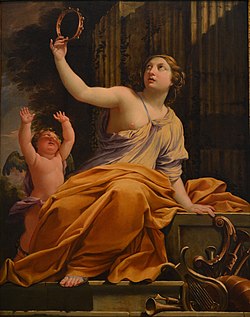
Erato was named with the other muses in Hesiod's Theogony. She was also invoked at the beginning of a lost poem, Rhadine (Ῥαδινή), that was referred to and briefly quoted by Strabo. The love story of Rhadine made her supposed tomb on the island of Samos a pilgrimage site for star-crossed lovers in the time of Pausanias and Erato has linked again with love in Plato's Phaedrus; nevertheless, even in the third century BC, when Apollonius wrote, the Muses were not yet as inextricably linked to specific types of poetry as they became.
Erato is also invoked at the start of book 7 of Virgil's Aeneid, which marks the beginning of the second half or "Iliadic" section of the poem.
See also
Notes
- Pseudo-Apollodorus. The Library. Translated by Sir James George Frazer. 2 vols. Cambridge, Massachusetts: Harvard University Press; London: William Heinemann Ltd. 1921. ISBN 0-674-99135-4. and at the Perseus Digital Library.
- Apollonius Rhodius, Argonautica. Translated by Robert Cooper Seaton. R. C. Loeb Classical Library Volume 1. London: William Heinemann. 1912. .
- Apollonius Rhodius Argonautica. George W. Mooney, ed. London. Longmans, Green. 1912. .
- Bloch, René, "Erato (1)", in Brill's New Pauly: Encyclopaedia of the Ancient World. Antiquity, Volume 5, Equ – Has, edited by Hubert Cancik and Helmuth Schneider, Leiden, Brill, 2004. ISBN 9004122680.
- Diodorus Siculus. The Library of History. Translated by Charles Henry Oldfather. 12 vols. Loeb Classical Library. Cambridge, Massachusetts: Harvard University Press; London: William Heinemann. 1989. Vol. 3. Books 4.59–8. .
- Diodorus Siculus. Bibliotheca Historica. Vol 1–2. Immanel Bekker, Ludwig Dindorf and Friedrich Vogel, eds. Leipzig: B. G. Teubner. 1888–1890. .
- Hesiod. Theogony. In The Homeric Hymns and Homerica with an English translation by Hugh G. Evelyn-White. Cambridge, Massachusetts: Harvard University Press; London: William Heinemann. 1914. and at the Perseus Digital Library.
- Pausanias. Description of Greece. English translation by W. H. S. Jones. 4 vols. Cambridge, Massachusetts: Harvard University Press; London: William Heinemann. 1918. ISBN 0-674-99328-4. .
- Pausanias, Graeciae Descriptio. 3 vols. Leipzig: Teubner. 1903. .
- Strabo, The Geography of Strabo. Edition by H. L. Jones. Cambridge, Massachusetts: Harvard University Press; London: William Heinemann. 1924. .
- Strabo, Geographica, translated and edited by A. Meineke. Leipzig: Teubner. 1877. .
Further reading
- Van Aken, A. R. A. (1961). Elseviers Mythologische Encyclopedie. Amsterdam: Elsevier.
- Bartelink, G. J. M. (1988). Prisma van de mythologie. Utrecht: Het Spectrum.
- Cooper, J. C., ed. (1997). Brewer's Book of Myth and Legend. Oxford: Helicon.
- Lurker, Manfred (2004). Routledge Dictionary of Gods and Demons. London: Routledge.