Exeter
In-game article clicks load inline without leaving the challenge.
Exeter (/ˈɛksɪtər/ⓘ EK-sit-ər) is a cathedral city and the county town of Devon in South West England. It is situated on the River Exe, approximately 36mi (58km) northeast of Plymouth and 65mi (105km) southwest of Bristol. In 2024, Exeter had a population of 138,399, making it the second largest settlement in Devon after Plymouth. Under local government restructuring plans Exeter will, with the addition of parishes from East Devon, Teignbridge and Mid Devon, become a unitary authority from 2028.
The history of Exeter began with the civilian settlement associated with the Roman fort of Isca Dumnoniorum c. AD 55. The city was held by Saxons against Viking attacks and then conquered by the Normans. Exeter Cathedral was founded in the mid 11th century and the city became a religious centre during the Middle Ages. In the early modern period, Exeter became an affluent centre for the wool trade. Experiencing only limited industrialisation, by the First World War the city was in relative decline. After the Second World War, much of the city centre was rebuilt.
Exeter is today one of the largest and fastest growing cities in South West England, and a centre for education, business, and domestic tourism. It is home to two of the constituent campuses of the University of Exeter: Streatham and St Luke's. The city retains significant examples of medieval, Tudor, and Georgian architecture.
History
Toponymy
The modern name of Exeter is a development of the Old English Escanceaster, from the anglicised form of the river now known as the Exe and the Old English suffix -ceaster (as in Dorchester and Gloucester), used to mark important fortresses or fortified towns (from Latin castrum, meaning fortress, or castra, military camp). (Similarly, the city's Cornish name Karesk and its Welsh name Caerwysg both mean "caer or fortress on the Exe".) The name "Exe" is a separate development of the Brittonic name—meaning "water" or, more exactly, "full of fish" (cf. Welsh pysg, pl. "fish")—that also appears in the English Axe and Esk and the Welsh Usk (Wysg).
Early history
Exeter began as settlements on a dry ridge ending in a spur overlooking a navigable river teeming with fish, with fertile land nearby. Although there have been no major prehistoric finds, these advantages suggest the site was occupied early. Coins from the Hellenistic kingdoms suggest the existence of a settlement trading with the Mediterranean as early as 250 BC.

The Romans established a 42-acre (17ha) fort (Castrum) named Isca around AD55. The fort served as the southwest terminus of the Fosse Way (part of the Antonine Itinerary) and base for the 5,000-man Second Augustan Legion. An unplanned community (vicus) of natives and the soldiers' families grew up around it, which served as the tribal capital of the Dumnonii. When the fortress was abandoned around AD75, its grounds were converted to civilian purposes: its very large bathhouse was demolished to make way for a forum and a basilica, and a smaller-scale bath was erected to the southeast.
In the late 2nd century, the ditch and rampart defences around the old fortress were replaced by a bank and wall enclosing a much larger area, some 92 acres (37 hectares). The Devonian Isca seems to have been most prosperous in the first half of the 4th century: more than a thousand Roman coins have been found around the city and there is evidence for copper and bronze working, a stock-yard, and markets for the livestock, crops, and pottery produced in the surrounding countryside. The absence of coins dated after 380 suggests a rapid decline by this point.
Middle Ages
Nothing is certainly known of Exeter from the time of the Roman withdrawal from Britain around 410 until the seventh century. By that time, the city was held by the Saxons, to whom it was known as Escanceaster, who had arrived after defeating the British Dumnonians at Peonnum in Somerset in 658. In 876, the city was attacked and briefly captured by Danish Vikings before Alfred the Great drove them out the next summer. Over the next few years, he elevated Exeter to one of the four burhs in Devon, rebuilding its walls on the Roman lines. These permitted the city to fend off another attack and siege by the Danes in 893. King Athelstan again strengthened the walls around 928, and at the same time drove out the remaining Britons from the city. After failing again in 1001, the Danes were finally able to plunder it in 1003 when they were let in, for unknown reasons, by the French reeve of Emma of Normandy, who had been given the city as part of her dowry on her marriage to Æthelred the Unready the previous year.

In 1068, Exeter was a stronghold of Anglo-Saxon resistance to the Norman conquest as the residence of Gytha Thorkelsdóttir, the mother of the late King Harold. William the Conqueror's siege of the city ended in negotiation and generous terms for the defenders, although William had Rougemont Castle built to strengthen Norman control over the area. Saxon properties were transferred into Norman hands and, on the death of Bishop Leofric in 1072, the Norman Osbern FitzOsbern was appointed his successor. In 1136, early in the Anarchy, Rougemont Castle was held against King Stephen by Baldwin de Redvers. Redvers submitted after a three-month siege when the three wells and large supplies of wine had been exhausted. During the siege, King Stephen built an earthen fortification at the site now known (erroneously) as Danes Castle.

Exeter was relatively prosperous by the end of the High Middle Ages. The city held a weekly market from at least 1213, and by 1281 Exeter was the only town in the South West to have three market days per week. There are also records of seven annual fairs, the earliest of which dates from 1130, and all of which continued until at least the early 16th century. Until the expulsion of the Jews of England in 1290, Exeter was home to England's most westerly Jewish community. Sophisticated aqueduct systems brought pure drinking water into the city from springs in the neighbouring parish of St Sidwell's, partially via a network of tunnels, or underground passages.
Early modern
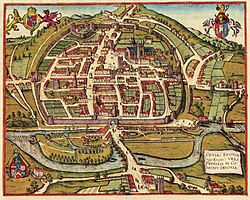
In 1537, the city was made a county corporate. In 1549, the city successfully withstood a month-long siege by the so-called Prayer Book rebels. The insurgents occupied its suburbs, burnt down two of the city gates and attempted to undermine the city walls, but eventually abandoned the siege after they were bested in battles with the king's army. From 1555 to 1568, John Hooker was chamberlain of the city and oversaw several schemes, including provisions for orphans.
Exeter was secured for Parliament at the beginning of the English Civil War, but it remained under pressure from the Royalists until, in September 1643, it was captured by the Cornish Royalist Army led by Prince Maurice. Queen Henrietta Maria stayed in Exeter for the birth of her youngest daughter, Henrietta, in 1644. The city was one of the final Royalist cities to fall into Parliamentarian hands, its surrender being negotiated in April 1646 at Poltimore House by Thomas Fairfax.
During this period, Exeter was an economically powerful city, with a strong trade of wool. This was partly due to the surrounding area which was "more fertile and better inhabited than that passed over the preceding day" according to Count Lorenzo Magalotti who visited the city when he was 26 years old. Magalotti writes of over thirty thousand people being employed in the county of Devon as part of the wool and cloth industries, merchandise that was sold to "the West Indies, Spain, France and Italy". Celia Fiennes also visited Exeter during this period, in the early 18th century. She remarked on the "vast trade" and "incredible quantity" in Exeter, recording that "it turns the most money in a week of anything in England", between £10,000 and £15,000.
Late modern and contemporary
The Industrial Revolution saw Exeter's industry develop on the basis of locally available agricultural products; a site was established on drained marshland to the west of the city, at Exe Island, to make use of water power. However, a scarcity of nearby coal deposits prevented further industrial development. Extensive canal redevelopments expanded Exeter's economy, and in 1778 a new bridge replaced the 500-year-old Old Exe Bridge.
In 1832, Exeter was struck by a cholera pandemic. In 1844, the Bristol and Exeter Railway opened a station at St Davids on the city's western edge. The first horse-drawn trams in Exeter were introduced in 1882 with three lines radiating from the city's East Gate. Electricity was first provided by the Exeter Electric Light Company, formed at the end of the 1880s, and the sewerage system was renovated during the 1890s.

During World War II, Exeter was subjected to air raids by the German Luftwaffe as part of the Baedeker Blitz. Roughly 40 acres (16ha) of the city was destroyed and a total of 156 people were killed in the raids. The city was defended by No. 307 Polish Night Fighter Squadron, known as the "Lwów Eagle Owls", based at Exeter Airport. Post-war rebuilding often made limited effort to preserve historic structures, resulting in the loss of landmarks such as St Lawrence Church, the College of the Vicars Choral, and Bedford Circus, although buildings such as The House That Moved did survive.
On 27 October 1960, following exceptional rainfall, the River Exe burst its banks, flooding large parts of Exeter, including Exwick, St Thomas, and Alphington. The construction of new flood defences for the city began in 1965 and took 12 years to complete. The scheme included three flood relief channels and two new concrete bridges, completed in 1969 and 1972, replacing the earlier Exe Bridge which had impeded river flow and exacerbated flooding.

Between 2005 and 2007, an area adjoining the Cathedral Close and the High Street was controversially redeveloped into the Princesshay shopping centre. In 2015, a £30 million flood defence improvement scheme was approved following a review by the Environment Agency. On 28 October 2016, a major fire destroyed large parts of the Royal Clarence Hotel and adjoining historic buildings in the Cathedral Close. In 2019, Exeter was made a UNESCO City of Literature. Exeter has recorded relatively high levels of rough sleeping compared with other English local authorities. In the autumn 2020 snapshot, it had the sixth highest number of rough sleepers in England.
Governance
Parliamentary elections
Exeter is one of the oldest extant parliamentary constituencies in the United Kingdom, having been in continuous existence since the Model Parliament of 1295. As an ancient parliamentary borough, Exeter elected two members to the unreformed House of Commons until 1918, when it was reduced to one MP by the Redistribution of Seats Act 1885.
Historically, the city was covered by a single constituency of the same name, but since the 2023 redrawing of boundaries three wards (Pinhoe, St Loyes, and Topsham) now belong to Exmouth and Exeter East. From 1910 to 1997, Exeter elected Conservative MPs in all but two elections: 1929 and 1966. Following the 1997 General Election, Exeter has elected Labour MPs; following the most recent general election in 2024, the incumbent is Steve Race. Exmouth and Exeter East was first contested in the 2024 general election, electing the Conservative MP David Reed.
Local government

Exeter is governed locally under a two-tier system, in which the city council (a non-metropolitan district authority) shares responsibility with Devon County Council. In 2026, the UK government consulted on proposals to replace this with a unitary authority, as part of a reorganisation of local government in England. The planned unitary authority will incorporate 49 additional parishes currently part of the Teignbridge, East Devon and Mid Devon districts. A previous bid for unitary authority status was blocked by ministers in May 2010, having been approved months before.
From Saxon times, it was in the hundred of Wonford. Exeter has had a mayor since at least 1207 and until 2002, the city was the oldest 'Right Worshipful' Mayoralty in England. As part of the Golden Jubilee of Elizabeth II Exeter was chosen to receive the title of lord mayor. Councillor Granville Baldwin became the first Lord Mayor of Exeter on 1 May 2002 when Letters Patent were awarded to the city during a visit by the Queen. The Lord Mayor is elected each year from amongst the 39 Exeter city councillors and is non-political for the term of office.
Geography
Physical geography
Exeter was established on the eastern bank of the River Exe on a ridge of land backed by a steep hill. It is at this point that the Exe, having just been joined by the River Creedy, opens onto a wide flood plain and estuary which makes the area flood-prone. Historically this was the lowest bridging point of the Exe, which was tidal and navigable up to the city until the construction of weirs later in its history. The Exe Estuary begins south of the city and runs for approximately eight miles before it reaches the English Channel.
Exeter sits predominantly on sandstone and conglomerate geology, although the structure of the surrounding areas is varied. The topography of the ridge which forms the backbone of the city includes a volcanic plug, on which the Rougemont Castle is situated. The cathedral is located on the edge of this ridge and is therefore visible for a considerable distance.
Climate

Exeter shares an oceanic climate with the rest of South West England, typified by frequent cloudy skies, mild winters with generally warm summers and precipitation all year round, especially in winter. Compared with the rest of the country, it is generally wetter and milder. Much of the rainfall in Exeter is caused by Atlantic depressions, especially in autumn and winter, or by convection. Average rainfall is around 829.16 millimetres (32.644in). Compared with some other areas in the region, Exeter experiences less rainfall because it sits in the rain shadow of Dartmoor, an area of upland.
In common with the South West, the seasonal temperature variation in Exeter is less extreme than in most of the United Kingdom due to the proximity of the sea. The hottest month is July with an average high of 21.8°C (71.2°F), and the coldest month is January with an average high of 9.1°C (48.4°F). The highest recorded temperature in Exeter stands at 34.0°C (93.2°F) recorded in June 2026, while the lowest recorded temperature is −16.5°C (2.3°F) recorded in December 2010. The annual sunshine (hours) is 1561.55, which is higher than the average for the region.
| Climate data for Exeter Airport (EXT), elevation: 27m (89ft), 1991–2020 normals, extremes 1958–present | |||||||||||||
|---|---|---|---|---|---|---|---|---|---|---|---|---|---|
| Month | Jan | Feb | Mar | Apr | May | Jun | Jul | Aug | Sep | Oct | Nov | Dec | Year |
| Record high °C (°F) | 16.5 (61.7) | 16.1 (61.0) | 20.9 (69.6) | 23.8 (74.8) | 30.9 (87.6) | 34.0 (93.2) | 32.2 (90.0) | 32.4 (90.3) | 28.5 (83.3) | 25.9 (78.6) | 18.5 (65.3) | 15.9 (60.6) | 34.0 (93.2) |
| Mean daily maximum °C (°F) | 9.1 (48.4) | 9.4 (48.9) | 11.3 (52.3) | 13.8 (56.8) | 17.1 (62.8) | 20.0 (68.0) | 21.8 (71.2) | 21.6 (70.9) | 19.3 (66.7) | 15.5 (59.9) | 12.0 (53.6) | 9.4 (48.9) | 15.0 (59.0) |
| Daily mean °C (°F) | 5.9 (42.6) | 5.9 (42.6) | 7.4 (45.3) | 9.3 (48.7) | 12.2 (54.0) | 15.2 (59.4) | 17.0 (62.6) | 16.9 (62.4) | 14.6 (58.3) | 11.6 (52.9) | 8.2 (46.8) | 6.0 (42.8) | 10.9 (51.6) |
| Mean daily minimum °C (°F) | 2.6 (36.7) | 2.4 (36.3) | 3.5 (38.3) | 4.8 (40.6) | 7.3 (45.1) | 10.4 (50.7) | 12.1 (53.8) | 12.1 (53.8) | 9.9 (49.8) | 7.8 (46.0) | 4.4 (39.9) | 2.7 (36.9) | 6.7 (44.1) |
| Record low °C (°F) | −15.0 (5.0) | −9.3 (15.3) | −9.6 (14.7) | −4.6 (23.7) | −2.3 (27.9) | 0.8 (33.4) | 2.0 (35.6) | 1.9 (35.4) | −1.1 (30.0) | −5.2 (22.6) | −6.6 (20.1) | −16.5 (2.3) | −16.5 (2.3) |
| Average precipitation mm (inches) | 85.6 (3.37) | 65.1 (2.56) | 62.3 (2.45) | 61.4 (2.42) | 51.0 (2.01) | 53.8 (2.12) | 48.2 (1.90) | 64.1 (2.52) | 60.3 (2.37) | 92.5 (3.64) | 95.3 (3.75) | 90.1 (3.55) | 829.2 (32.65) |
| Average precipitation days (≥ 1.0 mm) | 12.4 | 10.4 | 10.2 | 9.9 | 9.7 | 7.4 | 7.8 | 7.9 | 8.8 | 12.1 | 12.6 | 12.0 | 121.1 |
| Mean monthly sunshine hours | 58.4 | 82.7 | 117.1 | 167.4 | 195.5 | 194.7 | 193.8 | 171.8 | 151.2 | 106.8 | 69.5 | 52.6 | 1,561.6 |
| Source 1: Met Office (precipitation days 1981-2010) | |||||||||||||
| Source 2: Starlings Roost Weather |
Demography

The mid-year estimate for 2024 by the Office for National Statistics put Exeter's district area population at 138,399. Between the last two censuses (held in 2011 and 2021), the population of Exeter increased by 11.0%, from around 117,800 in 2011 to around 130,700 in 2021. This was a greater percentage increase than was experienced by the overall population of the South West (7.8%) and by the overall population of England (up 6.6% since the 2011 Census).
The Exeter Urban Area had a population of 124,079 in 2014, compared with 124,328 for the city and borough of Exeter. While the Exeter Metropolitan Area had a population of 467,257 in the same year and includes Exeter along with Teignbridge, Mid Devon and East Devon. Out of all the Devon districts, Exeter receives the largest number of commuters from East Devon, followed by Teignbridge. Most of the city's ethnic minority population live in the central, northwestern and eastern suburbs of the city. Outlying areas such as Pinhoe, Cowick and the expensive suburb of Topsham are all 95% White British as of 2011.
Ethnicity
In 2021, 90.3% of people in Exeter identified their ethnic group within the "White" category (compared with 93.1% in 2011), 4.9% within the "Asian, Asian British or Asian Welsh" category (up from 3.9% in 2011), and 2.5% identified within the "Mixed or Multiple" category (compared with 1.6% in 2011). The median age in 2024 was 35 years, remaining unchanged from 2011 and 2021. In 2021, 48.5% of Exeter residents reported having "No religion", making it the most common response in this local authority area (up from 34.7% in 2011) and higher than the percentage reporting this in the South West and across England (which increased from 29.3% to 44.1%, and from 24.8% to 36.7%, respectively).
Ethnicity of Exeter from 1991 to 2021:
| Ethnic Group | Year | |||||||
|---|---|---|---|---|---|---|---|---|
| 1991 | 2001 | 2011 | 2021 | |||||
| Number | % | Number | % | Number | % | Number | % | |
| White: Total | 96,811 | 98.7% | 108,459 | 97.6% | 109,590 | 93.1% | 118,034 | 90.3% |
| White: British | – | – | 105,231 | 94.7% | 104,013 | 88.3% | 108,095 | 82.7% |
| White: Irish | – | – | 668 | 629 | 875 | 0.7% | ||
| White: Gypsy or Irish Traveller | – | – | – | – | 93 | 100 | 0.1% | |
| White: Roma | 181 | 0.1% | ||||||
| White: Other | – | – | 2,560 | 2.3% | 4,855 | 4.1% | 8,783 | 6.7% |
| Asian or Asian British: Total | 663 | 0.7% | 1,107 | 1% | 4,595 | 3.9% | 6,375 | 4.8% |
| Asian or Asian British: Indian | 212 | 284 | 946 | 1,588 | 1.2% | |||
| Asian or Asian British: Pakistani | 37 | 67 | 164 | 274 | 0.2% | |||
| Asian or Asian British: Bangladeshi | 80 | 142 | 227 | 513 | 0.4% | |||
| Asian or Asian British: Chinese | 185 | 378 | 1,998 | 2,020 | 1.5% | |||
| Asian or Asian British: Other Asian | 149 | 236 | 1,260 | 1,980 | 1.5% | |||
| Black or Black British: Total | 202 | 0.3% | 225 | 0.2% | 667 | 0.6% | 1,137 | 0.9% |
| Black or Black British: Caribbean | 51 | 62 | 128 | 893 | 0.7% | |||
| Black or Black British: African | 76 | 142 | 492 | 137 | 0.1% | |||
| Black or Black British: Other Black | 75 | 21 | 47 | 107 | 0.1% | |||
| Mixed or British Mixed: Total | – | – | 924 | 1% | 1,938 | 1.6% | 3,308 | 2.6% |
| Mixed: White and Black Caribbean | – | – | 179 | 403 | 503 | 0.4% | ||
| Mixed: White and Black African | – | – | 108 | 278 | 484 | 0.4% | ||
| Mixed: White and Asian | – | – | 350 | 773 | 1305 | 1.0% | ||
| Mixed: Other Mixed | – | – | 287 | 484 | 1016 | 0.8% | ||
| Other: Total | 449 | 0.5% | 361 | 0.3% | 983 | 0.8% | 1,853 | 1.4% |
| Other: Arab | – | – | – | – | 659 | 802 | 0.6% | |
| Other: Any other ethnic group | 449 | 0.5% | 361 | 0.3% | 324 | 1,051 | 0.8% | |
| Other: Ethnic Jew | 220 | 0.3% | 281 | 0.35% | 321 | 0.3% | 442 | 0.3% |
| Total | 98,125 | 100% | 111,076 | 100% | 117,773 | 100% | 130,707 | 100% |
Religion
In the 2021 census, 48.5% of people in Exeter reported having "No religion", making it the most common response in this local authority area. This was up from 34.7% in 2011, and consistent with the trend across the South West and across England as a whole. 40.0% of people described themselves as Christian (down from 53.9%), while 7.4% did not state their religion (down from 8.1% in 2011).
Religious affiliation in Exeter from 2001 to 2021:
| Religion | 2001 | 2011 | 2021 | |||
|---|---|---|---|---|---|---|
| Number | % | Number | % | Number | % | |
| Holds religious beliefs | 78,839 | 70.9 | 67,382 | 57.2 | 57,697 | 44.1 |
| Christian | 76,773 | 69.1 | 63,486 | 53.9 | 52,221 | 40.0 |
| Buddhist | 375 | 0.3 | 683 | 0.6 | 715 | 0.5 |
| Hindu | 123 | 0.1 | 372 | 0.3 | 698 | 0.5 |
| Judaism | 152 | 0.1 | 155 | 0.1 | 201 | 0.2 |
| Muslim | 858 | 0.8 | 1,855 | 1.6 | 2,815 | 2.2 |
| Sikh | 76 | 0.1 | 160 | 0.1 | 179 | 0.1 |
| Other religion | 482 | 0.4 | 671 | 0.6 | 868 | 0.7 |
| (No religion and Religion not stated) | 32,237 | 29.1 | 50,391 | 42.8 | 73,012 | 55.9 |
| No religion | 22,719 | 20.5 | 40,862 | 34.7 | 63,385 | 48.5 |
| Religion not stated | 9,518 | 8.6 | 9,529 | 8.1 | 9,627 | 7.4 |
| Total population | 111,076 | 100.0 | 117,773 | 100.0 | 130,709 | 100.0 |
Economy
Based on a group of economic indicators from 2023 onwards, Exeter belongs to a cluster of areas defined by a high percentage of children in relative poverty, low rate of active businesses, low gross median weekly pay, low employment rate, low gross value added per hour worked and a low rate of housing completions. The Centre for Cities' 2026 report found that Exeter was among the worst performers in the United Kingdom for improving living standards over the ten years from 2013 to 2023.
Exeter ranked fourth out of 50 in PwC's Good Growth for Cities Index (2025), scoring particularly highly for its jobs and skills. Exeter has been identified among the top ten most profitable locations for a business to be based. As of 2022[update], 39% of Exeter workers are in professional occupations, much higher than the national average of 26%. However, median pay for full-time workers is below the figure for Great Britain as a whole, though above that for South West England.
Notable employers in Exeter include the Met Office, the University of Exeter, Devon County Council and Royal Devon University Healthcare NHS Foundation Trust. The university is the largest international export sector for the city and employs a large portion of those working in high-skilled (knowledge sector) jobs. The Exeter Science Park opened in 2015 as a centre of activity for businesses and expects the companies sited there to have contributed £350 million to the local economy once it is completed by the late 2030s.
Exeter is a major commuter town, with around 35,000 people commuting into the city on a daily basis. Exeter provides services, employment and shopping for local residents within the city limits and also from nearby towns in Teignbridge, Mid Devon and East Devon, together sometimes known as the Exeter & Heart of Devon area (EHOD). Exeter therefore provides for the EHOD area population of 457,400. The "Exeter Growth Point" strategy includes plans to build on land in the Teignbridge and East Devon areas, which border Exeter's boundaries. This includes the new town of Cranbrook, located about fivemi (eightkm) east of the city, which is now home to several thousand residents.
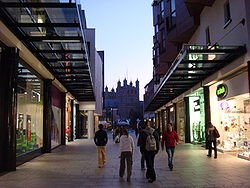
Shopping is centred on the High Street and two shopping centres, the pedestrianised Princesshay and indoor Guildhall, which offer a wide range of major retailers. Independent retailers are concentrated in the adjoining streets, such as Fore Street and Gandy Street. Historically, Exeter has been criticised for its overabundance of chain stores and lack of diversity in categories of other shops, leading the New Economics Foundation to brand it a clone town in 2005 and 2010. In 2024, Exeter's High Street was ranked as one of the UK's most appealing. Since 2004, Exeter has held Fairtrade City status.
Tourism is relatively less important to Exeter's economy compared to the local area, with only 7% of employment dependent on tourism compared with 13% for the county of Devon (2005 figures). In 2024, domestic and overseas tourism spend was £68 and £43 million, respectively, as compared to £231 and £47 million for Torbay (the area with the largest spend).
Architecture

St Nicholas' Priory was founded in 1087 as a Benedictine monastery, but parts were destroyed during the dissolution of the monasteries. Exeter Cathedral was founded in 1050, although the present building dates from approximately 1400. It is considered a superb example of the Decorated Gothic style and possesses the longest continuous medieval stone vault in the world, among other features of historical significance. The adjoining Bishop's Palace and its gatehouse, built in the 13th century, are separately Grade I listed; its west wing contains the Cathedral's library and archives. There are six Grade I listed churches in Exeter: St David's, St Mary Steps, St Thomas', St Martin's, St Mary Arches and St Michael and All Angels, as well as the Presbyterian George's Chapel. Completed in 1763, Exeter Synagogue is Britain's third oldest active synagogue.
Exeter's 2.35km-long city walls are of Roman origin but were repaired and rebuilt during the Anglo Saxon, medieval, and Civil War periods, and incorporate turrets and bastions from the first three periods. Rougemont Castle was built into the northern corner of these walls in 1068; while the Norman gatehouse survives, the original buildings of the inner bailey were replaced by a Palladian-style courthouse in 1774. The Old Exe Bridge, completed around 1200, is one of the best-preserved examples of a major medieval stone bridge of its date in England. Exeter's Guildhall dates from 1468 to 1470, although there has been a building on the present site since the 14th century. Tuckers Hall and The House That Moved are two surviving examples of 15th-century architecture. The Cathedral Close contains several historic buildings, among them St Petrock's Church and the timber-framed Mol's Coffee House; it also contains a World War I memorial by Edwin Lutyens, the Devon County War Memorial.
Northernhay Gardens, beside Rougemont Castle, were laid out in 1612 as a pleasure walk for Exeter residents. The gardens contain part of the city walls and the Exeter War Memorial, a First World War memorial. In the quay area of the city, the 17th-century Custom House represents the earliest purpose-built example of its kind in England. Nearby buildings originally used as a fish market and as warehouses date from the 19th century. The area of Southernhay contains many examples of Georgian architecture, including the original site of the Royal Devon and Exeter Hospital.
Transport
Road

The southwest end of the M5 motorway is at Exminster, just south of Exeter, and runs north past Bristol (where it connects with the M4 to London and South Wales) before reaching its northeast end near Birmingham. The older A30 road provides a more direct route to London via the A303 and M3, and a non-motorway route to Bristol via the A303 and A37. The M5 is the modern lowest bridging point of the River Exe. Going westwards, the A38 connects Exeter to Plymouth and south east Cornwall, whilst the A30 continues via Okehampton to Cornwall and ends at Penzance. The cities of Bristol, Plymouth, Bath, Salisbury and Truro can all be reached within two hours.
Travel by car in the city is often difficult with regular jams centred on the Exe Bridges area.[citation needed] Historically, the bridges were a significant bottleneck for holiday traffic heading to southwest England, leading to the construction of the first bypass in the mid-1930s over Countess Wear Bridge, followed by the M5 in 1977. To further address the problem of congestion in the city centre, Devon County Council opened three park and ride sites near junctions with the M5, and in 2006 considered the introduction of congestion charges.[needs update]
Local bus services are mainly operated by Stagecoach South West. Dartline Coaches and Greenslades are minor operators in the city, with Country Bus serving semi-regular services to Moretonhampstead. The South West Falcon coach service runs from Plymouth through Exeter to Taunton, Bristol Airport, and Bristol city centre. Many services originate from the bus station; the existing building was opened in 2015, replacing a building that had operated since 1964.
Railway

Exeter is a major rail hub in the South West and is linked to most branch lines in Devon, including to Paignton, Exmouth, Barnstaple and Okehampton. This makes it possible to reach most stations in Devon directly from Exeter St Davids.
Exeter is served by three main railway stations. Exeter St Davids is served by all services and is a major interchange station within the South West Peninsula's rail network, whilst Exeter Central is more convenient for the city centre but served only by local services and the main line route to London Waterloo. In the south-west of the city, Exeter St Thomas serves the western side of the city. There are also seven suburban stations, Topsham, St James Park, Polsloe Bridge, Pinhoe, Digby & Sowton, Marsh Barton and Newcourt, served only by local services. Under the ongoing Devon Metro scheme, a gradual upgrade programme is underway to bring a rapid transit-style service on Exeter's local rail network using these existing commuter lines.
There are two main line railway routes from Exeter to London, the faster route via Taunton and Reading to London Paddington and the slower West of England Main Line via Salisbury and Basingstoke to London Waterloo. Another main line, the Cross Country Route, links Exeter with Bristol, Birmingham, Derby, Leeds, Newcastle, Edinburgh and Aberdeen. Great Western Railway and CrossCountry services continue westwards along the Exeter to Plymouth Line, variously serving Torquay, Plymouth and Cornwall. Local branch lines run to Paignton (see Riviera Line), Exmouth (see Avocet Line), Barnstaple (see Tarka Line) and Okehampton (see Dartmoor Line).
The Exeter to Plymouth line of the London and South Western Railway (LSWR) used to provide an alternative route via Okehampton connecting north Cornwall and Plymouth to Exeter and the rest of the UK railway system until its closure in 1968. There are proposals to reopen the line from Okehampton via Tavistock to Bere Alston, for a through service to Plymouth. On the night of 4 February 2014, amid high winds and extremely rough seas, part of the South Devon Railway sea wall at Dawlish was breached, washing away around 40m (130ft) of the wall and the ballast under the railway immediately behind and closing the Exeter to Plymouth Line. Network Rail began repair work and the line reopened on 4 April 2014. In the wake of widespread disruption caused by damage to the mainline track at Dawlish by coastal storms in February 2014, Network Rail is considering reopening the Bere Alston to Okehampton and Exeter section of the former LSWR line as an alternative to the coastal route.
Air

Exeter Airport lies east of the city, and the local airline, previously called Jersey European and British European but later as Flybe, was a significant local employer until its collapse in 2020. It is also a base for TUI Airways with flights to Faro, Mallorca, Lanzarote and elsewhere. The airport offers a range of scheduled flights to British and Irish regional airports and charter flights. Connections to international hubs began with Paris-Charles de Gaulle in 2005 and later a daily service to Amsterdam Schiphol Airport which ended with the collapse of Flybe in 2020. Ryanair started flights in 2019 to Luqa, Naples and Málaga. Shortly adding Alicante but stopping the Naples and Luqa flights.
Canal

The Exeter Canal, also known as the Exeter Ship Canal, was first constructed by John Trew in about 1566, representing one of the oldest artificial waterways in Britain. It was cut to bypass the St James' Weir that had been built across the River Exe at Duckes Marsh to provide a leat to a mill constructed just below the confluence of the Northbrook, in what became the village of Countess Weir. The weir had the effect of preventing water-borne trade in the City of Exeter and forced boats to load and unload at Topsham from where the Earls of Devon were able to exact large tolls to transport goods to and from Exeter.
Originally 3ft (0.9m) deep and 16ft (5m) wide, the canal ran 2mi (3km) from the confluence of the Matford Brook, just above Bridge Road in Countess Weir to Haven Banks, close to the centre of Exeter. In order to maintain a consistent navigable water level, another weir was constructed by Trew, just below the point the canal joins the river. The canal was later extended south to Topsham Lock 3+21⁄32mi (5.88km), deepened and widened, and later still it was extended to Turf Lock near Powderham 5mi (8km). The canal was successful until the middle of the 19th century, since when its use gradually declined – the last commercial use was in 1972. However it is now widely used for leisure purposes, and the city basin is part of a £24million redevelopment scheme.
Education

Exeter's sole higher education provider, the University of Exeter, has two campuses in the city: its main campus, Streatham, and St. Luke's, at which Sport and Health Sciences, the Graduate School of Education, and the Medical School are based; its other campus is in Penryn, Cornwall and shared with Falmouth University. The University formally came into existence in 1955 with the receipt of its royal charter, having previously been the University College of the South West, but can trace its origins to predecessor institutions established from 1838 to 1888.
Exeter College offers further education. It was the sole sixth form for the maintained school sector in the city until 2014, when it was joined by the Exeter Mathematics School, a sixth form free school.
Since 2005, following a reorganisation and rebuilding programme, there have been 25 primary schools, four referral schools, three special schools and five secondary schools within Exeter. The secondary schools are Isca Academy (formerly Priory High School), St James School (formerly St James High School), St Luke's Church of England School (formerly Vincent Thompson High School), St Peter's Church of England Aided School (a consolidation of the former Bishop Blackall High School for Girls and Heles High School for Boys) and West Exe School (formerly St Thomas High School).
The city has a number of independent schools, including Exeter School, Exeter Cathedral School, The Maynard School and St Wilfrid's School.
There are several schools serving students with special educational needs in Exeter.
Sport
Rugby union
The city's professional rugby union team is the Exeter Chiefs. Founded in 1871, as Exeter Rugby Club, the team have played their home games at Sandy Park stadium, located adjacent to junction 30 of the M5, since 2006 after relocating from their previous stadium at the County Ground which had been used continually from 1905. They have been continuous members of the highest division of English rugby, the Premiership, since 2010. They have been English champions twice, in 2017 and 2020, and Anglo-Welsh Cup winners twice, in 2014 and 2018. In 2020, the club became European Champions for the first time in their history, defeating Parisian based club Racing 92 in the final at Bristol's Ashton Gate Stadium 31–27.
The city also has two other clubs: Wessex Rugby Club, which is located in Exwick, and Exeter Saracens Rugby Club, which is located in Whipton.
Football
Exeter City is Exeter's only professional football club. Currently members of EFL League One, they have played their home games at St James Park since their formation in 1901. The club were founder members of the Football League's Third Division (south) in 1920, but have never progressed higher than the third tier of the English football league system, and in 2003 were relegated to the Conference.
Other sports
Exeter Cricket Club administers three teams that play in the Devon Cricket League. The first of these plays in the Premier Division at first XI level, and the next plays at second XI level. The teams play their home games at County Ground, where the club has remained for over 180 years.
Exeter Rowing Club competes both locally and nationally, and has a recorded history originating in the early 19th century. The City of Exeter Rowing Regatta is run annually in July, and is the eldest and largest regatta in the South West, with racing first recorded on the river in the 1860s.
Exeter's speedway team, Exeter Falcons, was established in 1929 and were located at the County Ground until its permanent closure in 2005.[clarification needed] The team was revived in 2015, but is currently[when?] based in Plymouth. Speedway was also staged briefly at tracks in Alphington and Peamore after the Second World War.
Culture

Literature

The Exeter Book, an anthology of Anglo Saxon poetry, is conserved in the vaults of Exeter Cathedral. The Exeter Book originates from the 10th century and is one of four manuscripts that between them encompass all surviving poetry composed in Old English. Predominantly, the Book incorporates shorter poems, several religious pieces, and a series of riddles, a handful of which are famously lewd. Some of these riddles are inscribed on a highly polished steel obelisk in High Street, placed there on 30 March 2005.
Another famous manuscript is the Liber Exoniensis or Exon Domesday, a composite land and tax register of 1086. The piece contains a variety of administrative materials concerning the counties of Cornwall, Devon, Dorset, Somerset and Wiltshire. This document is also conserved in Exeter Cathedral.
In 2019, the city became a UNESCO City of Literature.
Theatre
Exeter has several theatres. The Northcott Theatre is situated in the Streatham campus of the University of Exeter and is one of relatively few provincial English theatres to maintain its own repertory company.

The Barnfield Theatre was originally constructed as Barnfield Hall by Exeter Literary Society towards the end of the 19th century and converted to a theatre in 1972.
The Cygnet Theatre in Friars Walk is the home of the Cygnet Training Theatre and is a member of the Conference of Drama Schools.
Additionally, more innovative and contemporary performances, theatrical productions and dance pieces are programmed the Exeter Corn Exchange in Market Street.
Music
The largest orchestra based in Exeter is the EMG Symphony Orchestra.
Chris Martin, lead singer of rock band Coldplay, was born in Exeter and grew up in a Grade II-listed Georgian house in the nearby village of Whitestone. He was educated at Exeter Cathedral School during his early teens. Subsequently, the band has frequently returned to Exeter to perform, including during BBC Radio 1's Big Weekend in 2016, which was hosted at the nearby Powderham Castle. Coldplay also teased the track list to their eighth studio album, Everyday Life (2019), in the Express & Echo, Exeter's local newspaper.
Another major rock band, Muse, has ties to Exeter. The band's members were all born and raised in nearby Teignmouth, and some of the band's earliest performances were at Exeter's 220-capacity Cavern Club, on Queen Street, in the early 1990s. They have since performed 33 times at the venue, most recently in 2022, when they débuted new material from their upcoming ninth studio album, Will of the People (2022).
The Cavern Club has become one of Exeter's primary live music venues since its opening in 1991, hosting artists including Coldplay, Muse, Biffy Clyro, George Ezra, The 1975, Bastille and Kaiser Chiefs. It remains a popular venue for local artists, as well as one of the city's main student nightclubs.
Thom Yorke, lead singer of rock band Radiohead, attended the University of Exeter in the early 1990s and helped to set up the Cavern Club. He also played multiple gigs on the university campus with techno band Flickernoise, and regularly DJed at the Lemon Grove, a student nightclub on the Streatham Campus, where he is rumoured to have written the lyrics to Radiohead's first hit single "Creep".
The University's Great Hall has emerged as a popular venue for live concerts in recent years, including English pop band Blossoms in 2022 and English internet personality and musician KSI in 2022. Westpoint Arena, on the city's eastern outskirts near Exeter Airport, has also hosted a handful of major artists, such as The 1975 and Lewis Capaldi in 2023.
Museums and galleries
- The Royal Albert Memorial Museum in Queen Street is Exeter's predominant museum. The museum maintains its own collections of regional, national and international importance. Recently, the museum underwent an extensive refurbishment. It reopened on 14 December 2011, and was subsequently awarded the National Art Fund Prize – UK Museum of the Year 2012. The Museum also runs St Nicholas Priory in Mint Lane, near Fore Street.
- Additionally, the University of Exeter has an extensive fine art collection and an assortment of exhibition spaces across its Streatham campus. Showing a vibrant programme of exhibitions, performances, films and visual arts. The sculpture collection contains works by artists including Barbara Hepworth, Peter Thursby, Geoffrey Clark and Elaine M. Goodwin. It can be located using the Sculpture Trail.
- Exeter Phoenix is one of South West England's leading contemporary arts venues. The venue occupies the former university site in Gandy Street and programmes international, national and outstanding regional artists.
- Until its closure in 2017, Spacex was a contemporary arts organisation that programmed exhibitions of contemporary art and promoted artist-led projects, events and research.
Newspapers
- Express and Echo, published weekly on Thursdays.
- Exeter Flying Post, published weekly. It was discontinued in 1917, but was revived in 1976 as an alternative community magazine. The last issue was in 2012.
- The Western Morning News, a Plymouth printed daily regional paper.
- Exeposé, the university's student newspaper, printed fortnightly.
Radio
BBC Radio Devon broadcasts to Exeter locally on FM (95.8) and AM (990 AM/MW), although the majority of programming originates in Plymouth. In the evenings, BBC Radio Devon joins the South West Regional service. Heart West formerly Gemini FM and DevonAir, broadcasts on 97.0 FM, with East Devon and Torbay utilising their own frequencies. Both Heart West and BBC Radio Devon broadcast from the St Thomas transmitter. AM radio is broadcast from Pearce's Hill located at J31 of the M5.
Other radio stations include Radio Exe, an easy listening station broadcasting on 107.3 FM, Phonic.FM which provides a "no adverts no playlist" alternative on 106.8 FM or online at www.phonic.fm, VI, a station broadcasting from the West of England School and College on 1386 AM/MW.
Additionally, Exeter University has a well established student station, Xpression FM, which broadcasts on 87.7 FM using two low-powered transmitters, although it can be heard over much of the north of the city.
The local commercial radio station is Radio Exe. The local community radio station is Phonic FM.
Television
Both BBC Spotlight and ITV West Country provide Exeter with regional news outputs. BBC Spotlight is broadcast from Plymouth and ITV West Country is broadcast from Bristol, although both services do have newsrooms in Exeter. The St Thomas and Stockland Hill transmitting station both provide the city's coverage.
Twin towns
- Rennes House, named after Rennes
- Piazza Terracina, named after Terracina
- Yaroslavl Footbridge, named after Yaroslavl
Exeter is twinned with:
| City | Since | Organisation |
|---|---|---|
| France Rennes, France | “early 1950s” | Exeter Twinning Circle |
| Germany Bad Homburg, Germany | 1965 | |
| Italy Terracina, Italy | 1988 | |
| Russia Yaroslavl, Russia | 1989 | Exeter Yaroslavl Twinning Association (Russian:Общество Дружбы Ярославль-Эксетер) |
Freedom of the City
The following people and military units have received the Freedom of the City of Exeter.
Individuals
- Admiral Horatio Nelson, 1st Viscount Nelson: 15 January 1801.
- Rob Baxter: 25 July 2017.
- Gareth Steenson: 7 October 2021.
- Richard Jacobs: 1 December 2021.
- Philip Bostock: 18 July 2022.
- Sir Samual Hall: 24 July 2018
Military units
- The Royal Marines: April 1977.
- 243 (The Wessex) Field Hospital (V): July 2002.
- The Rifles (formerly The Devonshire and Dorset Regiment): June 2007.
- The Coldstream Guards: July 2011.
- RAF Brize Norton: 21 October 2013.
- HMSDefender, RN: March 2014.
- HMSExeter, RN: August 1928.
Notable people
See List of people from Exeter and Category:People from Exeter
See also
Notes
Sources and further reading
External links
- 3 September 2014 at theWayback Machine from White's Devonshire Directory, 1850
- in theDomesday Book