Siege of Jerusalem (70 CE)
In-game article clicks load inline without leaving the challenge.
The siege of Jerusalem in 70 CE was the decisive event of the First Jewish Revolt against the Roman Empire (66–73 CE). Roman forces led by Titus besieged the Jewish capital, the revolt's main stronghold. After months of fighting, they breached the defenses, destroyed the Second Temple, and razed the city, killing, enslaving, or displacing much of its population. The city's fall marked the effective end of the revolt and had far-reaching political, religious, and cultural consequences.
In winter 69/70 CE, after a succession war in Rome, Titus led at least 48,000 troops—including four legions and auxiliary forces—back into Judaea. By spring, this army had encircled Jerusalem, the population of which had surged with refugees and Passover pilgrims. Inside the city, rival factions led by John of Gischala, Simon bar Giora and Eleazar ben Simon fought each other, destroying the city's food supplies and weakening its defenses. Although they eventually united and mounted fierce resistance, Roman forces breached the city walls and drove the defenders back into the Temple precincts.
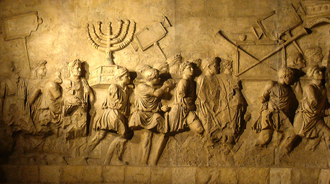
In the summer month of Av (July/August), the Romans captured the Temple Mount and destroyed the Second Temple—an event commemorated annually in Judaism on Tisha B'Av. The rest of Jerusalem fell soon afterward, by early September, with tens of thousands killed, enslaved, or executed. The Romans systematically razed the city, leaving only the three towers of Herod's citadel and sections of the wall as reminders of its former greatness. A year later, Titus and his father, Emperor Vespasian, celebrated their victory with a triumph in Rome, parading Temple spoils—including the menorah—alongside hundreds of captives. The victory was later commemorated in monuments such as the Arch of Titus and in the Judaea Capta coinage.
The destruction of Jerusalem and its temple marked a turning point in Jewish history. With sacrificial worship no longer possible, Judaism underwent a transformation, giving rise to Rabbinic Judaism, centered on Torah study, acts of loving-kindness and synagogue prayer. The city's fall also contributed to the growing separation between early Christianity and Judaism. After the war, Legio X Fretensis established a permanent garrison on the ruins. Inspired by Jerusalem's earlier restoration after its destruction in 587/586 BCE, many Jews anticipated the temple's rebuilding. In 130 CE, Emperor Hadrian re-founded it as Aelia Capitolina, a Roman colony dedicated to Jupiter, paving the way for the last major Jewish rebellion—the Bar Kokhba Revolt.
Background
Jerusalem on the eve of the revolt

On the eve of the revolt, Jerusalem was a thriving metropolis that served as the religious and political center of Jewish life both in Judaea and the diaspora. The city had reached its greatest extent, about 450 acres (180ha)—nearly twice the size of today's Old City—and was home to tens of thousands of residents. Its reputation extended well beyond Jewish circles: Roman author Pliny the Elder called it "by far the most famous city of the East" (Natural History, 5.70), while the historian Tacitus described it as "the capital of the Jews," noting a temple of "enormous reaches" (Histories, 5.8).
The city was organized into several distinct districts. The Lower City was densely populated, while the Upper City housed the elite, including many priestly families. Dominating both was the Temple Mount, the religious and political core of Jerusalem, at the center of which stood the Second Temple. Long central to Jewish national and religious identity, the Temple had been significantly expanded under King Herod, who ruled Judaea from 37 to 4 BCE and transformed it into one of the largest religious complexes in the ancient world.
The Temple complex functioned as more than a place of worship. It hosted popular assemblies and judicial proceedings and contained one of the city's largest marketplaces. Its upkeep was funded in part by an annual half-shekel tax levied on Jewish adults. During the Three Pilgrimage Festivals, tens of thousands of visitors from Judaea and abroad traveled to Jerusalem to take part in temple rituals—an influx that contributed substantially to the city's wealth and prominence.
Jerusalem's defenses
On the eve of the revolt, Jerusalem's strategic location, flanked by the Kidron Valley to the east and the Hinnom Valley to the south, provided natural barriers that made direct assaults difficult. These natural defenses were reinforced by a series of fortification walls built up over the city's long history. The "First Wall," constructed in the second century BCE by the Hasmonean kings on the foundations of an earlier wall dating to the kings of Judah, enclosed both the Lower and Upper City and formed the core of Jerusalem. As the city grew, the "Second Wall" was added further north to protect newer neighborhoods and commercial districts. Continued expansion in the early 40s CE led the Jewish vassal king Herod Agrippa to begin a "Third Wall" enclosing the new northern suburb of Bezetha; Roman emperor Claudius halted its construction, possibly out of concern over Jewish rebellion or following Agrippa's death, and it was only finished in haste once the revolt broke out.

The city's defenses also included fortified structures. The Antonia Fortress, positioned at the Temple Mount's northwestern corner, combined a military garrison and palace overlooking the temple complex. In the western Upper City, north of Herod's Palace, stood another fortified complex (today the site of the Tower of David), enclosed by walls and guarded by three towers named Phasael, Hippicus, and Mariamne.
Despite these defenses, Jerusalem's capacity to withstand a prolonged siege had its limits. The city depended heavily on food imported from the regions of Judea, Samaria, Galilee, and further afield, since local agriculture alone could not support its population, though it did keep stores of reserves. Its water supply relied on large rain-collecting pools, channels drawing from sources such as the Gihon Spring, and an aqueduct that brought water from the area near Bethlehem and beyond. During the revolt, the influx of refugees and insurgents swelled the population further, leaving the city increasingly vulnerable to the threat of famine.
Jerusalem during the revolt
In the spring of 66 CE, following clashes between Jews and Greeks in Caesarea Maritima, the Roman procurator Gessius Florus arrived in Jerusalem and seized funds from the Temple treasury. The act triggered widespread unrest, which the Romans suppressed by massacring civilians. Florus subsequently fled the city, and the client king Agrippa II, having failed to dissuade the population from rebellion, was chased out of it as well. A temple official, Eleazar ben Hanania, then halted the daily sacrifices offered on behalf of the emperor. Jewish insurgents seized the Antonia Fortress and set fire to the high priest's residence, the royal palaces, and the public archives containing debt records. In September, the remaining Roman garrison surrendered under a truce but was massacred by insurgents. The radical Sicarii faction, which played a leading role in the fighting, killed a former high priest before their own leader was killed in turn, prompting the surviving members to withdraw to the desert stronghold of Masada.
In response, Gaius Cestius Gallus, the governor of Roman Syria, advanced on Jerusalem with an army of approximately 30,000 soldiers, reaching Mount Scopus and burning the northern suburb of Bezetha. He then retreated unexpectedly and was ambushed by Jewish forces at Bethoron, losing nearly an entire legion. Following Gallus's defeat, a provisional Jewish government was established in Jerusalem, appointing commanders across the country and completing the city's Third Wall. John of Gischala led an independent rebel faction in Galilee, while Simon bar Giora led another in Judea.
In 67, Roman emperor Nero appointed the general Vespasian to suppress the revolt. Vespasian conducted a methodical campaign across Galilee, subduing rebel strongholds one by one. Meanwhile, Jerusalem grew increasingly unstable as refugees and rebel factions, including John of Gischala and his followers, poured into the city. The Zealots, a priestly anti-Roman faction led by Eleazar ben Simon, enlisted the support of the Idumeans and used it to overthrow the city's moderate leadership in a violent purge. By 68, Vespasian had subdued most of Judaea, but Rome itself was thrown into turmoil following Nero's suicide, triggering the succession conflict known as the Year of the Four Emperors. Vespasian postponed the siege of Jerusalem, choosing instead to let the rival Jewish factions weaken one another through infighting while he waited for the spring harvest. In 69, Vespasian was proclaimed imperator by his troops and departed for Italy to secure the imperial throne, entrusting command of the campaign to his son, Titus.
In Jerusalem itself, civil war broke out among the rebel factions. By spring 69, Simon bar Giora's forces were camped outside the city, attacking deserters, while radical factions inside terrorized the population. Hoping to weaken John of Gischala, his rivals allowed Simon to enter, but his arrival only deepened the conflict. Josephus, a Jewish commander and eyewitness who chronicled the revolt under Roman patronage in The Jewish War, describes Jerusalem as descending into a three-way civil war, with each faction fighting the other two; Tacitus similarly notes, in the Histories (5.12), that the city was divided among three generals and three armies. John of Gischala, Eleazar ben Simon, and Simon bar Giora each controlled separate sectors of the city: John held most of the Temple Mount and the southeastern hill, Eleazar controlled the inner Temple court, and Simon, commanding the largest force, dominated the remainder of the city. In the course of the fighting, the warring factions burned the city's food stores, destroying provisions that would prove critical once the Roman siege began.
Omens before the destruction
In The Jewish War (6.288–299), Josephus recounts several omens said to have foretold the destruction of Jerusalem in the years before it fell. Among those was "a star resembling a sword, which stood over the city, and a comet that continued a whole year"—possibly Halley's Comet, which was visible over Jerusalem in the winter and spring of 66. Other reported signs included a sudden bright light around the temple altar near the festival of Passover, a cow giving birth to a lamb, and the massive eastern gate of the Temple's inner sanctuary swinging open on its own. Josephus also describes what appeared to be armies in the sky before sunset, and recounts that during the pilgrimage festival of Shavuot, priests in the Temple heard a loud noise followed by a voice declaring, "We are departing from here." Beginning four years before the revolt, a peasant named Jesus ben Ananias wandered the city prophesying its destruction, continuing to do so for more than seven years.
Titus's march on Jerusalem and early engagements

In winter 69/70, Titus marched from Egypt through the coastal plain to Caesarea, where he established his main base. His forces comprised several legions, including V Macedonica, X Fretensis, and XV Apollinaris, along with XII Fulminata, which had suffered defeat in 66. Tiberius Julius Alexander, Titus's second-in-command, was a Jewish-born equestrian governor and general who had renounced his ancestral traditions. Additional troops were drawn from detachments of the Legio III Cyrenaica and the Legio XXII Deiotariana from Egypt, twenty infantry cohorts, eight cavalry alae, Syrian irregulars, and auxiliaries supplied by allied vassal kings. Tacitus also records the participation of "a strong force of Arabs", motivated by longstanding hostility toward the Jews. In total, this combined force numbered at least 48,200 soldiers, considerably larger than the army deployed for the Roman invasion of Britain in 43 CE.
Meanwhile, infighting continued within Jerusalem. Eleazar ben Simon had fortified his position in the Temple's inner court, seizing its stores of edible offerings. John of Gischala attacked him from below, while Simon bar Giora, who controlled the Upper and Lower city, in turn assaulted John's position. Both sides employed artillery in the fighting, inflicting heavy casualties, including among priests and worshippers.
I have heard that the total number of the besieged, of every age and both sexes, amounted to six hundred thousand. All who were able bore arms, and a number, more than proportionate to the population, had the courage to do so. Men and women showed equal resolution, and life seemed more terrible than death, if they were to be forced to leave their country. Such was this city and nation.
In early Nisan 70 (March/April), Titus set out from Caesarea with Legio XII Fulminata and Legio XV Apollinaris, marching toward Jerusalem. The Roman army advanced through Samaria, halting to rest at Gophna, about 13 miles (21km) north of Jerusalem. Meanwhile, Legio V Macedonica, under Sextus Vettulenus Cerialis, approached from the west via Emmaus, while Legio X Fretensis, commanded by A. Larcius Lepidus Sulpicianus, advanced from the east through Jericho. Titus's own force then made camp in the "Valley of Thorns" near Gibeah, about 3 miles (4.8km) from Jerusalem. Following the example of earlier conquerors of the city, including Sennacherib, Nebuchadnezzar II, Pompey, and Herod, Titus directed his assault against Jerusalem's northern and northeastern flanks, the only sides not protected by ravines.
Tacitus put the number of people besieged in Jerusalem at 600,000, noting that men and women of every age took up arms and showed equal resolve, regarding death as preferable to exile from their homeland (Histories, 5.13). Josephus, meanwhile, speaks of 1.1 million casualties over the course of the siege, among them many Passover pilgrims who found themselves trapped in the city once the siege began (War, 6.420–421). While rejecting these figures as exaggerated, historian Menahem Stern writes that Josephus's mention of 23,400 armed men in Jerusalem on the eve of the siege was likely realistic. The city also harbored refugees from Judea, Galilee and Idumaea. The rival factions ended their infighting and united only when the Romans began battering Jerusalem's walls.
Titus led a reconnaissance force of about 600 cavalry to assess Jerusalem's northern defenses, narrowly escaping an ambush after being cut off from the main body of his troops. He then advanced to Mount Scopus, northeast of the city, where he established camps for Legions XII, XV, and V. Legio X camped separately on the Mount of Olives; while its soldiers were still constructing fortifications, and some remained unarmed, they were attacked by a combined force from the rival Jewish factions. The attackers crossed the Kidron Valley and caught the Romans by surprise; the assault was repelled only after Titus intervened. John of Gischala and Simon bar Giora reconciled, though their factions continued to operate under separate command, maintaining their existing division of the city: John's forces controlled the Temple Mount, the Ophel, and the Kidron Valley, while Simon's held the residential quarters.
Battle for Jerusalem's walls
On 14 Nisan, the start of the Passover festival, the Romans took advantage of a temporary halt in Jewish attacks to move their siege forces closer to Jerusalem's walls. That same night, John of Gischala's forces exploited the opening of the Temple's inner gates for worshippers to enter the inner courtyards, overpower the Zealots stationed there, and seize control of the Temple. Some of the defeated Zealots fled to underground hiding places beneath the Temple Mount, while others joined John's faction; Eleazar ben Simon retained a command role under John's leadership. Titus offered the city peace terms, which were rejected.
The Romans then began their assault by targeting Jerusalem's Third Wall. Internal fighting briefly resumed, with Simon bar Giora's forces engaged on two fronts, against John within the Temple complex and against the advancing Roman siegeworks, though the two factions appear to have reached a truce shortly afterward. Once the Romans completed their siegeworks, Jewish forces launched an offensive that initially gained ground before being repelled by Roman cavalry. During or shortly after this engagement, the Idumean commander John ben Sosas was killed by an arrow, and the first crucifixion of the siege took place when Titus ordered a Jewish captive executed before the city wall to intimidate the defenders—a tactic later repeated throughout the siege.
After fifteen days of failed Jewish attempts to burn the Roman siege engines, a battering ram breached the Third Wall, forcing the defenders to retreat. Within five days, the Romans broke through the middle section of the Second Wall, but the narrow breach left their troops trapped in the city's alleys, where Jewish defenders, using their knowledge of the terrain, inflicted heavy losses and forced a Roman withdrawal. Four days later, the Romans returned, widened the breach, and captured the area. They then razed the northern section of the city and paused the offensive for several days, during which increasing numbers of Jews deserted the city.
From Antonia to the Temple Mount
When hostilities resumed, Titus constructed siege ramps at the Antonia Fortress and against the towers of the Upper City, while also employing psychological warfare. He staged a four-day parade of cavalry and infantry in polished armor, publicly distributing their pay to display Roman strength. He again offered peace terms through Josephus, who addressed the population in their "ancestral tongue"—likely Hebrew, though possibly Aramaic. Josephus argued that the Romans had respected Jewish holy sites, unlike the rebels who had endangered them, and urged repentance, claiming that Rome's victories showed that God now favored Roman rule. Met with mockery and violence, he responded by recounting Jewish history from the Exodus to the return from Babylonian exile, arguing that past victories had come through obedience to divine will rather than armed resistance. Comparing himself to the prophet Jeremiah, he warned that the true struggle was not against Rome but against God, and again urged the defenders to surrender in order to spare the city, the Temple, and their families. The rebels refused—whether out of trust in divine protection, confidence in their fortifications, or fear of the humiliation and torture that awaited them if captured.
Within the city, the rebel factions attacked those trying to flee and looted wealthy homes for food, often resorting to torture. Outside the walls, Roman forces tortured and crucified captured fugitives in plain sight of the defenders, at times in varied positions for the soldiers' amusement. These executions, said to have exceeded 500 per day and to have exhausted the available supply of timber for crosses, were intended to terrorize the besieged into surrender. Syrian and Arab auxiliaries reportedly disemboweled refugees in search of swallowed valuables.

As grain prices soared, residents scavenged for scraps in the sewers, and large numbers of corpses accumulated outside the city. Many died of starvation, while others succumbed to related illness. Josephus describes children with swollen bellies (War, 5.513) and deserters showing signs of what appears to have been dropsy. In Lamentations Rabbah (4.11), a rabbi named Eleazar bar Zadok recalls that his father's body never fully recovered from the famine, even decades later; the same source describes a woman whose hair fell out due to malnutrition. After building four siege ramps against the Antonia Fortress, the Romans breached and captured it, then turned their attention to the Temple itself.
On the seventeenth of Sivan (May/June), Roman siege operations resumed. John of Gischala countered by tunneling beneath the Roman siege engines at Antonia and setting their supports alight, collapsing them, while also destroying additional equipment in the western sector. The Romans rebuilt their machines and, according to Josephus, completed a stone circumvallation wall 5 miles (8.0km) long in just three days, cutting off supply lines and escape routes. Some residents attempted to flee by leaping from the walls or by feigning combat with stones in order to surrender.
Inside the city, Simon bar Giora executed members of the elite and suspected advocates of surrender, throwing their mutilated bodies beyond the walls. John and his followers reportedly plundered the Temple, melting down sacred vessels, consuming consecrated food, and distributing sacred oil and wine among their supporters. The famine grew more severe, claiming many lives. Josephus recounts the story of a woman named Maria, from the region of Perea (a region in Transjordan), who, after being plundered by rebels, killed, roasted, and ate her infant son; when rebel fighters, drawn by the smell of cooking, later came searching for food, she offered them what remained, leaving them horrified.
From the captured Antonia Fortress, the Romans attempted to breach the Temple complex; though initially successful, they were driven back after a 12-hour battle. According to Josephus, on 17 Tammuz (June/July) the daily temple sacrifice (Tamid) ceased for lack of priests or lambs. The Jewish defenders withdrew into the Temple courtyards, and Titus again offered peace through Josephus, again without success. Josephus recounts offering John permission to bring in sacrificial animals from outside the walls—an offer John is said to have refused, declaring that he had no fear for the city's capture, since it belonged to God. Whether or not the exchange occurred as described, it reflects a belief, dating back to the Kingdom of Judah, that Zion enjoyed divine protection.
Some priests and members of the upper class surrendered and were sent by Titus to Gophna; they were later brought back, together with Josephus, to encourage further surrenders, prompting many more residents to defect to the Roman side (War, 6.113–119). The Romans then built four ramps aimed at the Temple's defenses. The defenders set fire to several stoas (colonnades) connecting the Temple to the Antonia Fortress to block Roman access, while the Romans burned a nearby stoa. After repeated failed attempts to breach the Temple walls with battering rams, the Romans set fire to its gates and porticoes, forcing the defenders back into the inner court. Josephus (War, 6.237–243) reports that Titus then convened his commanders to debate the Temple's fate, and that he personally opposed those urging its destruction, arguing that so magnificent a structure should be preserved as an ornament of Roman rule—though events would soon prove otherwise.
Destruction of the Second Temple
According to Josephus, on 8 Av (July/August), Roman forces breached the temple's outer court. Two days later, on the tenth of Av, a Roman soldier hurled a burning piece of wood into the northern chamber, sparking a fire that ultimately consumed the entire Temple structure (War, 6.254–259). Josephus writes that when the blaze broke out, Titus, roused from a nap, rushed to the scene and ordered it extinguished, but amid the chaos many soldiers either failed to hear the order or ignored it outright, with some even urging others to spread the flames (War, 6.241–243). Titus and his officers then entered the Temple, viewing both the heikhal and the Holy of Holies, and again ordered the fire stopped—but his troops, driven by confusion, hatred, and greed, continued looting the building and setting it alight.
Josephus's account has long been contested by scholars. A rival version appears in the work of Sulpicius Severus, a 4th-century Christian historian from Gaul, who—possibly drawing on Tacitus's lost account in the Histories—claims that Titus deliberately ordered the Temple's destruction in order to eradicate both the Jewish and Christian religions (Chronica, 2.30, 6–7). Other sources, including the poet Valerius Flaccus and the Babylonian Talmud (Gittin 56b), likewise suggest that Titus bore direct responsibility for the Temple's burning.

Whether the destruction was intentional, and how much responsibility rests with Titus personally, remains a matter of scholarly dispute. Some historians find Josephus's version credible: Martin Goodman, for instance, considers it plausible given how difficult a fire would have been to contain in Jerusalem's dry summer heat. Most modern scholars, however, reject Josephus's account. Historian Lester L. Grabbe calls it "unbelievable", arguing that a Roman commander known for harsh discipline, including the use of the death penalty, would not have tolerated his soldiers openly disobeying orders in his presence. Since the destruction of temples was regarded in antiquity as an act of sacrilege, some scholars suggest that Josephus may have downplayed Titus's role in order to protect his reputation. Others, including Fausto Parente and Grabbe himself, argue instead that Josephus's version was meant to discourage Jews from seeking future vengeance for the Temple's destruction.
Several modern historians view the destruction as deliberate and ideologically motivated. Doron Mendels argues that the Romans targeted the Temple because they regarded it, and Jerusalem more broadly, as the center of Jewish rebellion. James Rives maintains that the goal was "not only to forestall future revolts but also to eliminate the anomalous cultic organization that hindered the integration of Jews into the empire". Steve Mason argues that Titus and the Flavian regime treated the Temple's destruction not as an embarrassment but as a military necessity, noting that Rome had previously destroyed temples at Carthage and Corinth, and that no evidence suggests Titus felt any guilt over the act. Mason points instead to a celebratory poem by Valerius Flaccus, which praises Titus as "begrimed with the dust of Jerusalem, scattering firebrands and causing havoc in every turret."
As the Temple burned, chaos spread through its courtyards. Ancient sources report that priests continued performing their ritual duties until they were killed, with many said to have accepted death willingly. Josephus recounts that two priests, Meirus son of Belgas and Joseph son of Daleus, threw themselves into the flames and died alongside the Temple (War, 6.280). Greco-Roman historian Cassius Dio writes that "the Jews defended themselves much more vigorously than before, as if they had discovered a piece of rare good fortune in being able to fight near the temple and fall in its defense"; they soon "met death willingly, some throwing themselves on the swords of the Romans, some slaying one another, others taking their own lives, and still others leaping into the flames" (Roman History, 65, 6:2–3). Dio frames this mass suicide as a form of victory and salvation in the eyes of the defenders, who chose to die alongside the temple rather than survive its fall. Avot de-Rabbi Natan (Version B, 7), a later rabbinic work, similarly relates that the sons of the high priests, seeing the sanctuary ablaze, cast the Temple keys toward heaven, declaring themselves unworthy custodians before leaping into the fire: "they held on to one another, were drawn into the fire, and burned."
Roman soldiers looted and killed indiscriminately, sparing no one, including those who begged for their lives. According to Josephus, some 6,000 people, many of them poor women and children, had taken refuge in a colonnade in the outer court; the Romans set it ablaze, killing everyone inside. Josephus attributes this tragedy to "false prophets" who had urged the crowd to gather on the Temple Mount, promising that doing so would bring deliverance.
The Romans then systematically destroyed what remained of the Temple Mount, razing its porticoes, treasuries, and gates. Soldiers carried their military standards into the Temple court and offered sacrifices before them, then hailed Titus as imperator. Before the Temple was fully consumed, they seized an immense quantity of plunder; so much, according to Josephus, that the price of gold in Syria fell by half (War, 6.137). A group of priests attempted to surrender, but Titus had them executed, declaring it fitting that they die alongside the Temple. With the destruction of the Temple complex complete, Roman forces turned to the destruction of the rest of the city.
Conquest of the lower and upper city
After the temple's destruction, some rebels sought a parley with Titus, meeting on a bridge overlooking the ruins, possibly at what is now Wilson's Arch. Hoping to save what remained of the city, they were met instead with a rebuke: Titus, speaking through an interpreter (possibly Josephus), condemned them for their repeated ingratitude and rejection of peace terms dating back to Pompey's time. He offered them one final chance to surrender, but the rebels demanded safe passage to the desert for themselves and their families. Offended by the demand, Titus broke off negotiations and declared that no further terms would be offered.
The following day, Titus authorized the burning and sacking of what remained of the city. Roman soldiers set fire to the city archives, the Acra fortress, the council chamber, and the Ophel district, and the blaze spread through the Lower City, eventually reaching Helena of Adiabene's palace and the Pool of Siloam. Titus granted protection to the family of King Izates of Adiabene, who were subsequently taken to Rome as hostages. The Romans found little plunder in the captured areas, as the rebels had already stripped them of anything valuable. The rebels then retreated to Herod's Palace, massacred those inside, and looted its contents. They captured two Roman soldiers, killing one and nearly executing the other, who escaped and was later spared but dishonorably discharged by Titus. Josephus's pleas for surrender were mocked as the rebels hid in tunnels, hoarding food and killing intruders.
Jerusalem's Upper City was the last district to fall. On 20 Av, the Romans launched a fresh assault, constructing siege ramps to the northwest and northeast. A group of Idumaean leaders secretly approached Titus to negotiate surrender, and he accepted, hoping their capitulation would encourage others to follow. Simon bar Giora, however, discovered the plot, executed the five envoys, and imprisoned the remaining leaders. Despite this, many Idumaeans still defected to the Romans; those who held Roman citizenship were released, while the rest were sold into slavery. A priest named Jesus son of Thebuthi surrendered a number of sacred items from the sanctuary, including two menorah lampstands, golden tables, garments, and precious stones, while another priest, Phineas, secured a pardon by handing over priestly vestments and the spices used in ritual offerings. These objects were later paraded in Rome during Titus's triumph.
Within eighteen days, the Romans completed their siege works and, on 7 Elul (August/September), launched their final assault. Once the Upper City's wall was breached, resistance collapsed quickly. The defenders abandoned the towers of Herod's citadel, which Josephus said could only have been taken by famine. Their last counterattack repelled, the rebel leaders fled into the city's underground tunnels. Roman forces raised their standards over the captured towers and carried out a massacre, killing civilians in the streets and in their homes; some families were found already dead of starvation, while others were killed outright. The killing ceased only with nightfall. By morning, Jerusalem was entirely engulfed in flames.
Destruction of Jerusalem
By early September, the conquest of Jerusalem was complete. Titus ordered the city's total destruction, reducing it to ruins. Only the three towers of Herod's citadel—Phasael, Hippicus, and Mariamne—were spared, left standing as a monument to the city's former strength, while a western stretch of the First Wall remained intact, providing shelter for Legio X, which was garrisoned there. The rest of Jerusalem was systematically leveled, erasing nearly all traces of its former grandeur. Josephus writes that the devastation was so complete that former residents would not have recognized the city, and that a visitor might well have doubted it had ever existed at all.
The army now having no victims either for Jerusalem slaughter or plunder, through lack of all objects on which to vent their rage—for they would assuredly never have desisted through a desire to spare anything so long as there was work to be done—Caesar ordered the whole city and the temple to be razed to the ground, leaving only the loftiest of the towers, Phasael, Hippicus, and Mariamme, and the portion of the wall enclosing the city on the west: the latter as an encampment for the garrison that was to remain, and the towers to indicate to posterity the nature of the city and of the strong defences which had yet yielded to Roman prowess. All the rest of the wall encompassing the city was so completely levelled to the ground as to leave future visitors to the spot no ground for believing that it had ever been inhabited. Such was the end to which the frenzy of revolutionaries brought Jerusalem, that splendid city of world-wide renown.
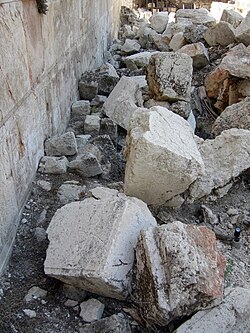
This historical account is strongly corroborated by archaeological evidence, with extensive remains found across the city confirming the widespread destruction of 70 CE. At the base of the Temple Mount, archaeologists have uncovered large stones and rubble toppled by Roman forces during their destruction of the Temple complex. Robinson's Arch, which once supported a monumental staircase leading up to the temple precinct, was destroyed immediately after the city fell.
Near the southern end of the Western Wall, excavators found a massive pile of stones—remnants of the Temple complex's retaining walls, hurled down onto the Herodian street below. These stones were subsequently dismantled in a systematic operation, likely carried out by Legio X Fretensis, which removed the upper courses of the retaining walls stone by stone. Among the finds from this area is the Trumpeting Place inscription, a monumental Hebrew inscription that once marked the spot where a priest would sound a trumpet to announce the beginning and end of Shabbat, Judaism's weekly day of rest.
In the 1970s and 1980s, excavations led by the archaeologist Nahman Avigad uncovered evidence of a massive fire that devastated Jerusalem's Upper City. The blaze consumed all organic material in its path, causing beamed ceilings and upper floors to collapse and bury their contents beneath them. Findings of calcium oxides indicate prolonged burning that damaged limestone walls, while layers of ash and debris accumulated up to two meters deep. The fire's effects were visible even on household objects: limestone vessels were stained with ash or calcined into lime, while glass vessels shattered or warped in the heat—among them a piece by the renowned glassmaker Ennion, found in a mansion in the Upper City. Many such objects were so severely damaged that they could not be restored even under laboratory conditions. One of the most significant structures uncovered in the Upper City is the Burnt House. Excavations there revealed thick layers of ash covering the basement, along with kitchen tools, pottery, and a stone weight inscribed with the name of the priestly Kathros family, suggesting the building may have formed part of the basement of the family villa. Among the finds were a spear and the skeletal arm of a young woman, likely killed during the siege.

Josephus' account of Jerusalem's inhabitants attempting to escape through underground passages after the city's fall aligns with archaeological findings beneath the stepped street in the Tyropoeon Valley. Excavations revealed a drainage channel large enough for a person to crawl through, filled with intact cooking pots and revolt coinage. In several places, paving stones had been removed, possibly providing access for refugees to hide or escape through the sewer system. The great urban drainage channel and the Pool of Siloam in the lower city became clogged with silt and stopped working, and the city walls collapsed in numerous places.
Captives and executions
After Jerusalem's fall, Titus ordered the killing of those who continued to resist, though many elderly and infirm prisoners were massacred as well, despite his orders to the contrary. Survivors in good condition were detained in the Court of the Women, one of the temple's courtyards, where the Roman official Fronto determined their fate: rebels and brigands were executed, the tallest and most handsome were selected for Titus' triumph in Rome, prisoners over 17 were sent in chains to Egypt, many were distributed across the empire for execution by the sword or wild animals, and those under 17 were sold into slavery.
Around 11,000 prisoners reportedly died of starvation, either from neglect or refusing food. Josephus claims to have rescued his brother and friends, and even intervened to save three men being crucified in Teqoa—though only one survived. 4th-century bishop Eusebius writes that Vespasian ordered the eradication of all members of the Davidic line, to prevent any potential Jewish royal resurgence (Ecclesiastical History, 3.12).
Once most of Jerusalem's remaining population had been killed or enslaved, the Romans turned to searching the city's underground tunnels for survivors. Many of those found were executed on the spot, while more than 2,000 were discovered already dead, killed by starvation or by one another. Soldiers also recovered valuables and prisoners the rebels had been holding. John of Gischala was captured after emerging from the tunnels and was sentenced to life imprisonment.
Simon bar Giora was caught after he and his companions, hiding in an underground passage, ran short of food. He surfaced at the site of the destroyed Temple dressed in a white tunic and a purple mantle—a choice of clothing possibly meant to assert a royal claim. The Roman officer Terentius Rufus had him seized and sent to Titus at Caesarea. Both John and Simon were later transported to Rome to be displayed in the triumph.
Following the conquest, Titus embarked on a regional victory tour. At Caesarea Philippi, he staged games featuring Jewish prisoners, including executions by wild animals and gladiatorial combat. At Caesarea Maritima, some 2,500 captives were killed in similar spectacles to mark his brother's birthday, and further prisoners died during games held in Berytus in honor of Vespasian's birthday.
Aftermath
Casualties, enslavement, and displacement
During the siege of Jerusalem and its aftermath, the population suffered mass extermination. Josephus claims that 1.1 million people died in the siege, mostly Jews who came for Passover and became trapped in the city as pilgrims kept arriving despite the revolt (War, 6.420–421). He also records several waves of desertions before and during the siege. Modern scholars generally regard his death toll as greatly exaggerated. Historian Seth Schwartz, for instance, estimates that Palestine's total population at the time was around one million, with roughly half being Jewish, and notes that sizable Jewish communities remained in the region after the war, even in Judea, despite its devastation. Historian Guy Rogers estimates the death toll at tens of thousands, likely 20,000–30,000. The philosopher and genocide scholar Shawn J. Kelley has characterized the event as a genocide.

Many in the surrounding region were also killed, displaced, or enslaved. Josephus reports that after the Romans put the armed and elderly to death, some 97,000 people were sold into slavery, while 40,000 survivors from Jerusalem were released by the emperor (War, 6.378–386, 420). Traces of this enslaved population surface in Italy: a tombstone from Puteoli, near Naples, commemorates a woman named Claudia Aster, identified as a captive from Jerusalem, whose name may derive from Esther. Roman poet Martial likewise mentions a Jewish slave in his own household, describing her as coming from "Jerusalem destroyed by fire."
Triumph and mop-up operations
in the summer of 71, about a year after Jerusalem's fall, Titus and Vespasian held a triumph in Rome celebrating their victory in Judaea. This triumph was unique in Roman history as the only one dedicated to subjugating the population of an existing province. It is also the best-documented triumph of the imperial era, described in vivid detail by Josephus in Book 7 of The Jewish War (116–157).
At dawn, Vespasian and Titus, wearing laurel crowns and ceremonial attire, left the Temple of Isis for the Porticus Octaviae, where they met Rome's leading officials. Seated on an ivory tribunal, they offered prayers of thanksgiving before proceeding to the Porta Triumphalis[it], where they performed sacrifices, donned purple triumphal robes, and began the procession. The event attracted an enormous crowd, estimated by archaeologist Ernst Künzl[de] at over 300,000 spectators. The procession included 700 Jewish captives, who were paraded as symbols of conquest and, according to Josephus, "to make a display of their own destruction", along with sacred items from the Temple, such as the menorah, the golden Table of Showbread, and the scrolls of the Law. Vespasian and Titus rode together in a triumphal chariot, while Domitian, Titus's younger brother, rode alongside them on horseback. An elaborate array of artworks, including rugs, gems, statues of deities, and decorated animals, was displayed on multi-story scaffolds displaying golden frames, ivory work, and tapestries illustrating scenes from the war. The triumph culminated on the Capitoline Hill with the execution of Simon bar Giora at the Mamertine Prison, in accordance with Roman custom.
After Jerusalem's fall, most of Judaea was finally pacified, with the exception of three strongholds—Herodium, Machaerus, and Masada—which remained under rebel control. Roman legates (high-ranking officers) were assigned to eliminate these final pockets of resistance. Herodium and Machaerus fell within two years, leaving Masada as the last stronghold. In 73/74, the Romans breached its walls after a prolonged siege, ending the Jewish revolt.
Legio X Fretensis garrisons the ruins of Jerusalem
After Jerusalem's fall, Legio X Fretensis, garrisoned the ruins for nearly two centuries. Their presence is confirmed by inscriptions, tiles, and bricks bearing the legion's stamp, though the camp's exact location remains uncertain. The establishment of a Roman garrison likely discouraged Jews from returning. Josephus wrote that Titus granted him property elsewhere, since those in Jerusalem were worthless due to the Roman garrison (Life, 422). He also stated that during the revolt, every tree around the city was cut down, leaving the land "as bare as virgin soil."

A small remnant may have remained after the city's destruction. In Josephus's account of Eleazar ben Yair's speech before Masada's fall, he describes "hapless old men sit[ting] beside the ashes of the shrine, and a few women, reserved by the enemy for basest outrage" (War, 7.377). Epiphanius, a 4th-century Christian bishop, records what may be authentic testimony of a small, impoverished Jewish community residing on Jerusalem's southwest hill between the revolts (On Weights and Measures, 129–130). Excavations at Shuafat, 4 kilometres (2.5mi) north of Jerusalem's Old City, revealed a post-destruction settlement built in Roman style but inhabited by a substantial Jewish population. At the start of the Bar Kokhba Revolt, it was partially burned, and the residents fled.
Commemoration in Rome
To celebrate their triumph, the Flavians initiated a series of grand construction projects in Rome. In 75, Vespasian completed the Temple of Peace—a monumental complex dedicated to Pax, the goddess of peace, adjacent to the Forum of Augustus. The temple housed the menorah, the Table of Showbread, and other ritual objects from Jerusalem, along with a large collection of artworks. Another landmark associated with the triumph was the Colosseum, completed under Titus and financed, according to an inscription, "from the spoils of war"—a reference to the war in Judaea.
The Flavians also launched a coinage campaign known as Judaea Capta ("Judaea has been conquered"). Issued over a span of 10 to 12 years, these coins became a central tool of Flavian propaganda. The obverse featured Vespasian or Titus, while the reverse depicted a mourning female figure, symbolizing the subjugated Jewish people, seated beneath a palm tree, the emblem of Judaea. In some variations, the figure appears bound or kneeling before the victory goddess Nike (Victoria).

Emperor Domitian (r. 81–96) continued to immortalize the victory, commissioning two triumphal arches that glorified the Flavian dynasty and its military success. Most prominent is the Arch of Titus, still standing in the Roman Forum along the Via Sacra, ancient Rome's main thoroughfare. Built shortly after Titus's death, the arch was dedicated by the Senate and People of Rome to the deified Titus and Vespasian. Its interior reliefs portray soldiers parading the seven-branched menorah, the Table of Showbread, a golden cup, and silver trumpets, during the triumphal procession. On the opposite panel, Titus appears in a quadriga, crowned with a laurel wreath by Victoria, while Virtus, the personification of bravery and military strength, leads the chariot. The menorah depicted on the arch was later chosen as the emblem of Israel.
A second triumphal arch, constructed c. 80/81, stood near the southeastern edge of the Circus Maximus, Rome's principal chariot-racing venue. Its inscription proclaimed that Titus "subdued the Jewish people and destroyed the city of Jerusalem, a feat either sought in vain by all generals, kings, and peoples before him or entirely untried," overlooking earlier conquests of the city.
Aelia Capitolina and the Bar Kokhba Revolt
In 129/130, Emperor Hadrian visited Jerusalem and founded the Roman colony of Aelia Capitolina on its ruins, an act the historian Martin Goodman has described as the "final solution for Jewish rebelliousness." The move is widely regarded as a key trigger for the Bar Kokhba Revolt (132–136), during which rebels led by Simon Bar Kokhba established a short-lived independent Jewish state before it was crushed by Rome, an outcome that nearly extinguished Jewish settlement in the Judea region altogether. In its wake, Hadrian renamed the province from Judaea to Syria Palaestina and barred Jews from entering Jerusalem and its vicinity. Aelia Capitolina itself grew into a modest town populated by legionaries and non-Jewish settlers, with temples to Roman deities replacing the city's former Jewish character.
For the following five centuries, Jews were permitted to enter Jerusalem only once a year, on Tisha B'Av, to mourn the Temple's destruction. A Christian pilgrim from Bordeaux who visited the city in 333 recorded that Jews would come annually to anoint a perforated stone, then "bewail themselves with groans, rend their garments, and so depart." The ban on Jewish settlement persisted even after the Roman Empire adopted Christianity. Under the emperor Julian (r. 361–363), Jews were briefly permitted to return, and may have begun efforts to rebuild the Temple, but the project was halted by a natural disaster and by Julian's death shortly afterward. Jews were not permitted to resettle Jerusalem on a permanent basis until after the Muslim conquest in 638. The Temple Mount itself appears to have remained largely in ruins until 693, when the Umayyad caliph Abd al-Malik built the Dome of the Rock.
Fate of the temple treasures
While most of the temple treasures were publicly displayed in Rome's Temple of Peace, items such as the purple temple curtains and the Torah scroll were instead deposited within the imperial palace. Rabbinic tradition attributed to Eliezer ben Jose (possibly dated to c. 170 CE) recounts that he saw a golden diadem and the temple curtain in Rome, possibly in Vespasian's private treasury. A slightly later source mentions these objects along with the menorah and the Table of Showbread.
In the 6th century, the Byzantine historian Procopius recorded that "the treasures of the Jews, which Vespasian's son Titus had brought to Rome after the conquest of Jerusalem along with other spoils", were among the war trophies paraded in Constantinople by General Belisarius following his victory in the Vandalic War in 533 (De Bello Vandalico, 4.9.4). He states that these had previously been taken to Carthage by the Vandal king Gaiseric, after his sack of Rome in 455. During the procession, a Jewish onlooker reportedly warned that these objects belonged only in the place originally designated by King Solomon, and that their possession had empowered both Geiseric and now Belisarius in conquest. Alarmed by the warning, Byzantine Emperor Justinian ordered that the items be sent to Christian shrines in Jerusalem. Some later medieval sources claimed that the temple treasures remained in Rome. The seven-branched lamp depicted in the apse mosaic of Santi Cosma e Damiano in the city has been associated by scholar John Osborne with the menorah. If the objects stayed in Jerusalem following their relocation, they were likely lost during the city's sack in 614.
Jewish responses
The destruction of the Second Temple marked a turning point in Jewish history, transforming Jewish identity and practice. With the loss of its religious and national centre, Judaism had to adapt to displacement and uncertainty. The collapse of the Temple cult brought an end to the High Priesthood, rendered sacrificial rites impossible, and led to the decline of sectarianism. In response, new forms of worship and religious practice emerged. The Pharisees, one of the leading sects of late Second Temple Judaism, became the central force in reshaping Jewish religious life. Under the leadership of their successors, the rabbis, the religion transitioned toward a model centred on Torah study, communal prayer, and acts of loving-kindness, inaugurating a new era in the absence of both the Temple and Jewish sovereignty.
The Temple's destruction also gave rise to profound theological reflection. Drawing from biblical interpretations of Jerusalem's destruction in 586/587 BCE by Nebuchadnezzar, mtuany Jews saw their suffering as a divine consequence of moral or religious transgressions. The idea that exile resulted from disobedience but that repentance could restore divine favor had been reinforced when the Persian king Cyrus allowed the Jews to return and rebuild the temple c. 539 BCE. However, while the Second Temple was rebuilt within sixty years of the destruction of the First, the Romans did not allow a similar reconstruction after its destruction, leaving Jewish expectations unfulfilled.
Apocalyptic literature
Blessed is he who was not born, or he who was born and died. But we, the living—woe to us, for we have seen the afflictions of Zion, and what has befallen Jerusalem. ... You, farmers, sow not again. And you, O earth, why do you give the fruit of your harvest? Keep within you the sweetness of your sustenance. And you, vine, why do you still give your wine? For an offering will no longer be given in Zion, and the first fruits will not again be offered. And you, heaven, keep your dew within you, and do not open the treasuries of rain. And you, sun, keep the light of your rays within you. And you, moon, extinguish the multitude of your light. For why should the light rise again, when the light of Zion is darkened? And you, bridegrooms, do not enter, and do not let the brides adorn themselves. And you, wives, do not pray to bear children, for the barren will rejoice more.
In the decades following Jerusalem's destruction, Jewish apocalyptic literature experienced a resurgence, mourning the temple's loss, seeking to explain its fate, and expressing hope for the city's restoration. Some works drew on the precedent of Jerusalem's destruction by the Babylonians in 587/6 BCE, a catastrophe that left a deep imprint on the Hebrew Bible and prompted later Jews facing a comparable disaster to reflect on it. One such work is 2 Baruch, an apocryphal text attributed to Baruch ben Neriah, Jeremiah's scribe at the time of the First Temple's destruction. It begins with God revealing to Baruch that Jerusalem's fall is imminent because of the people's sins and instructing him to warn others to flee. Baruch replies that he would rather die than witness the city's fall, calling Jerusalem "my mother", and wondering if the world itself is ending (3:1, 7–8). He pleads that its destruction will erase Israel's legacy, but God reassures him that the true, eternal Jerusalem remains preserved in heaven (4:1–7). The author calls on nature and humanity to cease their normal labors and joys in mourning over Jerusalem's fall (10:6–16). The work concludes with Baruch urging those remaining in the land to remain faithful to God's law and avoid the fate of the exiles. He writes to the exiles of the Assyrian and Babylonian captivities, describing the destruction of Zion, proclaiming divine promises of justice, and urging them to uphold God's law while awaiting redemption.
Another apocalyptic work, 4 Ezra, is believed to have been originally written in Hebrew, possibly during the reign of Domitian (81–96 CE). Attributed to the biblical scribe Ezra, who was active during the Return to Zion era (5th–4th centuries BCE), the work depicts him engaging in dialogues with the angel Uriel, expressing deep frustration reminiscent of the arguments in the Book of Job. The text describes the world's mourning for Zion, "the mother of us all" (10:7–8); Ezra is deeply shaken upon witnessing "the desolation of Zion and the wealth of those who lived in Babylon" (3:1–2). He questions why Israel should remain faithful when obedience has brought suffering, and challenges why their oppressors thrive while they are punished. The angel's reply—that Ezra himself has been righteous and will be rewarded—fails to satisfy him. The second half of the book presents a series of visions depicting the end of days, which some scholars interpret as a resolution to Ezra's doubts. The text conveys that divine justice is not immediately apparent but will be revealed in the long term, when Israel is restored and its enemies punished. Rome is depicted as an empire destined to fall through divine judgment, executed by the Messiah. Similarly, one of the Sibylline Oracles (4.115–136), which includes Jewish prophecies composed in the post-destruction era, describes the eruption of Mount Vesuvius in 79 as a divine punishment for the destruction of Jerusalem.
The destruction in rabbinic literature
Rabbinic literature addresses the destruction through stories, traditions, exegeses, and teachings that developed over the centuries. The rabbis understood the catastrophe as a moral and religious crisis, explaining Jerusalem's fall through internal causes such as factional conflict, the misuse of wealth, failures of leadership, neglect of communal responsibility, and sin. Their interpretation followed the biblical idea that Jerusalem, as a city under divine protection, could fall only because of Israel's own failings, while Rome's victory is seen as God's punishment for internal divisions and self-destructive behaviour.
Early rabbinic works, composed by the Tannaim—the rabbinic sages active from Jerusalem's destruction until the early 3rd century—reflect deep sorrow and anguish over the loss of the Temple. The Mishnah (Sotah, 9:12) laments that with the destruction, "faithful men came to an end", and since that time, "there has been no day without its curse". Similarly, Avot de-Rabbi Natan (Version B, 5) states: "While the temple service existed, the world was blessed ... But once the Temple was destroyed, blessing left the world."
Due to what reason was the First Temple destroyed? It was destroyed due to the fact that there were three matters that existed in the First Temple: Idol worship, forbidden sexual relations, and bloodshed. ... However, considering that the people during the Second Temple period were engaged in Torah study, observance of mitzvot, and acts of kindness, ... why was the Second Temple destroyed? ... due to the fact that there was wanton hatred during that period. This comes to teach you that the sin of wanton hatred is equivalent to the three severe transgressions: Idol worship, forbidden sexual relations and bloodshed.
The Babylonian Talmud (Gittin 55b–57a) provides an extensive narrative detailing the city's destruction and the factors that led to it. Another account, rich with interpretive homilies, appears in Lamentations Rabbah, particularly in its opening sections. The Yoma tractate of the Babylonian Talmud explains that the Second Temple fell due to the grave sin of baseless hatred (שִׂנְאַת חִנָּם; sin'at ḥinnam).
One of the most famous Talmudic tales explaining the destruction is the story of Kamsa and Bar Kamsa. In this account, a wealthy man in Jerusalem mistakenly invited his enemy, Bar Kamsa, to a banquet instead of his friend, Kamsa. When Bar Kamsa arrived, he was publicly humiliated and expelled, despite offering to pay for the entire feast. Seeking revenge, Bar Kamsa informed the Romans that the Jews were plotting a rebellion, triggering a chain of events that ultimately led to war. Another tale describes how three wealthy men—Ben Kalba Sabua, Naqdimon ben Gurion, and Ben Sisit Hakkeset—had enough provisions to sustain Jerusalem for 21 years, allowing the rabbis to negotiate with Rome. However, the revolutionaries (Jewish Babylonian Aramaic: baryoni) burned the city's food supplies, forcing the population into starvation and making war the only option.
Rabbinic literature refers to Titus as "Titus the Wicked", portraying him as arrogant and blasphemous, and emphasizing that although Israel's enemies may gain power, they serve only as instruments of divine wrath destined for punishment. One legend recounts Titus desecrating the temple's Holy of Holies by violating a prostitute on a Torah scroll, then slashing the veil with his sword, causing it to bleed. Later, a mosquito entered Titus's nose, consumed his brain, and caused his death.
Rabbinic sources reflecting on Jerusalem before its destruction speak of its unparalleled beauty; Avot de-Rabbi Natan (A, 28) states that "There is no beauty like the beauty of Jerusalem", while the Babylonian Talmud (Sukkah 51b) declares: "He who has not seen Jerusalem in its splendor has never seen a beautiful city in his life." Rabbinic literature also records visits to its ruins. One account describes Rabbi Akiva and his colleagues at the desolate site: while the others wept, Akiva laughed, explaining that just as the prophecies of destruction had come true, so too would the promises of restoration (Sifre to Deutronomy 43; Babylonian Talmud, Makkot 23a–b). Additional rabbinic texts portray God, along with Moses, the patriarchs, prophets, and angels, as mourning Jerusalem's destruction.
Ben Zakkai, Yavneh, and the emergence of the Rabbinic movement
According to rabbinic sources, Rabban Yohanan ben Zakkai (Ribaz), a prominent sage, was smuggled out of Jerusalem during the siege, hidden in a coffin and pretending to be dead. After meeting Vespasian and prophesying his rise to the imperial throne, he secured the establishment of a rabbinic center in Yavneh. From there, he and his disciples laid the groundwork for a form of Judaism no longer centered on the temple. A passage in Avot de-Rabbi Natan illustrates this shift, recounting how Ben Zakkai consoled his disciple, Joshua ben Hananiah, by teaching that acts of loving-kindness are equivalent to the temple's sacrificial atonement.
The emerging rabbinic approach called for restrained mourning that didn't disrupt daily life. Some Jews adopted ascetic practices, while others retreated to caves for fasting and awaited redemption. A debate in the Tosefta Sotah and Babylonian Talmud (Bava Batra 60b) recounts Rabbi Joshua countering those advocating abstention from meat and wine due to their role in temple offerings. He argued this logic would require abandoning bread, fruit, and water, leaving his opponents speechless. He also reminded them of the rabbinic enactment to leave a small section unpainted when plastering a new home as a memorial for Jerusalem.
Once as Rabban Johanan ben Zakkai was coming forth from Jerusalem, Rabbi Joshua followed after him and beheld the temple in ruins. "Woe unto us!" Rabbi Joshua cried, "that this, the place where the iniquities of Israel were atoned for, is laid waste!" "My son," Rabban Johanan said to him, "be not grieved; we have another atonement as effective as this. And what is it? It is acts of loving-kindness, as it is said, "For I desire mercy and not sacrifice" (Hosea 6:6).
The period after the temple's destruction saw Ribaz assume a leading role in reshaping Judaism. He is credited with introducing several enactments (taqqanot) which adapted Jewish religious practices to function in the absence of the temple. Among these, it was decreed that if Rosh Hashanah fell on a Shabbat, the shofar could be blown in any location with a court, rather than only in the Temple. Similarly, during Sukkot, the lulav was permitted to be carried outside Jerusalem for all seven days of the festival. Jewish prayer was also formalized, with the Amidah ("the Standing Prayer") becoming a central prayer recited three times daily, its timing linked to the Temple sacrifices. The priestly class maintained its influence by contributing to synagogue liturgy and possibly to biblical translations. The establishment of the center at Yavneh fostered a structured and authoritative system of rabbinic scholarship, shaping Jewish life through the integration of oral tradition with the written Torah. These efforts later led to the compilation of the Mishnah and the two Talmuds, which became central sources of Jewish law and guidance.
Legacy and cultural impact
In Jewish tradition and culture
The destruction of Jerusalem marked a profound turning point for the Jewish people, and Jewish political control over the city would not resume until the 20th century. Even so, Jerusalem remained central to Jewish religious life and identity throughout this long period. The hope of returning to Jerusalem and restoring Jewish nationhood was kept alive through symbols, customs, and rituals found throughout Jewish literature, prayer, song, and art.

In Judaism, the destruction is commemorated on Tisha B'Av, a major fast day that also marks the destruction of Solomon's Temple, along with other catastrophic events in Jewish history, including the fall of Betar and the expulsion of Jews from Spain. For three weeks leading up to this day, special prophetic readings are recited in the synagogue, and practices such as weddings, haircuts, and eating meat on the first eight days of Av are prohibited. The Western Wall, the most significant surviving remnant of the Second Temple, has long been a focal point for Jewish prayer and mourning, symbolizing both the destruction of the Jewish homeland and hopes for its restoration. "Next Year in Jerusalem" is a recurring declaration during various points of the Hebrew calendar, notably at the Passover Seder.

The destruction is also recalled in lifecycle rituals. At Jewish weddings, the groom breaks a glass to commemorate the Temple's destruction, often accompanied by a recitation of Psalm 137:5–6: "If I forget you, O Jerusalem, Let my right hand wither." Other mourning traditions include leaving a section of a home unpainted or refraining from wearing a full set of jewellery on joyous occasions. In late antiquity, some Jewish communities began dating life events from the temple's destruction. A common expression of comfort during funerary customs, both in the cemetery and afterward, is "May God comfort you among the mourners of Zion and Jerusalem."
Jews, both individually and in groups, attempted to return to Jerusalem throughout history, with notable cases including Judah Halevi in the 12th century and the followers of Sabbatai Zevi in the 17th century. The Talmuds, compiled in the 4th and 5th centuries, provide detailed prescriptions for mourning rituals observed by pilgrims visiting Jerusalem, including guidelines for tearing garments and reciting prayers when witnessing the ruins of Judea, Jerusalem, and the Temple. Lekha Dodi, the central piyyut (liturgical song) welcoming Shabbat, composed in 16th-century Safed, devotes five of its nine stanzas to Jerusalem, mourning its destruction while looking forward to its restoration. The rebuilding of the Temple and the restoration of sacrifices remain central themes in Orthodox Jewish liturgy.
Jewish diaspora communities preserved legends of their ancestors' exile from Jerusalem. A tradition recorded among Jews of Spain holds that their ancestors were taken there following the city's fall to Titus, with the earliest documented reference appearing in Seder Olam Zuta (c. 800 CE). One tradition holds that Jerusalemite exiles named the city of Toledo, linking it to the Hebrew words toledot or tulaytula, meaning "migration" or "wandering". The Abu Albalia family traced its ancestry to Baruch, a skilled silk weaver who, according to their tradition, was sent by Titus to Mérida along with other noble Jerusalemite families at the request of the local governor. Similar traditions appear in medieval Italian sources. The eleventh-century Chronicle of Ahimaaz and later manuscripts of Josippon recount that around 5,000 captives taken by Titus were relocated to various cities in Apulia, including Oria, Otranto, and Trani.
The memory of the destruction continues to resonate in Jewish thought and literature. Israeli author and Nobel Laurate Shmuel Yosef Agnon stated in his Nobel Banquet Address: "As a result of the historic catastrophe in which Titus of Rome destroyed Jerusalem and Israel was exiled from its land, I was born in one of the cities of the Exile. But always I regarded myself as one who was born in Jerusalem."
In Christian theology

In some early Christian texts, the destruction of Jerusalem was depicted as divine punishment for the Jewish people's rejection of Jesus, in line with the biblical view that sin results in divine retribution. The Gospels—beginning with the Gospel of Mark, composed c. 70—contain prophecies attributed to Jesus foretelling the destruction of Jerusalem and the Temple (Mark 13, Matthew 24, Luke 21), with the Gospel of Matthew possibly alluding to the burning of the city. The Epistle of Barnabas (written between 70 and 135) framed the destruction as evidence that God had rejected the physical temple in favor of a new, spiritual one, embodied in the faith and conversion of Gentile believers. Justin Martyr, writing after 135 CE, interpreted the Temple's destruction as punishment for the crucifixion of Jesus, and viewed the second revolt as sealing Jerusalem's desolation—a sign, in his view, that the temple cult and God's covenant with the Jews were temporary and had now been superseded by the Church.
According to 4th-century Church Fathers Eusebius (Ecclesiastical History, 3.5.3) and Epiphanius (Panarion, 1.29.7.7–8, 30.2.7; On Weights and Measures, 15), the Christian community in Jerusalem fled to Pella across the Jordan after receiving divine instruction, thereby avoiding the city's destruction. Critics question the account, pointing to Eusebius's mention of an oracle as evidence of bias and noting that Pella was attacked by Jewish rebels during the war. Others argue that Christians may have fled like other groups, while an alternative view holds that they surrendered to Rome and were resettled in Pella.
By the late 4th century, Christian writers further reinforced the view of Jerusalem's fall as divine punishment. John Chrysostom declared that in retribution for the crucifixion of Jesus, "he then destroyed your city... dispersed your people... and scattered your nation over the face of the earth", presenting this as evidence that Jesus had risen and was reigning in heaven (Adversus Iudaeos 4.6). Around the same period, Jerome described how Jews were only permitted to enter Jerusalem once a year to mourn the temple's destruction—after paying a fee. On that day, he wrote, "the people came mourning, the feeble foolish women assemble, and the old men, covered with years and rags, show the wrath of the Lord in their bodies and in their physical appearance." He contrasted their misery "with the banner of his cross gleaming from the Mount of Olives" (Commentary on Zephaniah 1:15–16). In the 19th century, Brooke Foss Westcott, Bishop of Durham, described the fall of Jerusalem as "the most significant national event in the history of the world," stating that once the "more perfect Tabernacle" (i.e., Jesus) was rejected, the temple was "necessarily doomed to final desolation."
In art, literature and popular culture
Jerusalem fall's has inspired writers and artists for millennia. An early medieval depiction appears on the Franks Casket, an 8th-century whalebone box from Anglo-Saxon England, whose back panel portrays the city's capture in a way seemingly informed by Josephus. The scene is labeled with the words "judgement" and "hostage", alongside an inscription interpreted as: "Here Titus and a Jew fight. Here its inhabitants flee from Jerusalem." Medieval Christian literature developed legends in which Vespasian and Titus were depicted as Christian heroes who converted after miraculous healings by Saint Veronica's relic, leading them to avenge the Jews. The legend's roots go back to De Pylato, a Latin prose text possibly written in the 11th century. It laid the groundwork for later works like the 12th-century La Destruction de Jerusalem and the 13th-century Legenda Aurea. A related narrative appears in the 14th-century Middle English alliterative poem Siege of Jerusalem, which portrays the event as "a crusade to avenge Christ's death," as described by medieval literature scholar Christine Chism. The destruction of Jerusalem is mentioned several times in Dante's Divine Comedy (c.1321), where the "good Titus" is portrayed as an instrument of divine retribution.

By the 17th century, artists began to adopt a more complex and ambivalent view of the event, marking a shift from earlier anti-Jewish readings. In his The Destruction of the Temple at Jerusalem (1638), French baroque painter Nicolas Poussin drew on Josephus to depict the siege as a scene of chaos and brutality. Rather than portraying Titus as a triumphant conqueror, Poussin depicted him as a conflicted figure, distressed by the ruin of the temple. In contrast, The Destruction of Jerusalem by Titus (1846) by German painter Wilhelm von Kaulbach follows the medieval Christian tradition, portraying the event as divine punishment, with avenging angels assisting Titus and the figure of the Wandering Jew being driven out by demons. Another 19th-century depiction is Destruction of Jerusalem by the Romans by Scottish-born orientalist painter David Roberts, who based his dramatic composition on sketches made during his 1839 visit to Jerusalem, though he took theatrical liberties with both the events and the city's topography. A painting by Italian Romantic painter Francesco Hayez (1860s) reflects the Romantic nationalism associated with Giuseppe Verdi, places the menorah at the center of the temple's destruction.

In early modern England, the destruction of Jerusalem was seen as a mirror for national introspection. Writers across genres came to identify Protestant England with the besieged Jews, while Catholic powers were recast as the modern Romans. The 1618 poem Canaan's Calamity presents the Romans as seeking "this Holy City to defile". Preacher Samuel Rolle compared Jerusalem's destruction to the Great Fire of London, hinting that Romanists may have been behind both. In Paradise Lost (1667), Milton presents Jerusalem's destruction as a redemptive loss, like Eden's fall, pointing beyond judgment to spiritual renewal and the hope of the New Jerusalem. This perspective fostered a more empathetic identification with Jews among the English.
In the modern era, Jerusalem's destruction has been portrayed in art works, novels and films. The destruction of Jerusalem is viewed negatively in Victor Hugo's novel Les Misérables (1862), where he declares, "massacred Jerusalem diminishes Titus... Woe to the man who leaves behind a shadow that bears his form." Henry Rider Haggard's The Pearl-Maiden (1901) uses the fall of Jerusalem as its backdrop, telling the story of Mariam, a young Christian woman, and her love for Marcus, a Roman soldier. More recently, the Israeli animated film Legend of Destruction (2021), directed by Gidi Dar, dramatized the siege of Jerusalem using still paintings and a voice cast, with Talmudic figure Ben Batiach as a central character; the film won four Ophir Awards.
See also
- Archaeological remnants of the Jerusalem Temple
- Excavations at the Temple Mount
- Fiscus Judaicus
- Herodian Quarter
- Holyland Model of Jerusalem
- Jerusalem Archaeological Park
- Jerusalem in Judaism
- List of incidents of cannibalism
- Preterism
- Siege of Betar
Notes
Ancient sources
- Cassius Dio (1925). Roman History: Books 61–70. Loeb Classical Library: Dio Cassius. Vol.VIII. Translated by Cary, Earnest. Cambridge, MA: Oxford University Press. OCLC.
- Eusebius (1926). Ecclesiastical History: Books 1–5. Loeb Classical Library: Eusebius. Vol.1. Translated by Lake, Kirsopp. Cambridge, MA: Harvard University Press. OCLC.
- Josephus (1927a). The Jewish War, Books I–II. Loeb Classical Library: Josephus. Translated by Thackeray, Henry St. John. Cambridge, MA: Harvard University Press. OCLC.
- Josephus (1927b). The Jewish War, Books III–IV. Loeb Classical Library: Josephus. Translated by Thackeray, Henry St. John. Cambridge, MA: Harvard University Press. OCLC.
- Josephus (1928). The Jewish War, Books V–VIII. Loeb Classical Library: Josephus. Translated by Thackeray, Henry St. John. Cambridge, MA: Harvard University Press. OCLC.
- Malalas, John (1986). Chronicle. Byzantina Australiensia. Melbourne: Australian Association for Byzantine Studies. ISBN978-0959363623.
- Philostratus. Life of Apollonius.
- Pliny (1942). Natural History: Books 3–7. Loeb Classical Library: Pliny. Vol.II. Translated by Rackham, Harris. Harvard University Press. OCLC.
- Sulpicius Severus (2015). Chronica. Ancient Christian Writers. Vol.70. Translated by Goodrich, Richard J. Newman Press. ISBN978-1587685248.
- Tacitus (1931). Histories: Books 4–5. Annals: Books 1–3. Loeb Classical Library: Tacitus. Translated by Moore, Clifford H. Cambridge, MA: Harvard University Press. OCLC.
- Avot de-Rabbi Natan [The Fathers According to Rabbi Nathan]. The Yale Judaica Series. Translated by Goldin, Judah. New Haven, CT: Yale University Press. 1990. ISBN978-0-300-04697-7.
- Avot de-Rabbi Natan [The Fathers According to Rabbi Nathan]. Translated by Saldarini, Anthony J. Leiden: Brill. 1975. ISBN978-9-004-04294-0.
- The Babylonian Talmud: A Translation and Commentary. Translated by Neusner, Jacob. Peabody, Massachusetts: Hendrickson Publishers. 2011. ISBN978-1-59856-526-3.
- Jerusalem Talmud – First Order: Zeraim – Tractate Berakhot. Studia Judaica. Vol.18. Translated by Guggenheimer, Heinrich W. De Gruyter Brill. 2000. ISBN978-3-110-16591-3.
- Lamentations Rabbah: An Analytical Translation. Neusner Titles In Brown Judaic Studies. Translated by Neusner, Jacob. University Of South Florida. 1989. ISBN978-1-555-40412-3.
- The Mishnah. Translated by Neusner, Jacob. New Haven, CT: Yale University Press. 1991. ISBN978-0300050226.
- Charlesworth, James H., ed. (1983). "2 (Syriac Apocalypse of) Baruch (Early Second Century AD)". The Old Testament Pseudepigrapha. Vol. 1: Apocalyptic Literature and Testaments. Translated by Klijn, A. F. J. Garden City, NY: Doubleday. pp.615–652. ISBN0-385-09630-5.
- Charlesworth, James H., ed. (1983). "The Fourth Book of Ezra (Late First Century AD)". The Old Testament Pseudepigrapha. Vol. 1: Apocalyptic Literature and Testaments. Translated by Metzger, Bruce M. Garden City, NY: Doubleday. pp.517–560. ISBN0-385-09630-5.
- "Commentary on Zephaniah". Commentaries on the Twelve Prophets. Ancient Christian Texts. Vol.1. Translated by Scheck, Thomas P. InterVarsity Press. 2016. pp.114–158. ISBN9780830829163.
- Maxwell, C. Mervyn (1966). (PhD thesis). University of Chicago.
Modern sources
- Agnon, Shmuel Yosef (1967). "Nobel Banquet Address". Hebrew Abstracts. 11. National Association of Professors of Hebrew (NAPH): 5–9. JSTOR.
- Alexander, Philip (2024). "A Tale of Two Cities: Rome and Jerusalem in Jewish Eschatology between 70 CE and 135 CE". In Czajkowski, Kimberley; Friedman, David A. (eds.). . Supplements to the Journal for the Study of Judaism. Vol.212. Leiden and Boston: Brill. pp.203–222. doi: (inactive 1 July 2025). ISBN978-9-004-68503-1.
{{cite book}}: CS1 maint: DOI inactive as of July 2025 (link) - Alon, Gedaliah (1977). . Magnes Press. ISBN978-9-652-23468-1.
- Bahat, Dan (1999). "The Herodian Temple". In Horbury, William; Davies, W. D.; Sturdy, John (eds.). . The Cambridge History of Judaism. Vol.3. Cambridge University Press. pp.38–58. ISBN978-1-139-05366-2.
- Beard, Mary (2002). "The Triumph of Flavius Josephus". In Boyle, A. J.; Dominik, W. J. (eds.). Flavian Rome: Culture, Image, Text. Brill. pp.543–558. ISBN978-9-004-11188-2.
- Belayche, Nicole (2001). . Tübingen: Mohr Siebeck. ISBN978-3-161-47153-7.
- Bokser, Baruch M. (1983). "Rabbinic Responses to Catastrophe: From Continuity to Discontinuity". Proceedings of the American Academy for Jewish Research. 50. American Academy for Jewish Research: 37–61. doi:. JSTOR.
- Bowers, W. P. (1975). "Jewish Communities in Spain in the Time of Paul the Apostle". The Journal of Theological Studies. New Series. 26 (2). Oxford University Press: 395–402. doi:. JSTOR.
- Broshi, Magen (1999). "The Archaeology of Palestine 63 BCE–CE 70". In Horbury, William; Davies, W. D.; Sturdy, John (eds.). . The Cambridge History of Judaism. Vol.3. Cambridge University Press. pp.1–37. ISBN978-1-139-05366-2.
- Chism, Christine (1998). (PDF). Journal of Medieval and Early Modern Studies. 28: 309–340.
- Cohen, Shaye J. D. (1984). "The Significance of Yavneh: Pharisees, Rabbis, and the End of Jewish Sectarianism". Hebrew Union College Annual. 55: 27–53. JSTOR.
- Cohen, Shaye J. D. (1999). "The Temple and the synagogue". In Horbury, William; Davies, W. D.; Sturdy, John (eds.). . The Cambridge History of Judaism. Vol.3. Cambridge University Press. pp.298–325. ISBN978-1-139-05366-2.
- Cohen, Shaye J. D. (2014). (3rded.). Louisville, Kentucky: Westminster John Knox Press. ISBN978-0-664-23904-6.
- Clarysse, Willy (2021). "The Jewish Presence in Graeco-Roman Egypt: The Evidence of the Papyri since the Corpus Papyrorum Judaicarum". In Salvesen, Alison; Pearce, Sarah; Frenkel, Miriam (eds.). . Ancient Judaism and Early Christianity. Vol.110. Leiden & Boston: Brill. pp.305–325. ISBN978-90-04-43539-1.
- Clements, Ruth A. (2012). "Temple and Identity in Early Christianity and in the Johannine Community: Reflections on the "Parting of the Ways"". In Schwartz, Daniel R.; Weiss, Zeev (eds.). Epilogue: 70 CE After 135 CE—The Making of a Watershed?. Brill. pp.517–536. ISBN978-9-004-21534-4.
- Daschke, Dereck (2010). . Biblical Interpretation Series. Vol.99. Brill. ISBN978-9-004-18181-6.
- Davies, Gwyn (2023). "Stamping Out the Embers: Roman "Mopping-Up" Operations at the End of the First Jewish Revolt". In Mizzi, Dennis; Grey, Matthew; Rassalle, Tine (eds.). . Supplements to the Journal for the Study of Judaism. Vol.208. Brill. pp.100–127. doi:. ISBN978-9-004-54082-8.
- Demsky, Aaron (1986). . Biblical Archaeology Review. 12 (6): 50–52.
- deSilva, David A. (2024). . Oxford University Press. ISBN978-0-190-26328-7.
- Eshel, Hanan (2006). "The Bar Kochba Revolt, 132–135". In Katz, Steven T. (ed.). The Late Roman-Rabbinic Period. The Cambridge History of Judaism. Vol.4th. Cambridge University Press. ISBN978-0-521-77248-8.
- Cotton, Hannah M.; Di Segni, Leah; Eck, Werner; Isaac, Benjamin; Kushnir-Stein, Alla; Misgav, Haggai; Price, Jonathan; Roll, Israel; Yardeni, Ada, eds. (2011). Corpus Inscriptionum Iudaeae/Palaestinae: Volume 1/Part 1 Jerusalem: 1–704. Berlin: De Gruyter. doi:. ISBN978-3-11-174100-0.
- Fine, Steven; Wisse, Jacob; Joshowitz, Jill (2021). "Exhibition Script and Object Checklist". In Fine, Steven (ed.). . pp.179–193. doi:. ISBN978-9-004-44779-0.
- Fine, Steven (2023). "Why Was Titus Killed by a Gnat? Reflections on a Rabbinic Legend". In Eleff, Zev; Seidler-Feller, Shaul (eds.). Emet le-Ya'akov: Facing the Truths of History: Essays in Honor of Jacob J. Schacter. De Gruyter. pp.544–568. doi:.
- Friedman, Mark (1996). "Jewish Pilgrimage after the Destruction of the Second Temple". In Rosovsky, Nitza (ed.). City of the Great King: Jerusalem from David to the Present. Harvard University Press. pp.136–147. ISBN978-0-674-36708-1.
- Gabba, Emilio (1999). "The social, economic and political history of Palestine 63 BCE–CE 70". In Horbury, William; Davies, W. D.; Sturdy, John (eds.). The Early Roman Period. The Cambridge History of Judaism. Vol.3. Cambridge University Press. pp.94–167. ISBN978-1-139-05366-2.
- Geva, Hillel (2010). "Stratigraphy and Architecture". In Geva, Hillel (ed.). Jewish Quarter Excavations in the Old City of Jerusalem Conducted by Nahman Avigad, 1969–1982, Vol. IV. The Burnt House of Area B and Other Studies, Final Report. Jerusalem: Israel Exploration Society. pp.1–90.
- Gerber, Jane S. (2021). "The Jews of Muslim Spain". In Lieberman, Phillip I. (ed.). Jews in the Medieval Islamic World. The Cambridge History of Judaism. Vol.5. Cambridge: Cambridge University Press. pp.164–198. doi:. ISBN978-1-139-04887-3.
- Goldenberg, Robert (2006). "The destruction of the Jerusalem Temple: its meaning and its consequences". In Katz, Steven T. (ed.). . The Cambridge History of Judaism. Vol.4. Cambridge University Press. pp.194–195. doi:. ISBN978-0-521-77248-8.
- Goodblatt, David (2006). "The political and social history of the Jewish community in the Land of Israel". In Davies, William David; Finkelstein, Louis; Katz, Steven T. (eds.). The Late Roman-Rabbinic Period. The Cambridge History of Judaism. Vol.4. Cambridge University Press. pp.404–430. ISBN978-0-521-77248-8.
- Goodman, Martin (1987). The Ruling Class of Judaea: The Origins of the Jewish Revolt against Rome, A.D. 66–70. Cambridge University Press. doi:. ISBN978-0-511-55265-6.
- Goodman, Martin (2004). "Trajan and the Origins of Roman Hostility to the Jews". Past & Present (182): 3–29. doi:. JSTOR.
- Goodman, Martin (2006). "Sadducees and Essenes after 70 CE". . Ancient Judaism and Early Christianity. Vol.66. Brill. pp.153–162. ISBN978-9-047-41061-4.
- Grabbe, Lester L. (2021). A History of the Jews and Judaism in the Second Temple Period, Volume 4: The Jews under the Roman Shadow (4 BCE–150 CE). The Library of Second Temple Studies. T&T Clark. ISBN978-0-567-70070-4.
- Groves, Beatrice (2015). . Cambridge University Press. ISBN978-1-107-11327-5.
- Gruen, Erich S. (2002). . In Wettstein, Howard (ed.). Diasporas and Exiles: Varieties of Jewish Identity. University of California Press. pp.18–46. ISBN978-0-520-22864-1.
- Hengel, Martin (1989). The Zealots: Investigation into the Jewish Freedom Movement in the Period from Herod until 70 AD. Translated by Smith, David (2nd (Translated from German)ed.). Edinburgh: T&T Clark. ISBN0-567-09372-7.
- Henze, Matthias (2013). "4Ezra and 2Baruch: The Status Quaestionis". In Henze, Matthias; Boccaccini, Gabriele (eds.). . Supplements to the Journal for the Study of Judaism. Brill. pp.3–27. ISBN978-9-004-25867-9.
- Horowitz, Wayne (July 1996). "Halley's Comet and Judaean Revolts Revisited". The Catholic Biblical Quarterly. 58 (3). Catholic Biblical Association: 456–459. JSTOR.
- Huitink, Luuk (2024). "Between Triumph and Tragedy: Josephus, Bellum Judaicum 7.121–157". In de Jong, Irene J. F.; Versluys, Miguel John (eds.). Reading Greek and Hellenistic-Roman Spolia: Objects, Appropriation and Cultural Change. Brill. pp.215–237. ISBN978-9-004-68269-6.
- Isaac, Benjamin (2024). "Monotheism and Religious Wars in Antiquity". In Czajkowski, Kimberley; Friedman, David A. (eds.). . Supplements to the Journal for the Study of Judaism. Vol.212. Leiden and Boston: Brill. pp.225–240. doi: (inactive 1 July 2025). ISBN978-9-004-68503-1.
{{cite book}}: CS1 maint: DOI inactive as of July 2025 (link) - Jones, Ken (2011). Jewish Reactions to the Destruction of Jerusalem in A.D. 70: Apocalypses and Related Pseudepigrapha. Supplements to the Journal for the Study of Judaism. Vol.151. Brill (published 20 September 2011). ISBN978-90-04-21027-1.
- Kelley, Shawn J. (2022). "Genocide in Antiquity". In Brown, Sara E.; Smith, Stephen D. (eds.). The Routledge Handbook of Religion, Mass Atrocity and Genocide. Routledge.
- Kessler, Edward (2010). . Cambridge University Press. doi:. ISBN978-0-511-80106-8. from the original on 20 December 2024.
- Kirschner, Robert (1985). "Apocalyptic and Rabbinic Responses to the Destruction of 70". The Harvard Theological Review. 78 (1/2): 27–46. doi:. JSTOR.
- Knight, W. (1896). The Arch of Titus and the Spoils of the Temple (2nded.). London: Religious Tract Society. pp.9–10.
- Künzl, Ernst (1988). Der römische Triumph: Siegesfeiern im antiken Rom (in German). Munich: Beck. ISBN978-3-406-32899-2.
- Landsberger, Franz (1941). "The Jewish Artist Before the Time of Emancipation". Hebrew Union College Annual. 16. Hebrew Union College Press: 321–414. JSTOR.
- Leaney, Alfred Robert Clare (1984). . Cambridge: Cambridge University Press. doi:. ISBN978-0-511-62136-9.
- Leone, Francesco (2017). (PDF). La Menorà: Culto, storia e mito, catalogo della mostra (Braccio di Carlo Magno in Vaticano–Museo Ebraico di Roma. Skira: 30–60.
- Levine, David (2018). "70 CE or 135 CE – Where was the Watershed? Ancient and Modern Perspectives". In Schwartz, Joshua J.; Tomson, Peter J. (eds.). Jews and Christians in the First and Second Centuries: The Interbellum 70‒132 CE. Compendia Rerum Iudaicarum ad Novum Testamentum. Vol.15. Brill. pp.161–175. doi:. ISBN978-90-04-35297-1.
- Levine, Israel L. (1984). פני התקופה: ארץ-ישראל כחלק מן האימפריה הרומית והמרד הגדול. In Stern, Menahem (ed.). The Roman Byzantine Period: The Roman Period from the Conquest to the Ben Kozba War (63 BCE – 135 CE). The History of Eretz Israel (in Hebrew). Vol.4. Ben-Zvi Institute. pp.283–370.
- Levine, Lee I. (2005). (2nded.). New Haven & London: Yale University Press. ISBN0-300-10628-9.
- Levine, Lee I. (2008). "Jerusalem in Jewish history, tradition, and memory". In Mayer, Tamar; Mourad, Suleiman A. (eds.). . London: Routledge. pp.27–47. doi:. ISBN978-0-203-92977-3.
- Lieu, Judith (2006). "Self-definition vis-à-vis the Jewish matrix". In Mitchell, Margaret M.; Young, Frances M. (eds.). . The Cambridge History of Christianity. Vol.1. Cambridge University Press. pp.214–229. ISBN978-1-139-05483-6.
- Magness, Jodi (2012). The Archaeology of the Holy Land: From the Destruction of Solomon's Temple to the Muslim Conquest. Cambridge University Press. ISBN978-1-139-01383-3.
- Magness, Jodi (2024). . New York: Oxford University Press. ISBN978-0-19-093780-5.
- Marx, Doron (2013). "The Missing Temple: The Status of the Temple in Jewish Culture Following Its Destruction". European Judaism. 46 (2): 61–78. doi:.
- Mason, Steve (2011). "What is History? Using Josephus for the Judaean-Roman War". In Popović, Mladen (ed.). . Brill. pp.155–240. doi:. ISBN978-9-004-21668-6.
- Mason, Steve (2016). A History of the Jewish War: AD 66–74. Key Conflicts of Classical Antiquity. Cambridge University Press. doi:. ISBN978-1-139-02071-8.
- Mendels, Doron (1992). The Rise and Fall of Jewish Nationalism: Jewish and Christian Ethnicity in Ancient Palestine. Anchor Bible Reference Library. New York: Doubleday. ISBN978-0-385-26126-5.
- Meyers, Eric M.; Chancey, Mark A. (2012). Alexander to Constantine: Archaeology of the Land of the Bible, Volume III. The Anchor Yale Bible Reference Library. Yale University Press. ISBN978-0-300-14179-5.
- McKitterick, Rosamond; Ward, Graeme (2018). "Knowledge of the History of the Jews in the Early Middle Ages". . Brepols Publishers. pp.231–256. doi:. ISBN978-2-503-58101-9.
- Millar, Bonnie (1999). "The Role of Prophecy in the Siege of Jerusalem and its Analogues". The Yearbook of Langland Studies. 13: 153–178. doi:.
- Millar, Fergus (1995). The Roman Near East: 31 BC–AD 337. Harvard University Press. ISBN978-0-674-77886-3.
- ——— (2005). "Last Year in Jerusalem: Monuments of the Jewish War in Rome". In Edmondson, Jonathan; Mason, Steve; Rives, James (eds.). Flavius Josephus and Flavian Rome. Vol.3. Oxford University Press. pp.101–128. doi:. ISBN978-0-199-26212-0.
- Millar, Fergus (2010). . Scripta Classica Israelica. 29: 59–79. doi:.
- Mitchell, Margaret (2006). "Gentile Christianity". In Mitchell, Margaret M.; Young, Frances M. (eds.). . The Cambridge History of Christianity. Vol.1. Cambridge University Press. pp.103–124. ISBN978-1-139-05483-6.
- Mondésert, Claude (1999). "Philo of Alexandria". In Horbury, William; Davies, W. D.; Sturdy, John (eds.). . The Cambridge History of Judaism. Vol.3. Cambridge University Press. pp.877–900. ISBN978-1-139-05366-2.
- Moormann, E. M. (2023). "Judaea at the Tiber: Sacred objects from Judaea and their new function in Imperial Rome". In Troelenberg, Eva-Maria; Despoina, Tsiafakis (eds.). . Vol.5. pp.238–262. doi:. ISBN978-90-04-68269-6.
- Overman, J. Andrew (2002). "The First Revolt and Flavian politics". In Berlin, Andrea M.; Overman, J. Andrew (eds.). The First Jewish Revolt: Archaeology, History, and Ideology. London and New York: Routledge. pp.213–221. ISBN978-0-415-62024-6.
- Paget, James Carleton (2018). "Jewish Revolts and Jewish-Christian Relations". In Schwartz, Joshua J.; Tomson, Peter J. (eds.). Jews and Christians in the First and Second Centuries: The Interbellum 70‒132 CE. Compendia Rerum Iudaicarum ad Novum Testamentum. Vol.15. Brill. pp.276–306. doi:. ISBN978-90-04-35297-1.
- Parente, Fausto (2005). "The Impotence of Titus, or Josephus' Bellum Judaicum as an example of 'pathetic' historiography". In Sievers, Joseph; Lembi, Gaia (eds.). . Supplements to the Journal for the Study of Judaism. Vol.104. Brill. pp.45–69. ISBN978-9-047-41552-7.
- Patrich, Joseph (2024). The Jerusalem Temple and the Temple Mount: Collected Essays. Wissenschaftliche Untersuchungen zum Neuen Testament. Vol.514. Tübingen: Mohr Siebeck. ISBN978-3-16-163269-3.
- Peleg-Barkat, Orit (2019). Mourad, Suleiman A.; Koltun-Fromm, Naomi; Der Matossian, Bedross (eds.). Herodian Jerusalem. Routledge. pp.34–46. ISBN978-1-138-93693-5.
- Price, Jonathan J. (1992). Brill's Series in Jewish Studies. Vol.3. Leiden, New York and Köln: Brill. ISBN978-9-004-09471-0.
- Price, Jonathan (2011). "The Jewish Population of Jerusalem from the First Century BCE to the Early Second Century CE: The Epigraphic Record". In Popović, Mladen (ed.). . Brill. pp.399–418. doi:. ISBN978-9-004-21668-6.
- Price, Jonathan (2024). "Historiography in the Time of Stasis: Reflections on the Nationalistic Uprisings in Judea/Palestine". In Czajkowski, Kimberley; Friedman, David A. (eds.). . Supplements to the Journal for the Study of Judaism. Vol.212. Leiden and Boston: Brill. pp.15–37. doi: (inactive 1 July 2025). ISBN978-9-004-68503-1.
{{cite book}}: CS1 maint: DOI inactive as of July 2025 (link) - Reich, Ronny; Billig, Yakov (2008). "Jerusalem, The Robinson's Arch Area". The New Encyclopedia of Archaeological Excavations in the Holy Land. 5: 1809–1811.
- Reich, Ronny (2009). חורבן ירושלים בשנת 70 לסה"נ: תיאורו של יוסף בן מתתיהו והממצא הארכאולוגי [The Sack of Jerusalem in 70 CE: Flavius Josephus' Description and the Archaeological Record]. Cathedra: For the History of Eretz Israel and Its Yishuv (in Hebrew) (131): 25–42. ISSN. JSTOR.
- Reich, Ronny; Shukron, Eli (2011). "The Pool of Siloam in Jerusalem of the Late Second Temple Period and Its Surroundings". In Galor, K.; Avni, G. (eds.). Unearthing Jerusalem: 150 Years of Archaeological Research in the Holy City. Winona Lake, IN: Eisenbrauns. pp.241–255. doi:.
- Reich, Ronny; Shukron, Eli (2019). "The Second Temple Period Siloam Pool". In Geva, H. (ed.). Ancient Jerusalem Revealed: Archaeological Discoveries, 1998–2018. Jerusalem: Israel Exploration Society. pp.73–83.
- Reich, Ronny; Baruch, Yuval (2020). "A Note on the Date of the Stone Collapse at the Western Wall of the Temple Mount". Israel Exploration Journal. 70 (1): 99–105. ISSN. JSTOR.
- ——— (2005). "Flavian Religious Policy and the Destruction of the Jerusalem Temple". In Edmondson, Jonathan; Mason, Steve; Rives, James (eds.). . Vol.3. Oxford University Press. pp.145–166. doi:. ISBN978-0-199-26212-0.
- Rocca, Samuele (2008). The Forts of Judaea 168 BC – AD 73. Oxford: Osprey. ISBN978-1-84603-171-7.
- ——— (2022). In the Shadow of the Caesars: Jewish Life in Roman Italy. The Brill Reference Library of Judaism. Vol.74. Brill. ISBN978-9-004-51704-2.
- Rogers, Guy MacLean (2022). For the Freedom of Zion: The Great Revolt of Jews against Romans, 66–74 CE. Yale University Press. ISBN978-0-300-24813-5.
- Safrai, Samuel (1976). "The Era of the Mishnah and Talmud (70–640)". A History of the Jewish People. Cambridge, Massachusetts: Harvard University Press. pp.307–382. ISBN0-674-39731-2.
- Saldarini, Anthony J. (2002). "Good from evil: The rabbinic response". In Berlin, Andrea M.; Overman, J. Andrew (eds.). . London and New York: Routledge. pp.221–233. ISBN978-0-415-62024-6.
- Schäfer, Peter (2003). The History of the Jews in the Greco-Roman World: The Jews of Palestine from Alexander the Great to the Arab Conquest. Routledge. ISBN978-0-415-30587-7.
- Schwartz, Seth (2006). "Political, social, and economic life in the Land of Israel, 66–c. 235". In Katz, Steven T. (ed.). . The Cambridge History of Judaism. Vol.4. Cambridge University Press. pp.23–52. ISBN978-0-521-77248-8.
- Schaper, Joachim (1999). "The Pharisees". In Horbury, William; Davies, W. D.; Sturdy, John (eds.). . The Cambridge History of Judaism. Vol.3. Cambridge University Press. pp.402–427. ISBN978-1-139-05366-2.
- Schwartz, Seth (2014b). . Cambridge University Press. ISBN978-1-139-64947-6.
- Silberman, Neil Asher (2002). "The First Revolt and its afterlife". In Berlin, Andrea M.; Overman, J. Andrew (eds.). The First Jewish Revolt: Archaeology, History, and Ideology. London and New York: Routledge. pp.237–252. ISBN978-0-415-62024-6.
- Sivan, Hagith (2008). Palestine in Late Antiquity. Oxford University Press. ISBN978-0-19-928417-7.
- Smallwood, E. Mary (1976). . SBL Press. ISBN978-90-04-50204-8.
- Steinberg, Jessica (9 February 2023). . Times of Israel.
- Stern, Menahem (1980). Greek and Latin Authors on Jews and Judaism. Vol.2. Jerusalem: Israel Academy of Sciences and Humanities.
- Stuckenbruck, Loren T.; Gurtner, Daniel M., eds. (2019). T&T Clark Encyclopedia of Second Temple Judaism. Vol.2. T&T Clark. ISBN978-0-567-66144-9.
- Tropper, Amram (2016). . London & New York: Routledge. ISBN978-1-138-64148-8.
- Von Falkenhausen, Vera (2012). "The Jews In Byzantine Southern Italy". In Bonfil, Robert; Irshai, Oded; Stroumsa, Guy G.; Talgam, Rina (eds.). Jews in Byzantium: Dialectics of Minority and Majority Cultures. Jerusalem Studies in Religion and Culture. Vol.14. Brill. pp.271–296. doi:. ISBN978-9-004-20355-6.
- Vette, Nathanael (December 2023). "The Omens at Jesus's Death (Mark 15:33–39) and the Divine Abandonment of the Temple before Its Destruction in 70 CE". Journal of Biblical Literature. 142 (4): 657–675. doi:. hdl:.
- Van Kooten, George H. (2011). "The Jewish War and the Roman Civil War of 68–69 CE: Jewish, Pagan, and Christian Perspectives". In Popović, Mladen (ed.). . Brill. pp.419–450. doi:. ISBN978-9-004-21668-6.
- Weksler-Bdolah, Shlomit (2019). . Mnemosyne, Supplements, History and Archaeology of Classical Antiquity. Vol.432. Brill. ISBN978-9-004-40733-6.
- Wilker, Julia (2012). ""God is with Italy now" Pro-Roman Jews and the Jewish Revolt". In Eckhardt, Benedikt (ed.). . Supplements to the Journal for the Study of Judaism. Vol.155. Brill. pp.157–187. doi:. ISBN978-9-004-21046-2.
- Yavetz, Zvi (1975). "Reflections on Titus and Josephus". Greek, Roman, and Byzantine Studies. 16 (4): 411–432.
- Zissos, Andrew (2016). "The Emperor Titus". In Zissos, Andrew (ed.). A Companion to the Flavian Age of Imperial Rome. Wiley. pp.487–517. doi:. ISBN978-1-444-33600-9.
External links
- 27 May 2011 at theWayback Machine