Frederick Fleet
In-game article clicks load inline without leaving the challenge.
Frederick Fleet (15 October 1887 – 10 January 1965) was a British sailor, crewman, and Titanic survivor. He served as a lookout on board the RMS Titanic and was the first to sight the iceberg that the ship struck on 14 April 1912, ringing the warning bell and reporting "Iceberg, right ahead!" to the bridge. Fleet survived the sinking and later told both the American and British inquiries that he and his fellow lookout would have seen the iceberg sooner had they been supplied with binoculars.
After the disaster he continued to work at sea, serving on the RMS Olympic at different points in his career and with merchant lines during both world wars, before leaving seafaring in 1936 to work for Harland & Wolff in Southampton. In later life he experienced financial difficulties, and after the death of his wife he suffered from depression. Fleet died by suicide in 1965 at the age of 77. His grave remained unmarked until 1993.
Early life and maritime career
Frederick Fleet was born on 15 October 1887 in Liverpool, England. He never knew his father, and his mother abandoned him when she left with a boyfriend for Springfield, Massachusetts, after which she was never seen or heard from again. Fleet was brought up by a series of foster families and distant relatives. In 1903 he went to sea as a deck boy and later became an able seaman.
Before joining the crew of the RMS Titanic, he had spent more than four years as a lookout on the RMS Oceanic. As a seaman, Fleet earned five pounds a month, with an additional five shillings for lookout duty. He joined the Titanic as a lookout in April 1912, along with five other watchmen.
RMS Titanic
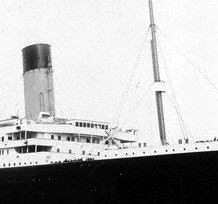
Fleet boarded the Titanic in Southampton on 10 April 1912. The ship made two stops, first at Cherbourg, France, and then at Queenstown (Cobh), Ireland. The six lookouts worked two-hour shifts because of the extreme cold in the crow's nest. The voyage was uneventful until the night of 14 April 1912. At 10:00 pm that night, Fleet and his fellow lookout Reginald Lee relieved George Symons and Archie Jewell at the nest. They were given the earlier order from Second Officer Charles Lightoller to keep watch for small ice. The night was calm and moonless, which made icebergs difficult to see because there were no waves breaking at their base and no reflection. Although Fleet and the other lookouts repeatedly asked for binoculars, none were provided. This has sometimes been linked to the last‑minute change in the ship's officer line‑up, when David Blair was removed from the maiden‑voyage crew (following the appointment of Henry Tingle Wilde as chief officer) without indicating where the binoculars were kept. It has also been suggested that Blair accidentally took the key to the cabinet containing them. Neither of the subsequent inquiries clarified why the lookouts were not supplied with binoculars, although evidence indicates that lookouts on White Star Line steamers did not routinely use them. Some experts have argued that, even with binoculars, neither Fleet nor Lee would have been able to spot the iceberg any earlier given the conditions that night.
At 11:39 pm, Fleet saw the iceberg and rang the crow's nest bell three times to warn the bridge. He then used the nest's telephone to report it. The call was answered by Sixth Officer James Paul Moody, who asked him, "What did you see?" Fleet gave the warning, "Iceberg! Right Ahead!" Moody passed the message to First Officer William McMaster Murdoch, who was in charge of the bridge. After the collision, Fleet and Lee remained on duty for a further 20 minutes.
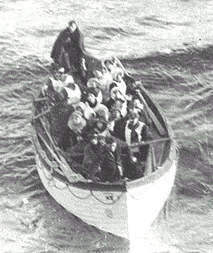
At 12 am, Fleet and Lee were relieved by Alfred Frank Evans and George Hogg. Fleet went down to the boat deck and helped prepare Lifeboat No. 6. Second officer Lightoller placed quartermaster Robert Hichens in charge of the boat and ordered Fleet to board as well. As the boat was lowered, Hichens and American socialite Margaret Brown realised that only two sailors, including Fleet, were available to man it, and called for another seaman. As none was nearby, Canadian Colonel Arthur Peuchen volunteered, saying he had sailing experience. Lightoller instructed him to reach the boat by climbing down a rope.
Once clear of the sinking ship, the lifeboat attempted to row towards the lights of a vessel in the distance, believed to be the SS Californian. While Hichens remained at the tiller, Fleet and Peuchen rowed. Arguments broke out in the boat as Hichens insulted and mistreated the rowers, including Brown and Helen Churchill Candee. Later in the night, there was disagreement about whether to return for survivors, with Hichens warning that the boat would be swamped. Lifeboat No. 6 reached RMS Carpathia by 6:00 am on Monday, 15 April 1912.
After the disaster, Fleet gave evidence to two inquiries: first the U.S. Inquiry, then the British Wreck Commissioner's inquiry. In the United States, he was questioned by Senator William Alden Smith, to whom he repeatedly stated that, had they been supplied with binoculars, the disaster would not have occurred. At the British inquiry, he underwent a lengthy examination but declined to answer many questions. Lord Mersey, the Chairman, ended the session by thanking him for his willingness to respond despite his evident reluctance. Fleet replied sarcastically, "Thanks."
World War I, World War II, and later life
Fleet served on the Titanic's sister ship RMS Olympic before leaving the White Star Line in August 1912, having noticed that the company treated those involved in the Titanic disaster differently. For the next 24 years he sailed for various shipping companies, including the Union-Castle Line. He served on merchant ships throughout World War I. Later, during the 1920s and early 1930s, he again worked as a lookout on the Olympic. When he left the sea in 1936, he was employed by Harland & Wolff at the company's shipyards in Southampton. While working there, he lived with his wife's brother. He served again during World War II.
Closer to retirement, he became a newspaper salesman and experienced financial difficulties.
Death
On 28 December 1964, Fleet's wife died, and her brother evicted him from the house. Fleet subsequently fell into a downward spiral of depression. He returned to his brother‑in‑law's home and died by hanging in the garden on 10 January 1965. He was 77. Fleet was buried in a pauper's grave at Hollybrook Cemetery in Southampton. The grave remained unmarked until 1993, when a headstone bearing an engraving of the Titanic was erected using donations raised by the Titanic Historical Society.
Portrayals
- Bernard Fox (1958) A Night to Remember (British film)
- Alec Sabin (1979) S.O.S. Titanic
- Alec Sabin (1996) Danielle Steel's No Greater Love (Uses footage from S.O.S. Titanic and A Night to Remember.)
- Byron Lucas (1996) Titanic
- Scott G. Anderson (1997) Titanic
- Jim Hope (2002) – Thumbtanic (short film)
- Aaron C. Fitzgerald (2003) Ghosts of the Abyss (Documentary)
- Scott G. Anderson (2005) (Last Mysteries of the Titanic) (Documentary)
- Ciaran Dow Jones (2008) – The Unsinkable Titanic (Documentary)
- Kaspars Karklins (2011) – Curiosity: What Sank Titanic? (TV episode)
- Jay Roberts (2012) – Titanic: Case Closed
- John Kearns (2016) – Drunk History (British TV series): Season 2: Episode 2: Scott of the Antarctic/Sinking of the Titanic
- Max Bessley Sr. (old) and Tom Brittney (young) (2023) – Fred (short film)
- Jason Kientz (2024) – Unsinkable (Film)
- Matthew Cassidy (2025) – Titanic Sinks Tonight
External links
- at Find a Grave