Fructose 6-phosphate
In-game article clicks load inline without leaving the challenge.
Fructose 6-phosphate (sometimes called the Neuberg ester) is a derivative of fructose, which has been phosphorylated at the 6-hydroxy group. It is one of several possible fructosephosphates. The β-D-form of this compound is very common in cells. The great majority of glucose is converted to fructose 6-phosphate upon entering a cell. Fructose is predominantly converted to fructose 1-phosphate by fructokinase following cellular import.
History
The name Neuberg ester comes from the German biochemist Carl Neuberg. In 1918, he found that the compound (later identified as fructose 6-phosphate) was produced by mild acid hydrolysis of fructose 2,6-bisphosphate.
In glycolysis
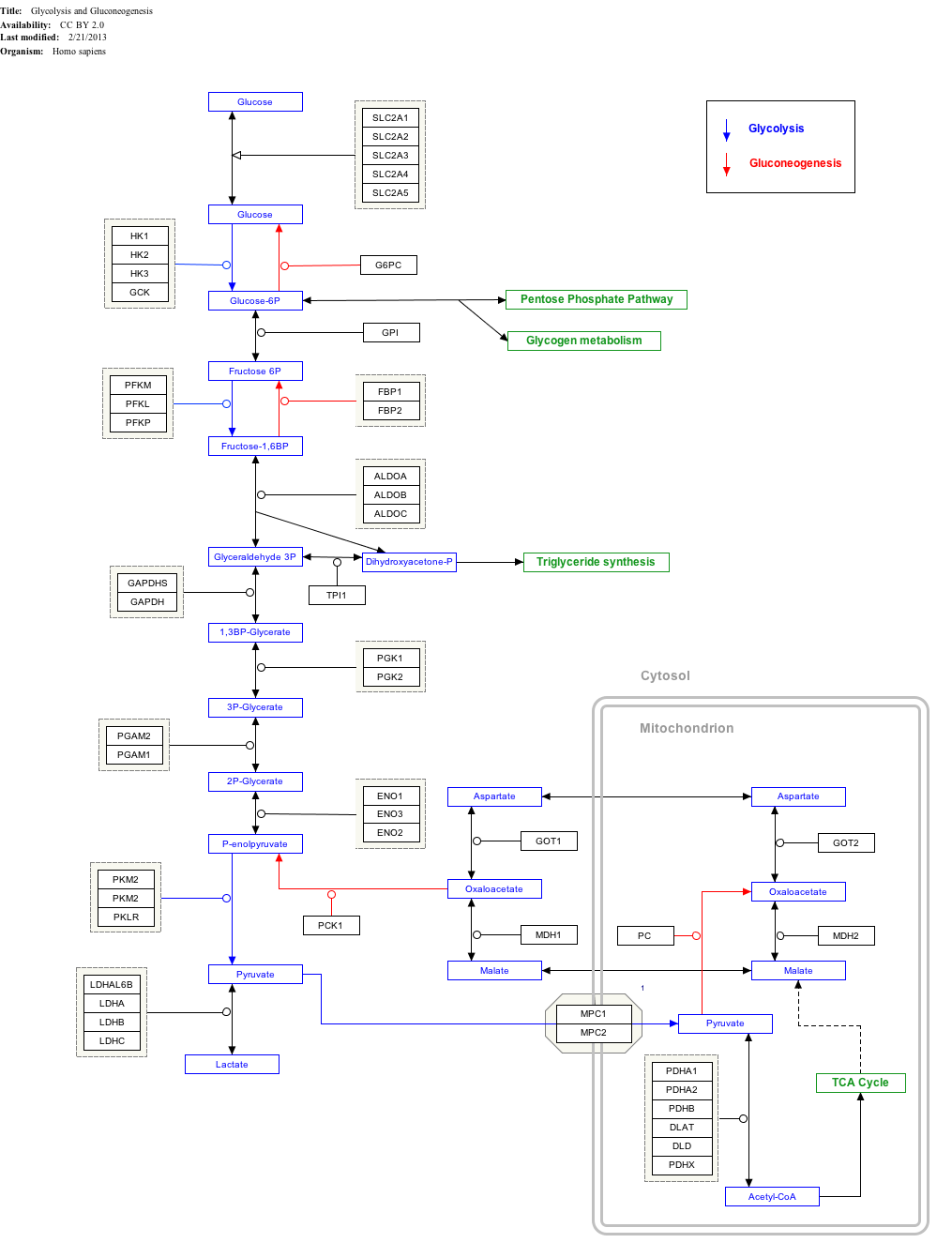
Fructose 6-phosphate lies within the glycolysis metabolic pathway and is produced by isomerisation of glucose 6-phosphate. It is in turn further phosphorylated to fructose-1,6-bisphosphate.
| α-D-glucose 6-phosphate | Phosphoglucose isomerase | β-D-fructose 6-phosphate | Phosphofructokinase-1 | β-D-fructose 1,6-bisphosphate |
| ATP | ADP | |||
| Pi | H2O | |||
| Phosphoglucose isomerase | Fructose bisphosphatase |
Compound at KEGG Pathway Database. Enzyme at KEGG Pathway Database. Compound at KEGG Pathway Database. Enzyme at KEGG Pathway Database. Enzyme at KEGG Pathway Database. Reaction at KEGG Pathway Database. Compound at KEGG Pathway Database.
Click on genes, proteins and metabolites below to link to respective articles.