Prior to its dissolution in 2020, the 377.84-square-kilometre (145.88 sq mi) municipality was the 247th largest by area out of the 422 municipalities in Norway. Fusa Municipality was the 235th most populous municipality in Norway with a population of about 3,861. The municipality's population density was 10.2 inhabitants per square kilometre (26/sq mi) and its population had increased by 1.8% over the previous 10-year period.
The Frank Mohn company's Fusa marine division was headquartered in the municipality, with almost 500 employees.
General information
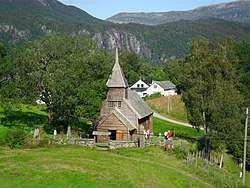
View of the FusafjordenHistoric church in Holdhus
The parish of Fuse (later spelled Fusa) was established as a municipality in 1856 when the large Os Municipality was divided in two. Initially, the new Fuse Municipality had 3,173 residents.
On 1 January 1903 Fusa Municipality was divided into three municipalities as follows:
the northeastern area (population: 647) became the new Haalandsdalen Municipality (later spelled Hålandsdal)
the northwestern area (population: 1,072) became a much smaller Fusa Municipality
During the 1960s, there were many municipal mergers across Norway due to the work of the Schei Committee. On 1 January 1964, Fusa Municipality was enlarged by merging the following areas:
most of Fusa Municipality (population: 1,466), except for the Bogstrand area on the west side of the Fusafjorden which was transferred to Os Municipality
On 1 January 2020, Fusa Municipality and Os Municipality were merged to form the new Bjørnafjorden Municipality. Historically, this municipality was part of the old Hordaland county. Also on 1 January 2020, the new Bjørnafjorden Municipality became a part of the newly-formed Vestland county (after Hordaland and Sogn og Fjordane counties were merged).
Name
The municipality (originally the parish) is named after the old Fusa farm (Old Norse: Fúsar) since the first Fusa Church was built there. The meaning of the name is uncertain. The name could be the plural form of the word fúss which means "eager" or "longing". Another possibility is that it comes from the verb fusa or its alternate spelling fuse which both mean "to rush" (as in rushing water). Historically, the name of the municipality was spelled Fuse. On 3 November 1917, a royal resolution changed the spelling of the name of the municipality to Fusa.
Coat of arms
The coat of arms was granted on 27 September 1991 and it was in use until 1 January 2020 when the municipality was dissolved. The official blazon is "Argent, three gurgesazurein pall" (Norwegian: På kvit grunn tre blå spiralar stilte i trepass). This means the arms have a field (background) has a tincture of argent which means it is commonly colored white, but if it is made out of metal, then silver is used. The charge is a set of three spirals, two over one. The design was chosen to symbolise the strong currents in the Fusafjorden and Bjørnafjorden. The spirals also symbolise the many giant's kettles (Norwegian: jettegryte) in the municipality, which were created by the water in the rocks. The arms were designed by Arvid Sveen. The municipal flag has the same design as the coat of arms.
Note: The municipal borders were changed in 1903 and 1964, causing a significant change in the population. Source: Statistics Norway and Norwegian Historical Data Centre
The municipal council(Kommunestyre) of Fusa Municipality was made up of 21 representatives that are elected to four year terms. The party breakdown of the final municipal council was as follows:
The mayor (Nynorsk: ordførar) of Fusa Municipality was the political leader of the municipality and the chairperson of the municipal council. In 2007, Fusa participated in a national trial where the mayor was directly elected. The sitting mayor, Hans S. Vindenes, won the election with 51.8% of the votes. The following people have held this position: