German Space Operations Center
In-game article clicks load inline without leaving the challenge.
48°05′15″N 11°16′53″E/48.087453°N 11.281474°E/ 48.087453; 11.281474
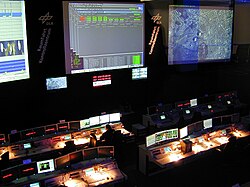
The German Space Operations Center (GSOC; German: Deutsches Raumfahrt-Kontrollzentrum) is the mission control center of German Aerospace Center (DLR) in Oberpfaffenhofen near Munich, Germany.
Tasks
The GSOC performs the following tasks in national and international spaceflight:
- Operation of scientific satellites
- Operation of commercial satellites
- Operation of human spaceflight
- Expansion and operation of the communication infrastructure
- Research and development of new technologies in the field of space operations
History
After the Federal Republic of Germany decided in the 1960s to launch a national space program and to participate in international space projects, the idea of having its own space control center became concrete. In 1967, then Federal Minister of Finance Franz Josef Strauss laid the foundation stone for the first building complex, which was opened a little later.
Until 1985, the Oberpfaffenhofen site of the then German Aerospace Research and Testing Institute (DFVLR) increasingly concentrated on spaceflight. The human spaceflight received special attention. The GSOC then accompanied two crewed missions: During STS-61-A in 1985, GSOC took over the control of the Spacelab, while flight control continued from NASA's Lyndon B. Johnson Space Center was acquired. For the first time, the Payload Operation Control Center (POCC) of a US space mission was directed outside of NASA. For the first time, a human spaceflight was partially monitored from outside the USA or the Soviet Union. During this mission, then Bavarian Prime Minister Franz Josef Strauss announced on 5 November 1985 an extensive investment program with which the role of Oberpfaffenhofen in European spaceflight should be increased.
The failure of Ariane 3 in 1985 and the Challenger disaster in 1986 slowed the development of the Oberpfaffenhofen and the GSOC. The investment program gave the GSOC a new building, Building 140. Construction began in April 1989.
In 1993, GSOC accompanied the entire operation with STS-55 and had full payload control via the Spacelab. This was the first time that there was unfiltered access to all data.
Missions operated by GSOC
Crewed missions
| Mission | Year |
|---|---|
| STS-9 | 1983 |
| STS-61-A (Deutschland-1) | 1985 |
| Soyuz TM-14 | 1992 |
| STS-55 (Deutschland-2) | 1993 |
| STS-59 | 1994 |
| Soyuz TM-22 | 1995 |
| Soyuz TM-25 | 1997 |
| STS-99 | 2000 |
| STS-122 | 2008 |
| ISS-Columbus | 2008 |
| ISS ATV-1 | 2008 |
| ISS-ATV 2 | 2011 |
| ISS-ATV 3 | 2012 |
| ISS-ATV 4 | 2013 |
| ISS-ATV 5 | 2014 |
| Blue Dot “Alexander Gerst” | 2014 |
| Horizons “Alexander Gerst” | 2018 |
| Alpha „Thomas Pesquet“ | 2021 |
Earth Observation and Science
| Mission | Year |
|---|---|
| Azur | 1969 |
| AEROS-A | 1972 |
| AEROS-B | 1974 |
| HELIOS-1 | 1974 |
| HELIOS-2 | 1976 |
| AMPTE | 1984 |
| Galileo | 1989 |
| ROSAT | 1990 |
| EXPRESS | 1995 |
| MARS 96 | 1996 |
| Equator-S | 1997 |
| ABRIXAS | 1999 |
| CHAMP | 2000 |
| BIRD | 2001 |
| GRACE 1 + 2 | 2002 |
| Rosetta / Philae | 2004 |
| SAR-Lupe 1 | 2006 |
| SAR-Lupe 2 | 2007 |
| SAR-Lupe 3 | 2007 |
| SAR-Lupe 4 | 2008 |
| SAR-Lupe 5 | 2008 |
| TerraSAR-X | 2007 |
| PRISMA | 2010 |
| TanDEM-X | 2010 |
| TET-1 | 2012 |
| MASCOT | 2014 |
| BIROS (FireBird) | 2016 |
| PAZ | 2018 |
| GRACE Follow-on (1+2) | 2018 |
| HP³ on Insight | 2018 |
| Eu_CROPIS | 2018 |
| EnMAP | 2022 |
Communication and Navigation
| Mission | Year |
|---|---|
| Symphonie A | 1974 |
| Symphonie B | 1975 |
| TV-SAT 1 | 1987 |
| TV-SAT 2 | 1989 |
| DFS Kopernikus 1 | 1989 |
| DFS Kopernikus 2 | 1990 |
| DFS Kopernikus 3 | 1992 |
| Eutelsat II-F1 | 1990 |
| Eutelsat II-F2 | 1991 |
| Eutelsat II-F3 | 1991 |
| Eutelsat II-F4 | 1992 |
| Eutelsat II-F5 | 1994 |
| Eutelsat II-F6 / HB1 | 1995 |
| Eutelsat W2 | 1998 |
| Eutelsat W3 | 1999 |
| Eutelsat W4 | 2000 |
| Eutelsat W1R | 2001 |
| Eutelsat HB6 | 2002 |
| Galileo GIOVE-B | 2008 |
| COMSATBw 1 | 2009 |
| COMSATBw 2 | 2010 |
| Alphasat TDP1 | 2013 |
| EDRS-A | 2016 |
| Small GEO HAG-1 | 2017 |
| EDRS-C | 2019 |