HMG-CoA
In-game article clicks load inline without leaving the challenge.
β-Hydroxy β-methylglutaryl-CoA (HMG-CoA), also known as 3-hydroxy-3-methylglutaryl coenzyme A, is an intermediate in the mevalonate and ketogenesis pathways. It is formed from acetyl CoA and acetoacetyl CoA by HMG-CoA synthase. The research of Minor J. Coon and Bimal Kumar Bachhawat in the 1950s at University of Illinois led to its discovery.
HMG-CoA is a metabolic intermediate in the metabolism of the branched-chain amino acids, which include leucine, isoleucine, and valine. Its immediate precursors are β-methylglutaconyl-CoA (MG-CoA) and β-hydroxy β-methylbutyryl-CoA (HMB-CoA).
HMG-CoA reductase catalyzes the conversion of HMG-CoA to mevalonic acid, a necessary step in the biosynthesis of cholesterol.
Biosynthesis
| Leucine metabolism in humans L-Leucine Branched-chain amino acid aminotransferase α-Ketoglutarate Glutamate Glutamate Alanine Pyruvate Muscle: α-Ketoisocaproate (α-KIC) Liver: α-Ketoisocaproate (α-KIC) Branched-chain α-ketoacid dehydrogenase (mitochondria) KIC-dioxygenase (cytosol) Isovaleryl-CoA β-Hydroxy β-methylbutyrate (HMB) Excreted in urine (10–40%) HMB-CoA β-Hydroxy β-methylglutaryl-CoA (HMG-CoA) β-Methylcrotonyl-CoA (MC-CoA) β-Methylglutaconyl-CoA (MG-CoA) CO2 CO2 O2 CO2 H2O CO2 H2O (liver) HMG-CoA lyase Enoyl-CoA hydratase Isovaleryl-CoA dehydrogenase MC-CoA carboxylase MG-CoA hydratase HMG-CoA reductase HMG-CoA synthase β-Hydroxybutyrate dehydrogenase Mevalonate pathway Thiolase Unknown enzyme β-Hydroxybutyrate Acetoacetyl-CoA Acetyl-CoA Acetoacetate Mevalonate Cholesterol Human metabolic pathway for HMB and isovaleryl-CoA relative to L-leucine. Of the two major pathways, L-leucine is mostly metabolized into isovaleryl-CoA, while only about 5% is metabolized into HMB. |
Mevalonate pathway
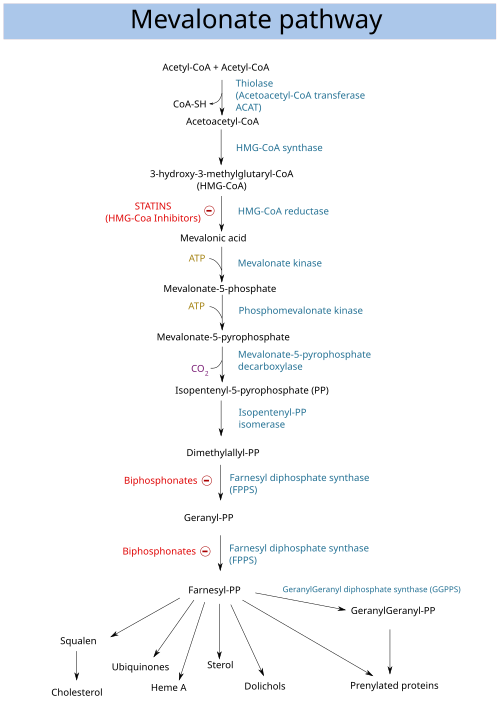
Mevalonate synthesis begins with the beta-ketothiolase-catalyzed Claisen condensation of two molecules of acetyl-CoA to produce acetoacetyl CoA. The following reaction involves the joining of acetyl-CoA and acetoacetyl-CoA to form HMG-CoA, a process catalyzed by HMG-CoA synthase.
In the final step of mevalonate biosynthesis, HMG-CoA reductase, an NADPH-dependent oxidoreductase, catalyzes the conversion of HMG-CoA into mevalonate, which is the primary regulatory point in this pathway. Mevalonate serves as the precursor to isoprenoid groups that are incorporated into a wide variety of end-products, including cholesterol in humans.
Ketogenesis pathway
HMG-CoA lyase breaks it into acetyl CoA and acetoacetate.
