Hainanese
In-game article clicks load inline without leaving the challenge.
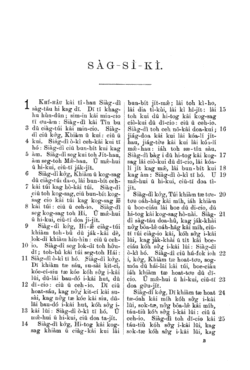
Hainanese is a variety of Min Chinese spoken in the island of Hainan and regional overseas Chinese communities.
In the classification by Yuan Jiahua, it was added to the Southern Min group by him despite being mutually unintelligible with Southern Min varieties such as Hokkien and Teochew. In the classification of Li Rong, used by the Language Atlas of China, it was treated as a separate Min subgroup. Hou Jingyi combined it with Leizhou Min, spoken on the Leizhou Peninsula, in a Qiong–Lei group. "Hainanese" is also used for the language of the Li people living in Hainan, but generally refers to Min varieties spoken in Hainan.
Phonology
The phonologies of the different varieties of Hainanese are highly divergent, with the Wenchang dialect being the prestige dialect, and often used as a reference.
Consonants
Below is a table for the consonants of Hainanese across the dialects of Wenchang, Haikou and the dialect of Banqiao Town, in Dongfang. For more information on a specific variety, please consult the relevant article.
| Labial | Dental | Alveolo- palatal | Velar | Glottal | |||
|---|---|---|---|---|---|---|---|
| Plosive | voiceless | /p/ 爸 pa | /t/ 洗 toi | /k/ 公 kong | /ʔ/ 啊 a | ||
| aspirated | /pʰ/ 婆 pho | /tʰ/ | /kʰ/ 去 khu | ||||
| voiced | /b/ | /d/ | /g/ 我 gua | ||||
| implosive | /ɓ/ 北 ɓak | /ɗ/ 茶 ɗei | (/ɠ/) | ||||
| Affricate | voiceless | /ts/ | /tɕ/ 食 tsia | ||||
| aspirated | /tsʰ/ | ||||||
| voiced | /dz/ | /dʑ/ 日 jit | |||||
| Fricative | voiceless | /ɸ/ 皮 fi | /θ/ | /s/ 事 sei | /ɕ/ | /x/ | /h/ 海 hai |
| voiced | /v/ 文 vun | /z/ 欲 zok | /ɦ/ | ||||
| Nasal | /m/ 目 mak | /n/ 念 niam | /ŋ/ 乐 ngak | ||||
| Approximant | /w/ 发 wat | /l/ 老 lao | /j/ 肉 yok |
Many of the most widely spoken varieties of Hainanese notably have a series of implosive consonants, /ɓ/ and /ɗ/, which were acquired through contact with surrounding languages, probably Hlai. However, more conservative varieties of Hainanese such as Banqiao remain closer to Leizhou Peninsula Min and other varieties, lack them.
The consonant system of Hainanese corresponds well with that of Leizhou Peninsula Min, but it has had some restructuring. In particular:
- Etymological plain stops have undergone implosivization (*p > [ɓ], *t > [ɗ]) in the more innovative varieties such as Wenchang and Haikou.
- Etymological aspirated stops have spirantized (*pʰ > [ɸ], *tʰ > [h], *tsʰ > [ɕ], *kʰ > [h~x]) in more innovative varieties.
- The lenition of an historic *b into [v] in Banqiao and Haikou, though not in Wenchang.
- Former *s has hardened into a stop (*s > [t]), although in the more conservative Banqiao dialect some instances have only undergone fortition to (*s > [θ]), and others have remained [s].
- Former *h has become [ɦ] in Wenchang.
Additionally, [ʑ] is an allophone of /j/.
These changes also make Hainanese fairly close to Sino-Vietnamese vocabulary.
| English meaning | Hainamese | Standard Chinese | Taiwanese Hokkien |
|---|---|---|---|
| eye | mak | jɛn | bak tsiu |
| sticky | niam | niɛn | liam |
| low | ɗɔi | ti | te |
Vowels
Hainanese has seven phonemic vowels.[citation needed]
Tones
| Tone number | Tone name | Tone contour | Example |
|---|---|---|---|
| 1 | yin ping (阴平) | ˨˦ (24) | 诗 |
| 2 | yang ping (阳平) | ˨˩ (21) | 时 |
| 3 | yin shang (阴上) | ˨˩˩ (211) | 死 |
| 4 | yin qu (阴去) | ˧˥ (35) | 四 |
| 5 | yang qu (阳去) | ˧ (33) | 是 |
| 6 | yin ru (阴入) | ˥ (5) | 失 |
| 7 | yang ru (阳入) | ˧ (3) | 实 |
| 8 | chang ru (长入) | ˥ (55) | 视 |
Romanization
Hainanese Pinyin
Hainanese Pinyin (海南话拼音方案) is a phonetic system announced by the Education Administration Department of Guangdong Province in September 1960. It marks tones with numbers.
Initials
| IPA | Hainanese Pinyin | Bǽh-oe-tu | Example |
|---|---|---|---|
| /ɓ/ | b | b | 北 |
| /p/ | b | p | 波 |
| /pʰ/ | p | ph | 坡 |
| /ɸ/ | p | f | 皮 |
| /m/ | m | m | 摩 |
| /b/ | v | b | ? |
| /v/ | v | v | 无 |
| /t/ | d | t | 装 |
| /ɗ/ | dd | d | 刀 |
| /n/ | n | n | 挪 |
| /l/ | l | l | 罗 |
| /k/ | g | k | 哥 |
| /ŋ/ | ng | g | 俄 |
| /x/ | h | kh | 可 |
| /h/ | hh | h | 号 |
| /ɠ/ | gh | g | 我 |
| /ts/ | z | c | 支 |
| /s/ | s | s | 妻 |
| /z/ | y | j | 余 |
Finals
| IPA | Hainanese Pinyin | Bǽh-oe-tu | Example |
|---|---|---|---|
| /a/ | a | a | 亚 |
| /o/ | o | o | 荷 |
| /ɛ/ | e | e | 摩 |
| /i/ | i | i | 医 |
| /u/ | u | u | 呜 |
| ai | ai | ai | 哀 |
| ɔi | oi | oi | 鞋 |
| au | ao | au | 喉 |
| ia | ia | ia | 也 |
| iɔ | io | io | 腰 |
| ua | ua | oa | 换 |
| ue | ue | oe | 话 |
| ui | ui | oi | 威 |
| uai | uai | oai | 坏 |
| ɔu | ou | ou | 黑 |
| iu | iu | iu | 柚 |
| iau | iao | iau | 妖 |
| iam | iam | iam | 厌 |
| im | im | im | 音 |
| am | am | am | 暗 |
| an | an | an | 安 |
| in | in | in | 烟 |
| un | un | un | 温 |
| uan | uan | oan | 弯 |
| aŋ | ang | ag | 红 |
| eŋ | eng | eg | 英 |
| ɔŋ | ong | og | 翁 |
| iaŋ | iang | iag | 央 |
| uaŋ | uang | oag | 汪 |
| iɔŋ | iong | iog | 匈 |
| ip | ib | ib | 邑 |
| iap | iab | iab | 协 |
| at | ad | at | 遏 |
| it | id | it | 乙 |
| ut | ud | ut | 核 |
| uat | uad | oat | 挖 |
| ak | ag | ak | 鹤 |
| ek | eg | ek | 益 |
| ok | og | ok | 喔 |
| iok | iog | iok | 育 |
| uak | uag | oak | 廓 |
| -ʔ | -h | -h | 不 |
Grammar
Hainanese is known for having post-verbal locative prepositional phrases, as opposed to having such phrases in the pre-verbal position, as is common in most other varieties of Chinese. For example:
伊
ʔi24
3SG
大聲
ɗua24tia24
loudly
啼
hi21
cry
佇
ɗu33
in
房裡
ɓaŋ21-lɛ33
room-LOC
(Haikou)
伊 大聲 啼 佇 房裡
ʔi24 ɗua24tia24 hi21 ɗu33 ɓaŋ21-lɛ33
3SG loudly cry in room-LOC
He was crying loudly in the room.
This has been attributed to contact with the Kra–Dai languages of Hainan, such as Hlai and Be.
See also
- Hainanese culture
- Hainanese people
Notes
Further reading
- Chang, Kuang-yu (1986). Comparative Min phonology (PhD thesis). University of California, Berkeley.
- Chen, Hongmai (1996). Hǎikǒu fāngyán cídiǎn 海口方言詞典 [Haikou dialect dictionary]. Great Dictionary of Modern Chinese Dialects. Vol. 16. Nanjing: Jiangsu Education Press. ISBN 978-7-5343-2886-2.
- Huang, Karen. . Annual Student Conference of the College of Languages, Linguistics, and Literature. University of Hawaii.
- Kwok, Bit-chee (2006). "The role of language strata in language evolution: three Hainan Min dialects". Journal of Chinese Linguistics. 34 (2): 201–291. JSTOR .
- Miyake, Marc. 2008. .
- Miyake, Marc. 2008. .
- Norman, Jerry Lee (1969). The Kienyang Dialect of Fukien (PhD thesis). University of California, Berkeley. includes a description of the phonology of the Ding'an dialect.
- Solnit, David B. (1982). . Proceedings of the Eighth Annual Meeting of the Berkeley Linguistics Society. 8: 219–230. doi:.
- Woon, Wee-Lee (1979a). "A synchronic phonology of Hainan dialect: Part I". Journal of Chinese Linguistics. 7 (1): 65–100. JSTOR . describes Wenchang dialect.
- Woon, Wee-Lee (1979b). "A synchronic phonology of Hainan dialect: Part II". Journal of Chinese Linguistics. 7 (2): 268–302. JSTOR .
- Yan, Margaret Mian (2006). Introduction to Chinese Dialectology. LINCOM Europa. ISBN 978-3-89586-629-6.
External links
- 2018-07-01 at the Wayback Machine