House of Commons of Great Britain
In-game article clicks load inline without leaving the challenge.
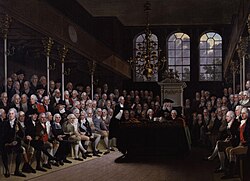
The House of Commons of Great Britain was the lower house of the Parliament of Great Britain between 1707 and 1801. In 1707, as a result of the Acts of Union of that year, it replaced the House of Commons of England and the third estate of the Parliament of Scotland, as one of the most significant changes brought about by the Union of the kingdoms of England and Scotland into the Kingdom of Great Britain.
In the course of the 18th century, the office of prime minister developed. The notion that a government remains in power only as long as it retains the support of Parliament also evolved, leading to the first motion of no confidence, when Lord North's government failed to end the American Revolution. The modern notion that only the support of the House of Commons is necessary for a government to survive, however, was of later development. Similarly, the custom that the prime minister is always a member of the lower house, rather than the upper one, did not evolve until the twentieth century.
The business of the house was controlled by an elected speaker. The speaker's official role was to moderate debate, make rulings on procedure, announce the results of votes, and the like. The speaker decided who may speak and had the powers to discipline members who break the procedures of the house. The speaker often also represented the body in person, as the voice of the body in ceremonial and some other situations. The title was first recorded in 1377 to describe the role of Thomas de Hungerford in the Parliament of England. By convention, speakers are normally addressed in Parliament as Mister Speaker, if a man, or Madam Speaker, if a woman.
In 1801, the House was enlarged to become the House of Commons of the United Kingdom, as a result of the Act of Union of 1800 which combined Great Britain and the Kingdom of Ireland into the United Kingdom of Great Britain and Ireland.
Creation
The members of the last House of Commons of England had been elected between 7 May and 6 June 1705, and from 1707 they all continued to sit as members of the new House of Commons. The last general election in Scotland had been held in the autumn of 1702, and from 1707 only forty-five of the members of the Parliament of Scotland joined the new house. In Scotland there was also no new election from the burghs, and the places available were filled by co-option from the last Parliament.
Parliamentary constituencies
The constituencies which elected members in England and Wales remained unchanged throughout the existence of the Parliament of Great Britain.
| Country | Constituencies | Members | ||||||
|---|---|---|---|---|---|---|---|---|
| Borough /Burgh | County | University | Total | Borough /Burgh | County | University | Total | |
| England | 203 | 40 | 2 | 245 | 405 | 80 | 4 | 489 |
| Wales | 12 | 12 | 0 | 24 | 12 | 12 | 0 | 24 |
| Scotland | 15 | 30 | 0 | 45 | 15 | 30 | 0 | 45 |
| Total | 230 | 82 | 2 | 314 | 432 | 122 | 4 | 558 |
Sources:
- Chris Cook & John Stevenson, British Historical Facts 1760-1830 (The Macmillan Press, 1980)
- Colin Rallings & Michael Thrasher, British Electoral Facts 1832-1999 (Ashgate Publishing Ltd, 2000)
House of Commons of Great Britian
| Whigs Position Uncertain Scottish Ministerial Support Patriot Whigs Tories | Total seats | ||||
| Whigs | Position Uncertain | Scottish Ministerial Support | Patriot Whigs | Tories | |
| 1708 | 268 20 45 225 | 558 | |||
| 268 | 20 | 45 | 225 | ||
| 1710 | 196 16 346 | 558 | |||
| 196 | 16 | 346 | |||
| 1713 | 161 28 369 | 558 | |||
| 161 | 28 | 369 | |||
| 1715 | 341 217 | 558 | |||
| 341 | 217 | ||||
| 1722 | 389 169 | 558 | |||
| 389 | 169 | ||||
| 1734 | 330 83 145 | 558 | |||
| 330 | 83 | 145 | |||
| 1741 | 186 131 136 | 558 | |||
| 186 | 131 | 136 | |||
| 1747 | 338 97 117 | 558 | |||
| 338 | 97 | 117 | |||
| 1754 | 368 42 106 | 558 | |||
| 368 | 42 | 106 | |||
| 1761 | 446 112 | 558 | |||
| 446 | 112 |
1768 - 1806
| Radical Foxites Rockinghamites Grenvillites Bedfordites Position Uncertain Ministerialist/Northite/Pittite Addingtonian Former Tories | Total seats | ||||||||
| Radical | Foxites | Rockinghamites | Grenvillites | Bedfordites | Position Uncertain | Ministerialist/Northite/Pittite | Addingtonian | Former Tories | |
| 1768 | 1 57 31 20 175 221 53 | 558 | |||||||
| 1 | 57 | 31 | 20 | 175 | 221 | 53 | |||
| 1774 | 1 215 343 | 558 | |||||||
| 1 | 215 | 343 | |||||||
| 1780 | 1 254 260 | 558 | |||||||
| 1 | 254 | 260 | |||||||
| 1784 | 1 155 122 280 | 558 | |||||||
| 1 | 155 | 122 | 280 | ||||||
| 1790 | 183 35 340 | 558 | |||||||
| 183 | 35 | 340 | |||||||
| 1796 | 95 39 424 | 558 | |||||||
| 95 | 39 | 424 |
See also
- Elections in Great Britain
- Unreformed House of Commons
- List of parliaments of Great Britain
- First Parliament of Great Britain
- 2nd Parliament of Great Britain
- List of members of the House of Commons at Westminster 1705–1708
- List of speakers of the British House of Commons
- The Structure of Politics at the Accession of George III
Further reading
- Almon, J. (1775). .
External links
51°29′59.6″N 0°07′28.8″W/51.499889°N 0.124667°W/ 51.499889; -0.124667