Oxalate
In-game article clicks load inline without leaving the challenge.
Oxalate (systematic IUPAC name: ethanedioate) is an anion with the chemical formula C2O2−4. This dianion is colorless. It occurs naturally, including in some foods. It forms a variety of salts, for example sodium oxalate (Na2C2O4), and several esters such as dimethyl oxalate ((CH3)2C2O4). It is a conjugate base of oxalic acid. At neutral pH in aqueous solution, oxalic acid converts completely to oxalate.
Relationship to oxalic acid
The dissociation of protons from oxalic acid proceeds in a determined order; as for other polyprotic acids, loss of a single proton results in the monovalent hydrogenoxalate anion HC2O−4. A salt with this anion is sometimes called an acid oxalate, monobasic oxalate, or hydrogen oxalate. The equilibrium constant (Ka) for loss of the first proton is 5.37×10⁻² (pKa = 1.27). The loss of the second proton, which yields the oxalate ion, has an equilibrium constant of 5.25×10⁻⁵ (pKa = 4.28). These values imply, in solutions with neutral pH, no oxalic acid and only trace amounts of hydrogen oxalate exist. The literature is often unclear on the distinction between H2C2O4, HC2O−4, and C2O2−4, and the collection of species is referred to as oxalic acid.[citation needed]
Structure
The oxalate anion exists in a nonplanar conformation where the O–C–C–O dihedrals approach 90° with approximate D2d symmetry. When chelated to cations, oxalate adopts the planar, D2h conformation. However, in the structure of caesium oxalate Cs2C2O4 the O–C–C–O dihedral angle is 81(1)°. Therefore, Cs2C2O4 is more closely approximated by a D2d symmetry structure because the two CO2 planes are staggered. Two structural forms of rubidium oxalate Rb2C2O4 have been identified by single-crystal X-ray diffraction: one contains a planar and the other a staggered oxalate.

The barrier to rotation about this bond is calculated to be roughly 2–6 kcal/mol for the free dianion, C2O2−4. Such results are consistent with the interpretation that the central C−C bond is regarded as a single bond with minimal π interactions between the two CO−2 units. This barrier to rotation about the C−C bond (which formally corresponds to the difference in energy between the planar and staggered forms) may be attributed to electrostatic interactions as unfavorable O−O repulsion is maximized in the planar form.
Occurrence in nature
Oxalate occurs in many plants, where it is synthesized by the incomplete oxidation of saccharides. Calcium oxalate crystals known as raphides are also used by plants as a defense mechanism.
Several plant foods such as the root and/or leaves of spinach, rhubarb, and buckwheat are high in oxalic acid and can contribute to the formation of kidney stones in some individuals. Other oxalate-rich plants include fat hen ("lamb's quarters"), sorrel, and several Oxalis species (also sometimes called sorrels). The root and/or leaves of rhubarb and buckwheat are high in oxalic acid. Other edible plants with significant concentrations of oxalate include, in decreasing order, star fruit (carambola), black pepper, parsley, poppy seed, amaranth, chard, beets, cocoa, chocolate, most nuts, most berries, fishtail palms, New Zealand spinach (Tetragonia tetragonioides), and beans.[citation needed] Leaves of the tea plant (Camellia sinensis) contain among the greatest measured concentrations of oxalic acid relative to other plants. However, the drink derived by infusion in hot water typically contains only low to moderate amounts of oxalic acid due to the small mass of leaves used for brewing.[citation needed] Some fungi of the genus Aspergillus also produce oxalic acid.
| Food item | Serving | Oxalate content (mg) |
|---|---|---|
| Beetroot greens, cooked | 1⁄2 cup | 916 |
| Purslane, leaves, cooked | 1⁄2 cup | 910 |
| Rhubarb, stewed, no sugar | 1⁄2 cup | 860 |
| Spinach, cooked | 1⁄2 cup | 750 |
| Beet, cooked | 1⁄2 cup | 675 |
| Chard, Swiss, leaves cooked | 1⁄2 cup | 660 |
| Rhubarb, canned | 1⁄2 cup | 600 |
| Spinach, frozen | 1⁄2 cup | 600 |
| Beet, pickled | 1⁄2 cup | 500 |
| Poke greens, cooked | 1⁄2 cup | 476 |
| Almond, raw | 1 oz | 296 |
| Endive, raw | 20 long leaves | 273 |
| Cocoa, dry | 1⁄3 cup | 254 |
| Dandelion greens, cooked | 1⁄2 cup | 246 |
| Okra, cooked | 8–9 pods | 146 |
| Sweet potato, cooked | 1⁄2 cup | 141 |
| Kale, cooked | 1⁄2 cup | 125 |
| Peanuts, raw | 1⁄3 cup (1+3⁄4 oz) | 113 |
| Turnip greens, cooked | 1⁄2 cup | 110 |
| Chocolate, unsweetened | 1 oz | 91 |
| Parsnips, diced, cooked | 1⁄2 cup | 81 |
| Collard greens, cooked | 1⁄2 cup | 74 |
| Pecans, halves, raw | 1⁄3 cup (1+1⁄4 oz) | 74 |
| Tea, leaves (4-minute infusion) | 1 level tsp in 7 fl oz water | 72 |
| Cereal germ, toasted | 1⁄4 cup | 67 |
| Gooseberries | 1⁄2 cup | 66 |
| Potato, Idaho white, baked | 1 medium | 64 |
| Carrots, cooked | 1⁄2 cup | 45 |
| Apple, raw with skin | 1 medium | 41 |
| Brussels sprouts, cooked | 6–8 medium | 37 |
| Strawberries, raw | 1⁄2 cup | 35 |
| Celery, raw | 2 stalks | 34 |
| Milk chocolate bar | 1 bar (1.02 oz) | 34 |
| Raspberries, black, raw | 1⁄2 cup | 33 |
| Orange, edible portion | 1 medium | 24 |
| Green beans, cooked | 1⁄2 cup | 23 |
| Chives, raw, chopped | 1 tablespoon | 19 |
| Leeks, raw | 1⁄2 medium | 15 |
| Blackberries, raw | 1⁄2 cup | 13 |
| Concord grapes | 1⁄2 cup | 13 |
| Blueberries, raw | 1⁄2 cup | 11 |
| Redcurrants | 1⁄2 cup | 11 |
| Apricots, raw | 2 medium | 10 |
| Raspberries, red, raw | 1⁄2 cup | 10 |
| Broccoli, cooked | 1 large stalk | 6 |
| Cranberry juice | 1⁄2 cup (4 oz) | 6 |
Physiological effects
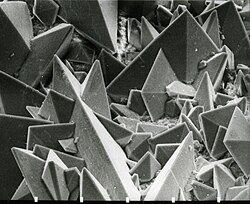
Excess consumption of oxalate-rich foods has been linked to formation of salts such as calcium oxalate, a risk factor for kidney stones.
As a ligand for metal ions
Oxalate also forms coordination compounds where it is sometimes abbreviated as ox. It is commonly encountered as a bidentate ligand. When the oxalate chelates to a single metal center, it always adopts the planar conformation. As a bidentate ligand, it forms a 5-membered MC2O2 ring. An illustrative complex is potassium ferrioxalate, K3[Fe(C2O4)3]. The drug oxaliplatin exhibits improved water solubility relative to older platinum-based drugs, avoiding the dose-limiting side-effect of nephrotoxicity. Oxalic acid and oxalates can be oxidized by permanganate in an autocatalytic reaction. One of the main applications of oxalic acid is rust-removal, which arises because oxalate forms water-soluble derivatives with the ferric ion.
Excess
An excess oxalate level in the blood is termed hyperoxalemia, and high levels of oxalate in the urine is termed hyperoxaluria.
Acquired
Although unusual, consumption of oxalates (for example, the grazing of animals on oxalate-containing plants such as Bassia hyssopifolia, or human consumption of wood sorrel or, specifically in excessive quantities, black tea) may result in kidney disease or even death due to oxalate poisoning. The New England Journal of Medicine reported acute oxalate nephropathy "almost certainly due to excessive consumption of iced tea" in a 56-year-old man, who drank "sixteen 8-ounce glasses of iced tea daily" (roughly one gallon or 3.8 liters). The authors of the paper hypothesized that acute oxalate nephropathy is an underdiagnosed cause of kidney failure and suggested thorough examination of patient dietary history in cases of unexplained kidney failure without proteinuria (an excess of protein in the urine) and with large amounts of calcium oxalate in urine sediment. Oxalobacter formigenes in the gut flora may help alleviate this.
Congenital
Primary hyperoxaluria is a rare, inherited condition, resulting in increased excretion of oxalate, with oxalate stones being common.
Further reading
- Euler. . chm.uri.edu.
- Ibis, Fatma; Dhand, Priya; Suleymanli, Sanan; van der Heijden, Antoine E. D. M.; Kramer, Herman J. M.; Eral, Huseyin Burak (2020). . Crystals. 10 (10): 924. doi:. ISSN .
- Ulmgren, Per; Rådeström, Rune (1999). "Solubility of calcium oxalate in the presence of magnesium ions, and solubility of magnesium oxalate in sodium chloride medium". Nordic Pulp & Paper Research Journal. 14 (4): 330–335. doi:. ISSN . S2CID .
External links
- - Oxalate content of 750+ foods from university and government sources
- - Oxalate content database based on the latest trustworthy studies