Hypostomus
In-game article clicks load inline without leaving the challenge.
Hypostomus is a genus of catfish in the family Loricariidae. They are native to tropical and subtropical South America. H. plecostomus is the popular freshwater aquarium fish formerly known as Plecostomus plecostomus. The taxonomic structure of the Loricariidae is still being expanded by scientists. Hypostomus is a highly species-rich and widely distributed catfish genus.
Taxonomy and phylogeny
This genus is the type member of its tribe Hypostomini and subfamily Hypostominae. The type species of Hypostomus is H. guacari.
With the inclusion of Aphanotorulus, Isorineloricaria and Squaliforma, the genus Hypostomus is by far the largest genus of Loricariidae and the second largest genus of catfish. However, a good way to split up the genus further is unclear. Species level taxonomy of Hypostomus is still poorly known as well as the phylogenetic relationships within and of the genus. It has been shown that the genus does not form a natural group. However, small monophyletic groups are known to exist within the genus Hypostomus, such as the H. cochliodon group. Aphanotorulus and Isorineloricaria are considered separate genera by some authors based on molecular information.
Studies conducted with representatives of some genera of Hypostominae showed that within this group, the diploid number ranges from 2n = 52 to 2n = 80. However, the supposed wide karyotypic diversity that the family Loricariidae or the subfamily Hypostominae would present is almost exclusively restricted to the genus Hypostomus and the species from the other genera had a conserved diploid number.
Distribution and habitat
These species are originate from freshwater habitats of South America and the Caribbean island of Trinidad. They are found throughout most of the range of loricariids except for drainages west of the Atrato River (northwest Colombia). They are essentially ubiquitous throughout their range. Maximum diversity in number of species of Hypostomus occurs in rivers of the Paraná-Paraguay system.
Hypostomus species are found in almost all aquatic habitats, from large rivers to small rivulets. The typical habitat would be relatively fast moving water over a shallow gravel bed. Most species are lowland, sluggish stream- and lake-dwellers usually found associated with submerged wood; however, many species may be found among rocks in piedmont to mountain streams with moderate to swift flow. Members of this genus may be found over a range of substrates such mud, detritus, gravel, and sand. Many species spawn in hollows dug into mud banks or within hollow logs.
Description and ecology
As in all loricariids, these species have a suckermouth. They use their mouth as well as the pectoral, pelvic and caudal fin areas, to interact with the rocky river-bottom. The comb-toothed inferior mouth of Hypostomus is able to grasp green algae on the river bottom. With the help of the suckermouth, which anchor the fishes, in conjunction with the arched design of pectoral and pelvic fin spines, they are also able to remain upright while exploring this substratum. In addition, their large, concave caudal fin is associated with fast locomotion over short distances.
Also like other loricariids, Hypostomus species exhibit plates of armor over their body. The colouration among Hypostomus species varies. They may have a white ground color and black spots, or brown and spotted, or even black with red, gold, or white spots. Abdomen also varies in color from white to black and may be spotted or not. The caudal fin is forked with the lower lobe longer than upper. Most species have stout bodies, but some do have thinner, elongate bodies.
In most species, males develop hypertrophied odontodes on the leading edge of the pectoral fin spine and the end of the spine may become swollen. In some species, the males may also develop hypertrophied odontodes on the body during the breeding season.
Hypostomus species are well known for the ability to breathe air. This is achieved through a slightly modified stomach that is larger and thinner than in non-air breathers. To breathe air, Hypostomus must orient itself vertically.
Species of the H. cochliodon group are fairly large loricariids that reach about 30 centimetres (12 in) SL. Their colouration is typically dark brown with spots generally developed over most surfaces; however, most species of this group have been observed to have a well-developed ability to alter color according to substrate. Except for H. sculpodon, these species tend to have a deep body at the dorsal fin origin; this makes the body appear humped. Along with Panaque, species of the H. cochliodon group are unique among loricariids for xylophagy, or the ability to digest wood, accomplished through specialized spoon-shaped teeth. In H. hemicochliodon and H. sculpodon appear to be intermediate between other species of Hypostomus and the H. cochilodon group by feeding less on wood and lacking specialized teeth; many other Hypostomus will occasionally eat wood, but wood only amounts to a very small fraction of their diet.
Species
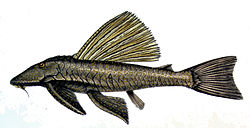
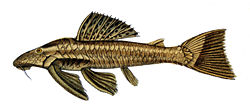


There are currently 157 recognized species in this genus:
Synonyms
- Hypostomus carvalhoi (A. Miranda-Ribeiro, 1937); valid as H. pusarum
- Hypostomus chrysostiktos Birindelli, Zanata & F. C. T. Lima, 2007; valid as Pterygoplichthys chrysostiktos
- Hypostomus cordovae (Günther, 1880); valid as H. paranensis
- Hypostomus duodecimalis Valenciennes in Cuvier & Valenciennes, 1840; valid as Pterygoplichthys etentaculatus
- Hypostomus eptingi (Fowler, 1941); valid as H. johnii
- Hypostomus jaguribensis (Fowler, 1915); valid as H. pusarum
- Hypostomus lexi (R. Ihering (pt), 1911); valid as H. albopunctatus
- Hypostomus nickeriensis Boeseman, 1969; valid as H. corantijni
- Hypostomus niger (Marini, Nichols & La Monte, 1933); valid as H. albopunctatus
- Hypostomus occidentalis Boeseman, 1968; valid as H. gymnorhynchus
- Hypostomus papariae (Fowler, 1941); valid as H. pusarum
- Hypostomus pospisili (L. P. Schultz, 1944); valid as H. hondae
- Hypostomus salgadae (Fowler, 1941); valid as H. pusarum
- Hypostomus scaphyceps (Nichols, 1919); valid as H. albopunctatus
- Hypostomus sipaliwinii Boeseman, 1968; valid as H. corantijni
- Hypostomus tapanahoniensis Boeseman, 1969; valid as H. gymnorhynchus
- Hypostomus winzi (Fowler, 1945); valid as Isorineloricaria tenuicauda