Holy Roman Emperor
In-game article clicks load inline without leaving the challenge.
The Holy Roman Emperor, originally and officially the Emperor of the Romans (Latin: Imperator Romanorum; German: Kaiser der Römer) during the Middle Ages, and also known as the Roman-German Emperor since the early modern period (Latin: Imperator Germanorum; German: Römisch-Deutscher Kaiser), was the ruler and head of state of the Holy Roman Empire. The title was held in conjunction with the title of King of Italy (Rex Italiae) from the 8th to the 16th century, and, almost without interruption, with the title of King of Germany (Rex Teutonicorum, lit.'King of the Teutons') throughout the 12th to 18th centuries.
The Holy Roman Emperor title provided the highest prestige among medieval Catholic monarchs, because the empire was considered by the Catholic Church to be the only successor of the Roman Empire during the Middle Ages and the early modern period. Thus, in theory and diplomacy, the emperors were considered primus inter pares—first among equals—among other Catholic monarchs across Europe.
From an autocracy in Carolingian times (AD 800–924), the title by the 13th century evolved into an elective monarchy, with the emperor chosen by the prince-electors. Various royal houses of Europe, at different times, became de facto hereditary holders of the title, notably the Ottonians (962–1024), the Salians (1027–1125) and the Hohenstaufen (1138–1254). Following the late medieval crisis of government, the Habsburgs kept possession of the title (with only one interruption) from 1452 to 1806. The final emperors were from the House of Habsburg-Lorraine, from 1765 to 1806. The Holy Roman Empire was dissolved by Francis II, after a devastating defeat by Napoleon at the Battle of Austerlitz.
The emperor was widely perceived to rule by divine right, though he often contradicted or rivaled the pope, most notably during the Investiture controversy. The Holy Roman Empire never had an empress regnant, though women such as Theophanu and Maria Theresa exerted strong influence. Throughout its history, the position was viewed as a defender of the Catholic faith. Until Maximilian I in 1508, the Emperor-elect (Imperator electus) was required to be crowned by the pope before assuming the imperial title. Charles V was the last to be crowned by the pope in 1530. There were short periods in history when the electoral college was dominated by Protestants, and the electors usually voted in their own political interest. However, even after the Reformation, the elected emperor was always a Roman Catholic.
Title
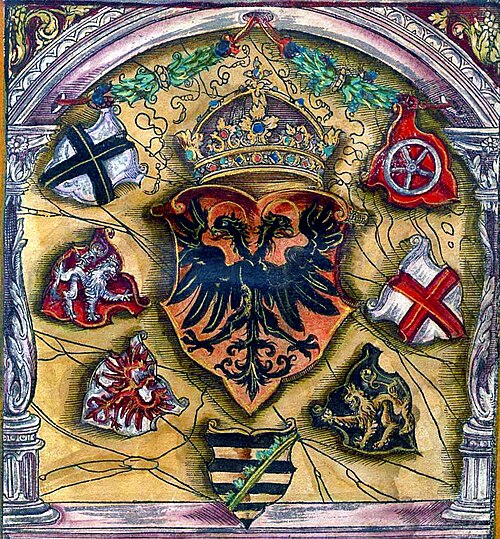

From the time of Constantine I (r. 306–337), the Roman Emperors had, with very few exceptions, taken on a role as promoters and defenders of Christianity. The reign of Constantine established a precedent for the position of the Christian emperor in the Great Church. Emperors considered themselves responsible to God for the spiritual health of their subjects, and after Constantine they had a duty to help the Church define and maintain orthodoxy. The emperor's role was to enforce doctrine, root out heresies, and uphold ecclesiastical unity. Both the title and connection between Emperor and Church continued in the Eastern Roman Empire throughout the medieval period (in exile during 1204–1261). The ecumenical councils of the 5th to 8th centuries were convoked by the Eastern Roman Emperors.
In Western Europe, the title of Emperor in the West lapsed after the death of Julius Nepos in 480, although the rulers of the barbarian kingdoms continued to recognize the authority of the Eastern Emperor at least nominally well into the 6th century. While the reconquest of Justinian I had re-established Byzantine presence in the Italian Peninsula, religious frictions existed with the Papacy who sought dominance over the Church of Constantinople. Toward the end of the 8th century, the Papacy still recognised the ruler at Constantinople as the Roman Emperor, though Byzantine military support in Italy had increasingly waned, leading to the Papacy to look to the Franks for protection. In 800 Pope Leo III owed a great debt to Charlemagne, the King of the Franks and King of Italy, for securing his life and position. By this time, the Eastern Emperor Constantine VI had been deposed in 797 and replaced as monarch by his mother, Irene.
Under the pretext that a woman could not rule the empire, Pope Leo III declared the throne vacant and crowned Charlemagne Emperor of the Romans (Imperator Romanorum), the successor of Constantine VI as Roman emperor, using the concept of translatio imperii. On his coins, the name and title used by Charlemagne is Karolus Imperator Augustus. In documents, he used Imperator Augustus Romanum gubernans Imperium ("Emperor Augustus, governing the Roman Empire") and serenissimus Augustus a Deo coronatus, magnus pacificus Imperator Romanorum gubernans Imperium ("most serene Augustus crowned by God, great peaceful emperor governing the empire of the Romans"). The Eastern Empire eventually relented to recognizing Charlemagne and his successors as emperors, but as "Frankish" and "German emperors", at no point referring to them as Roman, a label they reserved for themselves.
The title of emperor in the West implied recognition by the pope. As the power of the papacy grew during the Middle Ages, popes and emperors came into conflict over church administration. The best-known and most bitter conflict was that known as the investiture controversy, fought during the 11th century between Henry IV and Pope Gregory VII.
After the coronation of Charlemagne, his successors maintained the title until the death of Berengar I of Italy in 924. The comparatively brief interregnum between 924 and the coronation of Otto the Great in 962 is taken as marking the transition from the Frankish Empire to the Holy Roman Empire. Under the Ottonians, much of the former Carolingian kingdom of Eastern Francia fell within the boundaries of the Holy Roman Empire.
Since 911, the various German princes had elected the King of the Germans from among their peers. The King of the Germans would then be crowned as emperor following the precedent set by Charlemagne, during the period of 962–1530. Charles V was the last emperor to be crowned by the pope, and his successor, Ferdinand I, merely adopted the title of "Emperor elect" in 1558. The final Holy Roman emperor-elect, Francis II, abdicated in 1806 during the Napoleonic Wars that saw the Empire's final dissolution.
The term sacrum (i.e., "holy") in connection with the German Roman Empire was first used in 1157 under Frederick I Barbarossa.
The Holy Roman Emperor's standard designation was "August Emperor of the Romans" (Romanorum Imperator Augustus). When Charlemagne was crowned in 800, he was styled as "most serene Augustus, crowned by God, great and pacific emperor, governing the Roman Empire," thus constituting the elements of "Holy" and "Roman" in the imperial title.
The word Roman was a reflection of the principle of translatio imperii (or in this case restauratio imperii) that regarded the Holy Roman emperors as the inheritors of the title of emperor of the Western Roman Empire.
In German-language historiography, the term Römisch-deutscher Kaiser ("Roman-German emperor") is used to distinguish the title from that of Roman emperor on one hand, and that of German emperor (Deutscher Kaiser) on the other. The English term "Holy Roman Emperor" is a modern shorthand for "emperor of the Holy Roman Empire" not corresponding to the historical style or title, i.e., the adjective "holy" is not intended as modifying "emperor"; the English term "Holy Roman Emperor" gained currency in the interbellum period (the 1920s to 1930s); formerly the title had also been rendered as "German-Roman emperor" in English.
Succession
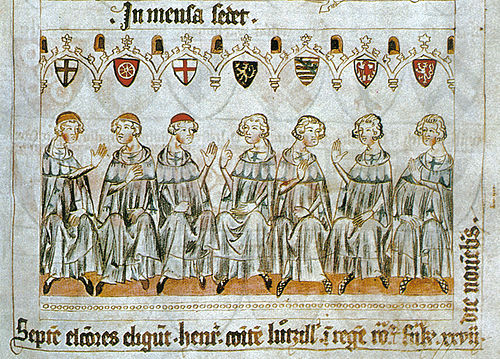
The elective monarchy of the Kingdom of Germany goes back to the early 10th century, the election of Conrad I of Germany in 911 following the death without issue of Louis the Child, the last Carolingian ruler of Germany. Elections meant the kingship of Germany was only partially hereditary, unlike the kingship of England, although sovereignty frequently remained in a dynasty until there were no more male successors. The process of an election meant that the prime candidate had to make concessions, by which the voters were kept on his side, which was known as Wahlkapitulationen (electoral capitulation).
Conrad was elected by the German dukes, and it is not known precisely when the system of seven prince-electors was established. The papal decree Venerabilem by Innocent III (1202), addressed to Berthold V, Duke of Zähringen, establishes the election procedure by (unnamed) princes of the realm, reserving for the pope the right to approve of the candidates. A letter of Pope Urban IV (1263), in the context of the disputed vote of 1256 and the subsequent interregnum, suggests that by "immemorial custom", seven princes had the right to elect the king and future emperor. The seven prince-electors are named in the Golden Bull of 1356: the archbishop of Mainz, the archbishop of Trier, the archbishop of Cologne, the king of Bohemia, the count palatine of the Rhine, the duke of Saxony and the margrave of Brandenburg.
After 1438, the title remained in the House of Habsburg and Habsburg-Lorraine, with the brief exception of Charles VII, who was a Wittelsbach. Maximilian I (emperor 1508–1519) and his successors no longer traveled to Rome to be crowned as emperor by the pope. Maximilian, therefore, named himself elected Roman emperor (Erwählter Römischer Kaiser) in 1508 with papal approval. This title was in use by all his uncrowned successors. Of his successors, only Charles V, the immediate one, received a papal coronation.
The elector palatine's seat was conferred on the duke of Bavaria in 1621, but in 1648, in the wake of the Thirty Years' War, the elector palatine was restored, as the eighth elector. The Electorate of Hanover was added as a ninth elector in 1692, confirmed by the Imperial Diet in 1708. The whole college was reshuffled in the German mediatization of 1803 with a total of ten electors, a mere three years before the dissolution of the Empire.
List of emperors
This list includes all 47 German monarchs crowned from Charlemagne until the dissolution of the Holy Roman Empire (800–1806).
Several rulers were crowned king of the Romans (king of Germany) but not emperor, although they styled themselves thus, among whom were: Conrad I and Henry the Fowler in the 10th century, and Conrad IV, Rudolf I, Adolf and Albert I during the interregnum of the late 13th century.
Traditional historiography assumes a continuity between the Carolingian Empire and the Holy Roman Empire, while a modern convention takes the coronation of Otto I in 962 as the starting point of the Holy Roman Empire (although the term Sacrum Imperium Romanum was not in use before the 13th century).
Roman Emperors
On Christmas Day, 800, Charlemagne, King of the Franks, was crowned Emperor of the Romans (Imperator Romanorum) by Pope Leo III, in opposition to Empress Irene, who was then ruling the Roman Empire from Constantinople. Charlemagne's descendants from the Carolingian Dynasty continued to be crowned Emperor until 899, excepting a brief period when the Imperial crown was awarded to the Widonid Dukes of Spoleto. There is some contention as to whether the Holy Roman Empire dates as far back as Charlemagne, some histories consider the Carolingian Empire to be a distinct polity from the later Holy Roman Empire as established under Otto I in 962.
800–888: Carolingian dynasty
| Portrait | Coat of arms | Name Lifespan | Reign | Relationship with predecessor(s) | Other title(s) | |
|---|---|---|---|---|---|---|
| Charlemagne (Charles I) 748–814 | 25 December 800 | 28 January 814 | None | King of the Franks King of the Lombards | ||
| Louis I, the Pious 778–840 | 11 September 813 | 20 June 840 | Son of Charles I | King of the Franks King of Italy King of Aquitaine | ||
| Lothair I 795–855 | 5 April 823 | 29 September 855 | Son of Louis I | King of Italy King of Middle Francia | ||
| Louis II 825–875 | 29 September 855 | 12 August 875 | Son of Lothair I | King of Italy | ||
| Charles II, the Bald 823–877 | 25 December 875 | 6 October 877 | Son of Louis I, younger half-brother of Lothair I | King of West Francia King of Italy | ||
| Charles III, the Fat 839–888 | 12 February 881 | 13 January 888 | Grandson of Louis I, nephew of Charles the Bald | King of West Francia King of East Francia King of Italy |
891–898: Widonid dynasty
| Portrait | Name Lifespan | Reign | Relationship with predecessor(s) | Other title(s) | |
|---|---|---|---|---|---|
| Guy ?–894 | 21 February 891 | 12 December 894 | 2nd Great-grandson of Charles I | King of Italy Duke of Spoleto | |
| Lambert 880–898 | 30 April 892 | 15 October 898 | Son of Guy | King of Italy Duke of Spoleto |
896–899: Carolingian dynasty
| Portrait | Coat of arms | Name Lifespan | Reign | Relationship with predecessor(s) | Other title(s) | |
|---|---|---|---|---|---|---|
| Arnulf 850–899 | 22 February 896 | 8 December 899 | Nephew of Charles III Great-grandson of Louis I | King of Italy King of East Francia |
901–905: Bosonid dynasty (Carolingian by adoption)
| Portrait | Name Lifespan | Reign | Relationship with predecessor(s) | Other title(s) | |
|---|---|---|---|---|---|
| Louis III, the Blind 880–928 | 22 February 901 | 21 July 905 | Grandson of Louis II Adopted son of Charles III | King of Italy King of Provence |
915–924: Unruoching dynasty
| Portrait | Name Lifespan | Reign | Relationship with predecessor(s) | Other title(s) | |
|---|---|---|---|---|---|
| Berengar 845–924 | December 915 | 7 April 924 | Grandson of Louis I | King of Italy Margrave of Friuli |
Holy Roman Emperors
While earlier Frankish and Italian monarchs had been crowned as Roman emperors, the actual Holy Roman Empire is often considered to have begun with the crowning of Frederick Barbarossa who called the empire "the holy empire", however in general it is already attributed to Otto I, at the time Otto was Duke of Saxony and King of Germany. Because the King of Germany was an elected position, being elected King of Germany was functionally a pre-requisite to being crowned Holy Roman Emperor. By the 13th century, the Prince-electors became formalized as a specific body of seven electors, consisting of three bishops and four secular princes. Up to the mid-14th century, the electors chose freely from among a number of dynasties. A period of dispute during the second half of the 13th century over the kingship of Germany led to there being no emperor crowned for several decades, though this ended in 1312 with the coronation of Henry VII, Holy Roman Emperor. The period of free election ended with the ascension of the Austrian House of Habsburg, as an unbroken line of Habsburgs held the imperial throne until the 18th century. Later a cadet branch known as the House of Habsburg-Lorraine passed it from father to son until the abolition of the Empire in 1806. Notably, from the 16th century, the Habsburgs dispensed with the requirement that emperors be crowned by the pope before exercising their office. Starting with Ferdinand I, all successive emperors forwent the traditional coronation.
962–1024: Ottonian dynasty
| Portrait | Coat of arms | Name Lifespan | Term as King began | Term as Emperor began | Term(s) ended | Relationship with predecessor(s) | Other title(s) |
|---|---|---|---|---|---|---|---|
| Otto I, the Great 912–973 | 7 August 936 | 2 February 962 | 7 May 973 | None | King of Italy King of Germany Duke of Saxony | ||
| Otto II, the Red 955–983 | 26 May 961 | 25 December 967 | 7 December 983 | Son of Otto I | King of Italy King of Germany | ||
| Otto III 980–1002 | 25 December 983 | 21 May 996 | 23 January 1002 | Son of Otto II | |||
| Henry II 973–1024 | 7 June 1002 | 14 February 1014 | 13 July 1024 | Second cousin of Otto III, grandnephew of Otto I, 7th generation descendant of Louis the Pious | King of Italy King of Germany Duke of Bavaria Duke of Carinthia |
1027–1125: Salian dynasty
| Portrait | Name Lifespan | Term as King began | Term as Emperor began | Term(s) ended | Relationship with predecessor(s) | Other title(s) |
|---|---|---|---|---|---|---|
| Conrad II, the Elder 990–1039 | 8 September 1024 | 26 March 1027 | 4 June 1039 | 2nd Great-grandson of Otto I and Eadgyth of England through Liutgarde, Duchess of Lorraine | King of Burgundy King of Italy King of Germany | |
| Henry III 1017–1056 | 14 April 1028 | 25 December 1046 | 5 October 1056 | Son of Conrad II, 7th generation descendant of emperor Charles II through his Carolingian great-grandmother Matilda of France | King of Burgundy King of Italy King of Germany Duke of Bavaria Duke of Swabia Duke of Carinthia Margrave of Meissen | |
| Henry IV 1050–1106 | 17 July 1054 | 1 April 1084 | 7 August 1106 | Son of Henry III | King of Burgundy King of Italy King of Germany Duke of Bavaria | |
| Henry V 1086–1125 | 6 January 1099 | 13 April 1111 | 23 May 1125 | Son of Henry IV | King of Italy King of Germany King of Burgundy |
1133–1137: Supplinburg dynasty
| Portrait | Name Lifespan | Term as King began | Term as Emperor began | Term(s) ended | Relationship with predecessor(s) | Other title(s) |
|---|---|---|---|---|---|---|
| Lothair II 1075–1137 | 30 August 1125 | 4 June 1133 | 4 December 1137 | 6th Great-grandnephew of Otto I [citation needed] | King of Italy King of Germany King of Burgundy Duke of Saxony |
1155–1197: Staufen dynasty
| Portrait | Coat of arms | Name Lifespan | Term as King began | Term as Emperor began | Term(s) ended | Relationship with predecessor(s) | Other title(s) |
|---|---|---|---|---|---|---|---|
| Frederick I Barbarossa 1122–1190 | 4 March 1152 | 18 June 1155 | 10 June 1190 | Great-grandson of Henry IV through Agnes of Waiblingen Descendant of Otto II through Matilda of Germany | King of Germany King of Italy King of Burgundy | ||
| Henry VI 1165–1197 | 15 August 1169 | 14 April 1191 | 28 September 1197 | Son of Frederick I | King of Germany King of Italy King of Burgundy Co-King of Sicily |
1209–1215: Welf dynasty
| Portrait | Coat of arms | Name Lifespan | Term as King began | Term as Emperor began | Term(s) ended | Relationship with predecessor(s) | Other title(s) |
|---|---|---|---|---|---|---|---|
| Otto IV 1175–1218 | 9 June 1198 | 21 October 1209 | 1215 | Great-grandson of Lothair II through Gertrude of Süpplingenburg | King of Germany King of Italy King of Burgundy |
1220–1250: Staufen dynasty
| Portrait | Coat of arms | Name Lifespan | Term as King began | Term as Emperor began | Term(s) ended | Relationship with predecessor(s) | Other title(s) |
|---|---|---|---|---|---|---|---|
| Frederick II, Stupor Mundi 1194–1250 | 5 December 1212 | 22 November 1220 | 13 December 1250 | Son of Henry VI | King of Germany King of Italy King of Sicily King of Jerusalem |
The interregnum of the Holy Roman Empire is taken to have lasted from the deposition of Frederick II by Pope Innocent IV in 1245 (or alternatively from Frederick's death in 1250 or from the death of Conrad IV in 1254) to the election of Rudolf I of Germany (1273). Rudolf was not crowned emperor, nor were his successors Adolf and Albert. The next emperor was Henry VII, crowned on 29 June 1312 by legates of Pope Clement V.
1312–1313: House of Luxembourg
| Portrait | Coat of arms | Name Lifespan | Term as King began | Term as Emperor began | Term(s) ended | Relationship with predecessor(s) | Other title(s) |
|---|---|---|---|---|---|---|---|
| Henry VII 1273–1313 | 27 November 1308 | 29 June 1312 | 24 August 1313 | Descendant of emperor Berengar I, Descendant of Charles II | King of Germany King of Italy Count of Luxemburg |
1328–1347: House of Wittelsbach
| Portrait | Coat of arms | Name Lifespan | Term as King began | Term as Emperor began | Term(s) ended | Relationship with predecessor(s) | Other title(s) |
|---|---|---|---|---|---|---|---|
| Louis IV, the Bavarian 1282–1347 | 20 October 1314 | 17 January 1328 | 11 October 1347 | Descendant of Otto II (through Matilda of Germany), Henry IV (through Agnes of Waiblingen and Lothair II (through Gertrude of Süpplingenburg) | King of Germany King of Italy Duke of Bavaria |
1355–1437: House of Luxembourg
| Portrait | Coat of arms | Name Lifespan | Term as King began | Term as Emperor began | Term(s) ended | Relationship with predecessor(s) | Other title(s) |
|---|---|---|---|---|---|---|---|
| Charles IV 1316–1378 | 11 July 1346 | 5 April 1355 | 29 November 1378 | Grandson of Henry VII Descendant of Frederick I through Philip of Swabia | King of Germany King of Italy King of Bohemia King of Burgundy Count of Luxemburg King of the Lombards | ||
| Sigismund 1368–1437 | 10 September 1410 /21 July 1411 | 31 May 1433 | 9 December 1437 | Son of Charles IV | King of Germany King of Italy King of Bohemia King of Hungary and Croatia |
1452–1740: House of Habsburg
In 1508, Pope Julius II allowed Maximilian I to use the title of Emperor without coronation in Rome, though the title was qualified as Electus Romanorum Imperator ("elected Emperor of the Romans"). Maximilian's successors each adopted the same titulature, usually on becoming the sole ruler of the Holy Roman Empire. Maximilian's predecessor Frederick III was the last to be crowned Emperor by the Pope in Rome, while Maximilian's successor Charles V was the last to be crowned by the pope, though in Bologna, in 1530.
1742–1745: House of Wittelsbach
| Portrait | Coat of arms | Name Lifespan | Term as King began | Term as Emperor began | Term(s) ended | Relationship with predecessor(s) | Other title(s) |
|---|---|---|---|---|---|---|---|
| Charles VII 1697–1745 | 24 January 1742 | 20 January 1745 | Great-great-grandson of Ferdinand II Son-in-law of Joseph I | King of Germany King of Bohemia Elector of Bavaria |
1745–1765: House of Lorraine
| Portrait | Coat of arms | Name Lifespan | Term as King began | Term as Emperor began | Term(s) ended | Relationship with predecessor(s) | Other title(s) |
|---|---|---|---|---|---|---|---|
| Francis I 1708–1765 | 13 September 1745 | 18 August 1765 | Great-grandson of Ferdinand III Son-in-law of Charles VI | King of Germany Archduke of Austria Grand Duke of Tuscany Duke of Lorraine |
1765–1806: House of Habsburg-Lorraine
| Portrait | Coat of arms | Name Lifespan | Term as King began | Term as Emperor began | Term(s) ended | Relationship with predecessor(s) | Other title(s) |
|---|---|---|---|---|---|---|---|
| Joseph II 1741–1790 | 27 March 1764 | 18 August 1765 | 20 February 1790 | Son of Francis I and Empress Maria Theresa of Austria Grandson of Charles VI | King of Germany King of Bohemia King of Hungary and Croatia Archduke of Austria | ||
| Leopold II 1747–1792 | 30 September 1790 | 1 March 1792 | Brother of Joseph II | King of Germany King of Bohemia King of Hungary and Croatia Archduke of Austria Grand Duke of Tuscany | |||
| Francis II 1768–1835 | 5 July 1792 | 6 August 1806 | Son of Leopold II | King of Germany King of Bohemia King of Hungary and Croatia Archduke of Austria Emperor of Austria |
Coronation
The Emperor was crowned in a special ceremony, traditionally performed by the Pope in Rome. Without that coronation, no king, despite exercising all powers, could call himself Emperor. In 1508, Pope Julius II allowed Maximilian I to use the title of Emperor without coronation in Rome, though the title was qualified as Electus Romanorum Imperator ("elected Emperor of the Romans"). Maximilian's successors adopted the same titulature, usually when they became the sole ruler of the Holy Roman Empire. Maximilian's first successor Charles V was the last to be crowned Emperor.
| Emperor | Coronation date | Officiant | Location |
|---|---|---|---|
| Charles I | 25 December 800 | Pope Leo III | Rome, Italy |
| Louis I | 5 October 816 | Pope Stephen IV | Reims, France |
| Lothair I | 5 April 823 | Pope Paschal I | Rome, Italy |
| Louis II | 15 June 844 | Pope Leo IV | Rome, Italy |
| Charles II | 29 December 875 | Pope John VIII | Rome, Italy |
| Charles III | 12 February 881 | Rome, Italy | |
| Guy III of Spoleto | 21 February 891 | Pope Stephen V | Rome, Italy |
| Lambert II of Spoleto | 30 April 892 | Pope Formosus | Ravenna, Italy |
| Arnulf of Carinthia | 22 February 896 | Rome, Italy | |
| Louis III | 15 or 22 February 901 | Pope Benedict IV | Rome, Italy |
| Berengar | December 915 | Pope John X | Rome, Italy |
| Otto I | 2 February 962 | Pope John XII | Rome, Italy |
| Otto II | 25 December 967 | Pope John XIII | Rome, Italy |
| Otto III | 21 May 996 | Pope Gregory V | Monza, Italy |
| Henry II | 14 February 1014 | Pope Benedict VIII | Rome, Italy |
| Conrad II | 26 March 1027 | Pope John XIX | Rome, Italy |
| Henry III | 25 December 1046 | Pope Clement II | Rome, Italy |
| Henry IV | 31 March 1084 | Antipope Clement III | Rome, Italy |
| Henry V | 13 April 1111 | Pope Paschal II | Rome, Italy |
| Lothair III | 4 June 1133 | Pope Innocent II | Rome, Italy |
| Frederick I | 18 June 1155 | Pope Adrian IV | Rome, Italy |
| Henry VI | 14 April 1191 | Pope Celestine III | Rome, Italy |
| Otto IV | 4 October 1209 | Pope Innocent III | Rome, Italy |
| Frederick II | 22 November 1220 | Pope Honorius III | Rome, Italy |
| Henry VII | 29 June 1312 | Ghibellines cardinals | Rome, Italy |
| Louis IV | 17 January 1328 | Senator Sciarra Colonna | Rome, Italy |
| Charles IV | 5 April 1355 | Pope Innocent VI's cardinal | Rome, Italy |
| Sigismund | 31 May 1433 | Pope Eugenius IV | Rome, Italy |
| Frederick III | 19 March 1452 | Pope Nicholas V | Rome, Italy |
| Charles V | 24 February 1530 | Pope Clement VII | Bologna, Italy |
See also
- Concordat of Worms
- Emperor for other uses of the title "Emperor" in Europe
- First Council of the Lateran
- Holy Roman Emperors family tree
- Holy Roman Empress
- King of the Romans
- List of German monarchs
- Holy Roman Empire
- King of Italy
- Kingdom of Italy (Holy Roman Empire)
Notes
External links
- Media related to Holy Roman Emperors at Wikimedia Commons