Kurdistan Region
In-game article clicks load inline without leaving the challenge.
The Kurdistan Region (KRI) is a semi-autonomous federal region of the Republic of Iraq. It comprises four Kurdish-majority governorates of Arab-majority Iraq: Erbil Governorate, Sulaymaniyah Governorate, Duhok Governorate, and Halabja Governorate. It is located in northern Iraq, which shares borders with Iran to the east, Turkey to the north, and Syria to the west.
It does not govern all of Iraqi Kurdistan and lays claim to the disputed territories of northern Iraq; these territories have a predominantly non-Arab population and were subject to the Ba'athist Arabization campaigns throughout the late 20th century. These northern territories remain contested between the Kurdistan Regional Government (in Erbil) and the Government of Iraq (in Baghdad) to the present day. The Kurdistan Region Parliament is based in Erbil, the capital of KRI.
Throughout the 20th century, Iraqi Kurds oscillated between fighting for autonomy and for full independence. Under the Ba'athist regime, the Kurds experienced Arabization and genocidal campaigns at the hands of the government in Baghdad. However, when the United States, the United Kingdom, and France established the Iraqi no-fly zones, which restricted the Iraqi government's power in the country's northern areas following the Gulf War and 1991 Iraqi uprisings, the Kurds were able to establish self-governance and the autonomous region was de facto established in 1992. The Iraqi government only recognized the Kurdistan Region's autonomy as a federal region in 2005, after the American-led 2003 invasion of Iraq overthrew Saddam Hussein and a federal, democratic Iraqi constitution was adopted. The KRI largely escaped the privations that afflicted other parts of Iraq in the last years of Saddam Hussein's rule as well as the chaos that followed his ousting during the Iraq War (2003–2011), and built a parliamentary democracy with a growing economy. In 2014, when the Syria-based Islamic State invaded the north of the country, the Iraqi Armed Forces retreated from most of northern and western Iraq, including the disputed territories, leading to the KRI's Peshmerga to enter and take control of these areas for the duration of the War in Iraq (2013–2017). In September 2017, the KRI held a non-binding independence referendum, which drew mixed international reactions. As a result, in October 2017, the Iraqi Armed Forces moved against the Peshmerga and reasserted control over most of the disputed territories.
History
Early struggle for independence (1923–1975)
Before Iraq became an independent state in 1923, the Iraqi Kurds had already begun their independence struggle from the British Mandatory Iraq with the Mahmud Barzanji revolts, which were subsequently crushed by the United Kingdom after a bombing campaign against Kurdish civilians by the Royal Air Force. Nonetheless, the Kurdish struggle persisted and the Barzani tribe had by the early 1920s gained momentum for the Kurdish nationalist cause and would become pivotal in the Kurdish-Iraqi wars throughout the 20th century. In 1943, the Barzani chief Mustafa Barzani began raiding Iraqi police stations in Kurdistan, which led the Baghdad government to deploy 30,000 troops to the region. The Iraqi Kurdish leadership fled to Iran in 1945. There, Mustafa Barzani founded the Kurdistan Democratic Party, and Iran and the Soviet Union began assisting the Kurdish rebels with arms. Israel began assisting the Kurdish rebels in the early 1960s.
From 1961 to 1970, the Kurds fought the Iraqi government in the First Iraqi–Kurdish War, which resulted in the Iraqi–Kurdish Autonomy Agreement. But simultaneously with its promise of Kurdish autonomy, the Iraqi government began ethnic cleansing Kurdish-populated areas, to reduce the size of the autonomous entity which a census would determine. This mistrust provoked the Second Iraqi–Kurdish War between 1974 and 1975, which resulted in a serious defeat for the Iraqi Kurds (see Algiers Accord) and forced all of the rebels to flee once more to Iran.
Insurgency and first elections (1975–1992)
The Patriotic Union of Kurdistan (PUK) was founded in 1975 by Jalal Talabani while the Kurdistan Democratic Party (KDP) was slowly recovering from their defeat. The PUK was more popular among left-wing Sorani speakers, while the KDP was more popular among right-wing Kurmanji speakers. The PUK leadership adhered to the Qadiri sect while the KDP leadership adhered to the Naqshbandi. The Kurdish insurgency became entangled in the Iran–Iraq War from 1980 onwards. During the first years of the war in the early 1980s, the Iraqi government tried to accommodate the Kurds in order to focus on the war against Iran. In 1983, the Patriotic Union of Kurdistan agreed to cooperate with Baghdad, but the Kurdistan Democratic Party remained opposed. In 1983, Saddam Hussein signed an autonomy agreement with Jalal Talabani of the PUK, though Saddam later reneged on the agreement.
By 1985, the PUK and KDP had joined forces, and Iraqi Kurdistan saw widespread guerrilla warfare up to the end of the war. On 15 March 1988, PUK forces captured the town of Halabja near the Iranian border and inflicted heavy losses among Iraqi soldiers. The Iraqis retaliated the following day by chemically bombing the town, killing about 5,000 civilians. This led the Americans and the Europeans to implement the Iraqi no-fly zones in March 1991 to protect the Kurds, thereby facilitating Kurdish autonomy amid the vacuum and the first Kurdish elections were consequently held in May 1992, wherein the Kurdistan Democratic Party secured 45.3% of the vote and a majority of seats.
Nascent autonomy, war and political turmoil (1992–2009)
The two parties agreed to form the first Kurdish cabinet led by PUK politician Fuad Masum as Prime Minister in July 1992 and the main focus of the new cabinet was to mitigate the effect of the American-led sanctions on Iraq and to prevent internal Kurdish skirmishes. Nonetheless, the cabinet broke down due to plagues of embattlement and technocracy which disenfranchised the Patriotic Union of Kurdistan and a new more partisan cabinet was formed and led by PUK politician Kosrat Rasul Ali in April 1993. The KDP-PUK relations quickly deteriorated and the first clashes in the civil war took place in May 1994 when PUK captured the towns of Shaqlawa and Chamchamal from KDP, which in turn pushed PUK out of Salahaddin (near Erbil). In September 1998, the United States mediated a ceasefire and the two warring parties signed the Washington Agreement deal, where in it was stipulated that the two parties would agree on revenue-sharing, power-sharing and security arrangements.
The anarchy in Kurdistan during the war created an opportunity for the Kurdistan Workers' Party (PKK), which created bases in the northern mountainous areas of the Kurdistan Region, which still operates in the Region in the 2010s with frequent calls for withdrawal.
In advance of the Iraq war in 2003, the two parties united in the negotiations with the Arab opposition to Saddam Hussein and succeeded in harvesting political, economic, and security gains and the Arab opposition agreed to recognize Kurdish autonomy in the case that Saddam Hussein was removed from power. America and Kurdistan also jointly rooted out the Islamist Ansar al-Islam group in Halabja area as Kurdistan hosted thousands of soldiers. The Kurdish autonomy which had existed since 1992 was formally recognized by the new Iraqi government in 2005 in the new Iraqi constitution and the KDP- and PUK-administered areas reunified in 2006, making the Kurdistan Region into one single administration. This reunification prompted Kurdish leaders and the Kurdish President Masoud Barzani to focus on bringing the Kurdish areas outside of the Kurdistan Region into the region and building healthy institutions.
In 2009, Kurdistan saw the birth of a new major party, the Gorran Movement, which was founded because of tensions in PUK and would subsequently weaken the party profoundly. The second most important political PUK figure, Nawshirwan Mustafa, was the founder of Gorran, who took advantage of sentiments among many PUK politicians critical of the cooperation with the KDP. Gorran would subsequently win 25 seats (or 23.7% of the votes) in the 2009 parliamentary elections to the detriment of the Kurdistan List. In the aftermath of the elections, Gorran failed at its attempts to persuade the Kurdistan Islamic Group and Kurdistan Islamic Union to leave the Kurdistan List, provoking both KDP and PUK. Gorran also attempted to create goodwill with the Iraqi Prime Minister Nouri al-Maliki, which only aggravated the situation in Kurdistan, and the KDP and PUK chose to boycott Gorran from politics.
Conflict with the Islamic State (2014–2017)
In the period leading up to the Islamic State invasion of Iraq in June 2014, the Iraqi-Kurdish relations were in a decline that the war against the Islamic State only worsened. When Iraqi forces withdrew from the Syrian-Iraqi border and away from the disputed areas, the Kurdistan Region consequently had a 1,000 km front with the Islamic State, which put the region into an economic stalemate. However, Kurdistan did not compromise on their stance regarding financial independence from Baghdad. Due to the Iraqi withdrawal, Kurdish Peshmerga took control of most disputed areas, including Kirkuk, Khanaqin, Jalawla, Bashiqa, Sinjar and Makhmur. The strategically important Mosul Dam was also captured by Kurdish forces.
Independence referendum and conflict with Iraq (2017–present)
However, control over these territories proved to be temporary. Following the 2017 Kurdistan Region independence referendum, the subsequent 2017 Iraqi–Kurdish conflict, culminating in the decisive Battle of Kirkuk, resulted in the federal Iraqi government regaining most of the disputed areas in October 2017.
As of 2019, the Kurdistan Region and the Federal Government in Baghdad are negotiating over joint control for the disputed areas as their relations have become more cordial in the aftermath of the Islamic State's defeat.
Geography

The Kurdistan region is located in northern Iraq. It borders Iran in the east, Turkey in the north, and Syria in the west. The region encompasses most of Iraqi Kurdistan, which is the southern part of the greater geographical region of Kurdistan. The region lies between latitudes 34° and 38°N, and longitudes 41° and 47°E. Most of the northern and northeastern parts of the region are mountainous, especially those bordering Turkey and Iran. The region has several high mountains and mountain ranges. Other areas of the region are hills and plains, which make up the central and most southern parts of the region.
Most of the precipitation there falls as rain or snow between November and April, annual precipitation ranges from about 375 to 724 mm. From ancient times this has made cultivation of winter crops (and vegetables and fruit in the summer) and the raising of livestock possible.

Around 1,368,388 hectares (33%) of the land is rainfed arable agricultural land and 328,428 hectares (8%) is Irrigated arable agricultural land.
Climate
The climate of the Kurdistan Region is semi-arid continental; hot and dry in summer, and cold and wet in winter. The region is cooler compared to the central and southern parts of Iraq.
Summers are hot and dry, with high average temperatures ranging from 35 °C (95 °F) in the cooler northernmost areas to blistering 40 °C (104 °F) in the southwest, with lows around 21 °C (70 °F) to 24 °C (75 °F). Winter is dramatically cooler than the rest of Iraq, with highs averaging between 9 °C (48 °F) and 11 °C (52 °F) and with lows hovering around 3 °C (37 °F) in some areas and freezing in others, dipping to −2 °C (28 °F) and 0 °C (32 °F) on average.
| Climate data for Erbil | |||||||||||||
|---|---|---|---|---|---|---|---|---|---|---|---|---|---|
| Month | Jan | Feb | Mar | Apr | May | Jun | Jul | Aug | Sep | Oct | Nov | Dec | Year |
| Record high °C (°F) | 20 (68) | 27 (81) | 30 (86) | 34 (93) | 42 (108) | 44 (111) | 48 (118) | 49 (120) | 45 (113) | 39 (102) | 31 (88) | 24 (75) | 49 (120) |
| Mean daily maximum °C (°F) | 12.4 (54.3) | 14.2 (57.6) | 18.1 (64.6) | 24.0 (75.2) | 31.5 (88.7) | 38.1 (100.6) | 42.0 (107.6) | 41.9 (107.4) | 37.9 (100.2) | 30.7 (87.3) | 21.2 (70.2) | 14.4 (57.9) | 27.2 (81.0) |
| Daily mean °C (°F) | 7.4 (45.3) | 8.9 (48.0) | 12.4 (54.3) | 17.5 (63.5) | 24.1 (75.4) | 29.7 (85.5) | 33.4 (92.1) | 33.1 (91.6) | 29.0 (84.2) | 22.6 (72.7) | 15.0 (59.0) | 9.1 (48.4) | 20.2 (68.3) |
| Mean daily minimum °C (°F) | 2.4 (36.3) | 3.6 (38.5) | 6.7 (44.1) | 11.1 (52.0) | 16.7 (62.1) | 21.4 (70.5) | 24.9 (76.8) | 24.4 (75.9) | 20.1 (68.2) | 14.5 (58.1) | 8.9 (48.0) | 3.9 (39.0) | 13.2 (55.8) |
| Record low °C (°F) | −4 (25) | −6 (21) | −1 (30) | 3 (37) | 6 (43) | 10 (50) | 13 (55) | 17 (63) | 11 (52) | 4 (39) | −2 (28) | −2 (28) | −6 (21) |
| Average rainfall mm (inches) | 111 (4.4) | 97 (3.8) | 89 (3.5) | 69 (2.7) | 26 (1.0) | 0 (0) | 0 (0) | 0 (0) | 0 (0) | 12 (0.5) | 56 (2.2) | 80 (3.1) | 540 (21.2) |
| Average rainy days | 9 | 9 | 10 | 9 | 4 | 1 | 0 | 0 | 1 | 3 | 6 | 10 | 62 |
| Average snowy days | 1 | 0 | 0 | 0 | 0 | 0 | 0 | 0 | 0 | 0 | 0 | 0 | 1 |
| Average relative humidity (%) | 74.5 | 70 | 65 | 58.5 | 41.5 | 28.5 | 25 | 27.5 | 30.5 | 43.5 | 60.5 | 75.5 | 50.0 |
| Source 1: Climate-Data.org, My Forecast for records, humidity, snow and precipitation days | |||||||||||||
| Source 2: What's the Weather Like.org, Erbilia |
Biodiversity
Vegetation in the region includes Abies cilicica, Quercus calliprinos, Quercus brantii, Quercus infectoria, Quercus ithaburensis, Quercus macranthera, Cupressus sempervirens, Platanus orientalis, Pinus brutia, Juniperus foetidissima, Juniperus excelsa, Juniperus oxycedrus, Salix alba, Olea europaea, Ficus carica, Populus euphratica, Populus nigra, Crataegus monogyna, Crataegus azarolus, cherry plum, rose hips, pistachio trees, pear and Sorbus graeca. The desert in the south is mostly steppe and would feature xeric plants such as palm trees, tamarix, date palm, fraxinus, poa, white wormwood and chenopodiaceae.
Animals found in the region include the Syrian brown bear, wild boar, gray wolf, golden jackal, Indian crested porcupine, red fox, goitered gazelle, Eurasian otter, striped hyena, Persian fallow deer, onager, mangar and the Euphrates softshell turtle.
Bird species include, the see-see partridge, Menetries's warbler, western jackdaw, Red-billed chough, hooded crow, European nightjar, rufous-tailed scrub robin, masked shrike and the pale rockfinch.
Government and politics
The Kurdistan Region is, under the Constitution of Iraq, a federal region within Iraq and exercises legislative, executive, and judicial authority in a wide range of areas, including governance and law, policing and security, education and health, natural resources, infrastructure, foreign policy, and others, through its own institutions. Because of its extensive powers in these domains, which are often exercised independently and against the will of the federal government of Iraq, the Kurdistan Region is often described as a quasi-state, de-facto state, proto-state or statelet, while some scholars argue that it often functions similarly to an independent state. In fact, the KRI has been argued to meet the traditional criteria for statehood as defined in the Montevideo Convention, namely a permanent population, a defined territory, a government, and the capacity to enter into relations with other states.
Legislature
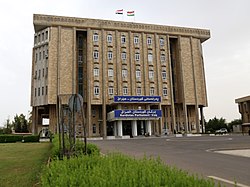
The Kurdistan Region Parliament, formerly known as Kurdistan National Assembly, is responsible for legislation, appointing the president, giving and withdrawing confidence from ministers, and approving the budget. It has 100 members, at least 30% of whom must be women, and they are elected for four-year terms. As per Article 36 of the Kurdistan Parliamentary Election Law, five seats are reserved for Chaldeans and Assyrians, five for Turkmens, and one for Armenians.
The following political parties are represented in the Kurdistan Parliament: Kurdistan Democratic Party (KDP), Patriotic Union of Kurdistan (PUK), New Generation Movement (NGM), Kurdistan Islamic Union, National Stance Movement, Kurdistan Justice Group, People's Front, Kurdistan Social Democratic Party (KSDP), and Gorran Movement.
Executive

The President of the Kurdistan Region is elected by the parliament and serves as head of state. They may serve two four-year terms and must ratify laws before they take effect, although the parliament can override any revisions. The current President is Nechirvan Barzani (KDP), who assumed office on 1 June 2019.
The Prime Minister of the Kurdistan Region is the head of government, specifically of the Kurdistan Regional Government (KRG) and its cabinet of ministers, with some seats reserved for women and minority groups. The current Prime Minister is Masrour Barzani (KDP), who took office in 2019. Cabinet seats were previously shared equally between the KDP and PUK, but the KDP opposes continuing this ratio due to its larger parliamentary representation.
Judiciary
The Kurdistan Judicial Council (KJC) in the KRI was established under Judicial Authority Law No. 14 of 1992 and serves as the region's court of cassation. Under Law No. 23 of 2007, the KJC is intended to be administratively and financially independent from the executive branch. For example, its chief justice is to be selected by the judges, while the judges are to be appointed by the Kurdistan Parliament, in line with principles found in the Iraqi constitution.
However, analysts and organizations such as the Tahrir Institute for Middle East Policy note that the judiciary faces significant challenges. Many provisions of Law No. 23 of 2007 have not been fully implemented, contributing to perceptions of politicization. Over time, the KDP and PUK have expanded their influence within the KJC, with judges reportedly appointed by the Prime Minister rather than the Kurdistan Parliament. The chief justice has also been appointed and sworn in by the Prime Minister, and many judges are considered to be affiliated with one of the two dominant parties.
Constitution
The foundations of Kurdish self-governance in Iraq were established on 8 April 1992 with Election Act No. 1, following an agreement among the Kurdistan Front, a coalition including the KDP and PUK. This enabled the creation of legislative, executive, and judicial institutions operating on a de facto basis.
In 2002, the Kurdistan Parliament drafted a regional constitution consisting of 78 articles, but it was not adopted due to political instability in Iraq and external pressure from neighboring countries, particularly over the status of Kirkuk as the proposed capital of the Kurdistan Region. However, the draft remained a reference point in subsequent constitutional discussions.
Following the 2003 invasion of Iraq and the subsequent political reorganization by the Coalition Provisional Authority, the 2005 Iraqi Constitution was adopted. Influenced by principles such as federalism and separation of powers, it formally recognized the Kurdistan Region as a federal region under Article 117, granting it constitutional legitimacy and affirming its existing institutions. Article 120 further allowed the region to adopt its own subnational constitution. Subsequently, in 2009, a new constitutional committee was convened and a second draft constitution, consisting of 122 articles, was prepared. However, persistent political disagreements among the major parties, particularly over whether the system should be semi-presidential or parliamentary, prevented it from being submitted to a referendum, and the draft was effectively shelved.
As a result, the Kurdistan Region continues to operate without a written subnational constitution. Governance remains largely based on laws passed by the Kurdistan Parliament, without a higher constitutional framework, contributing to ongoing political challenges.
Political dynamics

The Kurdistan Region's politics are dominated by the KDP and the PUK, which split in 1975. The KDP dominates Erbil and Dohuk, while the PUK dominates Sulaymaniyah and Halabja. The parties are shaped by the Barzani and Talabani families, respectively, and continue to share power despite ongoing rivalry. The Gorran Movement briefly emerged as a major opposition force in the 2010s, challenging corruption and PUK dominance, but has since declined.
The Carnegie Middle East Center wrote in August 2015:
The Kurdistan region of Iraq enjoys more stability, economic development, and political pluralism than the rest of the country. And public opinion under the Kurdistan Regional Government demands rule-of-law-based governance. But power is concentrated in the hands of the ruling parties and families, who perpetuate a nondemocratic, sultanistic system. These dynamics could foster instability in Kurdistan and its neighborhood, but could also provide a rare window of opportunity for democratization.
The first elections, held on 19 May 1992 under observation by human rights organizations, were considered among the most democratic in the Middle East at the time, with unprecedented voter participation. Voter turnout has consistently been higher in the KRI than in other parts of Iraq.
Territory

The territory of the Kurdistan Region of Iraq is not precisely defined and has evolved over time, shaped by shifting patterns of de facto and de jure control, constitutional provisions, and political developments. While the region formally comprises the governorates of Erbil, Sulaymaniyah, Duhok, and Halabja, its boundaries are commonly associated with the Green Line as reflected in the Constitution of Iraq, corresponding to areas under Kurdish administration prior to the 2003 invasion of Iraq.
Beyond the Green Line, the Kurdistan Regional Government has at various times exercised control over disputed territories in northern Iraq, particularly during periods of conflict such as after 2003 and between 2014 and 2017. These territories remain contested between federal Iraq and Kurdish authorities, and their final status is subject to constitutional mechanisms such as Article 140 of the Constitution of Iraq.
Subdivisons
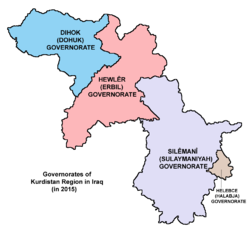
The Kurdistan Region is divided into four governorates (Kurdish: پارێزگا, Parêzga): the governorates of Erbil, Sulaymaniyah, Duhok, and Halabja. Each of these governorates is divided into districts, for a total of 26 districts. Each district is also divided into sub-districts. Each governorate has a capital city, while districts and sub-districts have 'district centers'.
| Governorate | Population (2020) | Area (km2) | Area (mi2) | |
|---|---|---|---|---|
| Erbil | هەولێر, Hewlêr | 2,932,800 | 14,873 | 5,743 |
| Sulaymaniyah | سلێمانی, Silêmanî | 2,250,000 | 20,144 | 7,778 |
| Duhok | دهۆک, Dihok | 1,292,535 | 10,956 | 4,230 |
| Halabja | هەڵەبجە, Hellebce | 109,000 | 889 | 343 |
| Total | 6,584,335 | 46,862 | 18,094 |
In 2012, an additional administrative division, the Independent Administration, was established. The first of these was the Raparin Administration, covering the Ranya and Qaladiza areas. This status provides greater decentralization, delegating more power to local authorities to improve public services. The name 'Raparin' (Kurdish: Raperîn, lit.: 'Revolution') was chosen to honor Ranya's central role during the 1991 uprisings. Other Independent Administrations include Soran and Zakho, both established in 2021.
Foreign relations

Although the Iraqi constitution designates the federal government as exclusively responsible for foreign policy, in practice the Kurdistan Regional Government has often conducted aspects of these policies independently, without coordination with Baghdad.
Despite being landlocked, the Kurdistan Region pursues a proactive foreign policy, which includes strengthening diplomatic relations with Iran, Russia, the United States and Turkey. Twenty nine countries have a diplomatic presence in the Kurdistan Region, while the Kurdistan Region has representative offices in 14 countries.
Military
Since 1991, no Iraqi army personnel have been stationed in the Kurdistan Region, leaving security and stability to Kurdish forces and contributing to its relative stability compared to other parts of Iraq. Article 117 of the 2005 Iraqi Constitution allows federal regions to establish their own internal security forces, including "police, security forces, and guards of the region." The Kurdish defense apparatus operates entirely independently of the Iraqi government.
The Peshmerga, under the Ministry of Peshmerga Affairs (MoPA), are the main military forces of the KRI. In addition, the Kurdistan Region maintains a range of security institutions, including the Kurdistan Region Police, domestic security and intelligence (Asayish and the Kurdistan Region Security Council), foreign intelligence (Parastin u Zanyari), gendarmerie forces (Zeravani and the Defense and Emergency Forces), and counter-terrorism and special forces such as the Counter Terrorism Department, the CTG Kurdistan, and the Kurdistan Commando Forces.
Demographics
Due to the lack of a proper census, the exact population and demographics of Kurdistan Region are unknown, but the KRG has started to publish more detailed figures in recent years. The population of the region is notoriously difficult to ascertain, as the Iraqi government has historically sought to minimize the importance of the Kurdish minority while Kurdish groups have had a tendency to exaggerate the numbers.
Population
According to preliminary 2024 census data, the Kurdistan Region has a population of 6,370,668, representing 14.02% of Iraq's total population (over 45.4 million). About 84% of residents live in urban areas and 16% in rural areas. The average household size is 4.3 persons across 1.38 million families. The population is nearly evenly split by gender and is relatively young, with 31.9% under 15 and 63.07% of working age. The region has experienced a population growth rate of 2.48% since 2009.
| Erbil | Duhok | Sulaymaniya | Total | |||||
|---|---|---|---|---|---|---|---|---|
| Population | % | Population | % | Population | % | Population | % | |
| Native | 2,060,000 | 86.0% | 1,470,000 | 67.2% | 2,080,000 | 88.9% | 5,610,002 | 81.0% |
| IDPs | 257,424 | 10.7% | 625,000 | 28.6% | 229,000 | 9.8% | 1,111,424 | 16.1% |
| Refugees | 77,637 | 3.2% | 93,000 | 4.3% | 31,000 | 1.3% | 201,637 | 2.9% |
| Total | 2,395,061 | 100.0% | 2,188,000 | 100.0% | 2,340,000 | 100.0% | 6,923,063 | 100.0% |
Languages
The Kurdistan Region is a multilingual area with a variety of languages and dialects spoken. The majority of the population speaks Kurdish in its various dialects, which, alongside Arabic, is an official language of the region. The two main Kurdish dialects in the region are Central Kurdish (Sorani), spoken in Erbil and Sulaymaniyah, and Northern Kurdish (Kurmanji), spoken mostly in Dohuk. Today nearly all people in the Kurdistan Region can speak or understand both of the major dialects.
Other languages and Kurdish dialects spoken by their respective communities include Hawrami and Southern Kurdish, as well as Arabic, Neo-Aramaic (including Chaldean and Assyrian), Armenian, and Turkmen. The KRG promotes linguistic diversity, and some schools have been established using these minority languages as the primary medium of instruction. Turkmen, Syriac, and Armenian are recognized languages in their respective administrative areas alongside Kurdish, according to the 2014 Law of Official Languages passed by the Kurdistan Parliament.
Religion
The Kurdistan Region has a religiously diverse population, a trend that was further reinforced with the rise of the Islamic State, as members of numerous minority groups fled to the region. The dominant religion is Islam, which is professed by the majority of Kurdistan Region's inhabitants. These include Kurds, Iraqi Turkmen, and Arabs, belonging mostly to the Shafi'i school of Sunni Islam. There is also a small number of Shia Feyli Kurds.
Christianity is practiced by Assyrians, Chaldeans, Kurds, and Armenians. The Kurdistan Regional Government seeks to promote the inclusion of Christian communities; for example, it enacted a law in 2015 to formally protect religious minorities, provides funding for the construction of churches and educational institutions, and in 2021 granted expanded autonomy to Ankawa, a predominantly Christian suburb of Erbil.
Yazidis make up a significant minority, with some 650,000 in 2005, or 560,000 as of 2013, The Yarsan (Ahl-e Haqq or Kakai) religion numbers around 200,000 adherents respectively.
In 2020, it was reported that 60 Zoroastrian families live in the Kurdistan Region, while other sources estimate 15,000–30,000 members. Their numbers may have grown as some Kurds see Zoroastrianism as their "original" religion, influenced by Kurdish nationalism, and have turned away from Islam following atrocities committed by the Islamic State. The first modern Zoroastrian temple was opened in the city of Sulaymaniyah in September 2016, while another was opened in 2020 in Erbil.
A tiny ethno-religious community of Mandaeans also exists within the region. The National Association of Jews from Kurdistan in Israel stated there is a small number of expatriate Jews in the Kurdistan Region, but no Jews remaining from original Jewish communities. Members of the Baháʼí Faith are also recognized.
- Mudhafaria Minaret in the Minare Park, Erbil
- Chaldean Catholic Mar Yousif Cathedral in Ankawa, Erbil
- Yazidi temples in Lalish
- Jewish ritualistic items displayed at the Kurd's Heritage Museum, Sulaymaniyah
- Remains of the Zoroastrian/Mithraic Qyzqapan tomb near Sulaymaniyah
Immigration
Widespread economic activity between the Kurdistan Region and Turkey has given the opportunity for Kurds in Turkey to seek jobs in the Kurdistan Region. A Kurdish newspaper estimated that around 50,000 Kurds from Turkey were living in the Kurdistan Region in 2009.
In December 2017, the Kurdistan Region hosted 1.2 million internally displaced (IDP) Iraqis who had been displaced by the war against the Islamic State. There were about 335,000 IDPs and refugees in the region prior to 2014 with the some arriving in 2014 as a result of unrest in Syria and early insurgency by the Islamic State.
Economy
- Oil (80.0%)
- Agriculture (10.0%)
- Tourism (4.00%)
- Other (6.00%)
The economy of the Kurdistan Region is dominated by the oil industry and a large public sector, leading it to be described as a rentier state or petrostate similar to those in the Gulf countries. Strong economic growth occurred in the Kurdistan Region following the 2003 invasion of Iraq; for example, between 2003 and 2006, the number of millionaires in Sulaymaniyah grew from 12 to 2,000, and economic opportunities attracted around 20,000 workers from other parts of Iraq between 2003 and 2005. Since the late 2010s, the Kurdish government has sought to diversify the economy in order to mitigate risks arising from sole dependence on oil and reduce vulnerability to economic crises.
Compared to the rest of Iraq, the Kurdistan Region has the lowest poverty rates and a relatively stronger economy. However, unemployment in the Kurdistan Region is still high, particularly among young people. Between 2021 and 2022, the International Labour Organization reported consistently high rates of 14–18%, worsened by the COVID-19 pandemic, and official statistics indicate that the rate surged to over 24% in 2024, amid conflict with the Iraqi government over salary payments. According to estimates, debt of the KRG reached $18 billion in January 2016.
Petroleum and mineral resources
The Kurdistan Region contains approximately 4 billion barrels of proven oil reserves. Furthermore, the KRG has estimated that the region contains around 45 billion barrels (7.2×10^9 m3) of unproven oil resource.
Extraction of these reserves began in 2007, as the KRG invited foreign companies to invest in 40 new oil sites, with the hope of increasing regional oil production over the following 5 years by a factor of five, to about 1 million barrels per day (160,000 m3/d). Notable companies active in the Kurdistan Region include Exxon, TotalEnergies, Chevron, Talisman Energy, DNO, MOL Group, Genel Energy, Hunt Oil, Gulf Keystone Petroleum, and Marathon Oil.
In November 2011, Exxon challenged the Iraqi government's authority with the signing of oil and gas contracts for exploration rights to six parcels of land with the KRG, including one contract in the disputed territories, just east of the Kirkuk mega-field. This act prompted Baghdad to threaten revoking Exxon's contract in its southern Iraqi fields, most notably the West Qurna project. Exxon responded by announcing its intention to leave the West-Qurna project.
In July 2012, Turkey and the Kurdistan Regional Government signed an agreement by which Turkey would supply the KRG with refined petroleum products in exchange for crude oil.
In 2015, major oil export partners included Israel, Italy, France and Greece.
Other mineral resources that exist in significant quantities in the region include coal, copper, gold, iron, limestone (which is used to produce cement), marble, and zinc. The world's largest deposit of rock sulfur is located just southwest of Erbil.
Cessation of oil exports
In March 2023 the International Chamber of Commerce ruled that the oil export agreement between KRI and Turkey was illegal. According to the verdict, only the Iraqi central government can sign international trade agreements regarding oil exports, and Turkey was found guilty of violating the Iraq–Turkey Pipeline Agreement of 1973, causing the pumping of petroleum products through the Kirkuk–Ceyhan Oil Pipeline between the Kurdistan Region and Turkey to cease. The closure of the pipeline left much of the Kurdistan Region's petroleum output with no legal outlet, causing a rise in illegal smuggling of oil to Iran via tanker trucks.
Resumption of oil exports by SOMO
On 25 September 2025, the Iraqi federal government announced that it had reached a multilateral deal with the Kurdistan Regional Government and international oil companies (IOCs) operating in the KRI wherein precise technical guidelines and conditions of payment for crude oil production and transportation are set out. The deal is in line with the 2023-2025 Federal Budget Law approved by the Iraqi Council of Representatives.
Under the deal, the Federal Government will receive at least 230 000 barrels per day of oil produced in KRI and delivered directly to the Iraqi State Organization for Marketing of Oil (SOMO), which will in turn independently conduct the sale of these barrels through the Kirkuk–Ceyhan pipeline. Conditional on SOMO receiving at least 230 000 barrels daily, the Federal Ministry of Finance will in turn pay the KRG its annual share of the federal budget according to the Federal Budget Law. The IOCs on the other hand, will be reimbursed for production and transportation costs of the amount received by SOMO (USD 14$ per barrel) paid through an escrow account directly.
The deal stipulates that KRG and IOCs will be completely excluded from the export process, and won’t directly receive revenues from exports of oil barrels produced in KRI. Instead, the Iraqi government will allocate the revenues gained from independently exporting at least 230 000 barrels per day produced in the KRI to the central government budget, from which the KRG will receive its share proportional to its population, a mechanism identical to that used with other Iraqi oil-producing governorates, such as Basrah. Of the amount produced by the international oil companies —that is, at least 280 000 barrels per day— an amount no more than 50 000 barrels will be allocated for KRI domestic consumption. The IOCs will be allowed to sell this amount to domestic buyers and receive the revenues of this amount only.
The Iraqi Ministry of Oil reiterated its "firm commitment to managing oil resources in accordance with the principle of national sovereignty and the supreme interest of the state, in order to ensure a fair distribution of wealth among all the Iraqi people, in accordance with the constitution". The Iraqi minister of oil, Hayan Abdul-Ghani stated that the deal guarantees that the Iraqi government controls all revenues of the country.
Education
Before the establishment of the Kurdistan Regional Government, primary and secondary education was almost entirely taught in Arabic. Higher education was always taught in Arabic. This however changed with the establishment of the Kurdistan Autonomous Region. The first international school, the International School of Choueifat opened its branch in the Kurdistan Region in 2006. Other international schools have opened and is the latest with a planned opening in Suleimaniah in September 2011.
The Kurdistan Region's official universities are listed below, followed by their English acronym (if commonly used), internet domain, establishment date and latest data about the number of students.
| Institute | Internet domain | Established | Students |
|---|---|---|---|
| University of Sulaimani (UOS) | 1968 | 25,900 (2013) | |
| Salahaddin University (SU) | 1970 | 20,000 (2013) | |
| University of Duhok | 2012-10-30 at the Wayback Machine | 1992 | 19,615 (2017) |
| University of Zakho | 2010 | 2,600 (2011) | |
| University of Koya (KU) | 2003 | 4260 (2014) | |
| University of Kurdistan Hewler (UKH) | 2006 | 400 (2006) | |
| The American University of Iraq – Sulaimani (AUIS) | 2007 | 1100 (2014) | |
| American University Duhok Kurdistan (AUDK) | 2014 | ||
| Hawler Medical University (HMU) | 2006 | (3400) (2018) | |
| Business & Management University (BMU) | 2007 | ||
| Lebanese French University | 2007 | 2,600 (2022) | |
| Cihan University | 2007 | ||
| Komar University of Science and Technology (KUST) | 2012 | ||
| Ishik University (IU) | 2018-08-09 at the Wayback Machine | 2008 | 1,700 (2012) |
| Soran University | 2009 | 2200 (2011) | |
| Nawroz University | 2004 | ||
| University of Human Development (UHD/Qaradax) | 2017-03-08 at the Wayback Machine | 2008 | |
| Sulaimani Polytechnic University (SPU) | 1996 | 13000 (2013) | |
| Knowledge University (KNU) | 2009 | 2800 (2021) | |
| Catholic University in Erbil (CUE) | 2015 | 271 (2022) |
Human resources
Iraqi Kurdistan has been investing in the growth of its human capital in general. Public sector employees are often enrolled in local training programmes or sent overseas to participate in training courses, technical classes, and professional development programmes. However, factors such as the lack of a practical and formal HRD framework specific to the KRG's public sector, the absence of evaluation process, inadequate civil service training institutions, and corruption have hampered effective and efficient professional development and training in the public sector. Therefore, an assessment of such programmes and their outcomes is needed to identify any misuse of public funds, as well as to assist in the reducing of administrative and political corruption and to make policy recommendations. The government's policies for the public sector have also had an impact on the private sector. However, the government has played a much smaller role in the private sector. In Iraqi Kurdistan, the Ministry of Planning has primarily concentrated on activating training in the public sector, with the goal of expanding opportunities and improving the efficiency of the training process. In the long run, this will have an effect on private sector training and growth.
According to the 2024 nationwide population census conducted by the Iraqi Ministry of Planning, Kurdistan Region's illiteracy rate was 16.23%, higher than the rest of Iraq (15.31%).
Infrastructure and transportation
Infrastructure
Due to the destruction caused by campaigns of the Iraqi army under Saddam Hussein and earlier regimes, much of the Kurdistan Region's infrastructure remained underdeveloped. Following the establishment of the safe haven in 1991, the KRG initiated reconstruction projects. By the 2000s, approximately 65 percent of the estimated 4,500 villages destroyed during earlier campaigns had been rebuilt. Scholars have described the KRG's reconstruction of the region, which had to start virtually from scratch, as its main achievement.
Transportation

Iraqi Kurdistan can be reached by land and air. By land, Iraqi Kurdistan can be reached most easily by Turkey through the Habur Border Gate which is the only border gate between Iraqi Kurdistan and Turkey. This border gate can be reached by bus or taxi from airports in Turkey as close as the Mardin or Diyarbakir airports, as well as from Istanbul or Ankara. Iraqi Kurdistan has two border gates with Iran, the Haji Omaran border gate and the Bashmeg border gate near the city of Sulaymaniyah. Iraqi Kurdistan has also a border gate with Syria known as the Faysh Khabur border gate. From within Iraq, the Kurdistan Region can be reached by land from multiple roads.
Two international airports are located in the region; Erbil International Airport and Sulaimaniyah International Airport, which both operate flights to Middle Eastern and European destinations. The KRG spent millions of dollars on the airports to attract international carriers, and currently Turkish Airlines, Austrian Airlines, Lufthansa, Etihad, Royal Jordanian, Emirates, Gulf Air, Pegasus Airlines, Egyptair, Middle East Airlines, Fly Baghdad, Atlas Jet, Iraqi Airways, Wizz Air, Flynas and Flydubai all service the region. There are at least 2 military airfields in Iraqi Kurdistan.
Culture
The culture of the Kurdistan Region is primarily Kurdish, with distinct traditions in music, dance, clothing, and festivals that differentiate it from other parts of Iraq. The annual celebration of Newroz, the Kurdish New Year and spring festival, is a public holiday on 21 March.
Human rights
In 2010 Human Rights Watch reported that journalists in the Kurdistan Region who criticize the regional government have faced substantial violence, threats, and lawsuits, and some have fled the country. Some journalists faced trial and threats of imprisonment for their reports about corruption in the region.
In 2009 Human Rights Watch found that some health providers in Iraqi Kurdistan had been involved in both performing and promoting misinformation about the practice of female genital mutilation. Girls and women receive conflicting and inaccurate messages from media campaigns and medical personnel on its consequences. The Kurdistan parliament in 2008 passed a draft law outlawing the practice, but the ministerial decree necessary to implement it, expected in February 2009, was cancelled. As reported to the Centre for Islamic Pluralism by the non-governmental organization, called as Stop FGM in Kurdistan, the Kurdistan Regional Government in northern Iraq, on 25 November, officially admitted the wide prevalence in the territory of female genital mutilation (FGM). Recognition by the KRG of the frequency of this custom among Kurds came during a conference program commemorating the International Day for the Elimination of Violence Against Women. On 27 November 2010, the Kurdish government officially admitted to violence against women in Kurdistan and began taking serious measures. 21 June 2011 The Family Violence Bill was approved by the Kurdistan Parliament, it includes several provisions criminalizing the practice. A 2011 Kurdish law criminalized FGM practice in Iraqi Kurdistan and law was accepted four years later. The studies have shown that there is a trend of general decline of FGM.
British lawmaker Robert Halfon sees the Kurdistan Region as a more progressive Muslim region than the other Muslim countries in the Middle East.
Although the Kurdish regional parliament has officially recognized ethnic minorities such as Assyrians, Turkmen, Arabs, Armenians, Mandaeans, Shabaks and Yazidis, there have been accusations of Kurdish discrimination against those groups. The Assyrians have reported Kurdish officials' reluctance in rebuilding Assyrian villages in their region while constructing more settlements for the Kurds affected during the Anfal campaign. After his visit to the region, Dutch politician Joël Voordewind noted that the positions reserved for minorities in the Kurdish parliament were appointed by Kurds as the Assyrians for example had no possibility to nominate their own candidates.
The Kurdish regional government has also been accused of trying to Kurdify other regions such as the Nineveh Plains and Kirkuk by providing financial support for Kurds who want to settle in those areas.
While Kurdish forces held the city of Kirkuk, Kurdish authorities attempted to Kurdify the city. Turkmen and Arab residents in Kirkuk experienced intimidation, harassment and were forced to leave their homes, in order to increase the Kurdish demographic in Kirkuk and bolster their claims to the city. Multiple Human Rights Watch reports detail the confiscation of Turkmen and Arab families' documents, preventing them from voting, buying property and travelling. Turkmen residents of Kirkuk were detained by Kurdish forces and compelled to leave the city. Kurdish authorities expelled hundreds of Arab families from the city, demolishing their homes in the process.
United Nations reports since 2006 have documented that Kurdish authorities and Peshmerga militia forces were illegally policing Kirkuk and other disputed areas, and that these militia have abducted Turkmen and Arabs, subjecting them to torture.
In April 2016, Human Rights Watch wrote that the Kurdish security force of KRG, the Asayish, blocked the roads to Erbil to prevent Assyrians from holding a protest. According to demonstrators, the reason for the blocked protest was that Kurds in the Nahla Valley, mainly populated by Assyrians, encroached on land owned by Assyrians, without any action by courts or officials to remove the structures the Kurds built there.
In February 2017, Human Rights Watch said Kurdistan Regional Government (KRG) forces are detaining men and boys who have fled the fighting in Mosul even after they have passed security checks. Detainees were held for up to four months without any communication with their families. Relatives of these men and boys said that KRG and Iraqi forces didn't inform them of the places of their detained relatives and didn't facilitate any contact with them.
Human Rights Watch reported that Kurdistan Regional Government security forces and local police detained 32 unarmed protesters in Erbil on March 4, 2017, at a peaceful demonstration against recent clashes in Sinjar. 23 of them were released at the same day and 3 more within four days, but 6, all foreign nationals, are still being held. A police chief ordered one protester who was released to permanently leave Erbil, where he was living. While in detention, protesters were not allowed to contact with anyone or have access to a lawyer.
In 2017, Assyrian activists Juliana Taimoorazy and Matthew Joseph accused the Kurdistan Regional Government of issuing threats of violence against Assyrians living in the area who protested its independence referendum. These accusations were later confirmed when the KDP-controlled provincial council of Alqosh issued a statement warning residents that they would face consequences for protesting the referendum.
In 2010, it was reported that passing of a new law in Iraqi Kurdistan, guaranteeing “gender equality”, has deeply outraged some local religious community, including the minister of endowments and religious affairs and prominent imams, who interpreted the phrase as "legitimizing homosexuality in Kurdistan". Kamil Haji Ali, the minister of endowments and religious affairs, said in this regard that the new law would “spread immorality” and “distort” Kurdish society. Following an outrage of religious movements, the KRG held a press conference, where the public were assured that gender equality did not include giving marriage rights to homosexuals, whose existence is effectively invisible in Iraq due to restrictive traditional rules.
In the disputed areas of Sinjar and the Nineveh Plains, the Kurdistan Regional Government has been accused by the native Assyrian and Yazidi inhabitants of forcefully disarming them with the guarantee of protection in order to justify the Peshmerga's presence in those regions. In 2014, when the Islamic State invaded Northern Iraq, the Peshmerga abandoned their posts in these areas without notifying the locals.
See also
- List of populated places in Kurdistan Region
- List of archaeological sites in Erbil Governorate
- Lake Felaw
- Rojava