Liang (mass)
In-game article clicks load inline without leaving the challenge.

Liang (simplified Chinese: 两; traditional Chinese: 兩; pinyin: liǎng), or leung in Cantonese, liae in Wenzhounese, liong in Hakka, lian in Shanghainese, also called "Chinese ounce" or "tael", is a traditional Chinese unit for weight measurement. It originated in China before being introduced to neighboring countries in East and Southeast Asia.
Modern standards for the liang include 1/10 jin (50 grams) in mainland China, 37.5 grams in Taiwan, Korea and Thailand, 37.799 grams in Hong Kong, Singapore and Malaysia, and 37.8 grams in Vietnam.
Liang is mostly used in traditional markets, and is a well-known measure for gold, silver and Chinese medicines.
Mainland China
Chinese mass units promulgated in 1915
On 7 January 1915, the Beiyang government promulgated a measurement law to use not only metric system as the standard but also a set of Chinese-style measures based directly on the Qing dynasty definitions (营造尺库平制).
| Pinyin | Character | Relative value | Metric value | Imperial value | Notes |
|---|---|---|---|---|---|
| háo | 毫 | 1⁄10000 | 3.7301 mg | 0.0001316 oz | |
| lí | 釐 | 1⁄1000 | 37.301 mg | 0.001316 oz | cash |
| fēn | 分 | 1⁄100 | 373.01 mg | 0.01316 oz | candareen |
| qián | 錢 | 1⁄10 | 3.7301 g | 0.1316 oz | mace or Chinese dram |
| liǎng | 兩 | 1 | 37.301 g | 1.316 oz | tael or Chinese ounce |
| jīn | 斤 | 16 | 596.816 g | 1.316 lb | catty or Chinese pound |
where liang is the base unit, equal to 37.301 grams.
Mass units in the Republic of China since 1930
On 16 February 1929, the Nationalist government adopted and promulgated The Weights and Measures Act to adopt the metric system as the official standard and to limit the newer Chinese units of measurement to private sales and trade, effective on 1 January 1930. These newer "market" units are based on rounded metric numbers. And jin became the base unit.
| Pinyin | Character | Relative value | Metric value | Imperial value | Notes |
|---|---|---|---|---|---|
| sī | 絲 | 1⁄1600000 | 312.5 μg | 0.00001102 oz | |
| háo | 毫 | 1⁄160000 | 3.125 mg | 0.0001102 oz | |
| lí | 市釐 | 1⁄16000 | 31.25 mg | 0.001102 oz | cash |
| fēn | 市分 | 1⁄1600 | 312.5 mg | 0.01102 oz | candareen |
| qián | 市錢 | 1⁄160 | 3.125 g | 0.1102 oz | mace or Chinese dram |
| liǎng | 市兩 | 1⁄16 | 31.25 g | 1.102 oz | tael or Chinese ounce |
| jīn | 市斤 | 1 | 500 g | 1.102 lb | catty or Chinese pound |
| dàn | 擔 | 100 | 50 kg | 110.2 lb | picul or Chinese hundredweight |
where one liang is equal to 1/16 of a jin, or 31.25 grams.
Mass units in the People's Republic of China since 1959
On June 25, 1959, the State Council of the People's Republic of China issued the "Order on the Unified Measurement System", retaining the market measure system, with the statement of "The market system originally stated that sixteen liangs are equal to one jin. Due to the trouble of conversion, it should be changed to ten liangs per jin."
| Pinyin | Character | Relative value | Metric value | Imperial value | Notes |
|---|---|---|---|---|---|
| lí | 市厘 | 1⁄10000 | 50 mg | 0.001764 oz | cash |
| fēn | 市分 | 1⁄1000 | 500 mg | 0.01764 oz | candareen |
| qián | 市錢 | 1⁄100 | 5 g | 0.1764 oz | mace or Chinese dram |
| liǎng | 市兩 | 1⁄10 | 50 g | 1.764 oz | tael or Chinese ounce |
| jīn | 市斤 | 1 | 500 g | 1.102 lb | catty or Chinese pound formerly 16 liang = 1 jin |
| dàn | 市擔 | 100 | 50 kg | 110.2 lb | picul or Chinese hundredweight |
Legally, 1 jin equals 500 grams, and 10 liangs equal 1 jin (that is, 1 liang equals 50 grams). The traditional Chinese medicine measurement system remains unchanged.
Taiwan
In 1895, Taiwan was ceded to Japan from China. The Japanese implemented the metric system, but the Taiwanese still followed their own habits and continued to use the old weights and measures of the Qing dynasty. 1 Taiwan liang is equal to 37.5 grams, or 1/16 Taiwan jin.
| Unit | Relative value | Metric | US & Imperial | Notes | |||||
|---|---|---|---|---|---|---|---|---|---|
| Taiwanese Hokkien | Hakka | Mandarin | Character | Legal | Decimal | Exact | Approx. | ||
| Lî | Lî | Lí | 釐 | 1⁄1000 | 3/80,000kg | 37.5mg | 3750/45,359,237lb | 0.5787gr | Cash; Same as Japanese Rin |
| Hun | Fûn | Fēn | 分 | 1⁄100 | 3/8000kg | 375mg | 37,500/45,359,237lb | 5.787gr | Candareen; Same as Japanese Fun |
| Chîⁿ | Chhièn | Qián | 錢 | 1⁄10 | 3/800kg | 3.75g | 375,000/45,359,237lb | 2.116dr | Mace; Same as Japanese Momme (匁) |
| Niú | Liông | Liǎng | 兩 | 1 | 3/80kg | 37.5g | 3,750,000/45,359,237lb | 21.16dr | Tael |
| Kin/Kun | Kîn | Jīn | 斤 | 16 | 3/5kg | 600g | 60,000,000/45,359,237lb | 1.323lb | Catty; Same as Japanese Kin |
| Tàⁿ | Tâm | Dàn | 擔 | 1600 | 60kg | 6,000,000,000/45,359,237lb | 132.3lb | Picul; Same as Japanese Tan |
where liang is the base unit.
Hong Kong and Macau
Hong Kong and Macau mass units
The liang is a legal weight measure in Hong Kong, and is still in active use. One liang is 37.799364167 g, and in Ordinance 22 of 1884 is 1+1⁄3 oz. avoir. Similar to Hong Kong, in Singapore, one tael is defined as 1+1⁄3 ounce and is approximated as 37.7994 g. In Hong Kong and Singapore, one liang is equivalent to 10 qian (Chinese: 錢; pinyin: qián) or 1⁄16 jin,. These Chinese units of measurement are usually used in Chinese herbal medicine stores as well as gold and silver exchange.
| Jyutping | Character | English | Portuguese | Relative value | Relation to the Traditional Chinese Units (Macau) | Metric value | Imperial value | Notes |
|---|---|---|---|---|---|---|---|---|
| lei4 | 厘 | li (cash) | liz | 1⁄16000 | 1⁄10 condorim | 37.79931 mg | 0.02133 dr | |
| fan1 | 分 | fen (fan, candareen) | condorim | 1⁄1600 | 1⁄10 maz | 377.9936375 mg | 0.2133 dr | |
| cin4 | 錢 | qian (tsin, mace) | maz | 1⁄160 | 1⁄10 tael | 3.779936375 g | 2.1333 dr | |
| loeng2 | 兩 | liang (leung, tael) | tael | 1⁄16 | 1⁄16 cate | 37.79936375 g | 1.3333 oz | 604.78982/16=37.79936375 |
| gan1 | 斤 | jin (gan, catty) | cate | 1 | 1⁄100 pico | 604.78982 g | 1.3333 lb | Hong Kong and Macau share the definition. |
| daam3 | 擔 | dan (tam, picul) | pico | 100 | None | 60.478982 kg | 133.3333 lb | Hong Kong and Macau share the definition. |
Similarly, Singapore law stipulates that one jin is also equal to sixteen liangs or 0.6048 kilograms, and one liang equals 37.799 g. Malaysia has the same regulations as it is a former British colony.
Hong Kong troy units
These are used for trading precious metals such as gold and silver.
| English | Character | Relative value | Metric value | Imperial value | Notes |
|---|---|---|---|---|---|
| fen (candareen) troy | 金衡分 | 1⁄100 | 374.29 mg | 0.096 drt | |
| qian (mace) troy | 金衡錢 | 1⁄10 | 3.7429 g | 0.96 drt | |
| liang (tael) troy | 金衡兩 | 1 | 37.429 g | 1.2 ozt |
Korea
The base unit of Korean weight is the gwan. One liang (兩, Korean ounce) is 1/100 of a gwan, or 37.5 g (1.32 oz).
| Romanization | Korean | English | Equivalents | ||||
|---|---|---|---|---|---|---|---|
| RR | MR | Other | Gwan | Other countries | Global | ||
| Ho | Ho | 호(毫) | 1⁄1,000,000 | 3.75 mg (0.0579 gr) | |||
| Mo | Mo | 모(毛) | |||||
| Ri | Ri | 리(釐/厘) | li | 1⁄100,000 | 0.0375 g (0.00132 oz) | ||
| Pun | P'un | 푼 | fen | 1⁄10,000 | 0.375 g (0.0132 oz) | ||
| Bun | Pun | 분(分) | |||||
| Don | Ton | 돈 | 1⁄1,000 | Momme | 3.75 g (0.132 oz) | ||
| Nyang | Nyang | Ryang Yang | 냥(兩) | liang (Korean ounce) | 1⁄100 | Tael | 37.5 g (1.32 oz) |
| Geun | Kŭn | Keun Kon | 근(斤) | jin (Korean pound) | 4⁄25 (meat), 1⁄10 (others) | Jin, Catty | 600 g (21 oz) (meat),375 g (13.2 oz) (others) |
| Gwan | Kwan | 관(貫) | 1 | 3.75 kg (8.3 lb) |
Vietnam
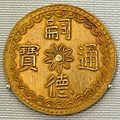
In Vietnam, the unit of liang is called "lang". In the time of French Indochina, the colonial administration fixed the (lạng) as 100 g, which is commonly used at food markets where many items typically weigh in the 100–900 g range. However, a different lang (called cây, lạng, or lượng) unit of 37.5 g is used for domestic transactions in gold. Real estate prices are often quoted in liangs of gold rather than the local currency over concerns over monetary inflation.
| Name in Chữ Quốc ngữ | Hán/Nôm name | Traditional value | Traditional conversion | Modern value | Modern conversion |
|---|---|---|---|---|---|
| tấn | 擯 | 604.5 kg | 10 tạ | 1 000 kg | 10 tạ |
| quân | 302.25 kg | 5 tạ | 500 kg | obsolete | |
| tạ | 榭 | 60.45 kg | 10 yến | 100 kg | 10 yến |
| bình | 30.225 kg | 5 yến | 50 kg | obsolete | |
| yến | 6.045 kg | 10 cân | 10 kg | 10 cân | |
| cân (jin) | 斤 | 604.5 g | 16 lạng | 1 kg | 10 lạng |
| nén | 378 g | 10 lạng | |||
| lạng (liang) | 兩 | 37.8 g | 10 đồng | 100 g | |
| đồngortiền (qian) | 錢 | 3.78 g | 10 phân | ||
| phân | 分 | 0.38 g | 10 ly | ||
| ly or li | 厘 | 37.8 mg | 10 hào | ||
| hào | 毫 | 3.8 mg | 10 ti | ||
| ti | 絲 | 0.4 mg | 10 hốt | ||
| hốt | 忽 | 0.04 mg | 10 vi | ||
| vi | 微 | 0.004 mg |
For more information on the Chinese mass measurement system, please see article Jin (mass).
Compounds
- wikt:幾斤幾兩 (jǐjīnjǐliǎng)
- wikt:半斤八兩 (bànjīnbāliǎng)
- wikt:缺斤少兩 (quējīnshǎoliǎng)
- wikt:銀兩 (yínliǎng)
Name of Tael
The English word tael comes through Portuguese from the Malay word tahil, meaning "weight". Early English forms of the name such as "tay" or "taes" derive from the Portuguese plural of tael, taeis. Tahil (/ˈtɑːhɪl/ in Singaporean English) is used in Malay and English today when referring to the weight in Malaysia, Singapore, and Brunei, where it is still used in some contexts especially related to the significant Overseas Chinese population.
See also
- Liang (currency)
- Chinese units of measurement
- Hong Kong units of measurement
- Taiwanese units of measurement
- Korean units of measurement
- Vietnamese units of measurement