Local government in Scotland
In-game article clicks load inline without leaving the challenge.
Local government in Scotland comprises thirty-two local authorities, commonly referred to as councils. Each council provides public services, including education, social care, waste management, libraries and planning. Councils receive the majority of their funding from the Scottish Government, but operate independently and are accountable to their local electorates. Councils raise additional income via the Council Tax, a locally variable domestic property tax, and Business rates, a non-domestic property tax.
Councils are made up of councillors who are directly elected by the residents of the area they represent. Each council area is divided into a number of wards, and three or four councillors are elected for each ward. There are currently 1,226 elected councillors in Scotland. Local elections are normally held every five years and use the single transferable vote electoral system. The most recent election was the 2022 Scottish local elections and the next election will be the 2027 Scottish local elections.
Council administrations typically comprise a group of councillors within the council who are able to command majority support. Minority administrations and majority administrations may be formed. Although coalition administrations are more typical, occasionally a majority administration is formed by a single political party, but this is uncommon due to the proportional voting system used in Scottish local elections. Despite being uncommon on the Scottish mainland, it is possible for independent politicians to form an administration.
The Convention of Scottish Local Authorities (COSLA) is an umbrella organisation formed in 1975 to represent the views of Scotland's thirty-two councils to central government.
History
Origins
The history of Scottish local government mainly surrounds involves the counties of Scotland. The counties have their origins in the sheriffdoms or shires over which a sheriff (a contraction of shire reeve) exercised jurisdiction.
Malcolm III appears to have introduced sheriffs as part of a policy of replacing native "Celtic" forms of government with Anglo Saxon and French feudal structures. This was continued by his sons Edgar, Alexander I and in particular David I. David completed the division of the country into sheriffdoms by the conversion of existing thanedoms.
From the seventeenth century the shires started to be used for local administration apart from judicial functions. In 1667 Commissioners of Supply were appointed in each sheriffdom to collect the land tax. The commissioners eventually assumed other duties in the county. In 1858, police forces were established in each county under the Police (Scotland) Act 1857.
As a result of the dual system of local government, burghs (of which there were various types) often had a high degree of autonomy.
Modern history

Between 1890 and 1975 local government in Scotland was organised with county councils (including four counties of cities) and various lower-level units. Between 1890 and 1929, there were parish councils and town councils, but with the passing of the Local Government (Scotland) Act 1929, the functions of parish councils were passed to larger district councils and a distinction was made between large burghs (i.e. those with a population of 20,000 or more) and small burghs. This system was further refined by the passing of the Local Government (Scotland) Act 1947.
Effective from 1975, the Local Government (Scotland) Act 1973 passed by the Conservative government of Edward Heath introduced a system of two-tier local government in Scotland (see Local government areas of Scotland 1973 to 1996), divided between large regional councils and smaller district councils. The only exceptions to this were the three island councils, Western Isles, Shetland and Orkney which had the combined powers of regions and districts. The Conservative government of John Major (1990–1997) decided to abolish this system and merge their powers into new unitary authorities. The new councils vary wildly in size – some are the same as counties, such as Clackmannanshire, some are the same as former districts, such as Inverclyde, and some are the same as the former regions, such as Highland. The changes took effect in 1996 with shadow councillors elected in 1995 to oversee the smooth transition of control.
In 2007, council elections moved to the single transferable vote system, with wards represented by either three or four councillors. The transition has resulted in no uncontested seats and has ended single-party controlled councils.
In 2016, there were ward boundary changes in 25 local authority areas, following the Scottish Government accepting some of the recommendations of Local Government Boundary Commission for Scotland.
The Islands (Scotland) Act 2018 and the Scottish Elections (Reform) Act 2020 have given Boundaries Scotland increased flexibility to vary the size of wards. Mainland wards may now have between 2 and 5 councillors, and single councillor wards are permitted where such a ward includes an inhabited island.
Responsibilities
- Council Tax
- Non-domestic rates collection
- Maintenance of all roads and pavements (except trunk roads which are the responsibility of Transport Scotland)
- All aspects of education relating to each respective council area; including early years, primary, secondary, additional support needs and school transportation
- The planning system, and Section 75
- Parking
- Bus stops
- Supporting non-commercial bus services
- Provides some Community Transport
- Local authority nurseries and private partnership nursery establishments
- Care of the elderly,
- Protection of vulnerable children and adults
- Refuse collection and disposal
- Licensing of hours of sale for alcohol
- Licensing of cultural music parades
- Licensing of taxis and private hire vehicles
- Licensing of window cleaners, market traders, scrap metal merchants, and street hawkers
- Licensing of sexual entertainment venues
- Food Hygiene inspections
- Regulation of landlords
- Council leisure centres and swimming baths
- Public parks
- Administering the Scottish Welfare Fund
Map of council areas
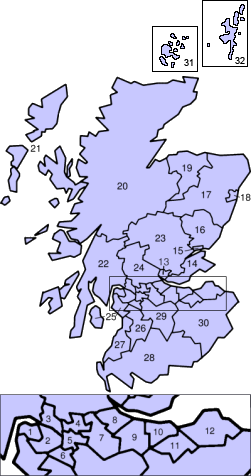
- Inverclyde
- Renfrewshire
- West Dunbartonshire
- East Dunbartonshire
- Glasgow City
- East Renfrewshire
- North Lanarkshire
- Falkirk
- West Lothian
- City of Edinburgh
- Midlothian
- East Lothian
- Clackmannanshire
- Fife
- Dundee City
- Angus
- Aberdeenshire
- Aberdeen City
- Moray
- Highland
- Na h-Eileanan Siar
- Argyll and Bute
- Perth and Kinross
- Stirling
- North Ayrshire
- East Ayrshire
- South Ayrshire
- Dumfries and Galloway
- South Lanarkshire
- Scottish Borders
- Orkney
- Shetland
Governance and administration

The power vested in local authorities is administered by elected councillors. There are currently 1,227 councillors, each paid a part-time salary for the undertaking of their duties. In total, there are 32 unitary authorities, the largest being the Glasgow City with more than 600,000 inhabitants, the smallest, Orkney, with just over 20,000 people living there (population of 21,670 in 2015).
Councillors are subject to a Code of Conduct instituted by the Ethical Standards in Public Life etc. (Scotland) Act 2000 and enforced by the Standards Commission for Scotland. If a person believes that a councillor has broken the code of conduct they make a complaint to the Commissioner for Ethical Standards in Public Life in Scotland (CESPLS). The Commissioner makes a determination on whether there is a need for an investigation, and then whether or not to refer the matter to the Standards Commission.
Provost
Each council elects a provost from among the members of the council to chair meetings and to act as a figurehead for the area. A council may also elect a depute provost, though this is not required. In the four cities of Glasgow, Edinburgh, Aberdeen and Dundee the provost is called a Lord Provost, whilst in other councils the council may choose another title for their provost or conveners. Most councils use the term 'provost', some use the term 'convener'.
The office of provost or convener is roughly equivalent to that of a mayor in other parts of the United Kingdom. Traditionally these roles are ceremonial and have no significant administrative functions. Lord provosts in the four city councils have the additional duty of acting as Lord Lieutenant for their respective city.
Leader of the Council
Since 2007 each council has been required to designate a "leader of the council" and a "civic head", who receive additional remuneration for holding those roles. The regulations direct that unless a council decides otherwise the leader is the convener and the civic head is the depute convener. In practice, most authorities appoint someone other than the convener as leader of the council, such that the political leader of the council is not also presiding over the debate at council meetings. The convener or provost usually takes the civic head role. The leader of the council is usually the leader of the largest political group, or in a coalition the leader of the largest party in that coalition. The Leader of the Council has no executive or administrative powers designated by statute. Prior to 2007 many authorities recognised the leader of the largest political group or coalition administration as being leader of the council, but there was no legislative basis for the role.
Officers
Officers of a council are administrative, non-political staff of the council. Generally the composition of the council's officers are a matter for the council, but there are a number of statutory officers whose roles are defined by the central government.
The most significant of these officers is the Head of Paid Service, usually titled the Chief Executive. The Chief Executive is similar in function to a city manager, though certain councillors have executive authority and there is no clear division of powers.
There is also a statutory Monitoring Officer, who usually heads the Legal Services division of the council, as well as a Chief Financial Officer.
2022 election results
| Party | First-preference votes | Councils | 2017 seats | 2022 seats | |||||||
|---|---|---|---|---|---|---|---|---|---|---|---|
| Count | Of total (%) | Change | Count | Change | Count | Of total (%) | Count | Of total (%) | Change | ||
| No overall control | —N/a | 27 | 2 | —N/a | —N/a | ||||||
| SNP | 633,252 | 34.1% | 1.8% | 1 | 1 | 431 | 35.1% | 453 | 36.9% | 22 | |
| Labour | 403,243 | 21.7% | 1.6% | 1 | 1 | 262 | 21.4% | 282 | 23.0% | 20 | |
| Conservative | 364,824 | 19.6% | 5.7% | 0 | 276 | 22.5% | 214 | 17.5% | 62 | ||
| Liberal Democrats | 159,815 | 8.6% | 1.7% | 0 | 67 | 5.5% | 87 | 7.1% | 20 | ||
| Independents | 156,815 | 8.4% | 2.0% | 3 | 168 | 13.7% | 152 | 12.4% | 15 | ||
| Green | 110,791 | 6.0% | 1.9% | 0 | 19 | 1.6% | 35 | 2.9% | 16 | ||
| Alba | 12,335 | 0.7% | 0 | 0.0% | New | ||||||
| Scottish Family | 6,857 | 0.4% | 0 | 0.0% | New | ||||||
| West Dunbartonshire Community | 1,462 | 0.1% | 0 | 1 | 0.1% | ||||||
| Scottish Socialist | 1,058 | 0.1% | 0.1% | 0 | 0.0% | ||||||
| TUSC | 1,022 | 0.1% | 0 | 0.0% | |||||||
| British Unionist | 859 | 0.1% | 0 | 1 | 0.1% | 1 | |||||
| Rubbish | 787 | 0.0% | 0 | 1 | 0.1% | ||||||
| Independence for Scotland | 742 | 0.0% | 0 | 0.0% | New | ||||||
| Libertarian | 698 | 0.0% | 0 | 0.0% | |||||||
| Freedom Alliance | 555 | 0.0% | 0 | 0.0% | New | ||||||
| Volt UK | 421 | 0.0% | 0 | 0.0% | New | ||||||
| Socialist Labour | 381 | 0.0% | 0 | 0.0% | |||||||
| UKIP | 372 | 0.0% | 0.2% | 0 | 0.0% | ||||||
| Women's Equality | 228 | 0.0% | 0 | 0.0% | New | ||||||
| Social Democratic | 222 | 0.0% | 0 | 0.0% | |||||||
| Sovereignty | 154 | 0.0% | 0 | 0.0% | New | ||||||
| Communist | 119 | 0.0% | 0 | 0.0% | New | ||||||
| Pensioner's | 75 | 0.0% | 0 | 0.0% | New | ||||||
| Vanguard | 74 | 0.0% | 0 | 0.0% | New | ||||||
| Workers | 61 | 0.0% | 0 | 0.0% | New | ||||||
| Scottish Eco-Federalist | 24 | 0.0% | 0 | 0.0% | New | ||||||
| Total | 1,889,658 | 100.0 | ±0.0 | 32 | 1,223 | 1,227 | 1,226 | 100.00 |
Council control
Last updated 25 February 2026.
| Council | Control | Web | |
|---|---|---|---|
| Aberdeen City | NOC | SNP-LD coalition | |
| Aberdeenshire | NOC | Con-LD-ind. coalition | |
| Angus | NOC | Con-ind.-Lab minority | |
| Argyll & Bute | NOC | SNP-LD-Grn-Lab-ind. coalition | |
| Clackmannanshire | NOC | SNP minority | |
| Dumfries & Galloway | NOC | SNP minority | |
| Dundee City | SNP | Majority | |
| East Ayrshire | NOC | SNP minority | |
| East Dunbartonshire | NOC | SNP minority | |
| East Lothian | NOC | Lab minority | |
| East Renfrewshire | NOC | Lab-ind. minority | |
| City of Edinburgh | NOC | Lab minority | |
| Falkirk | NOC | SNP minority | |
| Fife | NOC | Lab minority | |
| Glasgow City | NOC | SNP minority | 3 August 2020 at the Wayback Machine |
| Highland | NOC | SNP-ind. coalition | |
| Inverclyde | NOC | Lab minority | |
| Midlothian | NOC | SNP minority | |
| Moray | NOC | Con minority | |
| Na h-Eileanan Siar | Ind | Majority | 3 August 2020 at the Wayback Machine |
| North Ayrshire | NOC | SNP minority | |
| North Lanarkshire | NOC | Lab minority | |
| Orkney | Ind. | Ind-Grn coalition | |
| Perth & Kinross | NOC | SNP minority | |
| Renfrewshire | NOC | SNP minority | |
| Scottish Borders | NOC | Con-ind. coalition | |
| Shetland | Ind. | Majority | |
| South Ayrshire | NOC | Con minority | |
| South Lanarkshire | NOC | Lab-LD-ind. minority | |
| Stirling | NOC | SNP-Grn-ind coalition | |
| West Dunbartonshire | NOC | Lab minority | |
| West Lothian | NOC | Lab minority |
2017 election results
Following boundary changes:
| Party | First-preference votes | Councils | +/- | 2012 seats | 2017 seats | Seat change | |||||
|---|---|---|---|---|---|---|---|---|---|---|---|
| Seats won | Notional | Seats won | Seat % | vs Notional | |||||||
| Scottish National Party | 610,454 | 32.3% | 0.0 | 0 | 1 | 425 | 438 | 431 | 35.1% | 7 | |
| Conservative | 478,073 | 25.3% | 12.0% | 0 | 115 | 112 | 276 | 22.5% | 164 | ||
| Labour | 380,957 | 20.2% | 11.4% | 0 | 3 | 394 | 395 | 262 | 21.4% | 133 | |
| Independents | 199,261 | 10.5% | 1.3% | 3 | 196 | 198 | 172 | 14.1% | 26 | ||
| Liberal Democrats | 128,821 | 6.8% | 0.2% | 0 | 71 | 70 | 67 | 5.5% | 3 | ||
| Scottish Greens | 77,682 | 4.1% | 1.8% | 0 | 14 | 14 | 19 | 1.6% | 5 | ||
| No Overall Control | — | — | — | 29 | 4 | — | — | — | — | — | |
| Total | 1,889,658 | 100.0 | ±0.0 | 32 | 1,223 | 1,227 | 1,227 | 100.00 |
Note: There were boundary changes in many of these councils. Notional seats and seat change are based on a notional 2012 result calculated by the BBC. The methodology was officially revealed on 9 May 2017. The relevant explanation is available on the . Comparisons with the actual results from 2012 are inconsistent, as the number of seats and seat changes will be different because of an increase in council seats across the country from 1,223 to 1,227 and the different boundaries.
| Party | 2012 seats | 2012 notional | |
|---|---|---|---|
| Scottish National Party | 425 | 438 | |
| Conservative | 115 | 112 | |
| Labour | 394 | 395 | |
| Liberal Democrats | 71 | 70 | |
| Scottish Greens | 14 | 14 | |
| Others | 204 | 198 | |
| Total | 1,223 | 1,227 |
Council control
Political control may be held by minority governments (min), coalitions (co), joint leadership arrangements (j.l.) or partnership working arrangements (p.w.).
Last update 13 February 2022.
| Council | Control | Web | Total | SNP | CON | LAB | LD | SGP | Alba | Other | Vacant | Upcoming by-elections | |
|---|---|---|---|---|---|---|---|---|---|---|---|---|---|
| Aberdeen City | NOC | CON+ALAB+IND co | 45 | 19 | 10 | 9 | 3 | 4 | |||||
| Aberdeenshire | NOC | CON+LD+IND co | 70 | 19 | 20 | 1 | 13 | 1 | 3 | 16 | |||
| Angus | NOC | CON+IND+LD co | 28 | 9 | 8 | 1 | 10 | ||||||
| Argyll & Bute | NOC | CON+LD+IND+ISP co | 36 | 11 | 8 | 5 | 11 | 1 | |||||
| Clackmannanshire | NOC | SNP min | 18 | 7 | 5 | 4 | 1 | 1 | |||||
| Dumfries & Galloway | NOC | LAB+SNP co | 43 | 10 | 16 | 10 | 1 | 6 | |||||
| Dundee City | NOC | SNP min | 29 | 13 | 3 | 8 | 2 | 3 | |||||
| East Ayrshire | NOC | SNP min | 32 | 14 | 6 | 9 | 3 | ||||||
| East Dunbartonshire | NOC | LD+CON co | 22 | 7 | 5 | 2 | 6 | 1 | 1 | ||||
| East Lothian | NOC | LAB min | 22 | 6 | 7 | 9 | |||||||
| East Renfrewshire | NOC | SNP+LAB co | 18 | 5 | 5 | 4 | 4 | ||||||
| City of Edinburgh | NOC | SNP+LAB co | 63 | 16 | 17 | 11 | 6 | 7 | 5 | 1 | |||
| Falkirk | NOC | SNP+IND co | 30 | 13 | 7 | 7 | 3 | ||||||
| Fife | NOC | SNP+LAB j.l. | 75 | 29 | 13 | 23 | 7 | 2 | 1 | ||||
| Glasgow City | NOC | SNP min | 3 August 2020 at the Wayback Machine | 85 | 35 | 7 | 30 | 6 | 2 | 5 | |||
| Highland | NOC | IND+LD+LAB co | 74 | 19 | 10 | 3 | 11 | 1 | 29 | 1 | |||
| Inverclyde | NOC | LAB min | 22 | 5 | 2 | 8 | 1 | 2 | 4 | ||||
| Midlothian | NOC | LAB min | 18 | 7 | 5 | 6 | |||||||
| Moray | NOC | SNP min | 26 | 7 | 9 | 1 | 8 | 1 | |||||
| Na h-Eileanan Siar | IND | IND | 3 August 2020 at the Wayback Machine | 31 | 6 | 1 | 1 | 1 | 22 | ||||
| North Ayrshire | NOC | LAB min | 33 | 9 | 8 | 11 | 5 | ||||||
| North Lanarkshire | NOC | LAB min | 8 August 2016 at the Wayback Machine | 77 | 26 | 8 | 31 | 3 | 9 | ||||
| Orkney | IND | IND | 21 | 2 | 19 | ||||||||
| Perth & Kinross | NOC | CON min | 40 | 13 | 18 | 1 | 5 | 3 | |||||
| Renfrewshire | NOC | SNP min | 43 | 19 | 8 | 13 | 1 | 2 | |||||
| Scottish Borders | NOC | CON+IND co | 34 | 8 | 15 | 2 | 9 | ||||||
| Shetland | IND | IND | 22 | 1 | 21 | ||||||||
| South Ayrshire | NOC | SNP+LAB+IND p.w. | 28 | 9 | 12 | 5 | 2 | ||||||
| South Lanarkshire | NOC | SNP min | 64 | 25 | 11 | 17 | 3 | 8 | |||||
| Stirling | NOC | SNP+LAB | 23 | 7 | 9 | 4 | 1 | 1 | 1 | ||||
| West Dunbartonshire | NOC | SNP+IND | 22 | 9 | 2 | 8 | 1 | 2 | |||||
| West Lothian | NOC | LAB min | 33 | 14 | 7 | 11 | 1 |
2012 election results
Council control
The 32 unitary authorities were controlled as follows. The figures incorporate the results from the 2012 local government election, plus gains and losses from subsequent local by-elections, and party defections.
| Council | Political control | Lab | SNP | LD | Con | Grn | Ind/Oth | Total |
|---|---|---|---|---|---|---|---|---|
| Aberdeen City | Lab-Con-Ind | 17 | 16 | 5 | 2 | 0 | 3 | 43 |
| Aberdeenshire | Conservative/Liberal Coalition | 2 | 26 | 10 | 16 | 1 | 13 | 68 |
| Angus | SNP (minority) | 1 | 14 | 1 | 4 | 0 | 9 | 29 |
| Argyll and Bute | Ind-LD-Con | 1 | 8 | 4 | 3 | 0 | 20 | 36 |
| Clackmannanshire | Lab (minority) | 8 | 9 | 0 | 1 | 0 | 0 | 18 |
| Dumfries and Galloway | Lab-Ind (minority) | 13 | 9 | 1 | 9 | 0 | 15 | 47 |
| Dundee City | SNP | 10 | 16 | 1 | 1 | 0 | 1 | 29 |
| East Ayrshire | SNP-Con | 14 | 15 | 0 | 2 | 0 | 1 | 32 |
| East Dunbartonshire | Lab-Con-LD | 9 | 8 | 3 | 2 | 0 | 2 | 24 |
| East Lothian | Lab-Con-Ind | 10 | 8 | 0 | 3 | 0 | 2 | 23 |
| East Renfrewshire | Lab-SNP | 8 | 4 | 0 | 6 | 0 | 2 | 20 |
| City of Edinburgh | Lab-SNP | 21 | 17 | 2 | 11 | 5 | 2 | 58 |
| Comhairle nan Eilean Siar (Outer Hebrides) | Ind | 2 | 4 | 0 | 0 | 0 | 25 | 31 |
| Falkirk | Lab-Ind-Con | 14 | 13 | 0 | 2 | 0 | 3 | 32 |
| Fife | Lab (minority) | 33 | 26 | 10 | 3 | 0 | 6 | 78 |
| Glasgow City | Lab | 40 | 30 | 1 | 1 | 4 | 2 | 78 |
| Highland | SNP-Lab | 7 | 17 | 13 | 0 | 0 | 42 | 80 |
| Inverclyde | Lab (minority) | 9 | 6 | 2 | 1 | 0 | 2 | 20 |
| Midlothian | SNP-Ind (minority) | 8 | 8 | 0 | 0 | 1 | 1 | 18 |
| Moray | Ind-Con | 2 | 11 | 0 | 3 | 0 | 10 | 26 |
| North Ayrshire | Lab (minority) | 12 | 11 | 0 | 1 | 0 | 6 | 30 |
| North Lanarkshire | Lab (minority) | 31 | 22 | 0 | 0 | 0 | 17 | 70 |
| Orkney | Ind | 0 | 0 | 0 | 0 | 0 | 21 | 21 |
| Perth and Kinross | SNP (minority) | 4 | 18 | 5 | 11 | 0 | 3 | 41 |
| Renfrewshire | Lab | 20 | 16 | 1 | 1 | 0 | 2 | 40 |
| Scottish Borders | Ind-SNP-LD | 0 | 8 | 6 | 9 | 0 | 11 | 34 |
| Shetland | Ind | 0 | 0 | 0 | 0 | 0 | 22 | 22 |
| South Ayrshire | Con-Lab | 9 | 9 | 0 | 10 | 0 | 2 | 30 |
| South Lanarkshire | Lab | 38 | 21 | 1 | 3 | 0 | 4 | 67 |
| Stirling | Lab-Con | 8 | 9 | 0 | 4 | 1 | 0 | 22 |
| West Dunbartonshire | Lab | 38 | 21 | 1 | 3 | 0 | 4 | 22 |
| West Lothian | Lab (minority) | 16 | 15 | 0 | 1 | 0 | 1 | 32 |
| TOTAL | - | 379 | 401 | 66 | 110 | 12 | 254 | 1222 |
2007 election results
Following the introduction of the Local Governance (Scotland) Act 2004 local elections are held using the single transferable vote, with this taking place for the first time in 2007. This change in voting system saw all but five councils end up with no one party in control. Labour retained control of Glasgow City and North Lanarkshire, while Orkney, Shetland and Na h-Eileanan Siar continue to be controlled by Independent councillors.
Council control
The 32 unitary authorities are controlled as follows. The figures incorporate the results from the 2007 local government election, plus gains and losses from subsequent local by-elections, and party defections.
| Council | Political control | Lab | SNP | LD | Con | Grn | Oth | Total |
|---|---|---|---|---|---|---|---|---|
| Aberdeen City | LD-SNP | 10 | 13 | 15 | 4 | 0 | 1 | 43 |
| Aberdeenshire | SNP | 2 | 28 | 12 | 14 | 1 | 11 | 68 |
| Angus | Con-LD-Lab-Oth | 2 | 13 | 3 | 5 | 0 | 6 | 29 |
| Argyll and Bute | Oth-LD-Con | 0 | 10 | 8 | 3 | 0 | 15 | 36 |
| Clackmannanshire | Lab (minority) | 8 | 8 | 0 | 1 | 0 | 1 | 18 |
| Dumfries and Galloway | Con-LD (minority) | 14 | 10 | 3 | 18 | 0 | 2 | 47 |
| Dundee City | SNP (minority) | 8 | 14 | 2 | 3 | 0 | 2 | 29 |
| East Ayrshire | SNP (minority) | 14 | 14 | 0 | 3 | 0 | 1 | 32 |
| East Dunbartonshire | Con-Lab (minority) | 6 | 8 | 3 | 5 | 0 | 2 | 24 |
| East Lothian | SNP-LD | 7 | 7 | 6 | 2 | 0 | 1 | 23 |
| East Renfrewshire | Lab-SNP-Oth-LD | 7 | 3 | 1 | 7 | 0 | 2 | 20 |
| City of Edinburgh | LD-SNP | 15 | 12 | 17 | 11 | 3 | 0 | 58 |
| Comhairle nan Eilean Siar (Outer Hebrides) | Ind | 2 | 4 | 0 | 0 | 0 | 25 | 31 |
| Falkirk | Lab-Oth-Con | 14 | 13 | 0 | 2 | 0 | 3 | 32 |
| Fife | SNP-LD | 24 | 23 | 21 | 5 | 0 | 5 | 78 |
| Glasgow City | Lab | 46 | 22 | 5 | 1 | 5 | 0 | 79 |
| Highland | Oth-LD-Lab | 7 | 18 | 21 | 0 | 0 | 34 | 80 |
| Inverclyde | Lab-Con-Oth | 9 | 5 | 4 | 1 | 0 | 1 | 20 |
| Midlothian | Lab (minority) | 9 | 6 | 3 | 0 | 0 | 0 | 18 |
| Moray | Oth-Con | 2 | 9 | 0 | 3 | 0 | 12 | 26 |
| North Ayrshire | Lab (minority) | 12 | 8 | 2 | 3 | 0 | 5 | 30 |
| North Lanarkshire | Lab | 40 | 23 | 1 | 1 | 0 | 5 | 70 |
| Orkney | Oth | 0 | 0 | 0 | 0 | 0 | 21 | 21 |
| Perth and Kinross | SNP-LD | 3 | 18 | 8 | 12 | 0 | 0 | 41 |
| Renfrewshire | SNP-LD | 17 | 17 | 4 | 2 | 0 | 0 | 40 |
| Scottish Borders | Oth-Con-LD | 0 | 6 | 10 | 11 | 0 | 7 | 34 |
| Shetland | Oth | 0 | 0 | 0 | 0 | 0 | 22 | 22 |
| South Ayrshire | Con (minority) | 9 | 8 | 0 | 12 | 0 | 1 | 30 |
| South Lanarkshire | Lab-Con-LD | 30 | 24 | 2 | 8 | 0 | 3 | 67 |
| Stirling | Lab-Con | 8 | 9 | 0 | 4 | 0 | 1 | 22 |
| West Dunbartonshire | SNP-Oth | 10 | 9 | 0 | 0 | 0 | 3 | 22 |
| West Lothian | SNP-Oth | 14 | 13 | 0 | 1 | 0 | 4 | 32 |
| TOTAL | - | 348 | 363 | 166 | 143 | 8 | 194 | 1222 |
Community councils
Community councils represent the interests of local people. Local authorities have a statutory duty to consult community councils on planning, development and other issues directly affecting that local community. However, the community council has no direct say in the delivery of services. In many areas they do not function at all, but some work very effectively at improving their local area. Elections for community councils are determined by the local authority but the law does state that candidates cannot stand on a party-political ticket.
See also
- 2022 Scottish local elections
- List of political parties in Scotland
- Subdivisions of Scotland
- Local government in England
- Local government in Northern Ireland
- Local government in Wales
- Business rates in Scotland
- Local income tax
- Convention of Scottish Local Authorities
- Scottish Housing Regulator
- Social care in Scotland
- List of Scottish council areas by population
External links
- Scottish Government
- 20 August 2006 at the Wayback Machine