Majayjay
In-game article clicks load inline without leaving the challenge.
Majayjay (Tagalog:[mɐhaɪ̯ˈhaɪ̯]), officially the Municipality of Majayjay (Tagalog:Bayan ng Majayjay), is a municipality in southeastern Laguna bordering the town of Lucban, Quezon. According to the 2024 census, it has a population of 28,504 people.
History
Precolonial town
Majayjay was founded at the foot of a mountain, which gave it an abundant supply of fresh spring water. Four rivers flowed through the town: Initian, Oobi, Olla and Balanac (from the falls of Botocan), where all the rivers meet. Botocan Falls and the town's scenery were uniquely famous, attracting wealthy citizens from other towns to become guests at Majayjay. By 1571, Majayjay was one of the most populous towns around Laguna de Bay and near the capital of the Kingdom of Luzon in Manila.
The road to Majayjay was considered to be tough. Guests often had to be ferried from Manila through the Pasig River to Laguna de Bay.
In 1571, Spanish forces, accompanied by Cebuano Visayan reinforcements, advanced toward the town from Liliw after sacking Nagcarlan. Upon reaching the Olla River, they withdrew upon encountering resistance from Majayjay's defenders and instead proceeded through Panglan. They launched a pre-dawn attack using firearms and drums, prompting most of the residents to flee. Only a man named Liraw and a pregnant woman close to giving birth were left behind and subsequently captured. Following the assault, the town came under Spanish control.
Spanish rule

The town's popularity grew during Spanish rule.[citation needed] Botocan Falls went on to lead European travellers, besides wealthy Filipinos, to frequently visit the town. Land travel also started to be aided by horses.
After the conversion of the citizens of Majayjay, the Spanish priests ordered the construction of a provisional church near the May-it River,[citation needed] but it was destroyed by a fire in 1578.[citation needed] A new church made of bamboo and cogon thatch was built; however, another fire destroyed it again. A stone church was then built, which was also burned down.[citation needed] Despite the fires, the image of their patron saint, San Gregorio Papa Magno, survived.[citation needed]
Through the efforts of the Spanish priest Padre José de Puertollano, contributions enforced by parishioners, and forced labor of Filipinos, a new church was built in 1730[citation needed], with construction taking 19 years.[citation needed]

Geography
Majayjay is situated in southeastern Laguna. It nestles at the foot of Mt. Banahaw, and due to its higher altitude, the town is a popular summer vacation destination in the Philippines. It was once branded as the "Summer Capital of the Philippines" 300–400 years ago during the Spanish era, when most of the prominent names in the Spanish colonial Philippines visited the area. Other sights along the streets include remnants of Spanish-inspired houses that still stand at periodic key locations, mostly in the town square. Affluent families still maintain their ancestral houses.[citation needed]
Majayjay is situated at the base of Mount Banahaw, approximately 300 meters (980ft) above sea level. It is 62 kilometers (39mi) from Santa Cruz, 107 kilometers (66mi) from Manila and 12 kilometers (7.5mi) from Lucban, Quezon, which it borders to the southeast. Other bordering towns include Magdalena to the northwest, Luisiana to the northeast and Liliw to the west.
Climate
Majayjay is classified as Am (tropical monsoon climate) in the Köppen–Geiger climate classification. There is significant rainfall in most months of the year, with annual rainfall averaging 2,571mm, and the precipitation difference between the driest and wettest months is 332mm. The short dry season has little effect on the overall climate. The temperature here averages 25.8°C, and average temperatures vary by 3.2°C over the course of the year. The warmest month of the year is May, with an average temperature of 27.4°C. January has the lowest average temperature of the year, which is 24.2°C.
| Climate data for Majayjay, Laguna | |||||||||||||
|---|---|---|---|---|---|---|---|---|---|---|---|---|---|
| Month | Jan | Feb | Mar | Apr | May | Jun | Jul | Aug | Sep | Oct | Nov | Dec | Year |
| Mean daily maximum °C (°F) | 25 (77) | 26 (79) | 28 (82) | 30 (86) | 30 (86) | 29 (84) | 28 (82) | 27 (81) | 27 (81) | 27 (81) | 26 (79) | 25 (77) | 27 (81) |
| Mean daily minimum °C (°F) | 19 (66) | 19 (66) | 19 (66) | 20 (68) | 22 (72) | 23 (73) | 22 (72) | 22 (72) | 22 (72) | 21 (70) | 21 (70) | 20 (68) | 21 (70) |
| Average precipitation mm (inches) | 52 (2.0) | 35 (1.4) | 27 (1.1) | 27 (1.1) | 82 (3.2) | 124 (4.9) | 163 (6.4) | 144 (5.7) | 145 (5.7) | 141 (5.6) | 100 (3.9) | 102 (4.0) | 1,142 (45) |
| Average rainy days | 12.0 | 8.1 | 8.8 | 9.7 | 17.9 | 22.6 | 26.2 | 24.5 | 24.6 | 22.0 | 16.7 | 14.9 | 208 |
| Source: Meteoblue |
Barangays
Majayjay is politically subdivided into 40 barangays, the smallest administrative division in the Philippines, as listed in the table below. Each barangay consists of puroks, or unofficial divisions within a barangay, and some barangays also have sitios, which are also unofficial divisions within a barangay.
| Barangay Name | Barangay Chairman | Philippine Standard Geographic Codes Code | Urban/Rural | Population (2020 Census) |
|---|---|---|---|---|
| Amonoy | Marcelina M. Condino | 043416001 | Rural | 150 |
| Bakia | Digna A. Arce | 043416002 | Rural | 512 |
| Balanac | Digna R. Breganza | 043416004 | Rural | 51 |
| Balayong | Jeffrey John F. Esquillo | 043416005 | Rural | 73 |
| Banilad | Ricarte O. Solison | 043416007 | Rural | 204 |
| Banti | Carlito M. Breganza | 043416008 | Rural | 82 |
| Bitaoy | Efren G. Bojeador | 043416010 | Rural | 196 |
| Botocan | Manolo L. Arasa | 043416011 | Rural | 931 |
| Bukal | Magno Juaren P. Brosas | 043416003 | Rural | 745 |
| Burgos | Genaro A. Villaraza | 043416012 | Rural | 147 |
| Burol | Ariel M. Argañosa | 043416013 | Rural | 43 |
| Coralao | Mauro V. Bravante | 043416014 | Rural | 495 |
| Gagalot | Concepcion V. Borines | 043416015 | Rural | 923 |
| Ibabang Banga | Rosana C. Marquez | 043416016 | Rural | 835 |
| Ibabang Bayucain | Orlando S. Patron | 043416017 | Rural | 172 |
| Ilayang Banga | Nestor E. Villarmil | 043416018 | Rural | 1,187 |
| Ilayang Bayucain | Alan G. Expression | 043416019 | Rural | 84 |
| Isabang | Mylyn R. Comendador | 043416020 | Rural | 150 |
| Malinao | Beny P. Trovela | 043416021 | Rural | 752 |
| May-It | Crispin F. Rivera | 043416022 | Rural | 159 |
| Munting Kawayan | Librada D. Arapan | 043416023 | Rural | 744 |
| Olla | Renelito Dave M. Villar | 043416025 | Rural | 1,009 |
| Oobi | Margarito P. Gripo | 043416024 | Rural | 730 |
| Origuel (Poblacion) | Quennie Grace N. Macam | 043416026 | Urban | 1,446 |
| Panalaban | Francisca G. Mirano | 043416027 | Rural | 67 |
| Pangil | Jeffrey E. Zornosa | 043416029 | Rural | 817 |
| Panglan | Eugenio A. Arcellana | 043416028 | Rural | 441 |
| Piit | Marianito T. Rondilla | 043416030 | Rural | 700 |
| Pook | Joan A. Ordonez | 043416031 | Rural | 121 |
| Rizal | Juan V. Borines | 043416032 | Rural | 301 |
| San Francisco (Poblacion) | Juliana E. Oates | 043416033 | Urban | 2,899 |
| San Isidro | Joel S. Bomuel | 043416034 | Rural | 613 |
| San Miguel (Poblacion) | Jennifer B. Cantado | 043416035 | Urban | 4,132 |
| San Roque | Ritche B. Garcia | 043416036 | Rural | 110 |
| Santa Catalina (Poblacion) | Rodrigo A. Gonzaga Jr. | 043416037 | Urban | 2,042 |
| Suba | Aser R. Gonzaga | 043416038 | Rural | 2,099 |
| Talortor | Felicisimo V. Salazar | 043416041 | Rural | 1,105 |
| Tanawan | Celso R. Rubiales | 043416039 | Rural | 85 |
| Taytay | Gregorio A. Mirano | 043416040 | Rural | 415 |
| Villa Nogales | Mario Arnildo M. Sobreviñas | 043416042 | Rural | 126 |
Demographics
| Year | Pop. | ±% p.a. |
|---|---|---|
| 1903 | 5,800 | — |
| 1918 | 6,410 | +0.67% |
| 1939 | 7,543 | +0.78% |
| 1948 | 7,753 | +0.31% |
| 1960 | 9,906 | +2.06% |
| 1970 | 12,316 | +2.20% |
| 1975 | 13,182 | +1.37% |
| 1980 | 13,699 | +0.77% |
| 1990 | 15,875 | +1.49% |
| 1995 | 18,989 | +3.41% |
| 2000 | 22,159 | +3.36% |
| 2007 | 23,681 | +0.92% |
| 2010 | 26,547 | +4.25% |
| 2015 | 27,792 | +0.88% |
| 2020 | 27,893 | +0.08% |
| 2024 | 28,504 | +0.52% |
| Source: Philippine Statistics Authority |

In the 2024 census, the population of Majayjay was 28,504 people, with a density of 410 inhabitants per square kilometer or 1,100 inhabitants per square mile.
Economy
Poverty incidence of Majayjay
Source: Philippine Statistics Authority
The town boasts a line of shanties of budding small enterprises, mostly selling indigenous farm crops, along its main road.
Tourism

- Minor Basilica and Parish of Saint Gregory the Great: Majayjay is home to one of the oldest Roman Catholic churches in the Philippines, the Minor Basilica and Parish of Saint Gregory the Great. It was built in 1575 through forced labor by the town folks. Inside the church are antique statues of saints brought by the Spaniards during the early era of propagating Christianity. The church underwent fire incidents in 1576, 1606, and 1660, but was subsequently reconstructed and rehabilitated. A view of Laguna de Bay can be seen from the church roof. On January 25, 2025, Pope Francis designated it as a minor basilica, after a petition letter from the Bishop of San Pablo, Marcelino Antonio Maralit, on December 6, 2024; it is the first in the said diocese to be designated as such.
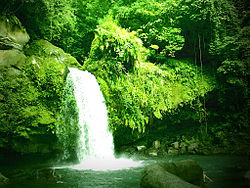
- Taytay Falls: Also known as Majayjay Falls or even Imelda Falls because ex-First Lady Imelda Marcos financed the promotion of tourism in this place. It is a two-story high fall located in a forested area.
- Puente de Capriccio: In José Rizal's El Filibusterismo, he mentioned an old Spanish stone bridge built in 1851. It was a one-arch bridge since it was not finished. Early natives built a bamboo footbridge to connect the opposite sides to make it accessible. Puente de Capriccio was initiated by Spanish Franciscan priest Victoriano del Moral. The priest was cruel and autocratic; anyone who did not labor in the construction would be later punished by whipping the buttocks. The workers were reportedly not paid a single centavo. Because of his cruelty, the workers campaigned against him; thus, the bridge's construction never resumed after 1851. The bridge still stands firm today, crossing the Olla River. It is called Tulay ng Pige (Bridge of Buttocks) by residents. The bridge now symbolizes the defiance of Filipino workers against the oppressive Spanish colonialists during the colonial period.
- Mount Banahaw: Majayjay is located at the foot of this mountain. In the early Spanish era, Mount Banahaw was called Monte de Majayjay, because it was the only way to travel to the mountain. Many European elites visited the town for Mount Banahaw.
- Bukal Falls: Popular among most tourists as the Enchanted Falls.
- Botocan Hydroelectric Power Plant and Dam: It is the first hydroelectric power plant constructed in the Philippines in the 20th century (1930). It is now owned by the CBK Power Company Limited.
- Ermita Church: Then, a tribunal. This holy place houses the image of Nuestra Señora de la Portería.
- Our Lady of the Gate Grotto: Situated along the Olla riverbank is a sacred place where masses are held at times. It is a small tourist destination for religious excursionists.
Culture
Festivals
Majayjay Day is celebrated every year on October 2 as part of the celebration of the town's founding anniversary. It features off-farm and agricultural products produced primarily from the town's 40 barangays. In 2016, this day was revamped as the AniLinang Festival, with the first such festival under this name held on October 2 that year as an initiative of the local government to promote the town's laid-back and peaceful way of life reflected in its agricultural produce and indigenous cuisines.
SaGreMa Festival (from the syllabic abbreviation of San Gregorio Magno Majayjay) is a parochial festivity celebrated on September 3, the day when Saint Gregory, the town's patron saint, became a pope, and March 12, the day he died. In the festival, Majayjayeños honor the saint for the fortunes of their town.
Transportation

The town can be accessed by four entry points: Magdalena-Majayjay Road to the north, Liliw-Majayjay Road to the west, Luisiana-Majayjay Road to the east, and Lucban-Majayjay Road to the south. Public utility vehicles, such as local jeepneys and tricycles, are modes of public transportation in the municipality.
Jeepney Routes
Infrastructure
Communication
The town of Majayjay has different communication lines, including PLDT, and cellular communications such as Globe, Smart, and DITO.
Education
The Majayjay Schools District Office, led by PSDS Dr. Ginalyn B. Freo, governs all educational institutions within the municipality. It oversees the management and operations of all private and public, from primary to secondary schools.
| School Name | School Head / Teacher-in-Charge | No. Of School Personnel |
|---|---|---|
| Bakia-Botocan Elementary School | Rizza-Lyn S. Rada | 10 |
| Bukal Elementary School | Jingle A. Moneda | 12 |
| Gagalot-Taytay Elementary School | Marie B. Sotalbo | 12 |
| Gagalot-Taytay ES Annex | Ramilo M. Aquino | 10 |
| Gold Rich Learning School Inc. | Adelaida B. Polecina | 5 |
| Liceo De Majayjay | N/A | N/A |
| Majayjay Elementary School | Dr. Edelita L. Artillero | 55 |
| Sta. Catalina Elementary School | Primo C. Royo | 24 |
| Suba Elementary School | Angelita U. Suerte | 20 |
| Suba ES - Munting Kawayan Annex | Angelita M. Vinas | 10 |
| School Name | School Head / Teacher-in-Charge | No. Of School Personnel |
|---|---|---|
| Liceo De Majayjay | N/A | N/A |
| Sta. Catalina Intergrated National High School | Laurita P, Arca, PhD. | 79 |
| Sta. Catalina National High School Bakia-Botocan Ext. | Marian Z. Arsolacia | 8 |
| Suba National High School | Ellenor T. Lat | 20 |
| Suba National High School Gagalot Annex | Alberto B. Emata, PhD | 8 |
Government

Elected officials
| Majayjay Municipal Officials (2025–2028) | ||||
|---|---|---|---|---|
| Name | Party | Term of office | ||
| Start | End | |||
| Municipal Mayor | ||||
| Romeo P. Amorado | Lakas–CMD | 30 June 2025 | 30 June 2028 | |
| Municipal Vice Mayor | ||||
| Juan Ariel A. Argañosa Jr. | Lakas–CMD | 30 June 2025 | 30 June 2028 | |
| Member of the Municipal Council | ||||
| Felix U. Arnuco | Lakas–CMD | 30 June 2025 | 30 June 2028 | |
| Edison S. Reyes | AKAY | 30 June 2025 | 30 June 2028 | |
| Gabriel A. Mentilla | NUP | 30 June 2025 | 30 June 2028 | |
| Ma. Esperanza Z. Bravante | Lakas–CMD | 30 June 2025 | 30 June 2028 | |
| Ma. Fe B. Cabonce | Lakas–CMD | 30 June 2025 | 30 June 2028 | |
| Elfredo A. Bicomong | Lakas–CMD | 30 June 2025 | 30 June 2028 | |
| Dandred O. Eriga | Lakas–CMD | 30 June 2025 | 30 June 2028 | |
| Jauncho M. Andaya | Lakas–CMD | 30 June 2025 | 30 June 2028 | |
| ABC Federation President | ||||
| Margarito P. Gripo | Nonpartisan (Oobi) | 15 December 2023 | ||
| SK Federation President | ||||
| Brian E. Fresco | Nonpartisan (Oobi) | 14 November 2023 |
Notable people
- Gustavo Tobler (1834-1875), merchant and coffee planter from Switzerland
External links
- 2012-05-23 at theWayback Machine