Margalla Hills
In-game article clicks load inline without leaving the challenge.
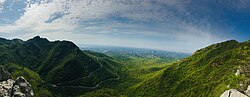
The Margalla Hills is a hill range within the Margalla Hills National Park in the northwestern Punjab region in Pakistan, forming the northern edge of the Islamabad Capital Territory, just south of Haripur district of Khyber Pakhtunkhwa. They are part of the Himalayan foothills on the Himalayan biodiversity hotspot and form a subtropical moist broadleaf forest ecoregion. The Margalla range has an area of 12,605 hectares.
Climate
This region falls in the Humid subtropical climate zone. The average annual rainfall in the Islamabad area is 1,457 millimetres (57.4 in). Much of the high rainfall is delivered here from the moisture laden air of the bay of Bengal hitting the lower Himalayas.
Paleontology and archeology
According to the research carried out by scientists and archaeologists of the project "Post-Earthquake Explorations of Human Remains in Margalla Hills", the formation of the Margalla Hills dates to the Miocene epoch. The dominant limestone of the Margalla is mixed with sandstone and occasional minor beds of shale. The archaeologists of the project have also found two human footprints over one million years old here, preserved in sands.
The Shah Allah Ditta Caves are also part of its ancient history. This cave is about 2500 years old and is believed that Alexander The Great as well as several other emperors used this route to either pass by or pass into this area. The cave also have Buddhist-era murals dating to at least 2400 before present. The cave has seven alcoves of different sizes for lamps which are still conserved today. Furthermore, one of the paintings found within the cave is of the Hindu god Shiva.
Flora

There are around 250 to 300 species of plants on the Margalla Hills. As many as two-thirds of them are used by the people for their medicinal effects to treat or cure various diseases.
There are several species of native trees in hills, some of the trees in the lower slopes include species like the bombax ceiba, ficus benghalensis, ficus lacor, ficus racemosa, ficus palmata, ficus religiosa, ficus auriculata, cassia fistula, Alstonia scholaris, bauhinia variegata, prunus cerasoides, butea monosperma, syzygium cumini, erythrina suberosa, sterculia diversifolia, melia azedarach, morus alba, toona ciliata, flacourtia indica, lannea coromandelica, mallotus philippensis, phyllanthus emblica, pyrus pashia and many others, the upper slopes are dominated by pinus roxburghii and dodonaea viscosa.
There is high diversity of the other plants as well including cannabis ssp., adhatoda vasica, Rhododendron arboreum, Hypericum oblongifolium, ajuga ssp., Tulipa clusiana, Woodfordia fruticosa, fabaceae ssp., Nelumbo nucifera, Gloriosa superba, Sauromatum venosum, Malva sylvestris, Hedera nepalensis as well as the bamboo species Dendrocalamus strictus.
- Ficus religiosa in the Margalla hills
- ficus benghalensis in Margalla hills.
- Old Banyan tree in the hills
- Fruiting ficus racemosa tree near the hills.
- Forested stream.
- Humid lowland forests along a trail.
- Open highland forests.
Fauna
There have been 431 bird species recorded in and around Margalla hills, some of them include the blue-throated barbet, coppersmith barbet, great barbet, plum-headed parakeet, rose-ringed parakeet, slaty-headed parakeet, Indian pitta, Indian paradise flycatcher, spotted forktail, Indian pied myna, rusty-cheeked scimitar babbler, rufous-bellied niltava, verditer flycatcher, blue-throated blue flycatcher, crimson sunbird, Mrs. Gould's sunbird, purple sunbird, kalij pheasant, Asian koel, orange-headed thrush, rufous treepie, Indian pond heron, scarlet minivet, wire-tailed swallow, Himalayan bulbul, Indian white-eye, brahminy starling, white-capped redstart, Oriental magpie-robin, red-vented bulbul and others.
There are around 30 or more mammal species here, some of the herbivores include the rhesus macaque, Indian boar, Northern red muntjac, Indian flying fox, Kashmir flying squirrel, Indian crested porcupine, and grey goral, carnivores include the Indian leopard, Indian wolf, golden jackal, yellow-throated marten, masked palm civet, small Indian civet, red fox, jungle cat and leopard cat.
There are many butterfly species in and around these hills like the papilio protenor, papilio polyctor, vagrans egista, graphium sarpedon, hypolimnas bolina, pseudergolis wedah, symbrenthia lilaea, arhopala rama, catopsilia pomona, charaxes agrarius as well as the Tajuria cippus.
- Blue-throated blue flycatcher in the Margalla hills
- Blue-throated barbet in the hills.
- Papilio polyctor, one of the butterfly species in the hills.
- Rhesus macaques near the Daman-e-Koh tourist area.
- A crimson sunbird in the hills.
- Kalij pheasant in the undergrowth.
Bird watching
The Margallas are an excellent place for bird watchers. The area is home to a large number of birds, including robins, sparrows, kites, crows, larks, paradise flycatchers, black partridge, shrikes, pheasants, spotted doves, Egyptian vultures, falcons, hawks, eagles, Himalayan griffon vulture, laggar falcon, peregrine falcon, kestrel, Indian sparrow hawk, white cheeked bulbul, yellow vented bulbul, cheer pheasant, khalij pheasant, golden oriole, collared dove, wheatears and buntings.
The cheer pheasant, indigenous to the Khyber Pakhtunkhwa, was being reared in Margalla Hills as a part of conservation campaign by the World Pheasant Association and Capital Development Authority.
Environmental conservation
The ecology of Margallas faces threats from quarrying by stone-crushing plants, deforestation, illegal encroachments, and buildings, and poachers. Crush plants situated around the hills near Taxila are busy eroding the hills for extracting building material. Deforestation is resulting from fires and illegal felling of trees.

Margalla Hills Society
The Margalla Hills Society was established in 1989.
World Wildlife Fund (WWF) Pakistan
The WWF-Pakistan's 'Green School Programme', in collaboration with the Capital Development Authority (CDA), carries out 'Eco-Adventure Activities' on the Margalla hills to raise awareness in the school children regarding the conservation of natural environment and about the importance of being environmentally responsible.

Events
- On 28 July 2010, Airblue Flight 202, an Airbus A321 operating a domestic flight from Jinnah International Airport in Karachi to Benazir Bhutto International Airport in Islamabad, crashed into the Margalla Hills, killing all 152 people on board.
- On 6 January 2012, snowfall over Margalla Hills.
- On 11 February 2016, snowfall over Margalla Hills.

Places in Margalla Hills
See also
- Margalla Hills National Park
- Birds of Islamabad
- Airblue Flight 202
- Faisal Mosque
- List of ecoregions in Pakistan
- Indomalayan realm
- Himalayan subtropical broadleaf forests
- Terai–Duar savanna and grasslands
- Meghalaya subtropical forests
- Mizoram–Manipur–Kachin rain forests
- Western Himalayan broadleaf forests
- Aravalli West Thorn Scrub Forests