Chabacano metro station
In-game article clicks load inline without leaving the challenge.
Chabacano metro station is a transfer station on the Mexico City Metro in Cuauhtémoc, Mexico City. It is a combined underground and at-grade station with two side platforms and one island platform, employing the Spanish solution layout. It serves Lines 2 (the Blue Line), 8 (the Green Line), and 9 (the Brown Line).
Chabacano metro station is located between San Antonio Abad and Viaducto stations on Line 2, between Obrera and La Viga stations on Line 8, and between Lázaro Cárdenas and Jamaica stations on Line 9. It serves the colonias (neighborhoods) of Ampliación Asturias, Obrera, and Vista Alegre. The station's pictogram features an apricot and its name derives from a nearby street that once had several apricot trees.
Chabacano metro station opened on 1 August 1970, initially providing northbound service on Line 2 toward Pino Suárez metro station and southbound service toward Tasqueña station. Service on Line 9, running west to east from Centro Médico to Pantitlán, began on 26 August 1987. Line 8 service, with trains running southeast toward Constitución de 1917 station and north toward Garibaldi station, commenced on 20 July 1994. The Line 2 station was rebuilt when the transfer facilities were constructed.
The station is accessible to people with disabilities, with elevators, escalators and wheelchair ramps. Outside, several local bus routes serve the area. Inside are an Internet café, an information desk, a cultural showcase, a private library, and a mural titled Civilización y Cultura by José de Guimarães. The station was used as a filming location for the 1990 film Total Recall, starring Arnold Schwarzenegger. Javier Álvarez named a composition after the station. In 2025, the station recorded an average of 32,793 daily entries.
Location and layout
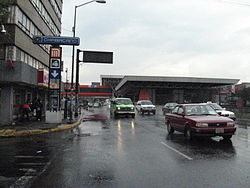
Chabacano is a transfer metro station, located in the Cuauhtémoc borough, in central Mexico City. It is situated along Calzada de Tlalpan (Line 2), beneath Calle Juan A. Mateos (Line 8) and beneath Eje 3 Sur – Calzada Chabacano (Line 9). The station serves three colonias (neighborhoods) of Ampliación Asturias, Obrera, and Vista Alegre. The station is named after the avenue of the same name, which once had several apricot trees, and its pictogram features the silhouette of its fruit. Chabacano means "apricot" in Mexican Spanish; in other regions, it can mean "tacky" or "vulgar".
Chabacano metro station serves as an interchange for three lines. It is located between San Antonio Abad and Viaducto stations on Line 2, between Obrera and La Viga stations on Line 8, and between Lázaro Cárdenas and Jamaica stations on Line 9.
Several bus routes serve the station. The Red de Transporte de Pasajeros (RTP) bus system includes Routes 2-A, 31-B, 33, 111-A, and 145-A, while the public bus system includes Routes 9-C, 9-E, 14-A, 17-C, 17-H, and 17-I.
Chabacano metro station has multiple exits serving its various lines. For Line 2, there are two exits: the eastern exit is located between Calle Juan A. Mateos, Calzada Chabacano, and Avenida San Antonio Abad in Colonia Vista Alegre, while the western exit is located between Calle Manuel Caballero, Calle Antonio Solís, and Avenida San Antonio Abad in Colonia Obrera.
Line 8 has three exits: north, southeast, and southwest. These are located at the respective corners of Calle Juan A. Mateos and Calle Vicente Beristain in Colonia Vista Alegre. Line 9 has four exits: the northeast and southeast exits are located at the corners of Calzada Chabacano and Calle J. Antonio Torres X in Colonia Vista Alegre, while the northwest and southwest exits are at the corners of Calzada Chabacano and Calle Francisco Ayala in Colonia Ampliación Asturias.
Unlike the system's other transfer stations, which are linked by underground tunnels, the transfer passageway between Lines 2 and 9 is elevated due to limited space for a tunnel. The bridge crosses several houses and streets and is 200 meters (660 ft) long. Commuters using Line 8 must navigate two additional sets of stairs that connect to a tunnel running between Calle Francisco Ayala and Calle Vicente Beristain.
History and construction

Line 2
The line was built by Ingeniería de Sistemas de Transportes Metropolitano, Electrometro and Cometro, the latter being a subsidiary of Empresas ICA. Chabacano station opened on 1 August 1970, as part of the inaugural Pino Suárez–Tasqueña service. The station was built at grade level with a design similar to other stations in the at-grade section, including an island platform. The section between Chabacano and San Antonio Abad is 642 meters (2,106 ft) long, while the section between Chabacano and Viaducto measures 774 meters (2,539 ft).
When construction of Lines 8 and 9 began, the station was rebuilt to improve passenger boarding and alighting. The Spanish solution was implemented across all platforms, whereby alighting passengers use the central platform, while boarding passengers use the side platforms on the opposite side of the train. The station offers accessibility features, including four elevators.
As part of preparations for the 2026 FIFA World Cup, authorities implemented partial closures at the station starting on 9 February 2026, to carry out rehabilitation work on the line.
Line 8
ICA built the line, whose first and only section opened on 20 July 1994, running from Garibaldi to Constitución de 1917. Chabacano is an underground station; the tunnel between Chabacano and Obrera is 1,143 meters (3,750 ft) long, while the section between Chabacano and La Viga measures 843 meters (2,766 ft).
Line 9
Cometro built the line, whose first section, including Chabacano, opened on 26 August 1987, running from Centro Médico towards Pantitlán station. Chabacano is an underground station; the tunnel to Lázaro Cárdenas is 1,000 meters (3,300 ft) long, while the tunnel toward Jamaica measures 1,031 meters (3,383 ft) long.
The station provides accessible facilities, including wheelchair ramps, two elevators, and escalators. These facilities were renovated in 2021 to address obsolescence.
Incidents
On 28 December 2010, an elderly passenger attempting to help two people who had dropped their belongings onto the tracks fell onto the rails and was struck and killed by an approaching Line 2 train. On 4 June 2018, a law student was arrested for attempting to access the Benito Juárez library inside the station after the station manager denied him entry, stating that it was reserved for metro personnel. The public prosecutor’s office declined to pursue charges, deeming the restriction unjustified under the City Libraries Code, as the facility is located in a public space. Metro authorities later clarified that the library is open to the general public upon registration.
On 12 September 2020, the station was vandalized by feminists protesting reported cases of harassment and restrictions on street vendors within the metro system. Following the collapse of a bridge on Line 12, which resulted in 26 deaths, demonstrators vandalized the station again and assaulted metro staff, whom they held responsible for the accident. On 1 April 2022, a woman slipped on an escalator, triggering a chain reaction that knocked down seven other people, all of whom sustained minor injuries.
Landmarks, cultural events and popular culture


The station includes an Internet café, an information desk, a cultural display, a private library, and a mural titled Civilización y Cultura (English: "Culture and Civilization") by Portuguese artist José de Guimarães. Created on a 120-square-meter (1,300 sq ft) ceramic surface, the mural is divided into two sections and is located on Line 9. Inaugurated on 6 November 1996, it features elements from the pre-Hispanic cultures of Mesoamerica. According to de Guimarães, "two fundamental archetypes have prevailed throughout the centuries [in pre-Hispanic culture in Mexico]: the serpent as a symbol of water-life and the jaguar as a symbol of earth-fertility. Without these two important elements for man, history would not take place".
Due to its size, Chabacano metro station has held cultural programs in its lobby. The station has hosted mini-concerts featuring musicians such as Trans-X, Ji-Hae Park, and the Orquesta Sinfónica de Yucatán.
Scenes from the 1990 film Total Recall were filmed at the station at night. Starring Arnold Schwarzenegger and set in the year 2084. The film depicts a future in which humanity has colonized Mars. In one scene on Earth, Douglas Quaid, a secret agent with erased memories, escapes from attackers by entering a subway station and leaping through the window of an outbound train. During filming, Schwarzenegger accidentally cut his wrist when the crew failed to detonate the window on time. To transform the building for the scene, the film crew painted the walls and a train in cement gray, covered the signage, and added monitors throughout the station. Mexican composer Javier Álvarez named one of his compositions after the metro station. It was played live by the Cuarteto Latinoamericano at the station during an exhibition in September 1991.
By 2020, the station and its surrounding area had become a popular location for buying and selling used and vintage clothing, particularly on weekends.
Ridership

According to official data, Line 2 records higher usage than Lines 8 and 9, which are among the least accessed in the system. Prior to the impact of the COVID-19 pandemic the station recorded a total ridership of 15,920,404 passengers in 2019, averaging 43,584 daily entries.
By line, Line 2 recorded 7,932,688 passengers in 2025, averaging 21,733 per day. Line 8 recorded 1,273,326 passengers, averaging 3,488 per day. Line 9 recorded 2,763,641 passengers, averaging 7,571 per day. System authorities estimated that an average of 83,000 passengers used the station daily in 2021.
In 2025, when considered individually among the system's 195 stations, the Line 2 station ranked 47th busiest; the Line 8 station ranked 188th in the system, while the Line 9 station ranked 155th.
| Annual passenger ridership (Line 2) | |||||
|---|---|---|---|---|---|
| Year | Ridership | Average daily | Rank | % change | Ref. |
| 2025 | 7,932,688 | 21,733 | 47/195 | +12.40% | |
| 2024 | 7,057,566 | 19,282 | 53/195 | −11.84% | |
| 2023 | 8,005,603 | 21,933 | 43/195 | +9.53% | |
| 2022 | 8,005,603 | 20,024 | 43/195 | +62.52% | |
| 2021 | 4,497,267 | 12,321 | 61/195 | −32.96% | |
| 2020 | 6,707,998 | 18,327 | 34/195 | −35.83% | |
| 2019 | 10,452,786 | 28,637 | 47/195 | −3.49% | |
| 2018 | 10,831,155 | 29,674 | 45/195 | +5.52% | |
| 2017 | 10,264,980 | 28,123 | 47/195 | −0.07% | |
| 2016 | 10,272,203 | 28,066 | 49/195 | +0.34% |
| Annual passenger ridership (Line 8) | |||||
|---|---|---|---|---|---|
| Year | Ridership | Average daily | Rank | % change | Ref. |
| 2025 | 1,273,326 | 3,488 | 188/195 | −0.78% | |
| 2024 | 1,283,378 | 3,506 | 180/195 | −13.23% | |
| 2023 | 1,479,067 | 4,052 | 170/195 | +26.33% | |
| 2022 | 1,170,770 | 3,207 | 171/195 | +18.48% | |
| 2021 | 988,177 | 2,707 | 177/195 | +11.73% | |
| 2020 | 884,432 | 2,416 | 189/195 | −43.12% | |
| 2019 | 1,554,977 | 4,260 | 191/195 | −1.02% | |
| 2018 | 1,571,045 | 4,304 | 191/195 | +10.33% | |
| 2017 | 1,424,001 | 3,901 | 191/195 | +2.15% | |
| 2016 | 1,394,042 | 3,808 | 191/195 | +0.44% |
| Annual passenger ridership (Line 9) | |||||
|---|---|---|---|---|---|
| Year | Ridership | Average daily | Rank | % change | Ref. |
| 2025 | 2,763,641 | 7,571 | 155/195 | +15.07% | |
| 2024 | 2,401,683 | 6,561 | 155/195 | −21.87% | |
| 2023 | 3,073,903 | 8,421 | 132/195 | −0.58% | |
| 2022 | 3,091,961 | 8,471 | 128/195 | +9.90% | |
| 2021 | 2,813,390 | 7,707 | 117/195 | +32.75% | |
| 2020 | 2,119,283 | 5,790 | 150/195 | −45.83% | |
| 2019 | 3,912,641 | 10,719 | 150/195 | −2.54% | |
| 2018 | 4,014,545 | 10,998 | 146/195 | +0.42% | |
| 2017 | 3,997,946 | 10,953 | 143/195 | −0.01% | |
| 2016 | 3,998,201 | 10,924 | 144/195 | +0.59% |
Notes
External links
- Media related to Estación Chabacano (Metro de México) at Wikimedia Commons
- The dictionary definition of chabacano at Wiktionary
- . At the Official Guide to Mexico City.