Nagano Prefecture
In-game article clicks load inline without leaving the challenge.
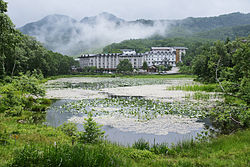
Nagano Prefecture(長野県, Nagano-ken; Japanese pronunciation: [naꜜɡano,naɡanoꜜkeɴ]) is a landlocked prefecture of Japan located in the Chūbu region of Honshu. It has a population of 2,007,682 as of 1 July 2023[update] and a geographic area of 13,561.56 square kilometres (5,236.15 sq mi). It borders Niigata Prefecture to the north, Gunma Prefecture to the northeast, Saitama Prefecture to the east, Yamanashi Prefecture to the southeast, Shizuoka Prefecture and Aichi Prefecture to the south, and Gifu Prefecture and Toyama Prefecture to the west.
Nagano is the prefecture's capital and largest city, with other major cities including Matsumoto, Ueda, and Iida. The prefecture is known for its impressive highland areas of the Japanese Alps, including most of the Hida Mountains, Kiso Mountains, and Akaishi Mountains, which extend into neighbouring prefectures; it contains nine of the twelve highest mountains in Japan. Its mountain ranges, natural scenery, and history have gained the prefecture international recognition as a winter sports tourist destination, and it received further attention as the host of the 1998 Winter Olympics. It is served by the Hokuriku Shinkansen railway line with direct services to Tokyo, Toyama, and Kanazawa.
History
Geography
Nagano Prefecture is landlocked and borders more prefectures than any other in Japan: Niigata Prefecture to the north, Gunma Prefecture to the northeast, Saitama Prefecture to the east, Yamanashi Prefecture to the southeast, Shizuoka Prefecture and Aichi Prefecture to the south, and Gifu Prefecture and Toyama Prefecture to the west. It contains the point furthest from the sea in all of Japan, located in the city of Saku. Its mountains have made it relatively isolated, and many visitors come for its mountain resorts and hot springs. Nine of the twelve highest mountains in Japan can be found in Nagano and one of its lakes, Lake Kizaki, is a beach resort popular for its water attractions and games. The climate is predominantly alpine with warm summers, cold snowy winters, and less intense humidity than the lower coastal areas.
As of 1 April 2014[update], 21% of the total land area of the prefecture are natural parks, namely the Chichibu Tama Kai, Chūbu-Sangaku, Jōshin'etsu-kōgen, and Minami Alps national parks; Myōgi-Arafune-Saku Kōgen, Tenryū-Okumikawa, and Yatsugatake-Chūshin Kōgen quasi-national parks; and Chūō Alps, Enrei Ōjō, Hijiriyama Kōgen, Mibugawa Suikei, Ontake, and Tenryū Koshibu Suikei prefectural natural parks.
Cities


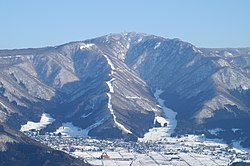
Nineteen cities are located in Nagano Prefecture:
- Azumino
- Chikuma
- Chino
- Iida
- Iiyama
- Ina
- Komagane
- Komoro
- Matsumoto
- Nagano (capital)
- Nakano
- Okaya
- Ōmachi
- Saku
- Shiojiri
- Suwa
- Suzaka
- Tōmi
- Ueda
Towns and villages
These are the towns and villages in each district:
- Chiisagata District Aoki Nagawa
- Hanishina District Sakaki
- Higashichikuma District Asahi Chikuhoku Ikusaka Omi Yamagata
- Kamiina District Iijima Minamiminowa Minowa Miyada Nakagawa Tatsuno
- Kamiminochi District Iizuna Ogawa Shinano
- Kamitakai District Obuse Takayama
- Kiso District Agematsu Kiso (village) Kiso (town) Nagiso Ōkuwa Ōtaki
- Kitaazumi District Hakuba Ikeda Matsukawa Otari
- Kitasaku District Karuizawa Miyota Tateshina
- Minamisaku District Kawakami Kitaaiki Koumi Minamiaiki Minamimaki Sakuho
- Shimoina District Achi Anan Hiraya Matsukawa Neba Ōshika Shimojō Takagi Takamori Tenryū Toyooka Urugi Yasuoka
- Shimominochi District Sakae
- Shimotakai District Kijimadaira Nozawaonsen Yamanouchi
- Suwa District Fujimi Hara Shimosuwa
Mergers
Demographics

| Year | Pop. | ±% p.a. |
|---|---|---|
| 1880 | 1,000,414 | — |
| 1890 | 1,146,071 | +1.37% |
| 1903 | 1,348,556 | +1.26% |
| 1913 | 1,484,205 | +0.96% |
| 1920 | 1,562,722 | +0.74% |
| 1925 | 1,629,217 | +0.84% |
| 1930 | 1,717,118 | +1.06% |
| 1935 | 1,714,000 | −0.04% |
| 1940 | 1,710,729 | −0.04% |
| 1945 | 2,121,050 | +4.39% |
| 1950 | 2,060,831 | −0.57% |
| 1955 | 2,021,292 | −0.39% |
| 1960 | 1,981,433 | −0.40% |
| 1965 | 1,958,007 | −0.24% |
| 1970 | 1,956,917 | −0.01% |
| 1975 | 2,017,564 | +0.61% |
| 1980 | 2,083,934 | +0.65% |
| 1985 | 2,136,927 | +0.50% |
| 1990 | 2,156,627 | +0.18% |
| 1995 | 2,193,984 | +0.34% |
| 2000 | 2,215,168 | +0.19% |
| 2005 | 2,196,114 | −0.17% |
| 2010 | 2,152,449 | −0.40% |
| 2015 | 2,099,759 | −0.49% |
| 2020 | 2,052,493 | −0.45% |
| source: |
The life expectancy in Nagano Prefecture is the highest nationwide, with an average life expectancy of 87.18 years for women and 80.88 years for men.
Transportation
Railway
- Central Japan Railway Company Chūō Main Line (west line) Iida Line
- East Japan Railway Company Chūō Main Line (east line) Hokuriku Shinkansen Koumi Line Ōito Line (from Matsumoto to Minami-Otari) Shin'etsu Main Line Shinonoi Line
- Matsumoto Electric Railway Kamikōchi Line
- Nagano Electric Railway Nagano Line
- Shinano Railway Shinano Railway Line
- Ueda Dentetsu Bessho Line
- West Japan Railway Company Ōito Line (from Minami-Otari to Itoigawa)
- Hokuriku Shinkansen
- Iida Line
- Shinano Railway
- Nagano Electric Railway
Road
Expressways
- Chubu-jukan Expressway
- Chubu-odan Expressway
- Chuo Expressway
- Joshinetsu Expressway
- Nagano Expressway
- Sanen-nanshin Expressway
National highways
- Route 18
- Route 19 (Nagano-Matsumoto-Shioriri-Nagiso-Nakatsugawa-Tajimi-Nagoya)
- Route 20 (Matsumoto-Suwa-Kofu-Otsuki-Hachioji-Nihonbashi of Tokyo)
- Route 117
- Route 141
- Route 142
- Route 143 (Matsumoto-Azumino-Ueda)
- Route 144
- Route 147 (Matsumoto-Omachi)
- Route 148 (Omachi-Itoigawa)
- Route 151 (Iida-Shinshiro-Toyohashi)
- Route 152
- Route 153 (Nagoya-Toyota-Iida-Shioriri)
- Route 158 (Fukui-Gujo-Takayama-Matsumoto)
- Route 254
- Route 256 (Gifu-Gujo-Gero-Nakatsugawa-Nagiso-Iida)
- Route 403
- Route 406 (Omachi-Hakuba-Nagano-Susaka-Tsumagoi-Takasaki)
- Route 418 (Ono-Seki-Ena-Iida)
Airports
The prefecture is home to Matsumoto Airport, its only main airport, though it provides only limited domestic routes. However, other airports in nearby prefectures such as Chubu Centrair International Airport in Aichi, Shizuoka Airport in Shizuoka, Toyama Airport in Toyama, and Haneda Airport and Narita Airport in Tokyo are also used by travellers from the prefecture.
Education
Universities
Public
- Shinshu University (National)
- Nagano College of Nursing (Prefectural)
- The University of Nagano (Prefectural)
- Nagano University [Municipal (Ueda City)]
- Suwa Tokyo University of Science [Municipal (Chino City)]
Private
- Matsumoto University (Private)
- Matsumoto Dental University (Private)
- Saku University (Private)
- Seisen Jogakuin College (Private)
Economy
Nagano Prefecture has a large and diversified economy, with a strong focus on electronics, information technology, precision machinery, agriculture and food products, and tourism, with a total GDP of about ¥8.5trillion (2017). Several large Japanese companies have production facilities in Nagano Prefecture, such as Citizen Watch, MinebeaMitsumi, Seiko Epson, and Vaio.
Tourism
- Five Mountains of Northern Shinshu
- Kamikōchi
- Lake Kizaki
- Lake Suwa
- Mount Kirigamine
- Suwa-taisha, one of the oldest shrines in Japan
- Matsumoto Castle, one of Japan's national treasures
- One of the world's highest geysers (40–50 meters) in Suwa
- Zenkō-ji temple
- Zenkō-ji
- Onbashira Festival, held once every seven years
- Yashima Wetland in Kirigamine Hill
- Matsumoto Castle
- Utsukushigahara Hills
- Ski resort in Shiga Hills
Sports

There are two local J.League clubs: AC Nagano Parceiro and Matsumoto Yamaga FC.[citation needed]
Prefectural symbols
- Gentian
- Japanese serow
- Ptarmigan
- Siberian Silver Birch
- Shinano no Kuni (prefecture song)
Sister regions
- Taiwan Changhua County, Taiwan, since 2008
- United States Colorado, United States
- China Hebei, China
Notable people
- Yuto Adachi, member of South Korean boy band Pentagon
- Glim Spanky, rock band
- Yasuyuki Kazama, drift driver
- Tadamichi Kuribayashi, Imperial Japanese Army general
- Jun'ya "ZUN" Ota, video game developer
- Yasuo Tanaka, independent politician and former governor of Nagano
- Keiichi Tsuchiya, racing driver
- Bumpei Usui, artist
- Takashi Yamazaki, filmmaker
- Tatsumi Yoda, former chairman of Avex
See also
Notes
- Nussbaum, Louis-Frédéric and Käthe Roth. (2005). Cambridge: Harvard University Press. ISBN 978-0-674-01753-5;
External links
- Media related to Nagano Prefecture at Wikimedia Commons
- (in Japanese)
- (in English)
- (in English)
36°15′N 138°6′E/36.250°N 138.100°E/ 36.250; 138.100