Dynasty
In-game article clicks load inline without leaving the challenge.

A dynasty is a sequence of rulers from the same family, usually in the context of a monarchical system, but sometimes also appearing in republics. A "house" is an imperial, royal or noble family, not always ruling. Historians periodize the histories of many states and civilizations, such as the Roman Empire (27BCE – 1453CE), Imperial Iran (678BCE – 1979CE), Ancient Egypt (3100–30BCE), and Ancient and Imperial China (2070BCE – 1912CE), using a framework of successive dynasties. As such, the term "dynasty" may be used to delimit the era during which a family reigned.
Before the 18th century, most dynasties throughout the world were traditionally reckoned patrilineally, such as those that followed the Frankish Salic law. In polities where it was permitted, succession through a daughter usually established a new dynasty in her husband's family name. This has changed in all of Europe's remaining monarchies, where succession law and conventions have maintained dynastic names de jure through a female.
Terminology
The word "dynasty" (from the Greek:δυναστεία, dynasteía "power", "lordship", from dynástes "ruler") is sometimes used informally for people who are not rulers but are, for example, members of a family with influence and power in other areas, such as a series of successive owners of a major company, or any family with a legacy, such as a dynasty of poets or actors. It is also extended to unrelated people, such as major poets of the same school or various rosters of a single sports team.
The dynastic family or lineage may be known as a "noble house", which may be styled as "imperial", "royal", "princely", "ducal", "comital" or "baronial", depending upon the chief or present title borne by its members, but it is more often referred by adding the name afterwards, as in "House of Habsburg".
Dynast

A ruler from a dynasty is sometimes referred to as a "dynast", but this term is also used to describe any member of a reigning family who retains a right to succeed to a throne. For example, King Edward VIII ceased to be a dynast of the House of Windsor following his abdication.
In historical and monarchist references to formerly reigning families, a "dynast" is a family member who would have had succession rights, were the monarchy's rules still in force. For example, after the 1914 assassinations of Archduke Franz Ferdinand of Austria and his morganatic wife, their son Maximilian, Duke of Hohenberg, was bypassed for the Austro-Hungarian throne because he was not a Habsburg dynast. Even after the abolition of the Austrian monarchy, Duke Maximilian and his descendants have not been considered the rightful pretenders by Austrian monarchists, nor have they claimed that position.
The term "dynast" is sometimes used only to refer to agnatic descendants of a realm's monarchs, and sometimes to include those who hold succession rights through cognatic royal descent. The term can therefore describe overlapping but distinct sets of people. For example, David Armstrong-Jones, 2nd Earl of Snowdon, a nephew of Queen Elizabeth II, is in the line of succession to the British crown, making him a British dynast. On the other hand, since he is not a patrilineal member of the British royal family, he is not a dynast of the House of Windsor.
Comparatively, the German aristocrat Prince Ernst August of Hanover, a male-line descendant of King George III, possesses no legal British name, titles or styles (although he is entitled to reclaim the former royal dukedom of Cumberland). He was born in the line of succession to the British throne and was bound by Britain's Royal Marriages Act 1772 until it was repealed when the Succession to the Crown Act 2013 took effect on 26 March 2015. Thus, he requested and obtained formal permission from Queen Elizabeth II to marry the Roman Catholic Princess Caroline of Monaco in 1999. Yet, a clause of the English Act of Settlement 1701 remained in effect at that time, stipulating that dynasts who marry Roman Catholics are considered "dead" for succession to the British throne. That exclusion, too, ceased to apply on 26 March 2015, with retroactive effect for those who had been dynasts before triggering it by marriage to a Roman Catholic.
Dynastic marriage
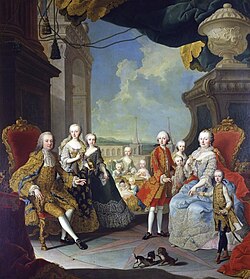
A "dynastic marriage" is one that complies with monarchical house law restrictions, so that the descendants are eligible to inherit the throne or other royal privileges. For example, the marriage of King Willem-Alexander of the Netherlands to Máxima Zorreguieta in 2002 was dynastic, making their eldest child, Princess Catharina-Amalia, the heir apparent to the Crown of the Netherlands. The marriage of his younger brother, Prince Friso of Orange-Nassau, in 2003 lacked government support and parliamentary approval. Thus, Prince Friso forfeited his place in the order of succession to the Dutch throne, and consequently lost his title as a "Prince of the Netherlands", and left his children without dynastic rights.
The Pragmatic Sanction of 1713 was an edict issued by Holy Roman Emperor Charles VI on 19 April 1713 to ensure that the Habsburg monarchy could be inherited by his daughter undivided (see agnatic-cognatic primogeniture). In 1736, Francis Stephen of Lorraine married Archduchess Maria Theresa of Austria, the sole heir of Emperor Charles VI. With the marriage of Maria Theresa, the only offspring of the House of Austria, she became together with her husband the founder of the new dynasty of the House of Habsburg-Lorraine. Since 1740 he was her co-regent in the Habsburg hereditary lands and from 1745 he was Holy Roman Emperor as Francis I, but was hardly involved in government affairs. Francis was as Duke of Lorraine the last non-Habsburg monarch of the Holy Roman Empire. The couple were the founders of the Habsburg-Lorraine dynasty, which ruled until 1918. Empress Maria Theresa of the Habsburg dynasty had her children married into various European dynasties. Habsburg marriage policy amongst European dynasties led to the Pax Austriaca.
History
Historians periodize the histories of many states and civilizations, such as Ancient Iran (3200BCE – 1979CE), Ancient Egypt (3100–30BCE) and Ancient and Imperial China (2070BCE – 1912CE), using a framework of successive dynasties. As such, the term "dynasty" may be used to delimit the era during which a family reigned, and also to describe events, trends and artefacts of that period (e.g., "a Ming dynasty vase"). Until the 19th century, it was taken for granted that a legitimate function of a monarch was to aggrandize his dynasty: that is, to expand the wealth and power of his family members.
Before the 18th century, most dynasties throughout the world had traditionally been reckoned patrilineally, such as those that followed the Frankish Salic law. In polities where it was permitted, succession through a daughter usually established a new dynasty in her husband's family name. This has changed in all of Europe's remaining monarchies, where succession law and conventions have maintained dynastic names de jure through a female. For instance, the House of Windsor is maintained through the children of Queen Elizabeth II, as it did with the monarchy of the Netherlands, whose dynasty remained the House of Orange-Nassau through three successive queens regnant. The earliest such example among major European monarchies was in the Russian Empire in the 18th century, where the name of the House of Romanov was maintained through Grand Duchess Anna Petrovna. This also happened in the case of Queen Maria II of Portugal, who married Prince Ferdinand of Saxe-Coburg and Gotha-Koháry, but whose descendants remained members of the House of Braganza, per Portuguese law;, since the 1800s, the only female monarch in Europe who had children belonging to a different house was Queen Victoria and that was due to disagreements over how to choose a non German house. In Limpopo Province of South Africa, Balobedu determined descent matrilineally, while rulers have at other times adopted the name of their mother's dynasty when coming into her inheritance. Less frequently, a monarchy has alternated or been rotated, in a multi-dynastic (or polydynastic) system—that is, the most senior living members of parallel dynasties, at any point in time, constitute the line of succession.[citation needed]
Longevity

Dynasties lasting at least 200 years include the following.
| Dynasty | Years ruled | Corrected length of rule | Notes |
|---|---|---|---|
| Pandya | c. 400BCE – 1618CE | c.2018 years | Non-continuous; disappeared from historical record during Kalabhra dynasty rule from around 361–560CE. Excluding the Kalabhra interlude, the Pandyas ruled for c.1819 years. |
| Imperial House of Japan | c. 500 – present | c.1,500+ years | Continuous, mostly ceremonial since 12th century; pre-500 CE emperors semi-legendary, exact start uncertain |
| Wessex/England/United Kingdom | c. 520 – present | c.1,500 years | Non-continuous; deposed in 1066, de facto interregnum 1649–1660; survived through marriages and cadet branches |
| Guhila / Sisodia | c.525 – 1971 | c.1,500 years | Agnatic dynasty of the Kingdom of Mewar; ceremonial after 1949 |
| Chera | c. 200BCE – 1100CE | c.1,300 years | Estimation; fragmented early records, gaps likely |
| Velir | c.50–1300; 1400–1751; 1803–1948 | c.1,250 years | Non-continuous; independently ruling Malyaman branch ended in 1300CE; cadets survived until 1751CE under Nayaka suzerainty; surviving descendant Princely Pari family,[unreliable source] ceremonial zamins 1803–1948CE under British paramountcy[full citation needed] (dynasty in power for 1,746 years)[verification needed][unreliable source] |
| Tonga | c.950 – present | c.1,075 years | Estimation; title changed in 1865, now constitutional |
| Capetian | 987–present | 1,038 years | Continuous through cadet branches (e.g., Bourbon); active in Spain |
| Bagrationi | 780–1801 | c.1,021 years | Georgian royal house; ended with Russian annexation |
| Silla | 57BCE – 935CE | 992 years | Korean kingdom; estimate for early start |
| Adaside | c. 1700 – 722BCE | 978 years | Neo-Assyrian period; estimation |
| Eastern Ganga | 498–1434 | c.936 years | Odisha rulers; diminished after 1434 |
| Baduspanids | 665–1598 | 933 years | Rulers of Tabaristan |
| Chola | c.300BCE – 200CE; 848–1279CE | c.929years | Non-continuous; interregnum c.200–848; early period semi-legendary |
| Borjigin | c.1130–1930 | c.800 years | Continuous through cadet branches (e.g., Taichiud, Tughlugh-Timurids); rulers of the Mongol Empire and successor states |
| Zhou | 1046–256BCE | 790 years | Nominal rule in later Warring States period; traditional dates |
| Abbasid | 750–1258, 1261–1517 | 764 years | Non-continuous; caliphal rule, ceremonial after 1258 |
| Rurikid | 862–1598 | 736 years | Kievan Rus' to Tsardom of Russia |
| Sayfawa | c.1085 – 1846 | c.761 years | Kanem–Bornu Empire; estimation |
| Grimaldi | 1297–present | 729 years | Reigning Princes of Monaco |
| Goguryeo | 37BCE – 668CE | 705 years | Korean kingdom; well documented |
| Solomon | 1270–1975 | 705 years | Ethiopian emperors; restored in 1270 |
| Bavand dynasty | 651–1349 | 698 years | Rulers of Tabaristan |
| Kachhwaha | 1128–1818 | 690 years | Jaipur rajputs; effective rule ended with British control |
| Bolkiah | c.1360 – present | c.665 years | Sultans of Brunei; estimation for early start |
| Ottoman | 1299–1922 | 623 years | Sultans of the eponymous beylik, later empire |
| Vijaya | 543BCE – 66CE | 609 years | Sri Lankan kings; traditional dates |
| Ahom | 1228–1826 | 598 years | Assamese kingdom |
| Oldenburg | 1448–present | 577 years | Danish/Norwegian monarchs; active in Denmark |
| Rathore | 1243–1818 | 575 years | Marwar/Jodhpur rajputs; ended with British control |
| Bohkti | c. 1330 – 1855 | c.525 years | Kurdish principality; adjusted start date |
| Joseon and Korean Empire | 1392–1910 | 518 years | Korean rulers |
| Habsburg | 1278–1780 | 502 years | Agnatic line; all are extinct after the death of Maria Theresa. |
| Shang | 1600–1046BCE | 496 years | Chinese royal rulers |
| Goryeo | 918–1392 | 474 years | Korean kingdom |
| Arsacid | 247BCE – 224CE | 471 years | Parthian Empire |
| Nabhani | 1154–1624 | 470 years | Omani imams |
| Han and Shu Han | 202BCE – 9CE, 25–220CE | 448 years | Non-continuous; Chinese emperors |
| Árpád | 858–1301 | 443 years | Kings of Hungary |
| Mataram | 1586–present | c.439 years | Indonesian sultans; estimation for continuity |
| Přemyslid | 870–1306 | c.436 years | Czech dukes and kings of Bohemia |
| Sassanian | 224–651 | 427 years | Persian Empire |
| Davidic | c.1010–586BCE | c.424 years | Kingdom of Judah; traditional dates |
| Jafnid | 220–638 | 418 years | Arab kingdom |
| Piast | 960–1370 | 410 years | Dukes and kings of Poland |
| Argead | c.700 – 309BCE | c.391 years | Macedonian kings; adjusted start |
| Copán | 426–810 | 384 years | Maya city-state |
| Siri Sanga Bo | 1220–1597 | 377 years | Kandy kingdom, Sri Lanka |
| Umayyad | 661–750, 756–1031 | 364 years | Non-continuous; caliphs |
| Yuan and Northern Yuan | 1271–1635 | 364 years | Mongol China |
| Komnenos | 1057–1059, 1081–1185, 1204–1461 | 363 years | Byzantine emperors; non-continuous |
| Later Lê (Primitive and Revival Lê) | 1428–1527, 1533–1789 | 355 years | Vietnamese emperors; non-continuous |
| Estridsen | 1047–1375, 1387–1412 | 353 years | Kings of Denmark; non-continuous |
| Aryacakravarti | 1277–1619 | 342 years | Jaffna kingdom |
| Lakhmid | c. 268–602 | c.334 years | Arab kingdom |
| Stuart | 1371–1651, 1660–1714 | 334 years | Scottish/British monarchs; de jure continuous |
| Mughal | 1526–1857 | 331 years | Mughal Empire; cadet branch of Timurid dynasty |
| Plantagenet | 1154–1485 | 331 years | Kings of England |
| Jiménez | 905–1234 | 329 years | Monarchs of Navarre and Aragon |
| Bendahara | 1699–present | c.326 years | Pahang/Malaysia sultans; estimation |
| Song | 960–1279 | 319 years | Chinese emperors |
| Romanov | 1613–1917 | 304 years | Tsars of Russia |
| Liao and Western Liao | 916–1218 | 302 years | Khitan rulers |
| Later Jin and Qing | 1616–1912 | 296 years | Jurchen/Manchu emperors of China |
| Ming and Southern Ming | 1368–1662 | 294 years | Chinese emperors |
| Babenberg | 962–1246 | 284 years | Dukes of Austria |
| Ptolemaic | 305–30BCE | 275 years | Final (Hellenistic) dynasty of independent Egypt |
| Tang | 618–690, 705–907 | 274 years | Chinese emperors; non-continuous |
| Fatimid | 909–1171 | 262 years | Caliphs |
| Nasrid | 1230–1492 | 262 years | Emirs of Granada |
| Rajasa | 1222–1478 | 256 years | Javanese rulers |
| Thutmosid | c.1550 – c.1295BCE | c.255 years | Eighteenth Dynasty of Egyptian pharaohs |
| Dunkeld | 1034–1286 | 252 years | Kings of Scotland |
| Bubastite | c.945 – c.715BCE | c.230 years | Twenty-second Dynasty of Egyptian pharaohs |
| Achaemenid | 550–330BCE | 220 years | Persian Empire; adjusted start |
| Bernadotte | 1818–present | 208 years | Swedish monarchs; Norwegian monarchs 1818–1905 |
Extant sovereign dynasties
There are 43 sovereign states with a monarch as head of state, of which 41 are ruled by dynasties. There are currently 26 sovereign dynasties.
Political families
Though in elected governments, rule does not pass automatically by inheritance, political power often accrues to generations of related individuals in the elected positions of republics and constitutional monarchies. Eminence, influence, tradition, genetics, and nepotism may contribute to the phenomenon.
Hereditary dictatorship

Hereditary dictatorships are characterized by the dictator keeping political power within their family due to personal choice. The successor may be groomed during their lifetime, as was the case for Bashar al-Assad and his brother Bassel, or a member of their family may manoeuvre to take control of the dictatorship after the dictator's death, similar to the case of Ramfis Trujillo or Mojtaba Khamenei.
| Dynasty | Regime | Dynastic founder | Current leader | Year founded | Length of rule |
|---|---|---|---|---|---|
| Kim family | North Korea | Kim Il Sung | Kim Jong Un | 1946 | 78years, 176days |
| Gnassingbé family | Togo | Gnassingbé Eyadéma | Faure Gnassingbé | 1967 | 59years, 111days |
| Bongo family | Gabon | Omar Bongo | Brice Oligui Nguema | 1967 | 58years, 248days |
| Nguema family | Equatorial Guinea | Francisco Macías Nguema | Teodoro Obiang Nguema Mbasogo | 1968 | 57years, 295days |
| Gouled-Guelleh family | Djibouti | Hassan Gouled Aptidon | Ismaïl Omar Guelleh | 1977 | 49years, 37days |
| Hun family | Cambodia | Hun Sen | Hun Manet | 1985 | 41years, 201days |
| Khamenei family | Iran | Ali Khamenei | Mojtaba Khamenei | 1989 | 37years, 60days |
| Déby family | Chad | Idriss Déby | Mahamat Déby | 1991 | 35years, 156days |
| Aliyev family | Azerbaijan | Heydar Aliyev | Ilham Aliyev | 1993 | 33years, 40days |
| Berdimuhamedow family | Turkmenistan | Gurbanguly Berdimuhamedow | Serdar Berdimuhamedow | 2006 | 19years, 225days |
| Dynasty | Regime | Dynastic founder | Last leader | Year founded | Year ended | Length of rule |
|---|---|---|---|---|---|---|
| Cromwell family | Great Britain | Oliver Cromwell | Richard Cromwell | 1653 | 1659 | 5 years, 150 days |
| López family | Paraguay | Carlos Antonio López | Francisco Solano López | 1844 | 1870 | 25 years, 293 days |
| Rana family | Nepal | Jung Bahadur Rana | Mohan Shumsher Jung Bahadur Rana | 1846 | 1951 | 105 years, 58 days |
| Chiang family | Taiwan | Chiang Kai-shek | Chiang Ching-kuo | 1928 | 1988 | 59 years, 95 days |
| Trujillo family | Dominican Republic | Rafael Trujillo | Ramfis Trujillo | 1930 | 1961 | 31years, 93days |
| Somoza family | Nicaragua | Anastasio Somoza García | Anastasio Somoza Debayle | 1936 | 1979 | 43 years, 39 days |
| Duvalier family | Haiti | François Duvalier | Jean-Claude Duvalier | 1957 | 1986 | 28years, 108days |
| Castro family | Cuba | Fidel Castro | Raul Castro | 1959 | 2021 | 62years, 62days |
| Assad family | Syria | Hafez al-Assad | Bashar al-Assad | 1971 | 2024 | 53years, 269days |
| Kabila family | DR Congo | Laurent-Désiré Kabila | Joseph Kabila | 1997 | 2019 | 21years, 252days |
Influential wealthy families
See also
- Cadet branch
- Commonwealth realm
- Conquest dynasty
- Dynastic cycle
- Dynastic order
- Dynastic union
- Elective monarchy
- Family seat
- Genealogy
- Heads of former ruling families
- Hereditary monarchy
- Iranian Intermezzo
- List of current constituent monarchs
- List of current monarchies
- List of current monarchs of sovereign states
- List of dynasties
- List of empires
- List of family trees
- List of kingdoms and royal dynasties
- List of largest empires
- List of monarchies
- List of noble houses
- Non-sovereign monarchy
- Royal family
- Royal household
- Royal intermarriage
- Self-proclaimed monarchy
- Political family
Notes
Further reading
- James Loxton. 2026. "." Journal of Democracy.